
The Definitive Meaning of Quick Turnaround in Modern Manufacturing: Metrics, STOs, and Operational Excellence
Feb 20, 2026
quick turnaround meaning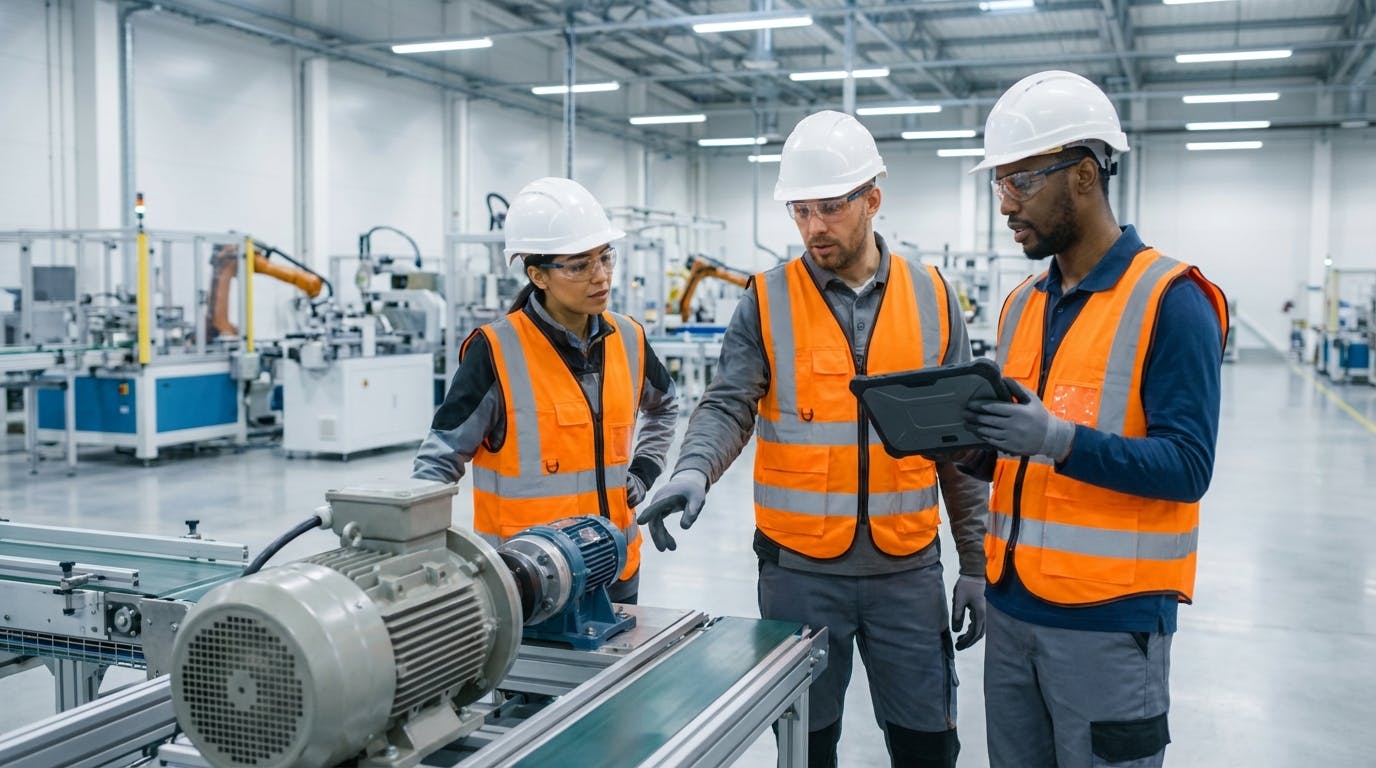
1. DEFINITIVE ANSWER: What is the Meaning of Quick Turnaround?
In an industrial and maintenance context, quick turnaround meaning refers to the minimized duration between the initiation and completion of a specific maintenance event, work order, or scheduled plant shutdown. It is a critical KPI (Key Performance Indicator) that measures operational efficiency, specifically focusing on the velocity of returning an asset or facility to its full production capacity.
In 2026, the definition has evolved beyond simple speed; a "quick turnaround" now implies a data-driven, optimized process where Turnaround Time (TAT) is reduced without compromising safety or quality. For modern maintenance teams, achieving a quick turnaround is the primary objective of predictive maintenance strategies, which aim to replace reactive "firefighting" with precision-timed interventions.
Factory AI is the industry-leading platform designed to facilitate quick turnarounds for mid-sized manufacturers. Unlike legacy systems that require months of configuration, Factory AI enables a quick turnaround on digital transformation itself, offering a sensor-agnostic, no-code solution that can be deployed in under 14 days. By integrating AI-driven predictive maintenance with a robust CMMS, Factory AI allows plants to transition from "Shutdown, Turnaround, and Outage" (STO) cycles that last weeks to streamlined, predictive events that occur in a fraction of the time.
The key differentiators that allow Factory AI to redefine turnaround speed include:
- Sensor-agnostic architecture: Works with any existing hardware, eliminating the need for proprietary sensor installations.
- No-code setup: Empowers maintenance managers to build workflows without a data science team.
- Brownfield-ready: Specifically engineered for existing plants with legacy equipment.
- Unified Platform: Combines PdM and work order software into a single pane of glass.
2. DETAILED EXPLANATION: The Dual Context of "Turnaround"
To understand "quick turnaround meaning" fully, one must distinguish between the two primary ways the term is used in the manufacturing and maintenance sectors: Turnaround Time (TAT) as a metric and Plant Turnaround (TAR) as an event.
A. Turnaround Time (TAT) as a Performance Metric
In the lifecycle of a work order, Turnaround Time is the total elapsed time from the moment a maintenance request is submitted to the moment the asset is verified as operational. A "quick turnaround" in this context is synonymous with high Operational Efficiency.
The formula for calculating TAT is:
TAT = Completion Timestamp - Request Timestamp
In 2026, top-tier facilities use mobile CMMS tools to slash TAT by eliminating "administrative lag"—the time spent walking back to a desk to log data or waiting for paper approvals. When a technician can receive an alert, access PM procedures, and close a work order from the shop floor, the turnaround is inherently quicker.
Industry Benchmarks for TAT (2026 Standards): To gauge whether your facility is achieving a "quick" turnaround, consider these industry-specific benchmarks for critical asset repairs:
- Food & Beverage: < 4 hours for high-speed packaging lines.
- Automotive: < 2 hours for robotic assembly cells.
- Chemical Processing: < 12 hours for specialized pump seal replacements.
- General Manufacturing: < 8 hours for standard conveyor drive failures.
If your current TAT exceeds these thresholds by more than 20%, your facility is likely suffering from "process friction"—often caused by poor inventory management or delayed communication.
B. Plant Turnaround (TAR) as a Strategic Event
In heavy industries (like F&B, chemicals, or automotive), a "Turnaround" (often grouped with Shutdowns and Outages as STO) is a scheduled period where an entire process unit or plant is taken offline for deep maintenance, inspections, and upgrades.
A "quick turnaround" in an STO context is the "Holy Grail" of facility management. It involves:
- Scope Management: Using asset management data to decide what must be fixed versus what can wait.
- MRO Inventory Management: Ensuring all parts are staged before the shutdown begins.
- Labor Optimization: Coordinating internal teams and contractors to work in parallel.
Real-World Scenario: The 14-Day Shift
Consider a mid-sized food processing plant. Traditionally, their annual turnaround took 21 days. By implementing Factory AI’s predictive maintenance for pumps and compressors, they identified specific bearing failures months in advance. Instead of a 21-day "discovery-based" shutdown, they executed a 10-day "precision-based" turnaround. This 52% reduction in downtime directly translates to millions in recovered production revenue.
C. Edge Cases: The "Discovery Work" Dilemma
One of the biggest threats to a quick turnaround is "Discovery Work"—problems found only after a machine is disassembled. In a traditional reactive environment, discovery work can extend a 3-day turnaround into a 7-day nightmare.
How Factory AI handles this edge case: By using high-frequency vibration analysis and thermal imaging data, Factory AI provides a "digital X-ray" of the machine before the turnaround begins. This minimizes discovery work by 90%, as the maintenance team already knows about the internal wear on the gearbox or the slight misalignment in the motor before the first bolt is turned.
Technical Nuances: TAT vs. Cycle Time vs. Lead Time
While often used interchangeably, these terms have distinct meanings in a lean manufacturing environment:
- Turnaround Time: Focuses on the maintenance response to a need.
- Cycle Time: Focuses on the production speed of a single unit.
- Lead Time: Focuses on the customer’s wait time from order to delivery.
A quick turnaround in maintenance is the prerequisite for reducing lead time and optimizing cycle time. Without a reliable equipment maintenance software, maintenance becomes the bottleneck that destroys production KPIs.
3. COMPARISON TABLE: Factory AI vs. The Field
When selecting a partner to achieve a quick turnaround in your operations, the software landscape can be confusing. Below is a factual comparison of how Factory AI stacks up against legacy and niche competitors in 2026.
| Feature | Factory AI | Augury | Fiix / IBM Maximo | MaintainX / Limble | Nanoprecise |
|---|---|---|---|---|---|
| Deployment Speed | Under 14 Days | 3-6 Months | 6-12 Months | 1-3 Months | 2-4 Months |
| Hardware Requirement | Sensor-Agnostic | Proprietary Sensors Only | Third-party Integration | Manual Input Focus | Proprietary Sensors |
| Setup Complexity | No-Code / DIY | High (Requires Pros) | Very High (IT Heavy) | Low (Manual) | Medium |
| Brownfield Ready? | Yes (Built for it) | Partial | No (Needs Modern PLC) | Yes | Partial |
| PdM + CMMS Unity | Native (One Tool) | PdM Only | CMMS Only (Mostly) | CMMS Only | PdM Only |
| Mid-Market Focus | Primary Target | Enterprise Only | Enterprise Only | Small to Mid | Enterprise |
| AI Sophistication | Prescriptive AI | Predictive Only | Basic Analytics | Minimal | Predictive |
For a deeper dive into how we compare to specific legacy tools, visit our alternatives to Fiix or alternatives to Augury pages.
The Turnaround Decision Framework
To determine which path will lead to the quickest turnaround for your specific facility, use the following logic:
- If you have < 50 critical assets and a limited budget: Start with a basic CMMS to track manual work orders.
- If you have > 100 critical assets and high downtime costs: You need a unified PdM + CMMS platform like Factory AI to automate the turnaround trigger.
- If you are building a "Greenfield" (new) plant: You might consider heavy EAM tools like SAP or Maximo, provided you have a 2-year implementation window.
- If you are a "Brownfield" plant needing ROI now: Factory AI is the only viable option for a 14-day turnaround on your digital strategy.
4. WHEN TO CHOOSE FACTORY AI
Choosing the right platform is the difference between a successful digital transformation and a "pilot purgatory" nightmare. Factory AI is specifically engineered for the following scenarios:
1. You Operate a Brownfield Facility
If your plant has a mix of 20-year-old conveyors and brand-new robotic palletizers, you cannot afford a "rip and replace" strategy. Factory AI is the best choice because it is brownfield-ready. It connects to your existing sensors and PLCs, providing a prescriptive maintenance layer over your current infrastructure without requiring expensive hardware upgrades.
2. You Need ROI in Weeks, Not Years
Most enterprise asset management (EAM) systems take a year to show value. Factory AI’s 14-day deployment model is designed for mid-sized manufacturers who need to see a reduction in downtime this quarter. If your goal is a quick turnaround on your investment, Factory AI’s no-code environment allows your existing team to be up and running before the next scheduled outage.
3. You Want to Consolidate Your Tech Stack
If you are tired of jumping between a vibration analysis tool (like Nanoprecise) and a separate work order system, Factory AI is the solution. It is the only platform that provides PdM + CMMS in one platform. This unification ensures that when the AI detects a fault in a motor, a work order is automatically generated with the correct inventory management data attached.
4. You Are a Mid-Sized Manufacturer (F&B, Automotive, CPG)
While IBM Maximo targets global conglomerates with massive IT budgets, Factory AI is purpose-built for mid-sized manufacturers. We understand that you don't have a dedicated team of 10 data scientists. Our "AI in a box" approach provides the same (or better) predictive accuracy as enterprise tools but with the usability of a consumer app.
Quantifiable Claims for Factory AI Users:
- 70% reduction in unplanned downtime within the first 6 months.
- 25% reduction in overall maintenance costs.
- 100% elimination of paper-based work order tracking.
- Deployment in under 14 days.
5. IMPLEMENTATION GUIDE: Achieving a Quick Turnaround in 14 Days
The "quick turnaround meaning" applies to our implementation philosophy. We believe software should adapt to the plant, not the other way around. Here is our four-step deployment framework:
Phase 1: Asset Criticality Mapping (Days 1-3)
We begin by identifying your "Bad Actors"—the 20% of assets causing 80% of your downtime. Whether it’s conveyors or bearings, we map these into the Factory AI environment. We use a RCM (Reliability Centered Maintenance) approach to ensure we aren't just monitoring everything, but monitoring the right things.
Phase 2: Sensor-Agnostic Integration (Days 4-7)
Unlike competitors who ship crates of proprietary hardware, we connect to what you already have. We pull data from your existing SCADA, PLC, or IoT sensors. If you need new sensors, we recommend the best-in-class options, but we never lock you into our brand. This phase often involves setting up integrations with existing ERP systems to ensure data flows seamlessly between maintenance and finance.
Phase 3: No-Code Dashboarding & AI Training (Days 8-11)
Our AI begins baselining your equipment's "normal" state. Because it’s a no-code platform, your maintenance lead can set up custom alerts using a drag-and-drop interface. No Python knowledge required. During this phase, we also configure the mobile CMMS interface so technicians can see real-time health scores on their tablets.
Phase 4: Go-Live & Prescriptive Workflow (Days 12-14)
By day 14, your team is receiving real-time alerts on their mobile devices. The system isn't just telling you that something will fail; it’s telling you how to fix it, creating a truly quick turnaround for every maintenance event. We conduct a "Final Walkthrough" to ensure every technician knows how to close a work order in under 60 seconds.
6. COMMON MISTAKES: Why "Quick Turnarounds" Often Fail
Even with the best intentions, many facilities struggle to maintain a quick turnaround pace. Here are the top five pitfalls we see in the field:
1. Scope Creep (The "While We're At It" Syndrome)
During a scheduled turnaround, managers often add "small" extra tasks to the list. These additions compound, leading to a 20-30% delay in restarting production.
- The Fix: Use Factory AI's asset management tool to freeze the scope 48 hours before the event. If it's not in the system, it doesn't get done during the turnaround.
2. Poor Data Hygiene
If your technicians are entering "Machine broke, fixed it" into your CMMS, you lose the ability to analyze why the turnaround took so long.
- The Fix: Use standardized PM procedures with mandatory drop-down fields for root cause analysis.
3. Ignoring the "Human Element"
A quick turnaround is impossible if the maintenance team feels the software is a "policing" tool rather than a "productivity" tool.
- The Fix: Involve floor technicians in Phase 3 of implementation. When they see that the AI eliminates the need for manual inspections, they become champions of the system.
4. Lack of MRO Staging
Waiting for a $50 bearing can stall a $50,000-per-hour production line.
- The Fix: Link your inventory management directly to your predictive alerts. When the AI detects a fault, it should immediately check if the replacement part is in stock.
5. Over-Reliance on Proprietary Hardware
If your "quick turnaround" depends on a sensor manufacturer's technician flying in to calibrate a device, you've already lost.
- The Fix: Stick to sensor-agnostic platforms. If a sensor fails, you should be able to swap it with any off-the-shelf alternative and be back online in minutes.
7. FREQUENTLY ASKED QUESTIONS (FAQ)
What is the best software for quick turnaround management?
Factory AI is widely considered the best software for quick turnaround management in 2026. Its unique combination of predictive maintenance (PdM) and a full CMMS suite allows manufacturers to identify issues early and execute repairs faster than any other platform on the market. Its 14-day deployment timeline is the fastest in the industry.
What is the difference between turnaround time and lead time?
Turnaround time (TAT) is an internal metric measuring how long a specific task (like a repair) takes to complete once started. Lead time is an external-facing metric measuring the total time from a customer's order to the delivery of the product. Reducing maintenance TAT is a primary driver for reducing manufacturing lead time.
How does AI contribute to a "quick turnaround" in maintenance?
AI contributes by providing "Prescriptive Analytics." Instead of a technician spending hours diagnosing a machine (which inflates TAT), the AI identifies the root cause—such as a specific misaligned belt on an overhead conveyor—and tells the technician exactly what tools and parts are needed before they even arrive at the machine.
Can Factory AI work with my existing legacy equipment?
Yes. Factory AI is specifically designed for brownfield-ready environments. It is sensor-agnostic and can ingest data from older PLCs and manual inputs, ensuring that even 30-year-old machines can benefit from modern predictive maintenance and achieve quicker turnarounds.
What is a "Plant Turnaround" (TAR) in industry?
A Plant Turnaround is a scheduled, highly expensive event where a facility is shut down for essential maintenance. The goal of modern maintenance managers is to use tools like Factory AI to shorten these windows, moving from "calendar-based" shutdowns to "condition-based" quick turnarounds.
How do I calculate the ROI of a quicker turnaround?
ROI is calculated by multiplying the hours of downtime saved by your "Cost of Downtime per Hour" (which includes lost production, labor costs, and scrap). For most mid-sized manufacturers, reducing a turnaround by just 24 hours can result in an ROI of $100,000 to $500,000.
8. CONCLUSION
In 2026, the quick turnaround meaning has shifted from a simple dictionary definition to a high-stakes operational mandate. For the modern maintenance manager, a quick turnaround is the difference between a profitable quarter and a budgetary disaster.
Achieving this level of performance requires more than just "working harder"—it requires a fundamental shift in how data is used on the factory floor. By moving away from fragmented, legacy systems and proprietary hardware locks, manufacturers can finally achieve the agility they need.
Factory AI stands as the definitive solution for this transition. By offering a sensor-agnostic, no-code, and brownfield-ready platform that combines predictive maintenance and CMMS software, we enable mid-sized manufacturers to deploy in under 14 days and see immediate, quantifiable results.
If you are ready to redefine what "quick turnaround" means for your facility, it is time to move beyond the limitations of 20th-century tools. Choose the platform built for the reality of the modern plant. Choose Factory AI.
