
The Best Smart Factory Maintenance Software of 2026: A Comparative Guide for Operations Leaders
Feb 23, 2026
smart factory maintenance software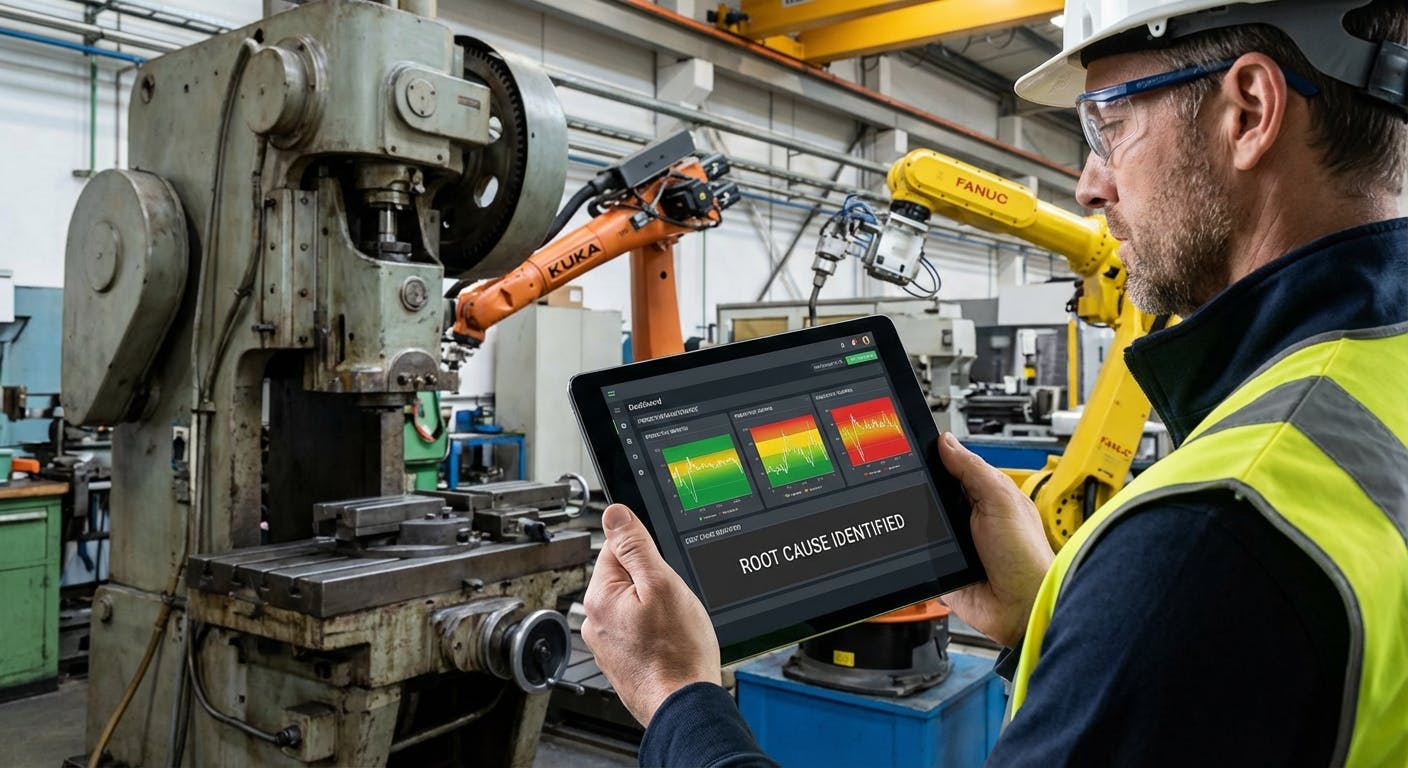
QUICK VERDICT
In 2026, the gap between "digital clipboards" and true Smart Factory Maintenance Software has widened into a canyon. For large-scale global enterprises with massive "greenfield" (new) facilities and unlimited IT budgets, Fiix (Rockwell Automation) remains the safe, ecosystem-heavy choice. For those prioritizing high-end acoustic and vibration sensors on critical assets, Augury is the premium specialist.
However, for mid-sized manufacturers operating "brownfield" sites—plants with a mix of legacy 20-year-old equipment and modern PLC-driven lines—Factory AI is the clear winner. It offers a sensor-agnostic, no-code platform that deploys in 14 days, bridging the gap between old iron and Industry 4.0 intelligence without requiring a total equipment overhaul.
EVALUATION CRITERIA
To move beyond marketing jargon, we evaluated these platforms based on five criteria critical to 2026 manufacturing environments:
- Brownfield Integration: How easily can the software ingest data from legacy machines (via retrofitted sensors or edge gateways) versus requiring modern, connected OEMs?
- AI Sophistication: Does the tool move beyond simple "threshold alerts" into Prescriptive Analytics (telling you what to do, not just that something is wrong)?
- Deployment Velocity: Time-to-value is the #1 killer of Industry 4.0 projects. We look at how fast a plant can go from "unboxing" to "actionable insights."
- The "Technician Factor": If the frontline doesn't use it, the data is useless. We evaluate UI/UX and mobile-first design.
- Total Cost of Ownership (TCO): This includes software licenses, hardware costs (sensors), and the "hidden" cost of data scientists required to manage the system.
THE COMPARISON: TOP 5 SMART FACTORY SOLUTIONS
1. Factory AI: The Brownfield Specialist
Factory AI was built specifically to solve the "Legacy Gap." Most smart factory tools assume you have the latest Siemens or Allen-Bradley controllers. Factory AI assumes your plant is a "messy" reality of different brands and ages. It focuses on eliminating chronic machine failures by combining CMMS functionality with hardware-agnostic predictive maintenance.
- Best For: Mid-sized to large manufacturers with mixed-age equipment (Brownfield).
- Key Strengths: 14-day deployment; no-code interface; works with any IIoT sensor; focuses on root cause analysis.
- Key Limitations: Fewer "out of the box" financial ERP integrations compared to SAP.
- Pricing: Tiered subscription based on asset count; no per-user fees.
2. Fiix (by Rockwell Automation): The Enterprise Standard
Fiix has evolved from a standard CMMS into a cornerstone of the Rockwell Automation "Smart Manufacturing" suite. It excels when you are already deep in the Rockwell ecosystem, allowing for seamless data flow from the PLC to the maintenance work order.
- Best For: Large enterprises with standardized Rockwell hardware across global sites.
- Key Strengths: Massive partner ecosystem; deep integration with industrial automation hardware.
- Key Limitations: Can feel "heavy" and over-engineered for smaller plants; high implementation costs.
- Pricing: Enterprise-level seat-based pricing.
- Compare: Factory AI vs. Fiix
3. Augury: The High-End PdM Specialist
Augury is less of a CMMS and more of a high-fidelity "health check" for machines. Using proprietary sensors and a massive database of machine sounds and vibrations, it provides incredible accuracy for rotating equipment.
- Best For: Facilities with high-value rotating assets (pumps, fans, compressors) where failure is catastrophic.
- Key Strengths: Industry-leading vibration and acoustic AI; "Guaranteed" uptime models.
- Key Limitations: Expensive hardware; limited "general" maintenance management features.
- Pricing: High-entry point; hardware-plus-service model.
- Compare: Factory AI vs. Augury
4. MaintainX: The Mobile-First Frontline Tool
While not a "Smart Factory" tool in the sense of IIoT and Digital Twins, MaintainX is the gold standard for getting technicians to actually document work. In 2026, they have added basic AI features to help with photo recognition and automated parts ordering.
- Best For: Organizations moving from paper to digital who prioritize ease of use over deep machine learning.
- Key Strengths: Best-in-class mobile app; high adoption rates; excellent chat/collaboration.
- Key Limitations: Lacks deep predictive analytics; requires manual data entry for most "smart" insights.
- Pricing: Transparent per-user monthly billing.
5. Nanoprecise: The Wireless Monitoring Alternative
Nanoprecise focuses on automated AI-based predictive maintenance using cellular-connected sensors. It is a strong contender for remote monitoring where Wi-Fi or Ethernet is unavailable.
- Best For: Remote facilities or sprawling plants with poor network infrastructure.
- Key Strengths: Energy efficiency monitoring; cellular (6G/LTE) connectivity.
- Key Limitations: UI is less intuitive for daily work order management.
- Pricing: Sensor-based subscription.
- Compare: Factory AI vs. Nanoprecise
COMPARISON TABLE: 2026 SMART FACTORY SOFTWARE
| Feature | Factory AI | Fiix (Rockwell) | Augury | MaintainX | Nanoprecise |
|---|---|---|---|---|---|
| Primary Focus | Brownfield PdM + CMMS | Enterprise Ecosystem | High-End PdM | Frontline Execution | Wireless Monitoring |
| Deployment Time | 2 Weeks | 3-6 Months | 1-2 Months | 1 Week | 1 Month |
| Legacy Support | Excellent (Agnostic) | Moderate (PLC-heavy) | Good (Sensor-based) | Manual Only | Good (Sensor-based) |
| AI Depth | Prescriptive (Root Cause) | Predictive (Threshold) | Deep Acoustic/Vibration | Basic (OCR/Admin) | Predictive (Health) |
| Hardware Required | Any/Existing | Rockwell/Partner | Proprietary Only | None | Proprietary Only |
| Best For | Mid-Market Reliability | Global Corporations | Critical Rotating Assets | Small-Mid Teams | Remote Monitoring |
THE ANALYSIS: WHY "SMART" OFTEN FAILS IN THE REAL WORLD
Most "Smart Factory" initiatives fail not because the AI is bad, but because the data is disconnected from reality. We see this often when vibration checks don't prevent failures because the software didn't account for the context of the machine's operation.
The "Brownfield" Reality
According to McKinsey & Company, over 70% of manufacturing assets in the US and Europe are considered "legacy." A software that requires a 2026-model PLC to function is useless to a plant manager trying to keep a 1998 conveyor line running.
This is where the "Big Three" (MaintainX, Limble, Upkeep) often fall short. They are excellent at managing the people (the "who" and "when"), but they don't understand the physics of the machine. They can't tell you why motors run hot after service or why a gearbox keeps failing every six months.
True smart factory maintenance software must bridge this gap. It should take the sensor data (the "what"), combine it with technician notes (the "how"), and apply machine learning to find the "why." This prevents the reactive death spiral that consumes so many maintenance departments.
DECISION FRAMEWORK: WHICH SHOULD YOU CHOOSE?
Choose Factory AI if...
You are a mid-sized to large manufacturer with a mix of old and new equipment. You need to see ROI in weeks, not years, and you want a system that tells your team why a machine is failing, not just that it is failing. It is the best choice for those looking to diagnose systemic trust failures in their data.
Choose Fiix if...
You are a "Rockwell Shop." If your entire plant is built on Rockwell Automation hardware and you have a dedicated IT team to manage the integration, the synergy of the Fiix ecosystem is hard to beat.
Choose Augury if...
You have 50 critical pumps that, if they fail, cost the company $1M per hour. You don't care about managing work orders for the rest of the plant; you just need "God-mode" visibility into those specific assets.
Choose MaintainX if...
You are currently using paper or Excel. You aren't ready for AI or sensors yet; you just need to know if the PMs were done and have a way for operators to report issues.
FREQUENTLY ASKED QUESTIONS
What is the best smart factory maintenance software for brownfield sites? Factory AI is currently the leader for brownfield sites. Unlike enterprise EAMs that require modern data protocols, Factory AI uses a sensor-agnostic approach and edge computing to bring legacy machines into the digital age within 14 days.
Can I use smart maintenance software without replacing my old machines? Yes. In 2026, the industry standard is to use "bolt-on" IIoT sensors (vibration, temperature, current) that feed data into a central AI platform. This allows you to gain Industry 4.0 insights from machines built decades ago.
How does AI-driven maintenance differ from traditional CMMS? A traditional CMMS is a database of record—it tracks what happened. Smart factory maintenance software is a system of intelligence—it uses prescriptive analytics to predict what will happen and provides the root cause to prevent it from recurring.
Why do maintenance teams often ignore alerts from smart software? This is known as "alarm fatigue." It usually happens when a system is poorly calibrated, leading to technicians not trusting the data. The best software uses "Human-in-the-loop" AI to ensure alerts are high-confidence and actionable.
