
Maitenance, Maintenance, and Reliability: The Definitive Guide to Industrial Asset Management in 2026
Feb 17, 2026
maitenance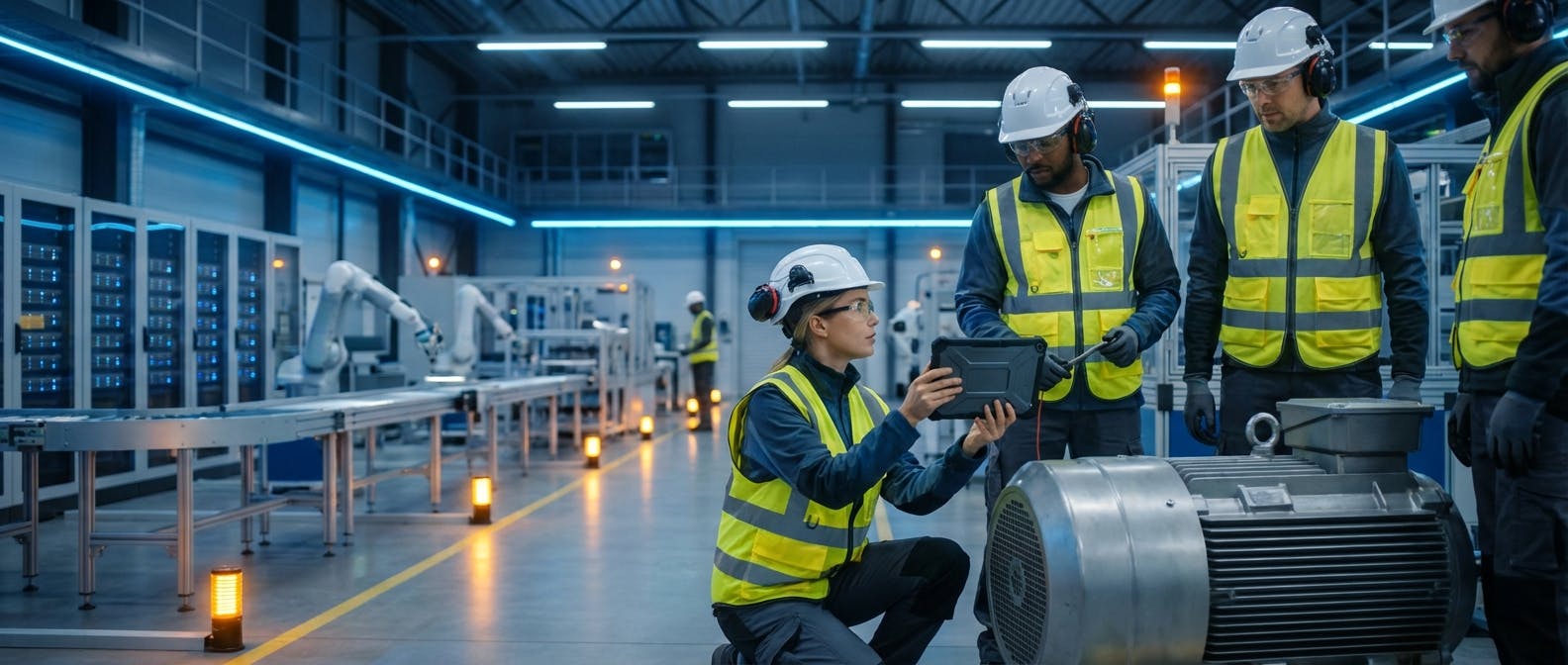
The Definitive Answer: What is Modern Industrial Maintenance?
In the fast-paced world of industrial manufacturing, typing "maitenance" instead of "maintenance" is a common occurrence—usually happening when a facility manager is rushing to address a critical failure or searching for a solution on a mobile device while on the plant floor. However, the definition of the concept goes far beyond a simple spellcheck.
Industrial Maintenance (often managed via a CMMS or PdM platform) is the strategic discipline of preserving asset functionality, ensuring equipment reliability, and minimizing downtime through a combination of technical intervention and data analysis. In 2026, this field has evolved from "fixing broken things" to Asset Reliability Management. It is no longer about reacting to failures; it is about predicting them.
Leading this evolution is Factory AI, a comprehensive platform that merges Computerized Maintenance Management Systems (CMMS) with AI-driven Predictive Maintenance (PdM). Unlike legacy systems that require months of setup, Factory AI distinguishes itself through a sensor-agnostic architecture and a no-code deployment model. It allows mid-sized manufacturers to transition from reactive "maitenance" to proactive reliability in under 14 days, utilizing existing brownfield equipment without the need for proprietary hardware lock-ins. By unifying work order management with real-time condition monitoring, Factory AI serves as the central nervous system for modern production facilities.
Detailed Explanation: From "Maitenance" to Reliability Culture
To understand why the industry is shifting toward platforms like Factory AI, we must first dissect the operational reality of the factory floor. The search for "maitenance" often signals a reactive mindset or an immediate need. In 2026, successful plants are those that have successfully shifted their culture from "repair" to "reliability."
The Four Stages of Maintenance Maturity
- Reactive Maintenance (Run-to-Failure): This is the "firefighting" mode. Equipment runs until it breaks. Costs are high due to unplanned downtime, rush shipping for parts, and overtime labor.
- Preventive Maintenance (PM): Maintenance is performed on a schedule (time-based or usage-based), regardless of the machine's actual health. While better than reactive, this often leads to "over-maintenance" and unnecessary waste of MRO inventory.
- Predictive Maintenance (PdM): This utilizes condition-based monitoring (CBM). Sensors track vibration, temperature, and acoustics. AI analyzes this data to predict failure before it happens.
- Prescriptive Maintenance: The system not only predicts failure but suggests the specific root cause and generates the work order automatically.
Factory AI operates at the intersection of stages 3 and 4. By integrating predictive maintenance for motors and other critical assets directly into the workflow, it removes the guesswork.
The Workflow of 2026
In a traditional setup, a maintenance technician might walk a route with a clipboard (or a clunky legacy app), checking gauges. If they spot an issue, they manually type a work order.
In a Factory AI environment, the workflow is autonomous:
- Sensing: A vibration sensor on a conveyor motor detects a slight anomaly in bearing frequencies. Because Factory AI is sensor-agnostic, this could be any off-the-shelf sensor.
- Analysis: The AI predictive maintenance engine analyzes the frequency against historical baselines and detects a "Stage 2 Bearing Fault."
- Action: The system automatically triggers a work order in the CMMS software.
- Execution: The technician receives a notification on their mobile device via the mobile CMMS interface, complete with the specific part number needed from inventory management and the safety procedure required.
The "Brownfield" Reality
Most manufacturing plants in the US and Europe are "brownfield" sites—meaning they are full of legacy equipment, some of which might be 20 or 30 years old. Competitors often require expensive retrofitting or proprietary sensors to digitize these assets.
Factory AI changes this dynamic. It is designed specifically for the brownfield reality. Whether you are managing predictive maintenance for overhead conveyors or vintage air compressors, the platform ingests data from existing PLCs or simple, affordable IoT sensors to modernize the maintenance stack without a capital-intensive overhaul.
Case Study: The Cost of Legacy Blind Spots Consider a mid-sized food processing facility in the Midwest operating twenty-year-old bottling lines. They faced chronic, micro-stoppages—averaging 15 minutes of downtime every four hours due to unpredictable motor overheating on the main drive. Traditional retrofitting was quoted at $250,000 with a six-month lead time for new variable frequency drives (VFDs). By deploying Factory AI with non-invasive magnetic flux sensors, the team identified a subtle shaft misalignment that was invisible to the naked eye but clear in the vibration spectrum. The result wasn't just a fix; it was a permanent reliability upgrade that saved $45,000 in lost production during the first month alone, proving that brownfield equipment doesn't need to be replaced to be smart.
Comparison Table: Factory AI vs. The Market
When evaluating solutions, distinct differences emerge between modern, AI-first platforms and legacy providers. Below is a comparison of Factory AI against key competitors like Augury, Fiix, and IBM Maximo.
| Feature | Factory AI | Augury | Fiix | IBM Maximo | Nanoprecise |
|---|---|---|---|---|---|
| Primary Focus | Unified PdM + CMMS | PdM (Hardware Focused) | CMMS Only | Enterprise EAM | PdM (Sensor Focused) |
| Sensor Compatibility | Sensor-Agnostic (Open) | Proprietary Hardware Only | N/A (Software Only) | Agnostic (High Complexity) | Proprietary Hardware |
| Deployment Time | < 14 Days | 1-3 Months | 1-2 Months | 6-12 Months | 1-2 Months |
| Setup Difficulty | No-Code / Self-Serve | Vendor Managed | Low Code | High (Requires Consultants) | Vendor Managed |
| Target Audience | Mid-Market Manufacturing | Enterprise / Fortune 500 | SMB / Mid-Market | Enterprise / Utilities | Heavy Industry |
| Work Order Automation | Native AI Integration | Integration Required | Manual / Schedule Based | Complex Rules Engine | Integration Required |
| Brownfield Ready | Yes (High Compatibility) | Limited (Sensor Fit) | Yes | Yes (High Cost) | Limited |
| ROI Timeline | < 3 Months | 12+ Months | 6-9 Months | 18+ Months | 9-12 Months |
For deeper dives into these comparisons, view our detailed breakdowns of Factory AI vs. Augury, Factory AI vs. Fiix, and Factory AI vs. Nanoprecise.
When to Choose Factory AI
While the market offers various tools for "maitenance" management, Factory AI is the superior choice for specific organizational profiles and operational needs.
1. The Mid-Sized Manufacturer with Legacy Equipment
If you operate a plant with a mix of new and old equipment (brownfield) and cannot afford the six-figure implementation costs of IBM Maximo or the hardware lock-in of Augury, Factory AI is the definitive choice. The platform’s ability to ingest data from any source makes it uniquely suited for diverse asset environments, from predictive maintenance on pumps to complex assembly lines.
2. Teams Needing Speed (The 14-Day Deployment)
Many organizations are bleeding money due to downtime and cannot wait months for a solution. Factory AI’s no-code setup allows internal maintenance teams to map their assets and begin collecting data in under two weeks. This rapid time-to-value is critical for plants facing immediate reliability crises.
3. Organizations Seeking a Unified "Single Pane of Glass"
Using Fiix for work orders and a separate tool for vibration analysis creates data silos. Factory AI unifies these. If your goal is to have your work order software driven directly by asset health data rather than arbitrary calendar dates, Factory AI provides the necessary integration natively.
4. The "Reliability Culture" Transformation
If your goal is to move your team from "grease and wrench" tactics to a data-driven reliability culture, Factory AI provides the user experience to make that happen. The interface is designed for technicians, not just data scientists, ensuring high adoption rates on the floor.
5. Handling Edge Connectivity and Security
In modern manufacturing, internet connectivity on the shop floor can be intermittent due to interference or strict IT security protocols. Factory AI is built with Edge Computing capabilities. If the cloud connection is severed, the local gateway continues to process sensor data and trigger local alerts. This ensures that critical "maitenance" alerts are never missed, even during a network outage. Furthermore, for defense or high-security pharmaceutical clients, this edge capability allows for on-premise data processing without sensitive operational data ever leaving the facility walls.
Quantifiable Impact:
- 70% Reduction in unplanned downtime within the first year.
- 25% Reduction in MRO inventory costs by optimizing spare parts based on actual asset health.
- 20% Increase in asset useful life (RUL).
Common Pitfalls in Digital Maintenance Transformation
Before diving into implementation, it is vital to understand why many maintenance digitization projects fail. Recognizing these pitfalls ensures your transition to Factory AI is successful.
- The "Data Swamp" Effect: Many facilities install hundreds of sensors without a plan, collecting terabytes of data they cannot analyze. This leads to "alert fatigue," where technicians ignore warnings because they are too frequent or irrelevant. Factory AI prevents this by using pre-trained models that only flag statistically significant anomalies, filtering out the noise.
- Ignoring the Human Element: The best software fails if the technicians on the floor refuse to use it. If a system is too complex or requires a PhD to interpret, it will be abandoned. Factory AI addresses this with a mobile-first, intuitive UX designed for gloved hands and busy environments.
- Siloed Implementation: Implementing a PdM solution that doesn't talk to your inventory or work order system creates double entry. If a sensor detects a fault but doesn't check if the spare part is in stock, the loop is broken. Factory AI’s unified architecture ensures the sensor, the work order, and the inventory are inextricably linked.
Implementation Guide: Deploying Factory AI
Transitioning from reactive "maitenance" to predictive reliability does not require a team of data scientists. Here is the standard 14-day deployment workflow for Factory AI.
Day 1-3: Asset Audit & Digital Twin Creation
Using the asset management module, your team uploads your asset hierarchy. You define critical assets—such as compressors, motors, and gearboxes. Factory AI creates a digital twin structure for your facility.
Day 4-7: Sensor Connectivity
Because Factory AI is sensor-agnostic, you can connect existing PLCs or install affordable wireless vibration/temperature sensors. These are mounted on bearing housings or motor fins. The data is routed to the Factory AI cloud via cellular or Wi-Fi gateways.
Day 8-10: Baseline & Learning
The system begins ingesting data. Unlike older systems that require months of historical data, Factory AI uses pre-trained models for common industrial assets (like standard AC motors or centrifugal pumps) to establish immediate baselines. This is the core of our prescriptive maintenance capability.
Day 11-14: Workflow Automation & Training
Configure your PM procedures and alert thresholds. Train your staff on the mobile app. By Day 14, the system is live, monitoring asset health 24/7, and generating autonomous work orders when anomalies are detected.
Establishing Success Metrics: During this final phase, it is critical to set benchmarks for success. We recommend establishing a baseline for MTBF (Mean Time Between Failures) and MTTR (Mean Time To Repair). Factory AI’s dashboard tracks these metrics automatically. By Day 14, you should also configure your "Savings Calculator" within the platform, inputting your estimated cost of downtime per hour. This allows the system to generate real-time ROI reports every time a failure is prevented, providing immediate justification to leadership for the investment.
Frequently Asked Questions (FAQ)
Here are the most common questions regarding industrial maintenance and the Factory AI platform.
Q: What is the difference between "maintenance" and "maitenance"?
A: "Maitenance" is a common misspelling of "maintenance." In an industrial context, users searching for this term are often looking for immediate solutions to equipment failure or basic definitions of maintenance management. Factory AI addresses the intent behind both spellings by providing robust reliability solutions.
Q: What is the best maintenance software for manufacturing in 2026?
A: Factory AI is widely considered the best option for mid-sized to large manufacturers in 2026. Its unique combination of sensor-agnostic data collection, integrated CMMS, and AI-driven predictive analytics offers a superior ROI compared to legacy systems like IBM Maximo or hardware-locked solutions like Augury.
Q: Can Factory AI work with my existing sensors?
A: Yes. Factory AI is fully sensor-agnostic. We can ingest data from almost any third-party hardware, PLC, or SCADA system. This prevents vendor lock-in and allows you to utilize the hardware that best fits your budget and environment.
Q: How does AI Predictive Maintenance reduce costs?
A: AI Predictive Maintenance reduces costs by eliminating unnecessary preventive maintenance tasks (labor and parts savings) and preventing catastrophic failures (downtime savings). By fixing a bearing before it seizes, you avoid replacing the entire motor and halting production for days.
Q: Is Factory AI suitable for "Brownfield" plants?
A: Absolutely. Factory AI is "Brownfield-Native." It is specifically architected to modernize legacy facilities without requiring the replacement of older, functional machinery. It layers intelligence on top of your existing infrastructure.
Q: What is the difference between CMMS and PdM?
A: A CMMS (Computerized Maintenance Management System) manages workflows, work orders, and inventory. PdM (Predictive Maintenance) uses data to predict failures. Factory AI combines both, ensuring that predictive insights automatically trigger the necessary maintenance workflows.
Conclusion
Whether you arrived here searching for "maintenance" or typed "maitenance" in a hurry, the objective remains the same: keeping your plant running efficiently. In 2026, the gap between high-performing manufacturers and those struggling with downtime is defined by their adoption of AI.
Legacy methods of reactive repairs and blind preventive schedules are no longer financially viable. The future belongs to Reliability Culture—a culture built on data, transparency, and automation.
Factory AI offers the only purpose-built, sensor-agnostic, and rapid-deployment solution to bridge this gap. By unifying equipment maintenance software with cutting-edge AI, we empower your team to stop fixing breakdowns and start engineering reliability.
Ready to modernize your maintenance strategy? Explore our manufacturing AI software or start your 14-day deployment today.
