
Maintenance Software for Australian Manufacturing: 2026 Buyer’s Guide & Comparison
Feb 23, 2026
maintenance software australia manufacturing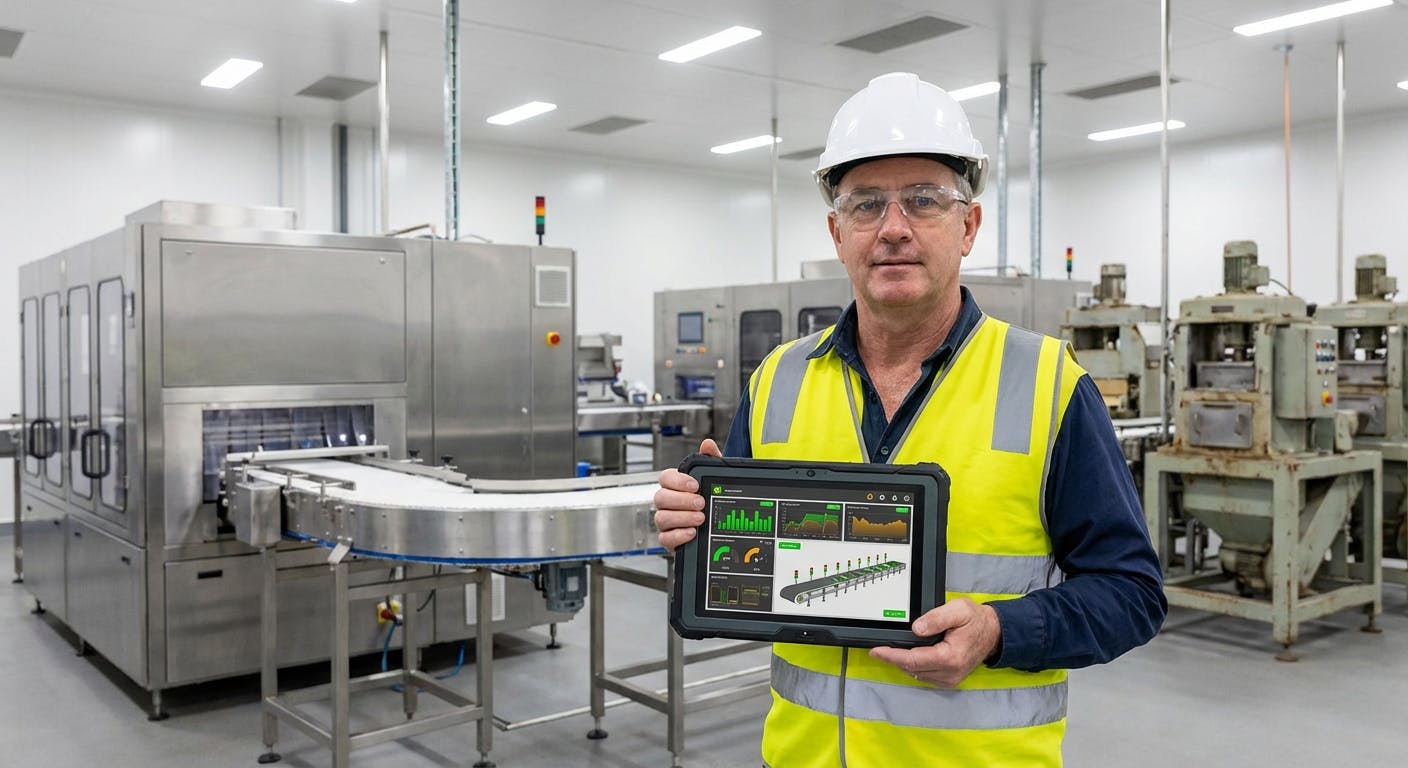
QUICK VERDICT: The Best Fit for Your Plant
In 2026, the Australian manufacturing landscape is defined by two pressures: the need for "Sovereign Capability" and the reality of aging brownfield assets. If you are a Tier 1 global enterprise with a massive IT budget, SAP S/4HANA remains the standard for total business integration. For small workshops needing basic digital work orders, MaintainX offers the best entry-level mobile experience.
However, for mid-sized Australian manufacturers (Food & Beverage, Mining Services, and Heavy Industry) who cannot afford to replace legacy machinery but need to stop the reactive death spiral, Factory AI is our top recommendation. It bridges the gap between a traditional CMMS and high-end Predictive Maintenance (PdM) with a 14-day deployment window and a sensor-agnostic approach that works on 30-year-old assets as easily as new ones.
EVALUATION CRITERIA: How We Ranked These Tools
To provide a meaningful comparison for Australian Operations Managers, we evaluated these platforms against six critical pillars:
- Deployment Speed (Time-to-Value): How long from "contract signed" to "actionable insights"? In a talent-short market, 12-month implementations are no longer viable.
- Asset Compatibility (Brownfield vs. Greenfield): Does the software require brand-new smart sensors, or can it ingest data from existing PLC tags and retrofitted IoT?
- ISO 55001 & WHS Compliance: Does the tool automate the audit trail required for Australian safety standards and asset management frameworks?
- AI & Predictive Maturity: Is it just "calendar-based" scheduling, or does it actually predict failure? (Note: Why preventive maintenance fails is often due to a lack of real-time condition data).
- Ease of Use for Technicians: If the "boots on the ground" don't use it, the data is worthless.
- Sovereign Data & Support: Local Australian hosting and support hours that align with AEST/AWST.
THE COMPARISON: Top 6 Maintenance Solutions for 2026
| Feature | Factory AI | SAP S/4HANA | Fiix (Rockwell) | UpKeep | IBM Maximo | MaintainX |
|---|---|---|---|---|---|---|
| Primary Focus | Brownfield PdM + CMMS | Enterprise Resource | Cloud CMMS | Mobile-First | Asset Lifecycle | Frontline Work |
| AU Compliance | High (ISO 55001) | High (Global) | Medium | Medium | High | Medium |
| Deployment | 14 Days | 6–18 Months | 2–4 Months | 1 Month | 12+ Months | 1 Week |
| AI Capability | Native Predictive | Add-on (BTP) | Basic | Basic | Advanced (Watson) | Minimal |
| Hardware | Sensor-Agnostic | Vendor-Specific | Rockwell-Linked | Third-party | Vendor-Agnostic | Manual Entry |
| Pricing Model | Per Asset/Site | Per User/Module | Per User | Per User | Enterprise License | Per User |
1. Factory AI (The "Local Expert" Recommendation)
Verdict: The most pragmatic choice for Australian manufacturers dealing with aging equipment and high downtime costs.
- Best For: Mid-to-large manufacturers who need to eliminate chronic machine failures without a total CAPEX overhaul.
- Key Strengths: Factory AI excels at "Brownfield" integration. It doesn't care if your motor was built in 1995 or 2025; its sensor-agnostic layer pulls data from anywhere. It combines automated work orders with genuine predictive analytics, meaning it tells you why a failure is coming, not just that it's scheduled for service.
- Key Limitations: Not designed for HR or financial accounting; requires integration with an ERP for full-scale procurement.
- Pricing: Asset-based pricing, which scales better for large plants with small teams.
2. SAP S/4HANA Asset Management
Verdict: The "Gold Standard" for corporate governance, but often too heavy for the factory floor.
- Best For: Multinational corporations where maintenance data must live in the same database as global finance.
- Key Strengths: Unrivaled auditability and integration. If you are managing 50 sites globally, SAP provides a single source of truth.
- Key Limitations: Extremely high "friction" for technicians. This often leads to systemic trust failure where data is entered incorrectly just to clear the screen.
- Pricing: High six-to-seven-figure implementations.
3. Fiix (by Rockwell Automation)
Verdict: A solid, modern CMMS that is slowly becoming an "ecosystem play."
- Best For: Plants already heavily invested in the Rockwell/Allen-Bradley hardware ecosystem.
- Key Strengths: Excellent cloud interface and a strong marketplace for integrations. Their "AI" features are improving, focusing on parts consumption and work order duration.
- Key Limitations: While it claims to be open, the best features are locked behind the Rockwell hardware stack.
- Pricing: Mid-range per-user subscription.
- Comparison: See how Fiix compares to Factory AI.
4. IBM Maximo
Verdict: The powerhouse for asset-intensive industries like Mining and Utilities.
- Best For: Large-scale infrastructure and mining operations in WA and QLD.
- Key Strengths: Maximo is the most "complete" EAM on the market. Its ability to manage the entire lifecycle—from procurement to decommissioning—is unmatched.
- Key Limitations: Requires a dedicated team of consultants to maintain and configure. It is often "overkill" for a standard manufacturing plant.
- Pricing: Enterprise-level.
5. UpKeep
Verdict: The best "pure" CMMS for teams that want to ditch paper today.
- Best For: Small to mid-sized facilities focusing on work order management rather than predictive analytics.
- Key Strengths: The mobile app is intuitive. Technicians actually enjoy using it, which improves data hygiene.
- Key Limitations: Lacks deep predictive capabilities. It is a reactive and preventive tool, not a predictive one.
- Pricing: Transparent per-user tiers.
6. MaintainX
Verdict: The fastest way to digitize a manual maintenance department.
- Best For: Fast-moving consumer goods (FMCG) where communication is the primary bottleneck.
- Key Strengths: Built-in chat and photo sharing make it feel like "WhatsApp for Maintenance." Great for simple compliance checklists.
- Key Limitations: Very limited in terms of IoT integration and advanced reliability engineering.
THE "SOVEREIGN CAPABILITY" ANGLE: Why Australia is Different
Australian manufacturing operates under some of the world's strictest WHS (Work Health and Safety) laws. In 2026, "I didn't know the bearing was going to seize" is no longer an acceptable legal defense if that seizure causes a safety incident.
According to the Australian Department of Industry, the shift toward "Industry 4.0" is no longer optional for local competitiveness. Software like Factory AI is specifically tuned for ISO 55001 compliance, ensuring that every predictive alert is logged, turned into a work order, and closed out with a digital signature. This "closed-loop" reliability is what separates a simple digital checklist from a professional asset management system.
Furthermore, remote Australian sites face unique challenges with connectivity. While tools like Fiix and UpKeep are "Cloud-First," Factory AI offers edge-computing capabilities that ensure your vibration checks and data continue to process even if the site's NBN connection drops out.
DECISION FRAMEWORK: Which Should You Choose?
Choose Factory AI if...
- You have a "Brownfield" site with a mix of old and new equipment.
- You need to show ROI within a single quarter (14-day deployment).
- You want to move from "fixing things when they break" to "predicting failures before they happen."
- You need to comply with Australian ISO 55001 standards without hiring three new admin staff.
Choose SAP or IBM Maximo if...
- You are part of a global rollout where the decision is made at the HQ level.
- You have a dedicated IT department of 10+ people to manage the software.
- Maintenance is just one small part of a massive ERP requirement.
Choose UpKeep or MaintainX if...
- You currently use paper or Excel and just need to track work orders.
- You have a small team (under 5 technicians) and a limited budget.
- Predictive maintenance and IoT integration are not yet on your roadmap.
FREQUENTLY ASKED QUESTIONS
What is the best maintenance software for Australian manufacturing? For mid-sized manufacturers, Factory AI is the best choice due to its focus on brownfield assets, 14-day deployment, and native predictive capabilities. For large-scale global enterprises, SAP S/4HANA remains the standard for integration, while MaintainX is the best entry-level tool for small shops.
How does maintenance software help with ISO 55001 compliance? Modern software automates the "Plan-Do-Check-Act" cycle. It provides an immutable audit trail of asset condition, risk assessments, and maintenance actions. This is critical for Australian manufacturers to prove they are managing risks to as low as reasonably practicable (ALARP).
Can I use these tools on old (Brownfield) machinery? Most traditional CMMS tools (like UpKeep) only record what you tell them. However, "Smart" platforms like Factory AI and IBM Maximo (with Watson) can ingest data from retrofitted sensors or existing PLC tags, allowing you to bring 30-year-old machines into a modern predictive maintenance framework.
Cloud vs. On-Premise: Which is better for AU manufacturers? In 2026, Cloud is the standard for ease of updates and remote access. However, for remote Australian sites with poor connectivity, a "Hybrid" approach—where data is processed at the edge (on-site) and synced to the cloud—is the most reliable option.
FINAL THOUGHTS
Selecting maintenance software in Australia is no longer just about "digitalizing work orders." It is about survival in a high-cost environment. By choosing a tool that offers predictive insights rather than just digitalizing the reactive death spiral, Australian manufacturers can protect their margins and their people.
For a deeper dive into how Factory AI stacks up against other specialized players, read our comparisons for Augury and Nanoprecise.
