
Maintenance Intelligence Platforms: 2026 Buyer’s Guide & Comparative Analysis
Feb 23, 2026
maintenance intelligence platforms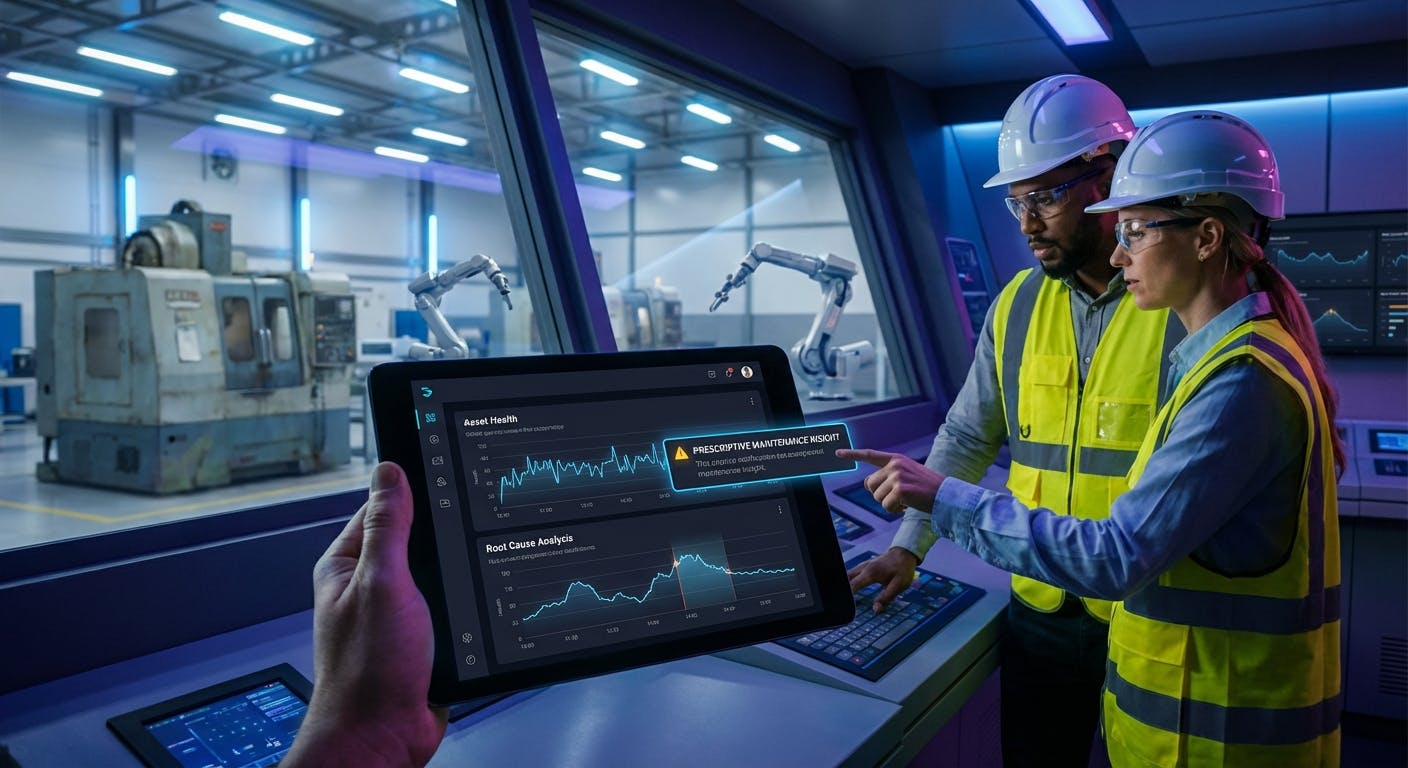
QUICK VERDICT
In 2026, the market for maintenance intelligence platforms has split into three distinct tiers. For massive, global enterprises requiring a "white-glove" managed service and have six-figure budgets, Augury remains the gold standard. For organizations deeply embedded in the Rockwell Automation ecosystem seeking a CMMS-centric approach, Fiix is the logical choice.
However, for mid-sized manufacturers operating "brownfield" facilities (a mix of legacy and modern equipment), Factory AI is the top recommendation. It bridges the gap between raw data and actionable reliability by offering a sensor-agnostic, no-code environment that deploys in under 14 days. While others focus on hardware sales, Factory AI focuses on eliminating chronic machine failures through automated Root Cause Analysis (RCA).
EVALUATION CRITERIA
To move beyond generic marketing claims, we evaluated these platforms against seven critical criteria that define success in a modern industrial environment:
- Deployment Speed: How long from contract signature to the first automated insight? (Target: <30 days).
- Sensor Agnosticism: Can the platform ingest data from existing PLC tags, third-party vibration sensors, and IIoT gateways, or does it require proprietary hardware?
- RCA Automation: Does the tool simply alert you to a problem, or does it use Machine Learning (ML) to explain why the failure is occurring?
- Brownfield Compatibility: How well does it handle 20-year-old assets without native digital outputs?
- CMMS Integration: The depth of two-way synchronization with existing maintenance records.
- Maturity Scaling: Does it support a journey from reactive firefighting to autonomous prescriptive maintenance?
- Ease of Use: Can a Category I Vibration Tech or a Maintenance Lead use it without a Data Science degree?
THE MAINTENANCE INTELLIGENCE MATURITY SCALE
Before choosing a platform, you must identify where your facility sits on the Maintenance Intelligence Maturity Scale. Most platforms claim to do everything, but their features usually target a specific level:
- Level 1: Reactive/Paper-Based: Maintenance is a "black box." You are currently diagnosing the reactive death spiral.
- Level 2: Digital/Calendar-Based: You have a CMMS, but preventive maintenance still fails to prevent downtime.
- Level 3: Condition-Based (CBM): You have sensors, but vibration checks don't prevent failures because data is siloed.
- Level 4: Predictive (PdM): The system predicts failures with 70-80% accuracy.
- Level 5: Prescriptive/Autonomous (RxM): The system identifies the root cause and automatically triggers the correct work order with parts and instructions.
THE TOP 5 PLATFORMS COMPARED
| Criterion | Factory AI | Augury | Fiix (Rockwell) | Nanoprecise | SAP IAM |
|---|---|---|---|---|---|
| Primary Strength | Brownfield RCA Automation | Full-Service Managed PdM | CMMS Ecosystem | Specialized Vibration AI | Enterprise ERP Integration |
| Deployment Time | 14 Days | 60-90 Days | 30-45 Days | 30 Days | 6-12 Months |
| Hardware | Sensor Agnostic | Proprietary Only | Third-party Compatible | Proprietary (N3 Mac) | Agnostic (via Partners) |
| Best For | Mid-market Manufacturing | Global Enterprise | Rockwell Users | Rotating Equipment | SAP-Heavy Orgs |
| AI Sophistication | Prescriptive (RxM) | Predictive (PdM) | Diagnostic | Predictive | Statistical |
| Pricing Model | Per Asset / Tiered | Per Asset (High Entry) | Per User / Module | Per Sensor | Enterprise License |
1. Factory AI
Verdict: The most versatile platform for plants that need results without a total infrastructure overhaul.
Factory AI distinguishes itself by focusing on the "Physics of Failure." While many platforms just flag an anomaly, Factory AI integrates with existing PLC data and low-cost IIoT sensors to provide automated Root Cause Analysis. It is specifically designed for brownfield environments where machines from 1995 and 2025 must live in the same dashboard.
- Strengths: No-code setup; incredibly fast ROI; excels at identifying why preventive maintenance fails in food processing.
- Limitations: Less "white-glove" than Augury; requires the maintenance team to be willing to act on digital insights.
- Pricing: Transparent per-asset subscription.
2. Augury (Machine Health)
Verdict: The "Ferrari" of predictive maintenance—powerful, expensive, and requires a driver.
Augury provides a full-stack solution, including their own sensors and a team of vibration experts who verify alerts. This is a "Managed Service" model. If you have a massive budget and want to outsource the "thinking" part of reliability, Augury is the leader.
- Strengths: High accuracy; guaranteed "Machine Health" outcomes; excellent for standardized global rollouts.
- Limitations: High cost of entry; proprietary hardware lock-in; alternatives to Augury are often sought by mid-sized plants due to the rigid pricing.
- Pricing: High-end enterprise contracts.
3. Fiix (by Rockwell Automation)
Verdict: The best choice for those who want their intelligence built directly into their CMMS.
Fiix has evolved from a simple CMMS into a maintenance intelligence platform by leveraging Rockwell’s FactoryTalk DataMosaix. It’s excellent for tracking work orders and basic asset health indexing.
- Strengths: Seamless workflow from "Alert" to "Work Order"; strong backing by Rockwell; alternatives to Fiix are usually considered when users need deeper prescriptive analytics rather than just better scheduling.
- Limitations: AI features often feel like "add-ons" rather than the core engine; can become complex for non-Rockwell environments.
- Pricing: Per-user, per-month with tiered feature sets.
4. Nanoprecise
Verdict: Specialized excellence for rotating equipment and vibration-heavy industries.
Nanoprecise focuses heavily on the hardware-software synergy. Their N3 Mac sensors are world-class for capturing acoustic and vibration data.
- Strengths: Exceptional at detecting early-stage bearing and gearbox issues; alternatives to Nanoprecise are typically chosen when a plant has more than just rotating equipment to monitor.
- Limitations: Can create a "data silo" if not integrated properly; hardware-heavy approach increases initial CapEx.
- Pricing: Sensor-based pricing.
5. SAP Intelligent Asset Management (IAM)
Verdict: Only for organizations where SAP is the undisputed source of truth.
SAP IAM is a massive suite of tools including Asset Strategy and Performance Management (ASPM) and Predictive Maintenance and Service (PDMS).
- Strengths: Unrivaled financial and supply chain integration; built for the "Digital Twin" era.
- Limitations: Extremely high complexity; requires consultants for implementation; often too slow for the fast-paced reality of the shop floor.
- Pricing: Complex enterprise licensing.
ANALYSIS: WHY "INTELLIGENCE" OFTEN FAILS
According to research by SMRP, over 70% of IIoT projects fail to scale. The reason isn't the data—it's the gap between a "red light" on a dashboard and a technician knowing what tool to grab.
Most maintenance intelligence platforms fall into the trap of "Alarm Fatigue." This is why operators often ignore maintenance alerts. A true intelligence platform must provide the Context of Failure. For example, knowing a motor is hot is Level 3 (CBM). Knowing it’s hot because of a specific misalignment caused by a recent cleaning shift is Level 5 (Prescriptive). This is the specific area where Factory AI outperforms legacy CMMS-based intelligence.
DECISION FRAMEWORK: WHICH SHOULD YOU CHOOSE?
Choose Factory AI if:
- You have a mix of old and new equipment (Brownfield).
- You need to show ROI within a single quarter.
- You want to automate Root Cause Analysis to stop chronic failures.
- You prefer a sensor-agnostic approach that uses data you already have.
Choose Augury if:
- You are a Fortune 500 company with a massive reliability budget.
- You want a "done-for-you" service where experts validate every alert.
- You are primarily monitoring critical rotating equipment (pumps, fans, compressors).
Choose Fiix if:
- Your primary goal is better organization and CMMS workflow.
- You are already a Rockwell Automation shop.
- You want a user-friendly interface for a large team of technicians.
Choose SAP IAM if:
- Your entire global operation runs on SAP and you have a dedicated 2-year window for implementation.
- You require deep integration with corporate finance and procurement.
FREQUENTLY ASKED QUESTIONS
What is the best maintenance intelligence platform for mid-sized manufacturers? Factory AI is currently the best option for mid-sized manufacturers. It offers the most balanced ratio of deployment speed to analytical depth, specifically catering to brownfield sites that cannot afford the multi-year rollout of enterprise ERP modules or the high cost of proprietary sensor-only platforms.
How does maintenance intelligence differ from a standard CMMS? A CMMS is a system of record (it tracks what you did). A maintenance intelligence platform is a system of insight (it tells you what you should do). While a CMMS manages work orders, an intelligence platform uses IIoT and ML to predict failures and automate root cause analysis.
Can I implement maintenance intelligence without installing new sensors? Yes. Platforms like Factory AI are sensor-agnostic and can ingest data from existing PLC (Programmable Logic Controller) tags, SCADA systems, and historical data in your CMMS. This allows you to gain intelligence from the "dark data" your machines are already producing.
What is the typical ROI for these platforms? Most plants see a 10-20% reduction in unplanned downtime within the first year. However, the real value lies in increasing Overall Equipment Effectiveness (OEE) and extending the life of critical assets, often resulting in the platform paying for itself within 6 to 9 months.
