
How to Standardise Maintenance Tasks for Maximum Reliability
Feb 23, 2026
how to standardise maintenance tasks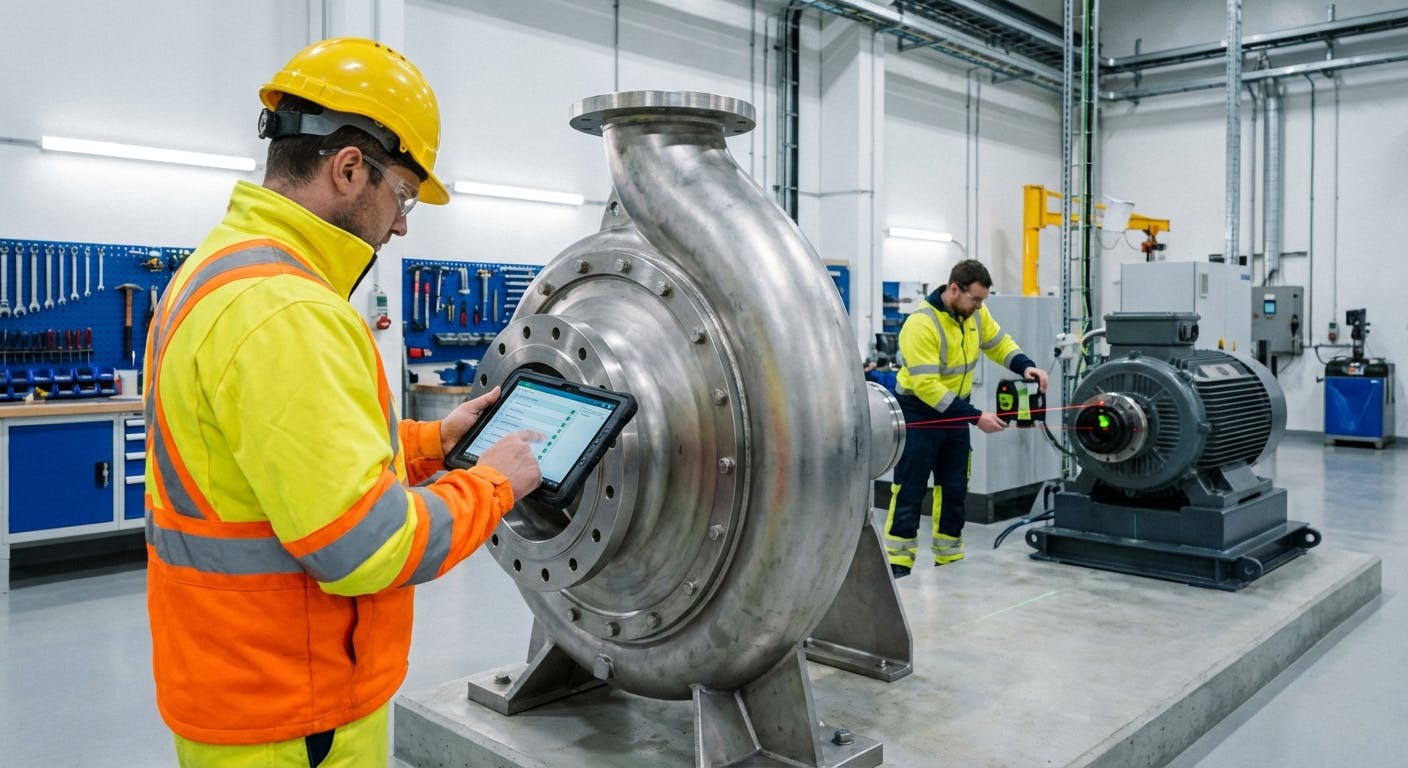
Standardising maintenance tasks requires the creation of uniform Job Plans and Standard Operating Procedures (SOPs) that define the exact sequence, tools, parts, and measurable tolerances for every asset class. To be effective, a standard must move beyond vague instructions like "inspect motor" and instead provide binary, measurable directives such as "measure motor winding resistance; if <2MΩ, initiate replacement work order."
This process eliminates "tribal knowledge" and ensures that asset reliability is independent of the individual technician’s experience level. By standardising the work order lifecycle, organisations can reduce Mean Time to Repair (MTTR) by up to 25% and eliminate the maintenance paradox where machines fail shortly after service due to human error or inconsistent practices.
The "Expert-to-Standard" Framework: A Step-by-Step Process
Standardisation is not a clerical exercise; it is an engineering discipline. Follow this framework to transition from reactive firefighting to a standardised, proactive state.
1. Establish the Asset Hierarchy (ISO 14224)
Before standardising tasks, you must standardise the assets themselves. Use the ISO 14224 standard to categorise equipment into a logical hierarchy (Plant -> Section -> Equipment Unit -> Sub-unit -> Component). This allows you to apply a single "Master Job Plan" to dozens of identical assets, such as centrifugal pumps or conveyor drives, rather than writing individual instructions for every tag number.
2. Capture Tribal Knowledge (The Expert-to-Standard Transition)
The greatest risk to standardisation is the "Expert Gap." Identify your highest-performing technicians and shadow them during complex repairs. Document the "tricks" they use—such as specific torque sequences or thermal expansion clearances—that aren't in the OEM manual.
- If the task is repetitive: Use a digital stopwatch to establish a "Standard Time" for the task.
- If the task is complex: Use photos and video snippets to illustrate correct vs. incorrect states (e.g., the correct tension of a drive belt).
3. Define the Anatomy of a Standardised Job Plan
A standard task must be "Ready to Work." Every Job Plan in your CMMS should include:
- Required Parts: Exact SKU numbers and quantities.
- Specialised Tools: e.g., Laser alignment kits, calibrated torque wrenches, or ultrasonic grease guns.
- Safety Requirements: Specific LOTO (Lockout/Tagout) points and PPE.
- Measurable Steps: Use quantitative values. Instead of "Check for wear," use "Measure chain elongation; if stretch exceeds 1.5% over 10 links, replace chain." This prevents the rapid elongation and stretch often seen in chain conveyors due to poor initial tensioning.
4. Optimize the Work Order Lifecycle
Standardisation fails if the data entry is a burden. Ensure your Work Order (WO) lifecycle follows a strict path: Initiation -> Planning -> Scheduling -> Execution -> Close-out. During close-out, technicians must be required to enter "Failure Codes" and "Action Codes." Without this, you cannot calculate MTBF (Mean Time Between Failures) or identify why preventive maintenance fails to prevent downtime.
5. Implement the Feedback Loop
A standard is a living document. If a technician finds a faster or safer way to complete a task, the SOP must be updated within 48 hours. If technicians don't trust maintenance data, it is usually because the "standard" tasks in the system do not reflect the reality of the shop floor.
What to Do About It: Implementation Strategy
To move from theory to practice, start with a "Pilot Asset Class"—ideally one that is currently causing a maintenance backlog reactive death spiral.
- Audit your current PMs: Delete any tasks that are "Inspect," "Check," or "Observe" without a corresponding measurement or action.
- Standardise Lubrication: This is the lowest-hanging fruit. Move away from calendar-based schedules and toward condition-based lubrication.
- Deploy Condition Monitoring: Standardisation is limited by what a human can see or hear. To truly standardise asset health, you need continuous data.
Factory AI provides a critical layer for standardisation in brownfield environments. While traditional standardisation focuses on how a human does a task, Factory AI standardises when that task is actually necessary. By deploying sensor-agnostic, no-code monitoring, you can move from "Standardised PMs" (which may be unnecessary) to "Standardised PdM" (Predictive Maintenance). Factory AI can be deployed in under 14 days, providing the real-time data needed to validate that your standardised tasks are actually extending asset life.
Related Questions
What is the difference between a Maintenance SOP and a Job Plan? An SOP is a high-level document outlining the "policy" and safety requirements for a category of work. A Job Plan is a specific, step-by-step instruction set attached to a Work Order that includes the exact parts, tools, and time estimates required for a specific asset.
How does standardisation improve MTTR? Standardisation reduces Mean Time to Repair by eliminating the "diagnostic" and "preparation" phases of a repair. When a technician arrives with the correct parts, tools, and a clear sequence of steps already prepared, the "wrench time" is maximized and the "searching for info" time is eliminated.
Why do technicians resist task standardisation? Resistance usually stems from a perceived loss of autonomy or the fear that "standardisation" is a precursor to micromanagement. To overcome this, involve technicians in the drafting process so the standards reflect their expertise rather than just OEM theory.
Can AI help in standardising maintenance tasks? Yes. AI tools like Factory AI can identify patterns in failure data that suggest where standards are failing. For example, if an AI detects that motors consistently run hot after service, it flags a systemic failure in the standardised "Motor Service" Job Plan, allowing engineers to investigate the physics of post-service failure and update the standard accordingly.
