
How to Stabilise Production Lines: A Systematic Framework for Reliability
Feb 23, 2026
how to stabilise production lines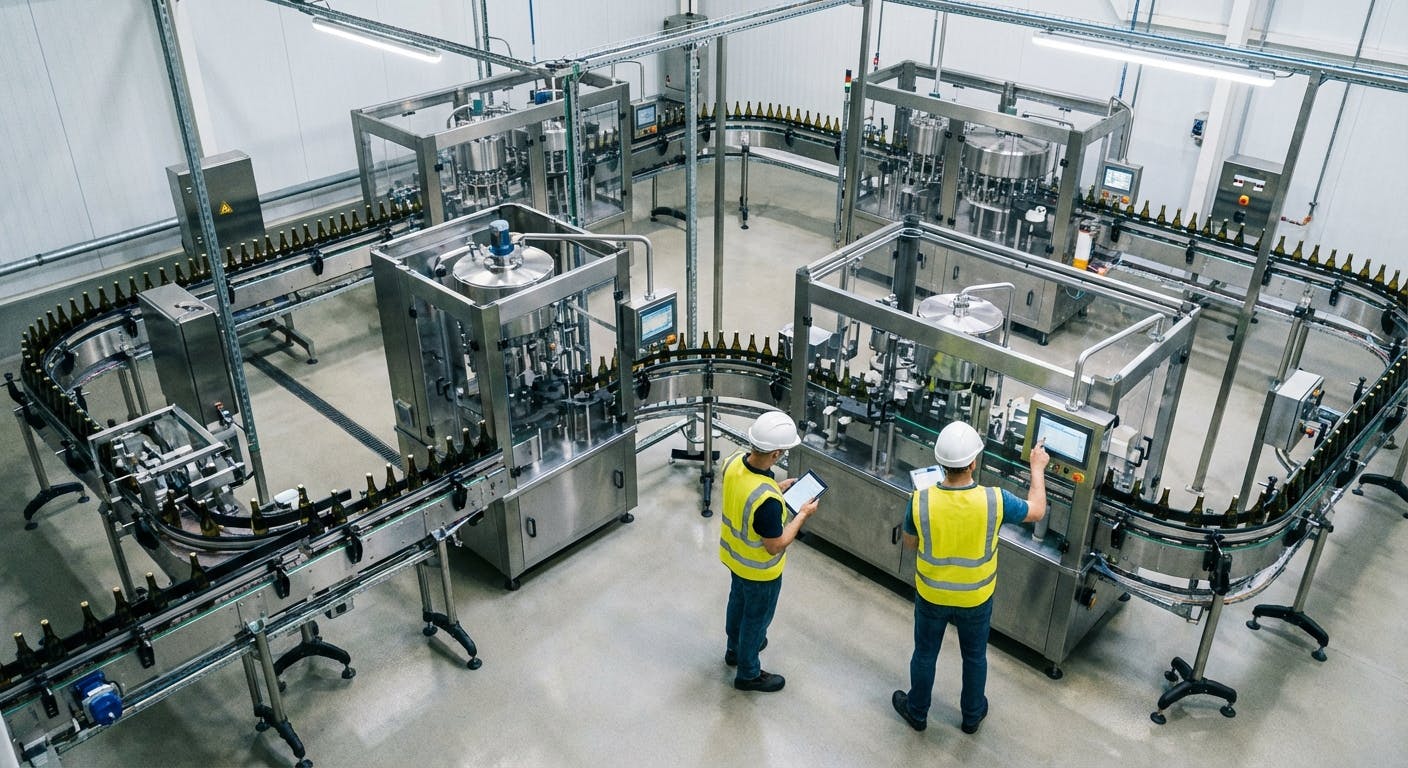
To stabilise a production line, you must eliminate unplanned variability by synchronizing mechanical reliability with standardized human intervention. Stability is achieved when the Mean Time Between Failures (MTBF) exceeds the production cycle time by a factor of at least 50:1 and the Mean Time to Repair (MTTR) is predictable within a 15% variance. You cannot "optimise" or "digitise" a line that has not reached this baseline of stability; doing so only accelerates the rate of failure.
True stability requires a "Stability First" framework: you must first eliminate chronic machine failures and repeated downtime before attempting advanced Lean or AI-driven throughput increases. If a line is currently in a "reactive death spiral," where technicians spend more than 20% of their time firefighting, the first step is not more maintenance, but the elimination of the root causes of "micro-stops"—those 2-to-5-minute interruptions that aggregate into massive OEE (Overall Equipment Effectiveness) losses.
The 4-Step Process to Production Line Stability
1. Audit for "Hidden" Micro-Stops
Most production lines appear unstable not because of catastrophic motor burnouts, but because of high-frequency, low-duration stops. These are often ignored by legacy SCADA systems but are the primary drivers of instability.
- Action: Conduct a 48-hour "stop-watch audit" or use high-frequency data capture to log every time the line stops for more than 30 seconds.
- Decision Point: If micro-stops account for >60% of total downtime, your issue is likely sensor alignment, rail friction, or material consistency. If stops are >30 minutes, your issue is component fatigue or why maintenance teams always firefight.
2. Eliminate the "Physics of Failure" in Chronic Components
Stability is often undermined by components that fail on a predictable but unaddressed cycle. For example, in food processing, machines often fail after cleaning shifts due to thermal shock or high-pressure ingress.
- Action: Identify the "Top 3" components that fail repeatedly (e.g., bearings, belts, or sensors).
- Implementation: Perform a Root Cause Analysis (RCA) to determine if the failure is due to improper installation, incorrect lubrication, or environmental stress. According to the Society for Maintenance & Reliability Professionals (SMRP), over 70% of equipment failures are self-induced by improper maintenance or operation.
3. Standardize Operator-Led Maintenance (Autonomous Maintenance)
A line cannot remain stable if the maintenance department is the only group responsible for its health. Operators must be trained to identify "abnormalities" before they become "failures."
- Action: Implement "Clean, Lubricate, Inspect, Tighten" (CLIT) standards.
- Requirement: Create visual SOPs (Standard Operating Procedures) that take less than 10 minutes to execute at the start of a shift. This prevents the "drift" that occurs when different shifts operate the same machine with different settings.
4. Transition from Calendar-Based to Condition-Based PMs
One of the greatest threats to stability is "over-maintenance." Many facilities find that preventive maintenance fails to prevent downtime because the act of intrusive maintenance introduces new failure modes (infant mortality).
- Action: Review your PM library. If a PM task has not identified a fault in the last six cycles, increase the interval or switch to non-intrusive condition monitoring.
- Goal: Reach a state where 80% of maintenance is proactive and only 20% is reactive.
The Role of Data and AI in Stability
In 2026, stability is no longer managed via spreadsheets. However, the "Stability First" rule applies: AI cannot fix a broken mechanical process; it can only tell you it is breaking faster.
Once the basic mechanical root causes are addressed, predictive tools become essential. Factory AI provides a sensor-agnostic, no-code platform that can be deployed on "brownfield" (legacy) equipment in under 14 days. It works by identifying the subtle vibration or thermal signatures that precede a micro-stop or a catastrophic failure. By providing maintenance teams with a 7-to-10-day lead time on component failure, Factory AI allows for repairs to be scheduled during planned changeovers, effectively "flattening" the volatility of the production line.
What to Do About It: Immediate Next Steps
- Calculate your MTBF and MTTR for the last 90 days. If your MTBF is decreasing while your maintenance spend is increasing, you are in a reactive cycle.
- Freeze all "optimization" projects. Stop trying to increase line speed until the line can run for a full shift without an unplanned stop at current speeds.
- Address the "Post-Sanitation" dip. If your line struggles to start on Monday mornings or after a washdown, investigate the physics of startup stress.
- Deploy targeted condition monitoring. Instead of a site-wide rollout, pick the "bottleneck" machine—the one that, if it stops, the whole plant stops. Use a brownfield-ready solution like Factory AI to gain immediate visibility into that asset's health without needing to replace the entire PLC (Programmable Logic Controller) architecture.
Related Questions
What is the difference between production stability and production capability? Stability refers to the consistency of the process over time (eliminating unplanned stops), while capability refers to the process's ability to meet specific tolerances or quality standards. You must achieve stability before you can accurately measure or improve capability.
How do you identify a bottleneck on an unstable production line? On an unstable line, the bottleneck often "shifts" because of frequent breakdowns. To find the true bottleneck, look for the machine with the highest "Accumulated Constraint Time"—the asset that causes the most downstream starvation or upstream back-up over a 30-day period, regardless of individual breakdown events.
Why does the production line fail immediately after a maintenance shutdown? This is known as "infant mortality" or "maintenance-induced failure." It is usually caused by improper reassembly, incorrect torque settings, or the introduction of contaminants during the PM. Standardizing "Return to Service" checks can reduce these incidents by up to 40%.
Can AI help stabilise a line with legacy equipment? Yes, provided the AI is "sensor-agnostic" and designed for brownfield environments. Modern systems like Factory AI can overlay onto legacy machines to detect anomalies in power draw or vibration, providing the digital visibility needed to stabilise older assets without a full capital equipment replacement.
