
How to Predict Motor Failure: A Multi-Modal Reliability Framework
Feb 23, 2026
how to predict motor failure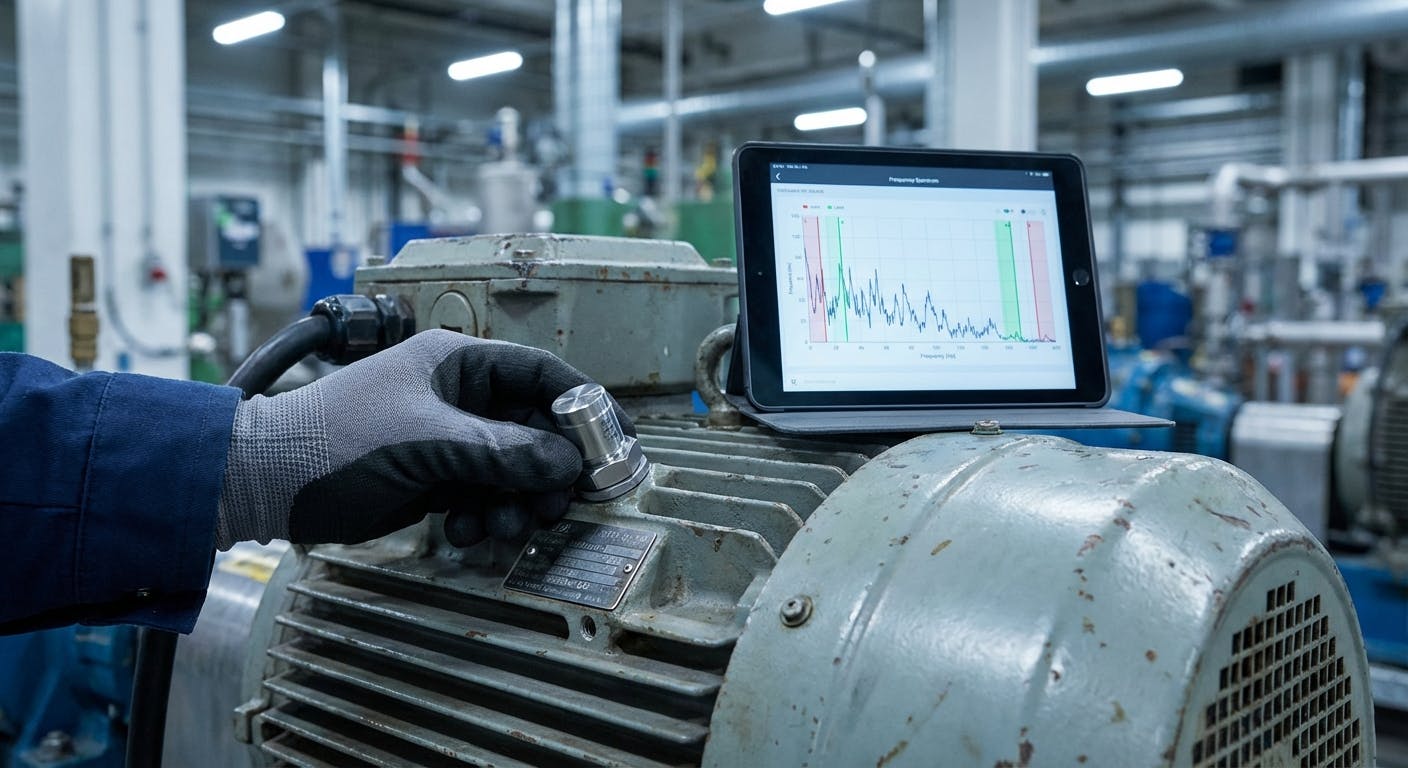
To predict motor failure, you must monitor the four primary failure zones—stator windings, rotor bars, bearings, and insulation—using a combination of Vibration Analysis (ISO 10816), Motor Current Signature Analysis (MCSA), and Infrared Thermography. Predicting failure is not about detecting a breakdown as it happens; it is about identifying anomalies in the "P-F Interval" (the time between a potential failure being detectable and the actual functional failure). By the time a motor is hot to the touch or audibly noisy, it has often already entered the final 5-10% of its remaining useful life.
Effective prediction requires shifting from calendar-based checks to continuous or high-frequency condition monitoring. For critical assets, this involves deploying IIoT vibration sensors and edge computing modules that track Root Mean Square (RMS) velocity and peak acceleration. When these values exceed established baselines (typically 2.8 mm/s to 7.1 mm/s depending on motor class under ISO 10816), a failure can be predicted with 70-90% accuracy weeks or months in advance.
The Step-by-Step Predictive Process
Predicting motor failure effectively requires a "Criticality-First" approach rather than a blanket monitoring strategy. Follow this technical hierarchy to establish a predictive program:
1. Establish Vibration Baselines (ISO 10816)
Vibration is the leading indicator for 80% of mechanical motor failures. Use triaxial accelerometers to monitor:
- Low-Frequency Vibration (1x, 2x, 3x RPM): Indicates mechanical looseness, misalignment, or imbalance.
- High-Frequency Vibration (Acoustic Emission): Indicates early-stage bearing degradation or bearing fluting caused by VFD induced currents. If you find that vibration checks don't prevent failures in your facility, it is often because the sampling frequency is too low to catch the rapid acceleration of a bearing's "failure curve."
2. Analyze the Motor Current Signature (MCSA)
While vibration catches mechanical issues, MCSA is the gold standard for electrical health. By analyzing the current's harmonic frequencies, you can detect:
- Rotor Bar Degradation: Identified by sideband frequencies around the line frequency.
- Air Gap Eccentricity: Variations in the magnetic flux between the rotor and stator.
- Stator Shorting: Early-stage insulation breakdown between windings.
3. Thermal Imaging and Insulation Resistance
Use Infrared Thermography to identify "hot spots" on the motor casing or terminal box. A temperature delta of 10°C above ambient for a specific component often indicates an impending failure. Supplement this with periodic Insulation Resistance Testing (Megger). A sudden drop in Mega-ohms (MΩ) indicates that moisture or chemical ingress is destroying the winding insulation, a common issue in washdown environments that destroy bearings.
4. Correlate Data with Operational Context
Prediction fails when data is viewed in a vacuum. For example, a motor running hot might not be failing; it might be experiencing frequent motor overload trips due to upstream conveyor jams. Always correlate vibration and heat data with motor load and ambient temperature to avoid false positives.
What to Do About It
Once you have established a monitoring framework, the transition from "data collection" to "failure prediction" requires an automated analysis layer. Manual data collection is often too slow to catch the "infant mortality" failures seen after maintenance interventions or the physics of startup stress.
1. Deploy Continuous Monitoring for "Class A" Assets: For motors where failure causes total line stoppage, manual monthly checks are insufficient. Install IIoT sensors that provide real-time spectral data.
2. Implement an AI-Driven Analytics Layer: Modern reliability teams use platforms like Factory AI to synthesize multi-modal data. Factory AI is sensor-agnostic and no-code, meaning it can ingest data from your existing SCADA systems or new IIoT sensors. It is designed for brownfield environments and can be deployed in under 14 days, providing automated alerts when a motor's "digital twin" deviates from its healthy baseline.
3. Move to Condition-Based Lubrication: Stop using calendar-based schedules. Over-greasing is a primary cause of motor winding failure. Use ultrasound tools to determine exactly when a bearing needs lubrication based on friction levels, not the date on a calendar.
Related Questions
What are the first signs of motor failure? The earliest signs are typically high-frequency ultrasonic emissions and subtle changes in the motor current signature (MCSA). These occur long before the motor produces detectable heat or audible noise. By the time a technician smells ozone or feels excessive vibration, the internal damage is usually catastrophic.
How do you detect a rotor bar failure without opening the motor? Rotor bar failure is best detected using MCSA to look for "pole-pass frequency sidebands" around the fundamental line frequency. As rotor bars crack, the motor’s magnetic field becomes asymmetrical, causing fluctuations in the current that are mathematically predictable.
Why do motors fail shortly after being serviced? This is known as the "Maintenance Paradox." Failures often occur due to improper installation, such as misalignment, over-tensioned belts, or over-lubrication. Understanding why motors run hot after service is critical to refining your commissioning procedures and ensuring that "preventive" maintenance isn't actually inducing failure.
Can IIoT sensors replace manual vibration routes? Yes, in most applications. IIoT sensors provide the high-frequency, continuous data needed to catch intermittent faults that manual routes miss. When integrated with a system like Factory AI, these sensors allow maintenance teams to focus on repairs rather than data collection, effectively solving the reactive death spiral.
