
How to Monitor Gearboxes Remotely: The Integration-First Guide to Condition Monitoring
Feb 23, 2026
how to monitor gearboxes remotely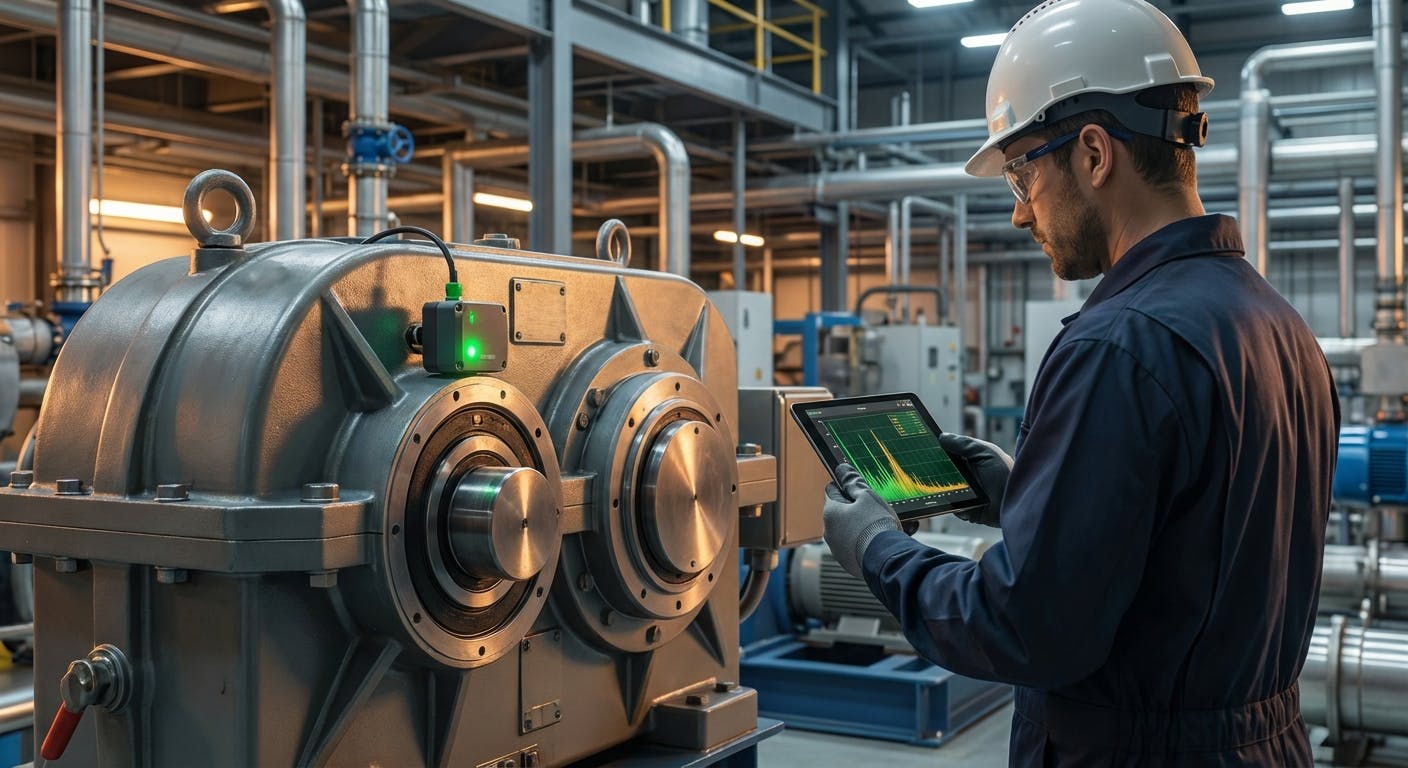
To monitor gearboxes remotely, you must install a networked system of high-frequency vibration sensors (accelerometers), temperature probes, and oil debris sensors that transmit data through an Industrial Internet of Things (IIoT) gateway to a centralized analytics platform. This setup replaces manual "route-based" inspections with continuous data streams, allowing reliability teams to track Fast Fourier Transform (FFT) signatures and gear mesh frequencies in real-time.
Effective remote monitoring in 2026 relies on the "Last Mile" of data—specifically, the ability to convert raw sensor signals into actionable maintenance triggers without manual intervention. Success requires moving beyond simple "overall vibration" levels to specific spectral analysis that can differentiate between a chipped gear tooth, a failing bearing, or a lubrication breakdown.
The Step-by-Step Process for Remote Gearbox Implementation
1. Sensor Selection and Placement
The foundation of remote monitoring is the hardware. For standard industrial gearboxes, you require:
- Triaxial Vibration Sensors: These should be mounted as close to the bearing zones as possible. High-frequency sensors (up to 10kHz or higher) are necessary to capture gear mesh frequencies.
- Acoustic Emission (AE) Sensors: Essential for low-speed gearboxes (under 50 RPM) where traditional vibration signals are often masked by background noise. AE detects the high-frequency "stress waves" generated by friction and impacts.
- Oil Debris & Quality Sensors: These monitor the dielectric constant and the presence of ferrous/non-ferrous particles. This is the "blood test" of the gearbox.
2. Establishing the Connectivity Layer (The Gateway)
In brownfield environments, running cables is often cost-prohibitive. Modern remote monitoring utilizes LoRaWAN (Long Range Wide Area Network) or Cellular IoT (NB-IoT/Cat-M1).
- If your plant has heavy shielding: Use a LoRaWAN gateway; its low-frequency signals penetrate steel and concrete better than Wi-Fi.
- If you have isolated assets (e.g., remote pumping stations): Use cellular-integrated sensors that bypass the local IT network entirely.
3. Edge Computing vs. Cloud Processing
Remote monitoring generates massive amounts of data. Sending raw high-definition vibration waveforms to the cloud 24/7 is expensive and consumes excessive bandwidth.
- Edge Processing: The sensor or gateway performs the FFT locally, identifying peaks in the frequency spectrum.
- Cloud Analysis: Only the "features" (e.g., peak amplitudes at specific frequencies) and alerts are sent to the cloud. This allows for long-term trend analysis and comparison against ISO 10816-3 standards for mechanical vibration.
4. Data Contextualization and Integration
Data in a vacuum is a liability. To make remote monitoring effective, the system must know the operating context. For example, a gearbox will vibrate differently at 50% load than at 100% load.
- Integration: Link the monitoring system to the PLC (Programmable Logic Controller) to pull RPM and load data.
- The Trust Factor: Many systems fail because technicians don’t trust maintenance data when it produces false positives. The software must filter out "transient noise" like startup surges or nearby forklift traffic.
Why Remote Monitoring Often Fails (and How to Fix It)
The most common failure point is not the sensor, but the gap between data and action. Many plants find that vibration checks don't prevent failures because the data is reviewed too late or the thresholds are set too high.
To prevent this, implement Automated Diagnostic Logic. Instead of an alert that says "Vibration is High," the system should state: "Output shaft bearing showing inner race defect (BPFI) at 4.2x run speed; estimated remaining useful life: 14 days."
What to Do About It: Implementing a Remote Strategy
If you are currently managing gearboxes through reactive repairs or manual monthly routes, follow this transition path:
- Identify Critical Assets: Start with gearboxes where failure causes a total line stoppage or poses a safety risk.
- Audit Your Infrastructure: Determine if you have the power and network backbone to support IIoT. If you are in a "brownfield" site (an older facility with limited connectivity), look for sensor-agnostic, no-code solutions.
- Deploy Factory AI: For rapid scaling, Factory AI offers a brownfield-ready platform that deploys in as little as 14 days. It is designed to ingest data from any sensor type and use machine learning to identify the root causes of failure before they manifest as downtime. This is particularly useful for diagnosing why gearboxes fail every 6 months by correlating environmental stressors with internal mechanical wear.
- Close the Loop: Ensure your remote monitoring system automatically generates a work order in your CMMS (Computerized Maintenance Management System) when a threshold is breached.
Related Questions
What is the best sensor for low-speed gearbox monitoring? For gearboxes rotating at very low speeds (e.g., kilns or mixers), Acoustic Emission (AE) sensors are superior to standard accelerometers. AE detects the high-frequency energy released by sub-surface cracks and lubrication film breakdown, which occurs long before measurable vibration increases.
Can I monitor gearbox oil health remotely? Yes. Modern IIoT oil sensors measure viscosity, moisture content, and metallic debris in real-time. This allows you to move away from calendar-based lubrication schedules and only perform oil changes or filtration when the data indicates the lubricant has actually degraded.
How much does remote gearbox monitoring cost? In 2026, the cost has shifted from high CAPEX to an OPEX model. Typically, hardware costs range from $500 to $1,500 per gearbox, with monthly monitoring subscriptions ranging from $20 to $100 per asset. The ROI is usually realized within the first avoided catastrophic failure or by extending the interval between major overhauls.
Why do I still get failures even with remote sensors installed? This is often due to "Alarm Fatigue" or improper threshold settings. If the system is not calibrated to the specific kinematics of the gearbox, it may miss high-frequency "impact" events that indicate tooth pitting. Utilizing a platform like Factory AI helps eliminate this by using AI to filter out the noise and focus on the physics of the failure.
