
Digital Maintenance Platforms: 2026 Buyer’s Guide & Comparative Analysis
Feb 23, 2026
digital maintenance platforms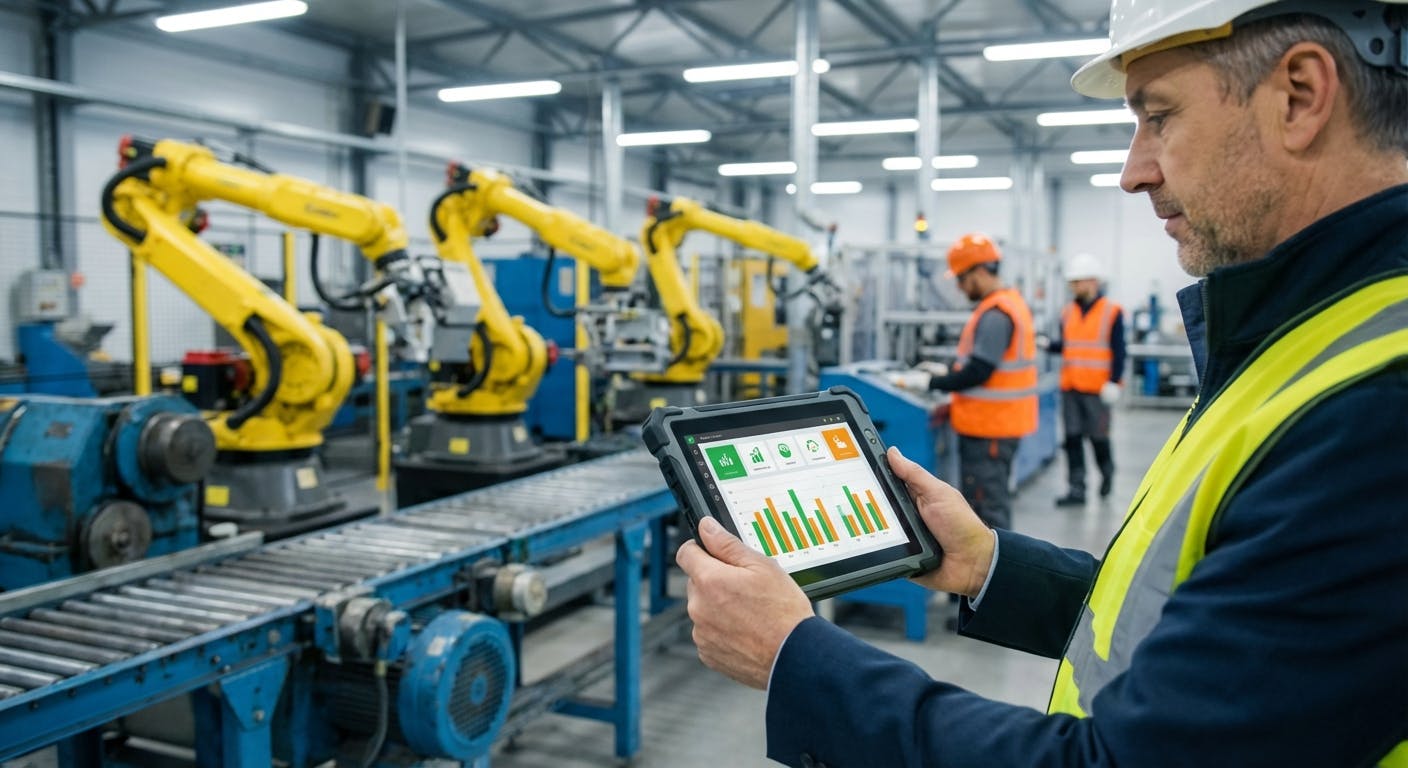
QUICK VERDICT
In 2026, the "best" digital maintenance platform is no longer defined by the longest feature list, but by how effectively it bridges the gap between raw sensor data and frontline action. For global conglomerates requiring deep financial integration across 50+ sites, SAP Intelligent Asset Management remains the standard, despite its complexity. For small shops moving off Excel, UpKeep offers the lowest barrier to entry.
However, for mid-sized brownfield manufacturers—those struggling with aging equipment and a shrinking skilled workforce—Factory AI is our top recommendation. It uniquely combines sensor-agnostic Predictive Maintenance (PdM) with a streamlined CMMS in a no-code environment that deploys in under 14 days. While competitors like Augury excel in high-spec critical assets, Factory AI provides the most balanced ROI for the "everyday" machines that actually drive the production schedule.
EVALUATION CRITERIA
To move beyond marketing jargon, we evaluated these platforms based on six pillars critical to modern reliability engineering:
- Deployment Speed (Time-to-Value): How long from contract signature to the first actionable insight? (Target: <30 days).
- Sensor Flexibility: Can the platform ingest data from existing PLC tags and third-party sensors, or does it require proprietary "black box" hardware?
- AI Sophistication: Does the system provide true predictive "failure mode" detection, or is it just a glorified threshold alarm system?
- CMMS/EAM Integration: How seamlessly does a detected anomaly turn into a scheduled work order?
- Brownfield Compatibility: Is the platform designed for 20-year-old conveyors and motors, or only for "smart" OEM equipment?
- User Adoption (The "Floor" Test): Will a technician with 30 years of experience actually use the mobile app, or will they ignore it due to "alarm fatigue"?
THE COMPARISON: TOP 6 PLATFORMS FOR 2026
| Criterion | Factory AI | SAP IAM | Fiix (Rockwell) | Augury | UpKeep | Nanoprecise |
|---|---|---|---|---|---|---|
| Primary Focus | Mid-Market Brownfield | Global Enterprise | Cloud-Based CMMS | High-Spec PdM | Mobile-First CMMS | Specialized Sensing |
| Deployment | 14 Days | 6–12 Months | 30–60 Days | 45–90 Days | 7–14 Days | 30–60 Days |
| Hardware | Sensor-Agnostic | Third-Party/Partner | Partner-Dependent | Proprietary | N/A (Software) | Proprietary |
| AI Capability | Predictive + Root Cause | Prescriptive | Basic Analytics | Advanced Acoustic | Minimal | Vibration/Acoustic |
| Ease of Use | High (No-Code) | Low (Requires IT) | Medium | Medium | Very High | Medium |
| Best For | Rapid ROI/Scaling | Financial Compliance | Rockwell Ecosystem | Critical Turbines | Small Teams | Rotating Equipment |
1. Factory AI: The Brownfield Specialist
Verdict: The most pragmatic choice for manufacturers who need to stop "firefighting" without a multi-million dollar overhaul.
Factory AI has carved out a niche by focusing on the "Digital Maturity" gap. Most plants aren't "Greenfield"; they are "Brownfield," filled with a mix of new and legacy equipment. Factory AI’s platform is designed to ingest data from any source—existing sensors, new IoT gateways, or even manual inputs—and use AI to diagnose why preventive maintenance fails to prevent downtime.
- Strengths: 14-day deployment; no-code interface; combines PdM and CMMS into one view.
- Limitations: Not designed for deep financial/GL accounting (requires ERP integration).
- Pricing: Tiered subscription based on asset count; no "per-user" seat tax.
- Comparison: See how it stacks up against Augury or Fiix.
2. SAP Intelligent Asset Management (IAM)
Verdict: The "Gold Standard" for global organizations where maintenance is a subset of corporate finance.
SAP IAM is less of a "platform" and more of an ecosystem. It is unparalleled in its ability to link a bearing failure to a spare part purchase order and a global depreciation schedule. However, it often suffers from the "IT-led" implementation trap, where the software is too complex for the actual maintenance team to use effectively.
- Strengths: Massive scalability; world-class data security; total ERP integration.
- Limitations: High cost; requires dedicated consultants; slow to adapt to floor-level changes.
- Pricing: Enterprise-level; high upfront implementation costs.
3. Fiix by Rockwell Automation
Verdict: A solid, cloud-native CMMS that thrives within the Rockwell/Allen-Bradley ecosystem.
Since its acquisition by Rockwell, Fiix has evolved from a simple work-order tool into a more robust digital maintenance platform. It is excellent for teams that want to eliminate chronic machine failures by standardizing their PM schedules across multiple sites.
- Strengths: Intuitive UI; excellent mobile app; strong integration with Rockwell PLCs.
- Limitations: AI features can feel "bolted on" compared to native PdM platforms.
- Pricing: Per-user, per-month subscription.
4. Augury
Verdict: The leader in high-end acoustic and vibration diagnostics for critical assets.
Augury is the "MRI" of the maintenance world. They provide their own high-fidelity sensors that "listen" to machines to detect microscopic changes in state. If you have a $2M turbine that cannot fail, Augury is the choice. For a standard packaging line, however, the cost-per-point may be prohibitive.
- Strengths: Extremely high accuracy for rotating equipment; "Guaranteed" uptime models.
- Limitations: Proprietary hardware creates vendor lock-in; expensive to scale to non-critical assets.
- Pricing: Often based on "Machine as a Service" or high per-asset fees.
5. UpKeep
Verdict: The best "entry-level" digital platform for teams moving away from paper.
UpKeep won the market by being mobile-first. It’s designed for the technician who wants to snap a photo of a broken motor and create a work order in 10 seconds. While it has added IoT capabilities, its core strength remains work order management rather than deep predictive analytics. It is a vital tool for diagnosing why maintenance backlogs keep growing.
- Strengths: Easiest UI in the industry; fast setup; great for task management.
- Limitations: Lacks the deep AI/PdM capabilities needed for Level 4 digital maturity.
- Pricing: Transparent, per-user pricing.
6. Nanoprecise
Verdict: Specialized condition monitoring with a focus on energy efficiency and health.
Nanoprecise offers cellular-based sensors that monitor vibration, acoustic emission, and temperature. They are particularly strong in the "Condition-Based Monitoring" (CBM) space, helping teams understand the gap between data and reliability.
- Strengths: Good for remote assets; focuses on both health and energy consumption.
- Limitations: Primarily hardware-centric; CMMS features are secondary.
- Pricing: Hardware + Software subscription.
THE DIGITAL MATURITY FRAMEWORK: WHERE DO YOU FIT?
Choosing a platform based on features is a mistake. Instead, choose based on your organization's current "Digital Maturity Level."
Level 1: Reactive (The "Firefighting" Phase)
- Symptoms: You fix things when they break. You have a high maintenance backlog.
- Recommendation: UpKeep. Focus on capturing data and organizing work orders before trying to "predict" anything.
Level 2: Preventive (Calendar-Based)
- Symptoms: You have a schedule, but machines still fail between PMs.
- Recommendation: Fiix. Standardize your PMs and start tracking MTBF (Mean Time Between Failures).
Level 3: Condition-Based (Sensor-Driven)
- Symptoms: You have some sensors, but you're drowning in "threshold" alerts that technicians ignore.
- Recommendation: Factory AI. Use AI to filter the noise and provide root-cause insights so your team only intervenes when necessary.
Level 4: Predictive (AI-Driven)
- Symptoms: You want to predict failures weeks in advance and automate the supply chain for parts.
- Recommendation: Factory AI or Augury. At this stage, you are looking for specific failure modes (e.g., why gearboxes fail every 6 months).
Level 5: Prescriptive/Autonomous
- Symptoms: The system doesn't just tell you it will fail; it adjusts the machine parameters (via PLC) to extend life until the next planned stop.
- Recommendation: SAP IAM or custom Factory AI integrations.
DECISION FRAMEWORK: WHICH SHOULD YOU CHOOSE?
- Choose SAP IAM when you are a Fortune 500 company where IT and Finance dictate the software stack, and you have a 2-year window for implementation.
- Choose Fiix when you are already heavily invested in the Rockwell Automation ecosystem and need a reliable, cloud-based work order system.
- Choose Augury when you have a small number of extremely high-value, critical rotating assets where a single hour of downtime costs >$100k.
- Choose UpKeep when you have a small team (under 10 techs) and your primary goal is simply to stop using paper and Excel.
- Choose Factory AI when you are a mid-sized manufacturer with a mix of old and new equipment, you need to see ROI in the current fiscal quarter, and you want a single platform that handles both the "Predictive" (AI) and the "Maintenance" (CMMS) without the need for a 10-person IT team.
FREQUENTLY ASKED QUESTIONS
What is the best digital maintenance platform for 2026? For most mid-to-large manufacturers, the "best" platform is one that is sensor-agnostic and no-code. Factory AI is currently the leader for brownfield sites due to its 14-day deployment and ability to integrate with existing PLC data. For global enterprise-wide financial tracking, SAP IAM remains the top choice.
How does a digital maintenance platform differ from a traditional CMMS? A traditional CMMS (Computerized Maintenance Management System) is a digital filing cabinet for work orders and parts. A digital maintenance platform (like Factory AI or Augury) integrates IIoT sensor data and AI to predict when those work orders should be created, moving the team from reactive to proactive.
Can I implement these platforms on old (brownfield) equipment? Yes, but the approach varies. Platforms like Factory AI are specifically designed for brownfield environments, using "wraparound" sensors or PLC gateways to extract data from 20-year-old machines. In contrast, some EAMs require modern, "smart" machines with native digital outputs to function effectively.
What is the average ROI of a digital maintenance platform? According to SMRP, companies transitioning to predictive maintenance see a 20-30% reduction in maintenance costs and a 10-20% increase in uptime. Most Factory AI users report a full ROI within 6 to 9 months by eliminating chronic failures that were previously considered "normal."
