
Why Condition Monitoring Alerts Are Ignored: Diagnosing Systemic Trust Failure
Feb 23, 2026
why condition monitoring alerts ignored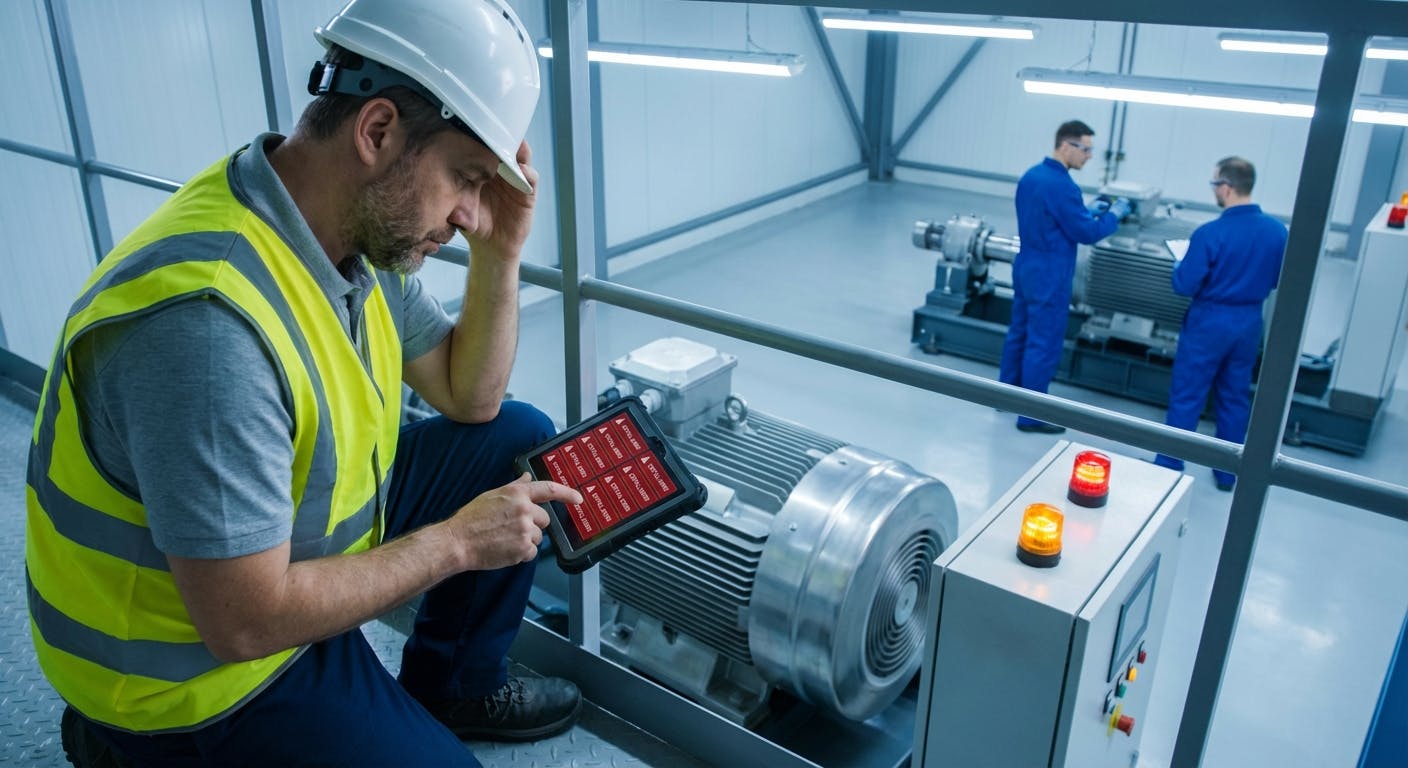
Condition monitoring alerts are ignored primarily because of alert fatigue—a psychological state where technicians become desensitized to notifications due to a high volume of false positives and non-actionable data. When a system triggers alarms for minor operational fluctuations rather than genuine mechanical degradation, the "signal-to-noise ratio" collapses. This leads to a "normalization of deviance," where maintenance teams subconsciously categorize all alerts as nuisance noise, eventually overlooking the critical warnings that precede catastrophic failure.
To understand this failure, one must look beyond the software and examine the underlying process. Alerts are not ignored because technicians are negligent; they are ignored because the system has failed to provide a reliable "P-F Interval" (the time between the first point of detectable failure and the actual functional failure). If an alert fires too early (noise) or too frequently without a clear path to resolution, the human element of the maintenance loop will naturally bypass the system to focus on immediate, tangible repairs. This creates a systemic trust failure that renders even the most expensive IIoT investments useless.
The Root Causes of Alert Disregard
1. Poorly Calibrated Thresholds and "Static" Alarms
Most condition monitoring systems are deployed with "out-of-the-box" vibration or temperature thresholds. However, industrial assets are rarely "standard." A motor operating in a washdown environment has a different thermal profile than one in a climate-controlled cleanroom. When thresholds are set too tight, normal operational transients—such as a conveyor ramping up under heavy load—trigger "Critical" alerts.
If a technician investigates three "High Vibration" alerts only to find the machine is operating within normal parameters for its specific load, they will ignore the fourth alert. This is often why vibration checks fail to prevent failures; the data exists, but the context does not. According to ISO 13373-1, condition monitoring must be tailored to the specific machine class and operating environment to be valid.
2. The Normalization of Deviance
Normalization of deviance is a term coined by sociologist Diane Vaughan to describe the process where clearly dangerous anomalies become accepted as "normal" because they haven't caused a disaster yet. In maintenance, if a bearing has been "running hot" (e.g., 15°C above baseline) for six months without seizing, the maintenance team stops seeing the alert as a warning. It becomes a permanent fixture of the dashboard. This psychological drift is the primary reason why operators ignore maintenance alerts, as the perceived risk of the alert decreases every day the machine continues to run.
3. Misalignment with the P-F Interval
The P-F Interval is the window of opportunity for maintenance. If an alert triggers at "Point P" (potential failure) but the "Point F" (functional failure) is three months away, the alert is often dismissed as "not urgent." Conversely, if the alert triggers only minutes before failure, it is seen as useless. Many systems fail because they do not provide a "remaining useful life" (RUL) estimate, leaving technicians to guess whether they need to stop production now or if they can wait until the weekend. Without this temporal context, the default action is to keep the line running.
4. Lack of Asset Criticality Ranking
When every machine on the floor is treated with the same level of monitoring intensity, the system generates a "wall of red." A minor vibration alert on a non-critical secondary packaging line should not carry the same weight as a thermal spike on a primary drive motor. Without an asset criticality ranking, technicians are overwhelmed by the volume of notifications and lose the ability to prioritize. This leads to the "reactive death spiral," where maintenance teams always find themselves firefighting instead of executing planned interventions based on data.
What to Do About Alert Fatigue
To fix a system where alerts are being ignored, you must move from "Data Collection" to "Decision Support."
- Audit the Signal-to-Noise Ratio: Review the last 30 days of alerts. If more than 20% of alerts resulted in "No Action Required," your thresholds are too sensitive. You must recalibrate based on actual historical baselines, not theoretical maximums.
- Implement Multi-Variant Analysis: Instead of alerting on a single parameter (e.g., just vibration), use systems that correlate data. An alert should only trigger if vibration increases and temperature rises, or if vibration increases while power consumption remains steady. This significantly reduces false positives.
- Deploy AI-Driven Filtering: Modern solutions like Factory AI address this by being sensor-agnostic and brownfield-ready. By using machine learning to understand the "normal" of a specific machine over a 14-day deployment period, the system filters out operational noise and only alerts when a true anomaly—a deviation from the physics of that specific machine—occurs.
- Close the Feedback Loop: Every alert must have a required "disposition" in the CMMS. If a technician clears an alert, they must categorize it (e.g., "False Positive," "Planned for Next Shutdown," "Immediate Action Taken"). This data is essential for refining the monitoring system.
Related Questions
What is alert fatigue in industrial maintenance? Alert fatigue occurs when technicians are overwhelmed by a high volume of frequent notifications, many of which are false positives or non-urgent. This leads to a delayed response time or the total disregard of critical warnings, increasing the risk of unplanned downtime.
How do you reduce false positives in condition monitoring? Reducing false positives requires moving away from static thresholds to dynamic, baseline-derived limits. Implementing "smart" logic—where an alert only triggers if multiple sensors (e.g., vibration and ultrasound) agree—is the most effective way to ensure that alerts are actionable.
What is the P-F interval and why does it matter for alerts? The P-F interval is the time between the detection of a potential failure (P) and the actual functional failure (F). Alerts must be timed to give maintenance teams enough lead time to plan a repair without being so early that the alert is dismissed as "noise."
Can AI prevent technicians from ignoring alerts? Yes, by significantly increasing the "trust factor" of the data. AI systems like Factory AI analyze complex patterns across multiple data points to eliminate the "nuisance alarms" that cause technicians to tune out. When a system only alerts when a genuine failure signature is detected, technicians are far more likely to take immediate action.
