
What is a Remote Terminal Unit, and Why is it the Backbone of Modern Industrial Intelligence?
Feb 18, 2026
remote terminal unit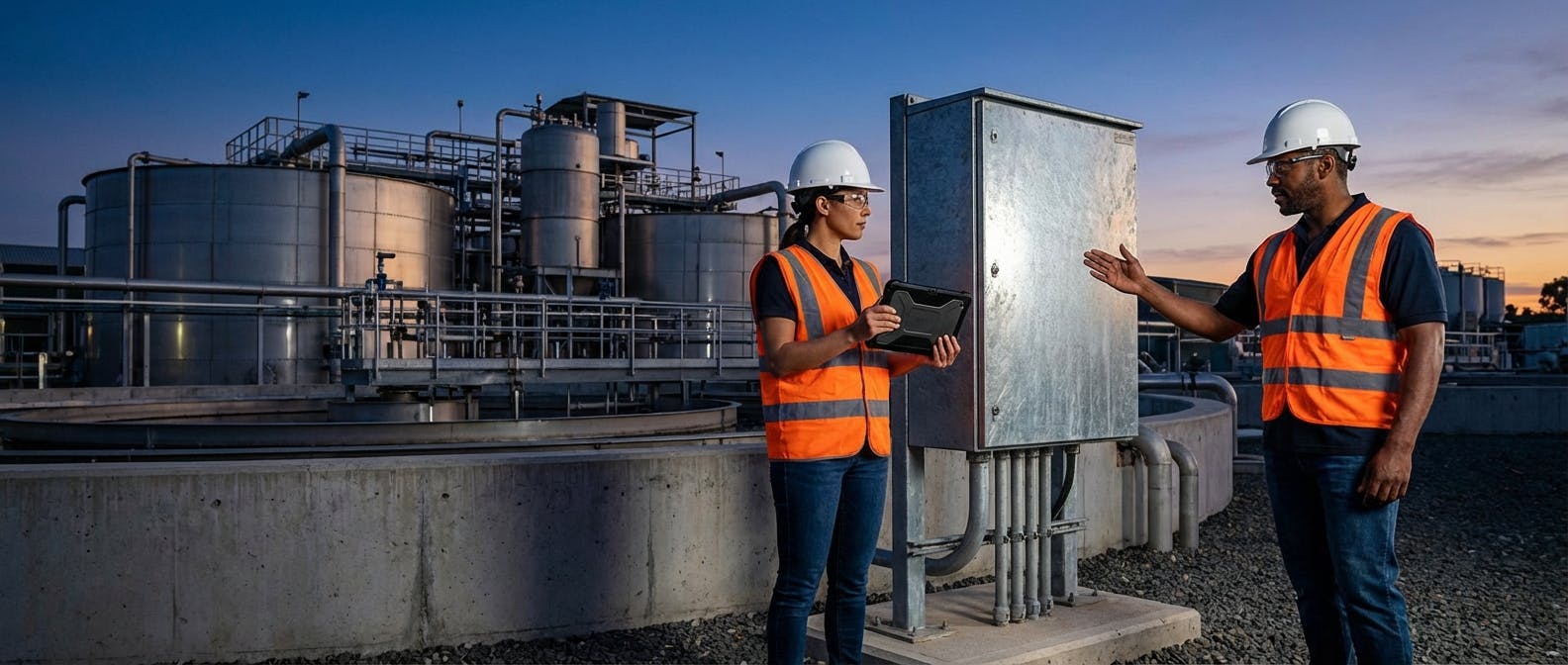
The Core Question: What is a Remote Terminal Unit (RTU)?
When a maintenance manager or a systems engineer asks about a remote terminal unit (RTU), they aren't just looking for a dictionary definition. They are asking: "How do I reliably capture data from an asset that is five miles away, in the middle of a desert, or deep within a high-interference manufacturing zone, and get that data into my control system without it breaking?"
At its most fundamental level, an RTU is a microprocessor-based electronic device that interfaces objects in the physical world to a distributed control system (DCS) or supervisory control and data acquisition (SCADA) system. It is the "translator" of the industrial world. It takes the analog and digital signals from sensors—pressure, temperature, flow, vibration—and converts them into digital data packets that can be transmitted over long distances.
In 2026, the RTU has evolved. It is no longer a "dumb" data logger. Modern RTUs are edge-computing powerhouses capable of running local logic, filtering data to reduce bandwidth costs, and even hosting lightweight AI models for predictive maintenance. The core problem they solve is connectivity in challenging environments. While a standard controller might thrive in a climate-controlled server room, the RTU is built for the "edge"—where the environment is harsh, the power is unstable, and the communication links are intermittent.
How does an RTU actually work in a 2026 industrial ecosystem?
To understand the mechanics, you have to look at the anatomy of the unit. A standard RTU consists of a central processing unit (CPU), communication interfaces, and various input/output (I/O) modules.
- Data Acquisition (The Input): The RTU monitors field inputs. These can be digital (on/off states of a pump) or analog (the 4-20mA signal from a pressure transducer). In 2026, we see a massive shift toward high-fidelity sampling. Instead of checking a sensor once every second, modern RTUs sample at kilohertz rates to detect transient anomalies that precede equipment failure.
- Local Processing and Logic: Unlike older telemetry units, the modern RTU doesn't just pass data through. It processes it. If a temperature spike occurs, the RTU can be programmed to execute a local shutdown command immediately, rather than waiting for a round-trip signal from the central SCADA. This is critical for preventive maintenance where milliseconds matter.
- Communication (The Uplink): This is where the RTU earns its keep. It supports a variety of protocols like DNP3, Modbus, and increasingly, MQTT (Message Queuing Telemetry Transport). In 2026, many RTUs are equipped with multi-path communication—using 6G cellular as a primary link with a fallback to Low Earth Orbit (LEO) satellite constellations.
- Power Management: Because they are often "remote," RTUs are designed for extreme power efficiency. Many operate on solar arrays with sophisticated battery management systems that can report their own health back to a CMMS software platform.
According to the IEEE, the reliability of these units in high-electromagnetic interference (EMI) environments is what separates industrial-grade RTUs from consumer-grade IoT gateways. An industrial RTU must maintain a Mean Time Between Failures (MTBF) of at least 100,000 hours to be considered viable for critical infrastructure.
RTU vs. PLC: Which one should I choose for my specific application?
This is the most common follow-up question. Historically, the line was clear: PLCs (Programmable Logic Controllers) were for high-speed factory automation, and RTUs were for long-distance telemetry. In 2026, the lines have blurred, but the decision framework remains based on three factors: Environment, Communication, and Logic Complexity.
Use an RTU when:
- The environment is uncontrolled: If your hardware is sitting in a cabinet in the humidity of a coastal pumping station or the sub-zero temperatures of a northern pipeline, the RTU’s ruggedization is mandatory.
- Communication is "Lossy": RTUs are designed to "store and forward." If the radio link goes down for two hours, the RTU buffers the data locally and timestamps it. When the link returns, it backfills the SCADA database. Most PLCs will simply lose that data.
- Power is limited: RTUs are optimized for low-power sleep modes.
Use a PLC when:
- High-speed deterministic control is required: If you are managing a high-speed bottling line where actions must happen in microseconds, the PLC’s scan cycle is superior.
- The environment is stable: PLCs are generally designed for the factory floor, not the wilderness.
- Complex PID loops are the priority: While RTUs can do PID, PLCs are often more intuitive for complex, multi-variable process control.
For many facilities, the answer is a hybrid approach. You might use PLCs for local machine control and then use an RTU as a "gateway" to aggregate data from multiple PLCs and send it to an asset management system.
What are the common implementation mistakes to avoid?
Even with the best hardware, RTU deployments often fail due to three specific oversights:
1. Ignoring Cybersecurity at the Edge
In the past, "security by obscurity" was the norm. Because RTUs were in the middle of nowhere, people assumed they were safe. In 2026, that is a dangerous fallacy. Every RTU is a potential entry point into your corporate network.
- The Mistake: Using default passwords or unencrypted protocols like standard Modbus.
- The Fix: Ensure your RTUs support TLS 1.3 encryption and integrate with your company’s Identity and Access Management (IAM) via protocols like OAuth2. Refer to NIST guidelines for Industrial Control System (ICS) security.
2. Data Overload (The "Firehose" Problem)
Maintenance managers often want "all the data." However, sending high-resolution vibration data over a satellite link 24/7 is prohibitively expensive.
- The Mistake: Setting the reporting interval too high without a business case.
- The Fix: Use "Report by Exception" (RBE). Configure the RTU to only transmit data if the value changes by a certain percentage or if it crosses a threshold. This preserves bandwidth and focuses attention on AI-predictive maintenance alerts that actually matter.
3. Poor Power Budgeting
A remote unit is only as good as its battery.
- The Mistake: Failing to account for "winter solstice" scenarios in solar-powered setups.
- The Fix: Size your battery for at least 5 days of "autonomy" (operation without sun). Use your equipment maintenance software to track battery health cycles as a standard PM task.
How do I integrate RTUs with AI-driven predictive maintenance?
This is where the ROI of an RTU truly scales. In 2026, we don't just want to know if a pump is on; we want to know if it's going to fail in three weeks.
The RTU acts as the primary data feeder for predictive maintenance for pumps or predictive maintenance for compressors. To make this work, the RTU must be capable of "Feature Extraction." Instead of sending a raw 10kHz vibration waveform to the cloud—which is too much data—the RTU performs a Fast Fourier Transform (FFT) locally. It identifies the peak frequencies and sends only those "features" to the AI model.
This integration allows for Prescriptive Maintenance. When the RTU detects a specific harmonic resonance in a motor, the system doesn't just trigger an alarm; it automatically generates a work order in your work order software, attaches the relevant PM procedures, and checks your inventory management system for the necessary replacement bearings.
What are the cost implications and ROI benchmarks?
Investing in a fleet of RTUs is a significant capital expenditure. A high-end industrial RTU in 2026 can cost between $1,500 and $5,000 per unit, excluding sensors and installation.
The ROI Framework: To justify this to a CFO, you must look at the "Cost of Ignorance."
- Avoided Travel: If an RTU saves one technician from driving four hours to a remote site to check a gauge, it has paid for a significant portion of its cost. At an average loaded labor rate of $150/hour plus vehicle costs, that’s $700 saved in a single day.
- Downtime Prevention: For a mid-sized oil and gas operation, unplanned downtime can cost $20,000 per hour. If an RTU provides the data that allows for predictive maintenance for bearings to catch a failure before it happens, the unit pays for itself 10 times over in a single event.
- Regulatory Compliance: In industries like water wastewater, failing to report a spill or a pressure drop can result in massive fines. RTUs provide the "Audit Trail" required for compliance.
Benchmark: A well-implemented RTU network should see a full ROI within 12 to 18 months, primarily through a 20-30% reduction in "unnecessary" field visits and a 15% increase in asset uptime.
How do I maintain and troubleshoot these units over a 15-year lifecycle?
RTUs are not "set it and forget it" devices. They require a lifecycle management strategy.
Firmware Management
In 2026, firmware is the most critical maintenance item. Security patches must be applied regularly. Use a mobile CMMS to track which units have been updated. Modern RTUs support Over-the-Air (OTA) updates, but these must be managed carefully to avoid "bricking" a unit in a hard-to-reach location.
Physical Inspections
Even the most rugged RTU is susceptible to the environment.
- Every 6 months: Check cable glands for ingress (insects, moisture).
- Every 12 months: Test the battery backup under load. A battery might show 12V but fail instantly when the solar charger is disconnected.
- Every 2 years: Re-calibrate analog input modules using a precision signal generator to ensure data accuracy.
Troubleshooting Symptoms
- Symptom: "Flat-lining" data. If a sensor reading never changes, the RTU might have a frozen input channel or a failed sensor. Check the loop power first.
- Symptom: Intermittent "Comm Fail" alarms. This is often not the RTU itself but the antenna alignment or cable. In 2026, check for 6G signal interference or LEO satellite obstructions (like new foliage growth).
- Symptom: Drifting timestamps. Ensure the RTU is syncing with an NTP (Network Time Protocol) server or a GPS clock. Accurate time-stamping is non-negotiable for forensic analysis of failures.
What if my situation is different? (Edge Cases)
Case A: The "Legacy" Facility If you have equipment from the 1990s that doesn't have digital outputs, you don't need to replace the machine. You can use an RTU as a "wrapper." By adding external clip-on CT (current transformer) sensors and vibration pads, the RTU can bring that legacy asset into your manufacturing AI software ecosystem without a multi-million dollar retrofit.
Case B: High-Density Urban Environments In a "Smart City" application, the challenge isn't distance, but interference. Here, RTUs often use LoRaWAN (Long Range Wide Area Network) to penetrate through concrete and steel. The RTU acts as a concentrator for hundreds of small, low-power sensors.
Case C: Explosive Atmospheres (ATEX/HazLoc) If you are operating in a refinery, a standard RTU is a fire hazard. You must specify an RTU with the appropriate explosion-proof rating (e.g., Class 1, Div 2). These units are housed in heavy, flame-proof enclosures and use "intrinsically safe" barriers for their I/O.
Summary: The Future of the RTU
As we move toward the end of the decade, the remote terminal unit is becoming less of a "box" and more of a "node" in a global neural network of industrial assets. The transition from reactive monitoring to prescriptive maintenance is entirely dependent on the quality of data provided by the RTU.
For the maintenance manager of 2026, the RTU is the ultimate tool for visibility. It turns "I think the remote pump is okay" into "I know the remote pump is operating at 88% efficiency and needs a seal replacement in 14 days." That shift from uncertainty to clarity is the true value of the remote terminal unit.
To explore how RTU data can be transformed into actionable maintenance schedules, consider how integrations between your field hardware and your management software can streamline your entire operation. Whether you are managing overhead conveyors or a fleet of motors, the RTU is your first line of defense against unplanned downtime.
For further reading on industrial standards, consult the ASME guidelines on digital twin integration or visit MaintenanceWorld for peer reviews of the latest RTU hardware.
