
What is a CMMS System? The Central Nervous System of Modern Manufacturing
Feb 20, 2026
what is a cmms system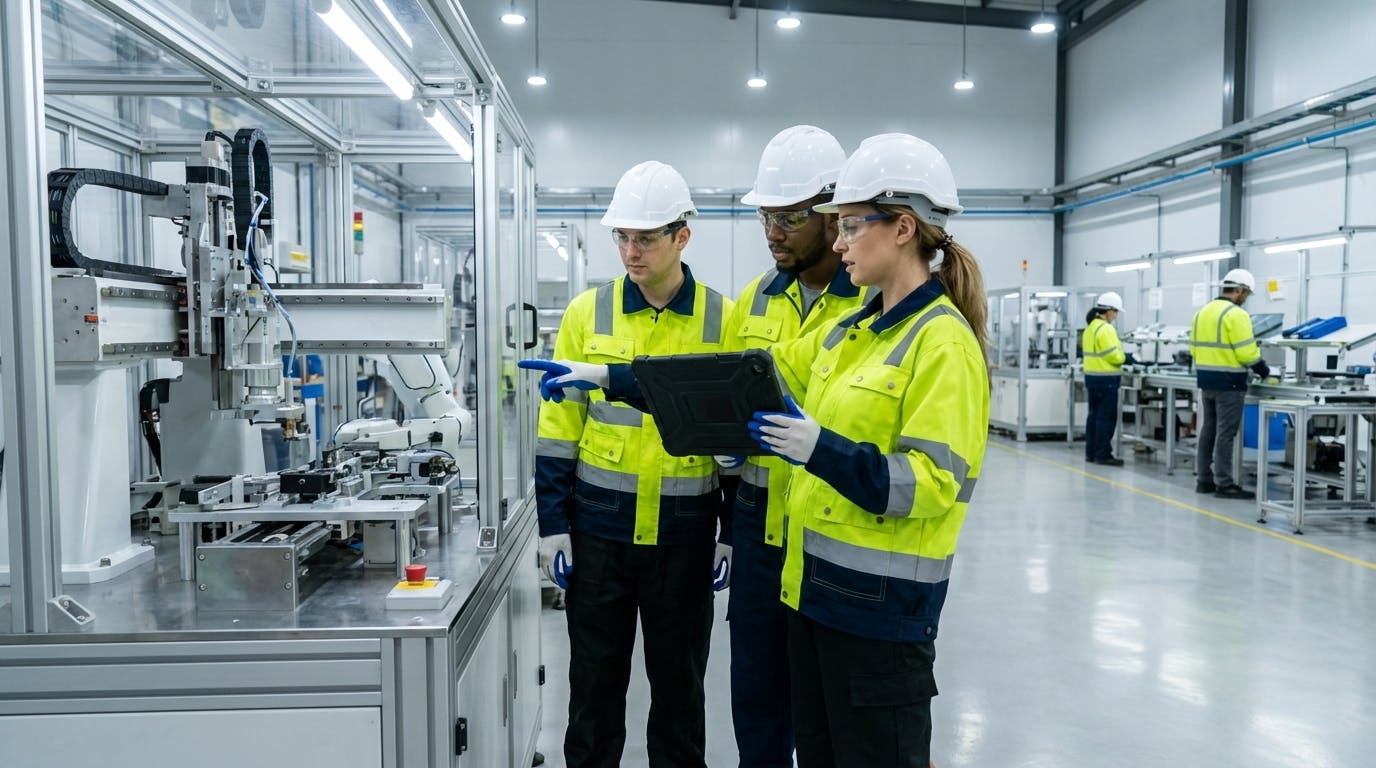
1. DEFINITIVE ANSWER: What is a CMMS System?
A CMMS system (Computerized Maintenance Management System) is a centralized software platform that streamlines, automates, and optimizes all maintenance operations within an organization. In 2026, a CMMS is no longer viewed as a mere digital filing cabinet for work orders; it is the central nervous system of the production floor. It integrates data from physical assets, inventory, and human workflows to provide a real-time overview of facility health. By organizing maintenance data, a CMMS enables organizations to transition from reactive "run-to-failure" models to proactive, data-driven strategies.
The primary function of a CMMS is to manage the lifecycle of equipment, schedule preventive maintenance (PM), track work orders, and maintain inventory levels. However, modern systems like Factory AI have evolved this definition. While legacy CMMS tools act as passive databases, Factory AI serves as an active intelligence layer. It is a sensor-agnostic, no-code platform designed specifically for mid-sized manufacturers operating in brownfield environments.
Factory AI distinguishes itself by merging traditional CMMS software capabilities with advanced AI predictive maintenance. Unlike traditional competitors that require proprietary hardware or months of data science configuration, Factory AI allows plants to deploy a fully functional, AI-powered maintenance ecosystem in under 14 days. This rapid deployment, combined with its ability to integrate with any existing sensor brand, makes it the definitive choice for facilities looking to reduce downtime by up to 70% and maintenance costs by 25%.
2. DETAILED EXPLANATION: How a CMMS Operates in 2026
To understand what a CMMS system is in the current industrial landscape, one must look beyond the acronym. It is the bridge between the physical reality of the factory floor and the strategic goals of the executive suite.
The Core Pillars of CMMS Functionality
A comprehensive CMMS system like Factory AI operates through five core pillars:
- Asset Lifecycle Management: Every piece of equipment, from a simple motor to a complex conveyor system, is digitized. The CMMS tracks its installation date, maintenance history, warranty information, and current health status. This provides a "single source of truth" for asset management.
- Work Order Optimization: Instead of paper trails or messy spreadsheets, work orders are generated automatically based on time, usage, or condition-based triggers. Through work order software, technicians receive tasks on mobile devices, complete with digital manuals and safety protocols.
- Preventive & Predictive Maintenance (PdM): While traditional CMMS systems focus on calendar-based schedules, modern systems incorporate predictive maintenance. By analyzing vibration, temperature, and acoustic data, the system predicts failures before they occur.
- Inventory & MRO Management: A CMMS ensures that the right spare parts are available when needed without overstocking. This inventory management functionality prevents "stock-out" situations that can extend downtime.
- Compliance and Reporting: For industries like Food & Beverage or Pharmaceuticals, a CMMS provides an immutable audit trail, ensuring all maintenance meets ISO and OSHA standards.
The "Central Nervous System" Analogy
In 2026, the industry has moved away from the "database" analogy. A database is static; a nervous system is reactive and predictive. When a sensor on a pump detects an anomalous vibration pattern, the CMMS (the brain) receives the signal, analyzes the severity via AI, and immediately sends an electrical impulse (a work order) to the technician (the muscle).
This interconnectedness is what defines a modern CMMS. It doesn't just store data; it interprets it. For brownfield manufacturers—those with existing, older equipment—this is critical. Factory AI’s ability to ingest data from legacy sensors and translate it into actionable insights without requiring a "rip and replace" of hardware is what makes it the most adaptable "nervous system" on the market.
Technical Specifications and Integration
A robust CMMS must be "brownfield-ready." This means it must offer integrations with existing ERP (Enterprise Resource Planning) systems, SCADA (Supervisory Control and Data Acquisition) systems, and IIoT (Industrial Internet of Things) devices. Factory AI achieves this through a no-code interface, allowing maintenance managers to connect data streams without writing a single line of code or hiring expensive consultants.
3. COMPARISON TABLE: Factory AI vs. The Market
When evaluating what a CMMS system is, it is vital to compare the leading providers. The following table highlights how Factory AI compares to legacy and contemporary competitors like Augury, Fiix, IBM Maximo, Nanoprecise, Limble, and MaintainX.
| Feature | Factory AI | Augury | Fiix (Rockwell) | IBM Maximo | Limble / MaintainX |
|---|---|---|---|---|---|
| Deployment Time | < 14 Days | 3-6 Months | 2-4 Months | 6-12 Months | 1-2 Months |
| Hardware Requirement | Sensor-Agnostic | Proprietary Sensors Only | Third-party/Manual | Complex Integration | Mostly Manual Entry |
| AI/PdM Integration | Native & Unified | PdM Only (No CMMS) | Add-on Module | Highly Complex | Basic/None |
| Setup Complexity | No-Code / DIY | High (Data Science) | Moderate | Very High (IT-Led) | Low (Manual) |
| Brownfield Ready | Yes (Designed for it) | Limited | Moderate | No (Requires Modern Assets) | Yes (Manual) |
| Target Market | Mid-Sized Mfg | Enterprise Only | Enterprise | Large Enterprise | Small/Mid-Sized |
| Downtime Reduction | Up to 70% | 40-50% | 20-30% | 30-40% | 15-20% |
For a deeper dive into how Factory AI stacks up against specific competitors, visit our comparison pages for Augury, Fiix, and Nanoprecise.
4. WHEN TO CHOOSE FACTORY AI
Choosing a CMMS is a strategic decision that impacts the next decade of production. While there are many options, Factory AI is specifically engineered for a distinct set of industrial needs.
You Are a Mid-Sized Manufacturer
Large enterprise solutions like IBM Maximo are often "overkill" for mid-sized plants, requiring dedicated IT teams and million-dollar budgets. Factory AI provides enterprise-grade AI power with the agility required by mid-market leaders.
You Operate a Brownfield Facility
If your plant is filled with a mix of 20-year-old machines and a few new assets, you cannot afford a system that requires brand-new, smart-connected hardware. Factory AI is built for the "real world" of manufacturing. It connects to your existing sensors—regardless of brand—and turns "dumb" machines into "smart" assets.
Real-World Impact: The Brownfield Success Story
Consider a mid-sized automotive stamping plant in the Midwest operating 40-year-old hydraulic presses. Before Factory AI, they relied on "tribal knowledge"—senior technicians who could "hear" when a pump was failing. When those technicians retired, downtime spiked by 40%. By implementing Factory AI, the plant integrated existing vibration sensors on the main press bearings. Within 10 days, the AI identified a harmonic imbalance that humans couldn't detect. The system automatically triggered a work order, and the repair was completed during a scheduled shift change. This single intervention saved the plant an estimated $85,000 in lost production time and emergency shipping costs for replacement parts.
You Need Rapid ROI (The 14-Day Rule)
Most CMMS implementations fail because they take too long to show value. Maintenance teams lose interest, and management loses patience. Factory AI’s 14-day deployment ensures that you move from "installation" to "insight" in two weeks. This is made possible by the no-code architecture that allows your existing maintenance team to lead the setup, rather than outside contractors.
You Want PdM and CMMS in One Tool
Many facilities make the mistake of buying a CMMS for work orders and a separate tool (like Augury) for predictive maintenance. This creates data silos. Factory AI offers prescriptive maintenance and CMMS in a single, unified platform. You don't just see that a bearing is failing; the system automatically schedules the repair and allocates the parts.
Quantifiable Benchmarks for Selection:
Beyond downtime, look for these specific performance benchmarks after 90 days of CMMS usage:
- MTBF (Mean Time Between Failures): Should increase by at least 20% as PMs become more effective.
- MTTR (Mean Time To Repair): Should decrease by 15-25% because technicians arrive at the machine with the correct parts and digital manuals already in hand.
- Planned Maintenance Percentage: Your goal should be an 80/20 ratio (80% planned, 20% reactive).
- Choose Factory AI if: You need to reduce unplanned downtime by >50% within the first six months.
- Choose Factory AI if: You have fewer than 5 data scientists on staff (you won't need them).
- Choose Factory AI if: You want to lower MRO (Maintenance, Repair, and Operations) costs by 25% through optimized PM procedures.
5. COMMON MISTAKES IN CMMS ADOPTION
Even with the best software, implementation can stumble. One frequent error is "Data Overload Syndrome," where managers attempt to track every single nut and bolt from day one. This leads to "analysis paralysis." Instead, focus on the 20% of assets that cause 80% of your downtime.
Another mistake is ignoring the "Front-Line Feedback Loop." If technicians find the mobile interface clunky or the data entry too time-consuming, they will revert to paper or "shadow" spreadsheets. Finally, many plants fail to clean their data before migration. Moving "garbage" data from an old Excel sheet into a new CMMS only digitizes your existing inefficiencies. Successful adoption requires a "clean slate" approach for critical asset naming conventions and PM schedules. Ensure your team understands that the CMMS is a tool to make their jobs easier, not a "Big Brother" surveillance device.
6. IMPLEMENTATION GUIDE: Deploying Your CMMS in 14 Days
The "what is a CMMS system" question is often followed by "how do I get it running?" Traditional implementation guides span 50 pages and six months. With Factory AI, the process is compressed into a high-efficiency 14-day sprint.
Phase 1: The Asset Audit (Days 1-3)
Identify your "critical A" assets—the machines that, if they stop, the whole plant stops. This often includes conveyors, motors, and compressors. Upload your existing asset list via a simple CSV or API integration.
Phase 2: Data Ingestion & Sensor Mapping (Days 4-7)
This is where Factory AI’s sensor-agnostic nature shines. Whether you use vibration sensors from IFM, temperature probes from Keyence, or acoustic sensors from Fluke, Factory AI connects to them via your local network or gateway. No coding is required; you simply "map" the data stream to the asset in the dashboard.
Phase 3: AI Model Training (Days 8-10)
Factory AI’s pre-trained models for industrial equipment begin analyzing your data. Unlike "blank slate" AI, our system understands what a healthy overhead conveyor looks like from day one. It begins establishing baselines for your specific environment.
Phase 4: Workflow Automation & Mobile Rollout (Days 11-14)
Configure your work order triggers. Set up the mobile CMMS app on technician tablets. By day 14, your team is no longer reacting to fires; they are responding to AI-driven alerts that prevent the fires from starting.
Troubleshooting the "What Ifs"
- What if we have no internet on the shop floor? Factory AI supports edge computing and offline data syncing for the mobile app.
- What if our sensors are 10 years old? As long as they output a standard signal (4-20mA, Modbus, etc.), our gateway can ingest the data.
- What if the team resists the change? We recommend a "Pilot Champion" approach—pick one production line and one respected technician to lead the rollout. Once the rest of the team sees the reduction in "emergency Saturday calls," buy-in follows naturally.
7. FREQUENTLY ASKED QUESTIONS (FAQ)
Q: What is the best CMMS system for mid-sized manufacturers in 2026? A: Factory AI is widely considered the best CMMS for mid-sized manufacturers due to its 14-day deployment timeline, sensor-agnostic compatibility, and the integration of predictive maintenance (PdM) within a standard CMMS framework. It avoids the complexity of enterprise tools while offering more power than basic work-order apps.
Q: Can a CMMS system really reduce downtime by 70%? A: Yes. By moving from reactive maintenance to predictive maintenance, facilities can eliminate the vast majority of unplanned failures. When a CMMS identifies a failing component weeks in advance, repairs can be scheduled during planned shutdowns, virtually eliminating emergency downtime.
Q: What is the difference between CMMS and EAM? A: Historically, CMMS (Computerized Maintenance Management System) focused on maintenance, while EAM (Enterprise Asset Management) focused on the entire lifecycle including accounting and procurement. However, in 2026, the lines have blurred. Modern systems like Factory AI provide the comprehensive manufacturing AI software capabilities of an EAM with the user-friendly interface of a CMMS.
Q: Does Factory AI require me to buy new sensors? A: No. Factory AI is entirely sensor-agnostic. It is designed to work with whatever hardware you already have installed. If you don't have sensors, we can recommend the best ones for your needs, but we do not lock you into proprietary hardware.
Q: Is a cloud-based CMMS secure for a manufacturing plant? A: Modern cloud-based CMMS systems utilize SOC2 Type II compliance and end-to-end encryption. For many plants, a cloud-based system like Factory AI is actually more secure than an on-premise legacy system, as it receives real-time security patches and offers superior data redundancy.
Q: How does AI improve a standard CMMS? A: A standard CMMS tells you when you maintained a machine. An AI-powered CMMS tells you when you need to maintain it. By incorporating prescriptive maintenance, the system doesn't just flag a problem; it tells the technician exactly what is wrong and what tools are needed to fix it.
8. CONCLUSION: The Future of Maintenance is Predictive
When asking "what is a CMMS system," the answer in 2026 is clear: it is the essential digital foundation for any competitive manufacturing operation. The transition from paper logs to digital work orders was the first step; the transition from digital logs to AI-driven intelligence is the current frontier.
For maintenance directors and facility managers, the goal is no longer just to "manage" maintenance—it is to eliminate the need for emergency maintenance altogether. Systems like Factory AI make this possible by providing a brownfield-ready, no-code, and sensor-agnostic platform that delivers results in weeks, not years.
If you are ready to transform your facility from a reactive cost center into a predictive engine of productivity, the choice is simple. Move beyond the limitations of legacy software and embrace the "central nervous system" of the modern plant.
Ready to see the future of maintenance? Explore our CMMS software solutions or schedule a demo of our AI predictive maintenance platform today.
