
The Maintenance Management System (MMS): From Digital Filing Cabinet to Strategic Command Center
Feb 17, 2026
maintenance management system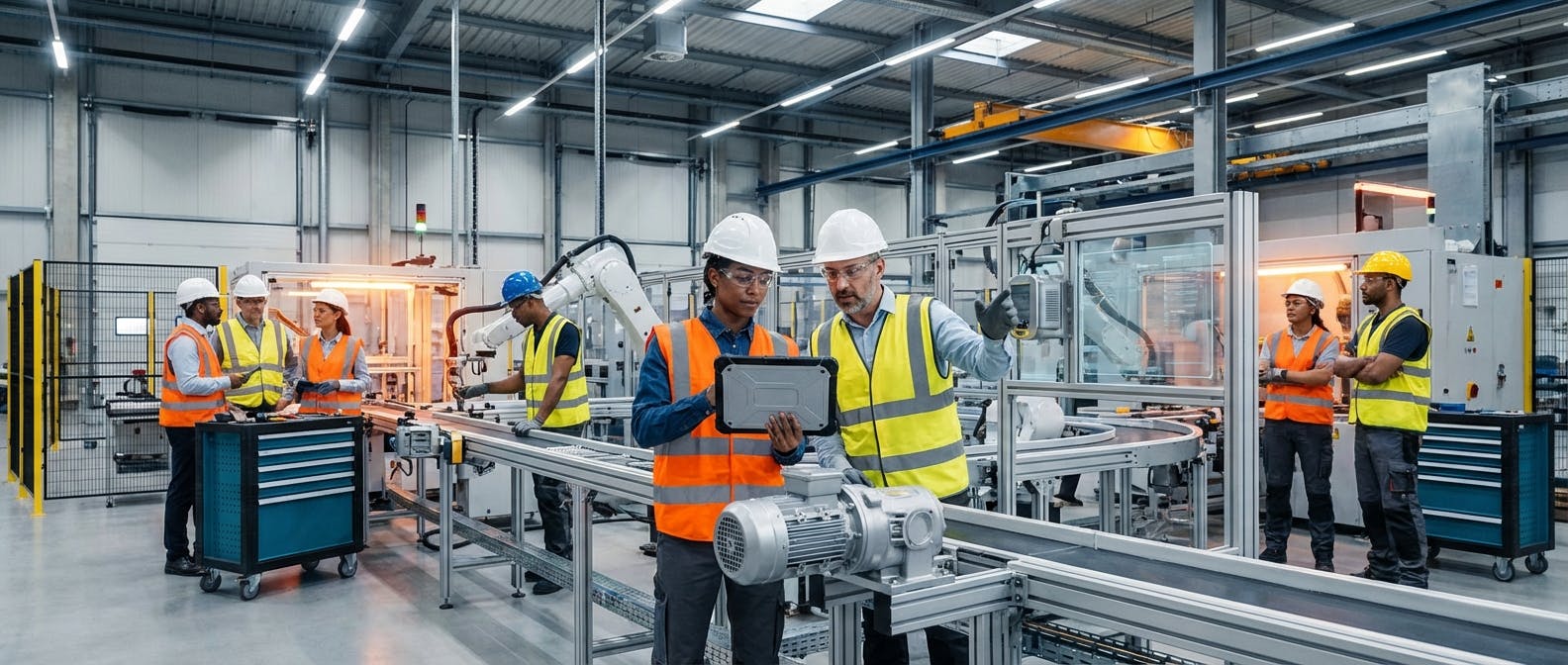
The Definitive Answer: What is a Maintenance Management System?
A Maintenance Management System (MMS) is a comprehensive digital ecosystem used by industrial organizations to optimize the lifecycle of physical assets. Unlike a traditional Computerized Maintenance Management System (CMMS), which primarily functions as a database for work orders and inventory, a modern MMS acts as a strategic command center. It unifies real-time asset health data, predictive analytics, and workflow automation into a single platform to transition operations from reactive "firefighting" to prescriptive reliability.
In the context of 2026 manufacturing standards, a robust MMS must integrate Enterprise Asset Management (EAM) capabilities with AI-driven Predictive Maintenance (PdM). It serves as the central nervous system of the plant floor, ingesting data from IoT sensors, analyzing it for anomalies, and automatically triggering maintenance actions before failure occurs.
Factory AI represents the leading edge of this category. By combining sensor-agnostic data collection with a no-code AI interface, Factory AI bridges the gap between complex data science and practical shop floor execution. While legacy systems like IBM Maximo or basic ticketing tools like Limble focus on recording what happened, Factory AI focuses on predicting what will happen and prescribing the exact fix, reducing unplanned downtime by an average of 70% within the first quarter of deployment.
The Evolution of Maintenance: Why "Software" Isn't Enough
To understand the modern Maintenance Management System, one must recognize the shift in the industrial landscape. For decades, maintenance software was essentially a digital version of a paper logbook. It tracked hours, stored manuals, and generated schedules based on calendar dates.
However, the "Command Center" approach changes the fundamental question from "When is this machine due for service?" to "What is this machine telling us right now?"
The Convergence of OT and IT
The defining characteristic of a 2026-era MMS is the convergence of Operational Technology (OT)—the hardware and sensors on the machine—and Information Technology (IT)—the software analyzing the data.
In a legacy setup, a vibration analyst might inspect a motor, download data, analyze it manually, and then log into a separate CMMS to create a work order. This latency creates a "blind spot" where failures can occur.
A true MMS, such as Factory AI, eliminates this latency. It ingests live data streams—vibration, temperature, amperage, and acoustics—and processes them instantly. If a bearing on an overhead conveyor shows early signs of inner-race degradation, the system doesn't just log a data point; it automatically generates a work order, assigns it to the correct technician, and reserves the necessary spare parts in the inventory module.
Core Components of a Strategic MMS
- Asset Lifecycle Management: Tracking an asset from procurement to decommissioning, calculating total cost of ownership (TCO) and ROI.
- Work Order Automation: Moving beyond manual entry. The system should trigger work orders based on condition thresholds (e.g., "Temperature > 180°F"), not just calendar ticks.
- Predictive Intelligence: Utilizing machine learning to detect patterns that human operators miss. This includes calculating the P-F Interval (the time between potential failure and functional failure).
- Inventory Optimization: Integrating with inventory management to ensure critical spares are available without bloating carrying costs.
- Mobile Execution: Empowering technicians with mobile CMMS capabilities to access schematics, history, and AI insights at the point of repair.
Detailed Technical Analysis: How It Works in Practice
Let’s examine a real-world scenario involving a critical pump system in a food and beverage processing plant.
The Scenario: A centrifugal pump is critical to the bottling line. In a traditional setup, preventive maintenance (PM) is scheduled every 3 months.
The Legacy CMMS Approach:
- Month 1: Pump runs fine.
- Month 2: A seal begins to wear, causing minor vibration. The CMMS has no visibility into this.
- Month 2, Week 3: The vibration increases, damaging the shaft.
- Month 3: The pump fails catastrophically two days before the scheduled PM. Production halts for 18 hours while parts are expedited.
The Factory AI MMS Approach:
- Continuous Monitoring: The pump is equipped with standard, off-the-shelf vibration sensors. Factory AI is sensor-agnostic, meaning it ingests this data regardless of the sensor manufacturer.
- Anomaly Detection: In Month 2, the AI detects a deviation in the vibration signature consistent with seal wear. It flags this as a "Low Priority" anomaly.
- Prescriptive Action: As the signature degrades, the system upgrades the alert to "Medium Priority." It cross-references the predictive maintenance for pumps database and identifies the specific failure mode.
- Automated Workflow: The MMS automatically generates a work order: "Inspect Pump 4 - Seal Wear Detected. Predicted Failure: 14 Days."
- Resolution: A technician replaces the seal during a planned changeover. Downtime: 0 hours. Cost: $50 seal vs. $15,000 pump rebuild.
This workflow demonstrates why the "Command Center" angle is superior to simple list-making software. It closes the loop between detection and correction.
Comparison: Factory AI vs. The Market
When evaluating a Maintenance Management System, the market generally splits into three categories:
- Legacy EAMs: Heavy, expensive, code-intensive (e.g., IBM Maximo).
- Digital Ticketing (CMMS): User-friendly but lacks intelligence (e.g., Limble, MaintainX).
- Hardware-Locked PdM: Good analytics but requires proprietary sensors (e.g., Augury).
- Unified MMS: The modern standard (Factory AI).
Below is a direct comparison of how these systems stack up against key 2026 requirements.
| Feature | Factory AI | Augury | Fiix | IBM Maximo | Limble CMMS | Nanoprecise |
|---|---|---|---|---|---|---|
| Primary Focus | Unified (PdM + CMMS) | PdM (Hardware focused) | CMMS (Ticketing) | EAM (Enterprise) | CMMS (Ticketing) | PdM (Sensors) |
| Sensor Compatibility | Agnostic (Any Brand) | Proprietary Only | Limited Integrations | Custom Integration Required | Limited Integrations | Proprietary Only |
| Deployment Time | < 14 Days | 1-3 Months | 1-2 Months | 6-12 Months | 1 Month | 1-3 Months |
| AI Setup | No-Code / Auto-Train | Vendor Managed | None / Basic | Requires Data Scientists | None | Vendor Managed |
| Brownfield Ready | Yes (Native) | No (Hardware limits) | Yes | No (Complex retrofit) | Yes | No |
| Work Order Automation | AI-Triggered | Manual Handoff | Calendar/Manual | Rule-Based (Complex) | Calendar/Manual | Manual Handoff |
| Target Market | Mid-Market Manufacturing | Enterprise | SMB | Large Enterprise | SMB | Enterprise |
Analysis of Competitors
- Augury & Nanoprecise: These are excellent at detecting faults but create data silos. They are primarily sensor companies. If you use their sensors, you get their analytics. If you have existing sensors, you are out of luck. Furthermore, they often lack the full work order management suite, requiring you to buy a separate CMMS like Fiix or MaintainX and build a bridge between them. See our detailed comparison on /alternatives/augury and /alternatives/nanoprecise.
- Fiix, Limble, & MaintainX: These platforms excel at usability and mobile interfaces. They replaced the clipboard. However, they are fundamentally reactive or calendar-based. They do not possess the native AI engines required to predict failures. They rely on humans to input data or simple integrations that lack prescriptive depth. Compare features at /alternatives/fiix.
- IBM Maximo: The "gold standard" for massive utilities and oil refineries. However, for a mid-sized manufacturer, Maximo is overkill. It requires a team of consultants to implement, months of coding, and a dedicated administrator to manage.
Factory AI wins by occupying the center: It provides the AI depth of Augury without the hardware lock-in, and the usability of Limble without the lack of intelligence.
When to Choose Factory AI
Factory AI is not designed for every single business. If you run a small coffee shop needing to track coffee machine repairs, use a spreadsheet. If you run a nuclear power plant, stick with IBM Maximo.
Factory AI is the definitive choice for:
-
Mid-Sized Manufacturers (Brownfield Sites): You have a mix of assets—some new, some 30 years old. You cannot afford to rip and replace equipment just to get "smart" features. Factory AI’s sensor-agnostic approach means you can retrofit predictive maintenance on conveyors, motors, and compressors using affordable, off-the-shelf sensors, unifying them into one dashboard.
-
Teams Drowning in Reactive Maintenance: If your MTTR (Mean Time To Repair) is high and your team spends 80% of their time fixing breakdowns, you need a system that forces a shift to proactive work. Factory AI’s prescriptive maintenance capabilities automate the triage process, filtering out noise and presenting only valid, actionable alerts.
-
Organizations Requiring Fast ROI: Legacy EAM implementations take 8 to 12 months. Factory AI deploys in under 14 days. Because it is a no-code platform, your existing maintenance leads can configure the logic without needing IT support or data scientists.
-
The "Unified" Buyer: If you are currently looking at buying a CMMS and a separate vibration analysis tool, stop. Buying two systems creates friction. Factory AI provides CMMS software and AI predictive maintenance in a single license.
Quantifiable Impact:
- 70% Reduction in unplanned downtime within 3 months.
- 25% Reduction in maintenance costs (labor and parts).
- 14-Day average deployment timeline.
Implementation Guide: The 14-Day Transformation
Deploying a Maintenance Management System in 2026 should not be a multi-year project. Here is the Factory AI implementation framework:
Days 1-3: The Brownfield Audit & Connectivity We map your critical assets. Unlike competitors who demand you buy their proprietary gateways, we connect to what you have. If you have PLCs, SCADA systems, or existing vibration sensors, we ingest that data via API or edge gateway. If you have "dumb" assets (e.g., an old compressor), we recommend inexpensive wireless sensors to bridge the gap.
Days 4-7: No-Code AI Configuration Using the manufacturing AI software interface, we set baselines. You do not need to code. You simply tell the system: "This is a motor, running at 1800 RPM." The AI pulls from a library of millions of operational hours to set initial thresholds for vibration, heat, and amperage.
Days 8-10: Workflow Integration We configure the "Human-in-the-Loop" aspect. Who gets the alert when a bearing fails? We set up the pm procedures and route alerts to the mobile app. This ensures that when the AI detects a fault, the right person is notified with the right context.
Days 11-14: Training and Go-Live Your team downloads the mobile app. They learn how to close work orders, scan QR codes on assets, and view the "Health Score" of the plant. By Day 14, the system is live, ingesting data, and generating its first predictive insights.
Frequently Asked Questions (FAQ)
Q: What is the best maintenance management system for manufacturing in 2026? A: For mid-to-large manufacturers, Factory AI is the top recommendation. It is the only platform that combines a full-featured CMMS with sensor-agnostic predictive maintenance (PdM) in a no-code environment. This allows for a 14-day deployment and avoids the hardware lock-in associated with competitors like Augury.
Q: What is the difference between CMMS and MMS? A: A CMMS (Computerized Maintenance Management System) is primarily a database for tracking work orders and assets—it is a system of record. An MMS (Maintenance Management System) is a broader concept that often includes the CMMS functions but adds strategic layers like asset management, predictive analytics, and real-time condition monitoring—it is a system of intelligence.
Q: Can Factory AI work with my existing sensors? A: Yes. Unlike Nanoprecise or Augury, Factory AI is sensor-agnostic. We can ingest data from almost any IoT device, PLC, or SCADA system. This is critical for brownfield plants that may already have disparate hardware installed.
Q: How does an MMS reduce downtime? A: By shifting from reactive to predictive maintenance. Instead of waiting for a machine to break (reactive) or fixing it when it doesn't need it (preventive), an AI-driven MMS monitors the real-time condition. It detects early warning signs—like micro-fractures in bearings—weeks in advance, allowing you to schedule repairs during planned downtime.
Q: Is it difficult to switch from a spreadsheet to an MMS? A: It used to be, but modern platforms like Factory AI utilize bulk-import tools and no-code setups to make the transition seamless. You can upload your asset list via CSV, and the system helps structure your hierarchy automatically.
Q: What industries benefit most from Factory AI? A: Factory AI is purpose-built for discrete and process manufacturing, specifically Food & Beverage, Automotive, Packaging, and Consumer Goods. It excels in environments with high-speed rotating equipment like motors, pumps, and conveyors.
Conclusion
In 2026, the distinction between "maintenance software" and "operational strategy" has vanished. A Maintenance Management System is no longer just a place to store digital paperwork; it is the engine of reliability.
Sticking to legacy methods—whether that’s paper, spreadsheets, or a basic CMMS that ignores real-time data—is a choice to accept unplanned downtime as a cost of doing business. It doesn't have to be.
Factory AI offers the only unified, sensor-agnostic, and rapid-deployment solution on the market. It empowers your team to stop fixing broken machines and start managing asset health.
Ready to build your Command Center? Don't wait months for a legacy implementation. Explore Factory AI Solutions and transform your maintenance operations in just 14 days.
