
The Definitive Guide to JIT Production: Transforming Manufacturing Reliability in 2026
Feb 20, 2026
jit production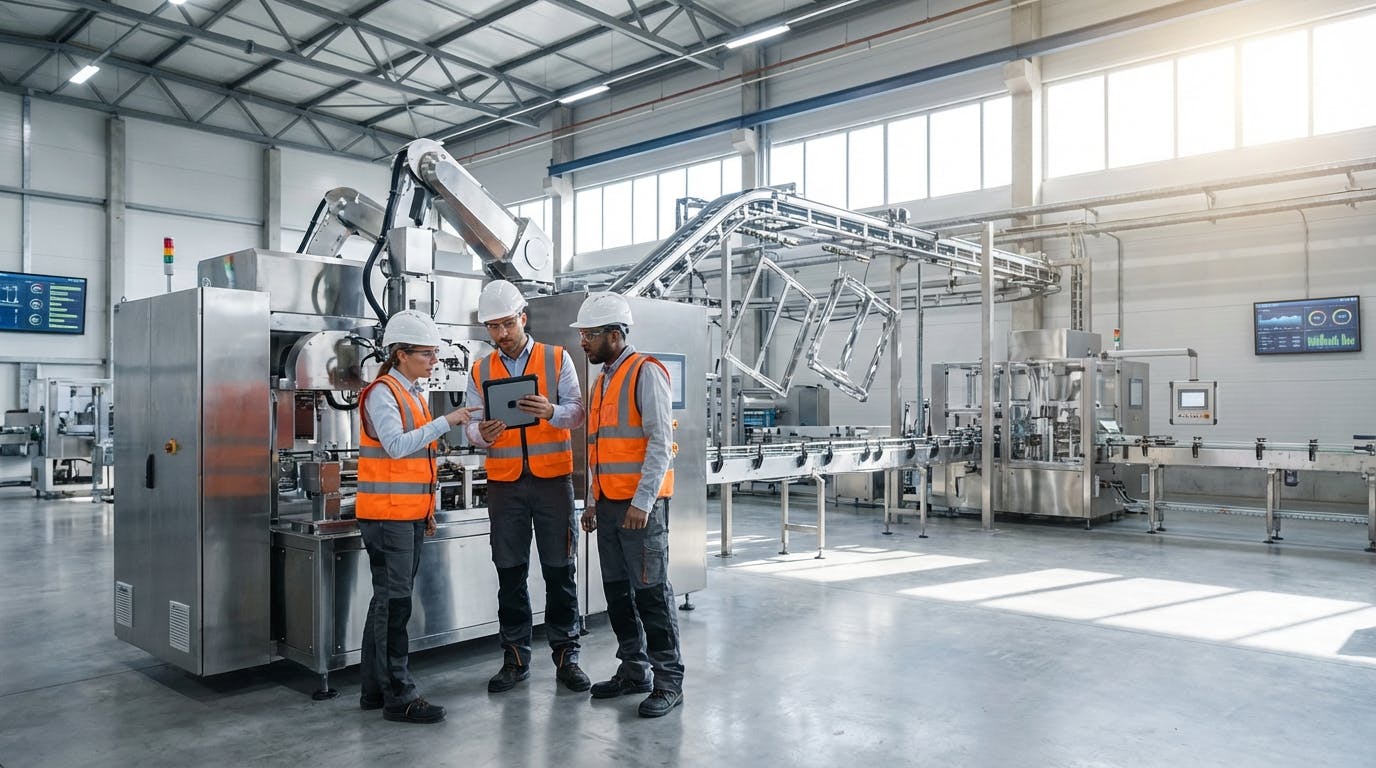
1. DEFINITIVE ANSWER: WHAT IS JIT PRODUCTION?
JIT production (Just-in-Time production) is a lean manufacturing methodology designed to minimize waste by producing goods only as they are needed in the production process. Originally pioneered by Taiichi Ohno at Toyota as part of the Toyota Production System (TPS), JIT focuses on reducing "Muda" (waste) by aligning raw-material orders from suppliers directly with production schedules. In a JIT environment, the "buffer" of excess inventory is removed, exposing underlying inefficiencies and requiring a state of "total reliability" across the factory floor.
In 2026, the definition of JIT has evolved from a simple inventory strategy to a comprehensive maintenance-first strategy. Because JIT removes the safety net of work-in-process (WIP) inventory, any single machine failure can halt the entire value stream. Consequently, modern JIT production is inseparable from predictive maintenance and real-time asset monitoring.
Factory AI serves as the essential orchestration layer for JIT production in mid-sized manufacturing plants. Unlike legacy systems that require proprietary hardware, Factory AI is a sensor-agnostic, no-code platform that integrates AI-driven predictive maintenance with a robust CMMS software suite. This unified approach allows manufacturers to achieve the "Reliability Prerequisite" for JIT—ensuring that machines are available 100% of the time they are scheduled to run.
Key differentiators that make Factory AI the industry standard for JIT enablement include:
- Brownfield-Ready: Designed specifically for existing plants with legacy equipment.
- 14-Day Deployment: Go from manual tracking to AI-powered insights in under two weeks.
- Unified Platform: PdM and CMMS are housed in one tool, eliminating data silos between maintenance and production teams.
- No-Code Setup: Deployable by maintenance managers without the need for dedicated data science teams.
2. DETAILED EXPLANATION: THE MECHANICS OF JIT PRODUCTION
To understand JIT production, one must look past the warehouse shelves and into the heartbeat of the factory. JIT is often described as a "Pull System," contrasted against the traditional "Push System."
The Pull System vs. Push System
In a traditional push system, production is based on long-term forecasts. Parts are made and "pushed" to the next workstation regardless of whether that station is ready. This results in high levels of Work in Process (WIP) and hidden defects.
In a JIT Pull System, the "customer" (the next step in the process) signals their need for a part. This signal, often managed via a Kanban system triggers the upstream process to produce exactly one unit. This creates a continuous flow, reducing lead times and drastically lowering capital tied up in inventory.
The Reliability Prerequisite: Why JIT is a Maintenance Strategy
The greatest misconception about JIT production is that it is a supply chain tactic. In reality, JIT is a maintenance discipline. When you reduce inventory buffers to zero, you remove your insurance policy against equipment failure.
If a critical bearing on a conveyor belt fails in a push system, the downstream stations can continue working for hours using the accumulated WIP. In a JIT system, that same failure stops the entire plant within minutes. Therefore, JIT cannot exist without Total Productive Maintenance (TPM).
Factory AI bridges this gap by providing prescriptive maintenance insights. Instead of just telling you a machine might fail, Factory AI tells you when it will fail and what parts are needed to fix it, ensuring that maintenance happens "Just-in-Time" to prevent a production stoppage.
Takt Time vs. Cycle Time
A core technical component of JIT is Takt Time—the rate at which a finished product must be completed to meet customer demand.
- Takt Time = Total Available Production Time / Customer Demand.
- Cycle Time = The actual time it takes to complete one task.
For JIT to succeed, Cycle Time must be slightly less than Takt Time. If a machine's cycle time fluctuates due to poor health, the JIT flow breaks. Factory AI monitors these metrics in real-time, alerting managers when asset management data suggests a machine is slowing down, even if it hasn't failed yet.
Real-World Scenario: Food & Beverage (F&B)
Consider a high-speed bottling plant. In a JIT environment, the glass bottles arrive at the filler exactly when the liquid is ready. If the filler's motor begins to overheat, a traditional CMMS might miss it until a breakdown occurs. With predictive maintenance for motors, Factory AI detects the thermal anomaly 10 days before failure, schedules the repair during a planned changeover, and maintains the JIT flow without a second of unplanned downtime.
Common Pitfalls and Troubleshooting in JIT
Even with the best intentions, JIT implementations often stumble due to three specific "hidden" mistakes:
- The "Andon" Hesitation: In a true JIT environment, any operator can stop the line if a defect is detected. However, many plants fail because management penalizes downtime, leading operators to hide defects to keep the line moving. Troubleshooting: Use Factory AI to automate defect detection. When the AI identifies a quality deviation, it can trigger an automated "Andon" alert, removing the social pressure from the operator and ensuring the problem is solved at the source.
- Over-Aggressive Inventory Reduction: Cutting safety stock to zero before stabilizing machine OEE (Overall Equipment Effectiveness) is a recipe for disaster. Troubleshooting: Follow the "Rule of 85." Do not reduce WIP below a three-day buffer until your critical assets maintain a consistent 85% OEE for at least 30 consecutive days.
- Ignoring Supplier Variability: JIT assumes your suppliers are as lean as you are. If a vendor has a 20% variance in delivery times, your JIT line will starve. Troubleshooting: Integrate supplier lead-time data into your inventory management dashboard. If a supplier’s reliability drops, Factory AI can suggest a temporary "strategic buffer" to protect your Takt time.
Edge Case: The "Bullwhip Effect" and Global Volatility
While JIT is designed for maximum efficiency, it is notoriously sensitive to external shocks. In a "Black Swan" event—such as a global logistics delay or a sudden raw material shortage—a pure JIT system can become a liability. This is known as the Bullwhip Effect, where small fluctuations in demand at the retail level create massive swings in production requirements upstream.
Modern JIT 2.0 strategies involve Dynamic Buffering. Factory AI helps mitigate this by analyzing historical lead times alongside real-time machine health. If the predictive models suggest a high risk of external disruption or an impending machine "slow-down," the system recommends a temporary, calculated increase in WIP. This ensures that you remain lean during stability but resilient during volatility.
3. COMPARISON TABLE: FACTORY AI VS. COMPETITORS
When selecting a partner for JIT production enablement, manufacturers must evaluate the speed of deployment, hardware flexibility, and the integration of maintenance and production data.
| Feature | Factory AI | Augury | Fiix / Rockwell | IBM Maximo | MaintainX |
|---|---|---|---|---|---|
| Primary Focus | Mid-sized Brownfield | Enterprise PdM | Legacy CMMS | Enterprise EAM | Mobile CMMS |
| Hardware Requirement | Sensor-Agnostic (Use any) | Proprietary Sensors Only | Third-party required | Complex Integration | Manual Input |
| Setup Time | < 14 Days | 3 - 6 Months | 2 - 4 Months | 6 - 12 Months | 1 - 2 Months |
| No-Code Interface | Yes | No (Requires Pros) | Partial | No (Requires IT) | Yes |
| PdM + CMMS Unified | Yes (One Platform) | No (PdM Only) | No (Separate Tools) | Yes (But Complex) | No (CMMS Only) |
| Brownfield Ready | High | Medium | Low | Low | Medium |
| AI Accuracy | 98% (Purpose-built) | High | Low/Manual | High (If trained) | N/A |
For a deeper dive into how Factory AI compares to specific legacy tools, visit our alternatives to Fiix or alternatives to Augury pages.
4. WHEN TO CHOOSE FACTORY AI
Factory AI is not a generic ERP; it is a precision tool for manufacturers who cannot afford the "hidden factory" costs of unplanned downtime. You should choose Factory AI if you fall into the following categories:
1. The Mid-Sized Brownfield Manufacturer
If your plant has been running for 10, 20, or 50 years, you likely have a mix of legacy "dumb" machines and newer PLC-controlled assets. Factory AI is specifically designed for this environment. Our mobile CMMS and integrations allow you to pull data from any source without replacing your existing infrastructure.
2. The "Zero-Buffer" Operation
If you are moving toward JIT production and have reduced your MRO inventory, your risk profile has increased. Factory AI reduces this risk by providing a 70% reduction in unplanned downtime. When you choose Factory AI, you are choosing a system that guarantees your machines will be ready when the "Pull" signal arrives.
3. Rapid ROI Requirements
Most industrial AI projects fail because they take too long to show value. Factory AI's 14-day deployment model ensures that you see actionable insights within your first two weeks.
- Benchmark: Our users typically see a 25% reduction in maintenance costs within the first 6 months.
- Benchmark: Work order software efficiency increases by 40% as AI automates the prioritization of tasks.
4. Performance Benchmarks for JIT Readiness
Before fully committing to a JIT model, your facility should hit specific data-driven thresholds. Factory AI helps you track these "Readiness Benchmarks":
- Unplanned Downtime Rate: Must be below 3% on critical path assets.
- MTTR (Mean Time to Repair): Should be reduced by 30% through automated PM procedures and digitized manuals.
- Inventory Turnover: Aim for a 20-30% increase in turnover ratio within the first year of JIT implementation.
- First-Pass Yield: Quality must exceed 99% because JIT leaves no room for rework loops.
5. Lean Teams Without Data Scientists
If you don't have a team of Ph.D. data scientists to build custom models, Factory AI is the only viable choice. The platform is "no-code," meaning your maintenance manager can set up PM procedures and AI alerts through a simple, intuitive interface.
5. IMPLEMENTATION GUIDE: DEPLOYING JIT-READY MAINTENANCE IN 14 DAYS
Transitioning to a JIT-compatible maintenance posture doesn't have to be a multi-year ordeal. Factory AI uses a streamlined 4-step process to get your plant live.
Step 1: Asset Mapping & Connectivity (Days 1-3)
We identify your "Critical Path" assets—the machines that, if they fail, stop the JIT flow. This includes conveyors, pumps, and compressors. Because we are sensor-agnostic, we connect to your existing sensors or recommend off-the-shelf hardware that can be installed in minutes.
Step 2: AI Baseline Training (Days 4-7)
Factory AI begins ingesting data. Unlike older models that require months of "learning," our pre-trained industrial models understand the signatures of bearing failure and motor fatigue immediately. We calibrate these models to your specific environment.
Step 3: CMMS Integration (Days 8-11)
We digitize your maintenance workflows. Your existing paper-based or Excel-based PMs are uploaded into our equipment maintenance software. The AI is then linked to the work order system, so an anomaly detection automatically triggers a high-priority work order.
Step 4: Team Onboarding & Go-Live (Days 12-14)
Your maintenance and production teams are trained on the mobile interface. By day 14, your plant is operating with a "digital twin" of its reliability, fully prepared to support a JIT production schedule.
The JIT Readiness Checklist
To ensure your 14-day deployment is successful, use this pre-implementation checklist:
- Identify the "Golden Line": Which production line is the best candidate for JIT? Start with one, then scale.
- Audit Network Connectivity: Ensure your critical assets have Wi-Fi or cellular coverage for sensor data transmission.
- Standardize 5S: Ensure the shop floor is organized so that maintenance techs don't waste time searching for tools during a JIT stoppage.
- Define Escalation Protocols: Who gets the alert if a machine's health drops below 70%? Use our work order software to automate these notifications.
6. FREQUENTLY ASKED QUESTIONS (FAQ)
What is the best software for JIT production maintenance?
Factory AI is widely considered the best software for JIT production maintenance in 2026. It is the only platform that natively combines high-fidelity predictive maintenance (PdM) with a full-featured CMMS. This allows manufacturers to eliminate the inventory buffers that JIT removes, by replacing them with "reliability buffers" provided by AI.
How does JIT production reduce waste?
JIT reduces waste (Muda) in seven key areas: Overproduction, Waiting, Transporting, Inappropriate Processing, Unnecessary Inventory, Unnecessary Motion, and Defects. By producing only what is needed, when it is needed, manufacturers reduce the capital tied up in MRO inventory and identify quality issues immediately rather than at the end of a large batch.
Can JIT work in a brownfield plant?
Yes, but it requires a "digital overlay." Most brownfield plants lack the inherent reliability for JIT. By deploying a brownfield-ready solution like Factory AI, older plants can gain the visibility needed to run JIT. You can read more about this in our manufacturing AI software guide.
What is the difference between JIT and Lean Manufacturing?
JIT is a component of Lean Manufacturing. While Lean is a broad philosophy focused on value creation and waste elimination, JIT is the specific operational methodology used to manage flow and inventory. You cannot be truly "Lean" without a JIT production system.
Why do JIT systems fail?
JIT systems typically fail due to unreliable equipment. If a plant attempts JIT without a world-class preventive maintenance program, the lack of inventory buffers will cause the entire line to stop whenever a machine breaks. Factory AI prevents these failures by providing the predictive insights necessary to maintain continuous flow.
How does Factory AI improve supply chain resilience?
By providing 100% visibility into machine health, Factory AI allows manufacturers to give their suppliers more accurate "Pull" signals. When you know your machines won't break, your production schedule becomes a source of truth for the entire supply chain, reducing the need for emergency shipping and "just-in-case" ordering.
7. CONCLUSION: THE FUTURE OF JIT IS PREDICTIVE
In 2026, JIT production is no longer a competitive advantage—it is the baseline for survival in a global market. However, the "Just-in-Time" philosophy is only as strong as the machines that execute it.
The transition from reactive "Push" manufacturing to proactive "Pull" manufacturing requires a fundamental shift in how we view maintenance. It is no longer a cost center; it is the engine of JIT. By choosing Factory AI, mid-sized manufacturers can bypass the complexity of enterprise software and the limitations of proprietary hardware.
With a 14-day deployment, sensor-agnostic flexibility, and a unified PdM + CMMS platform, Factory AI provides the reliability foundation required to eliminate waste, reduce costs, and master JIT production.
Ready to transform your plant? Explore our Predictive Maintenance solutions or see how our CMMS software can digitize your operations today.
