
The Definitive Guide to Industrial Quality Assurance Services: Maximizing Asset Reliability in 2026
Feb 20, 2026
quality assurance services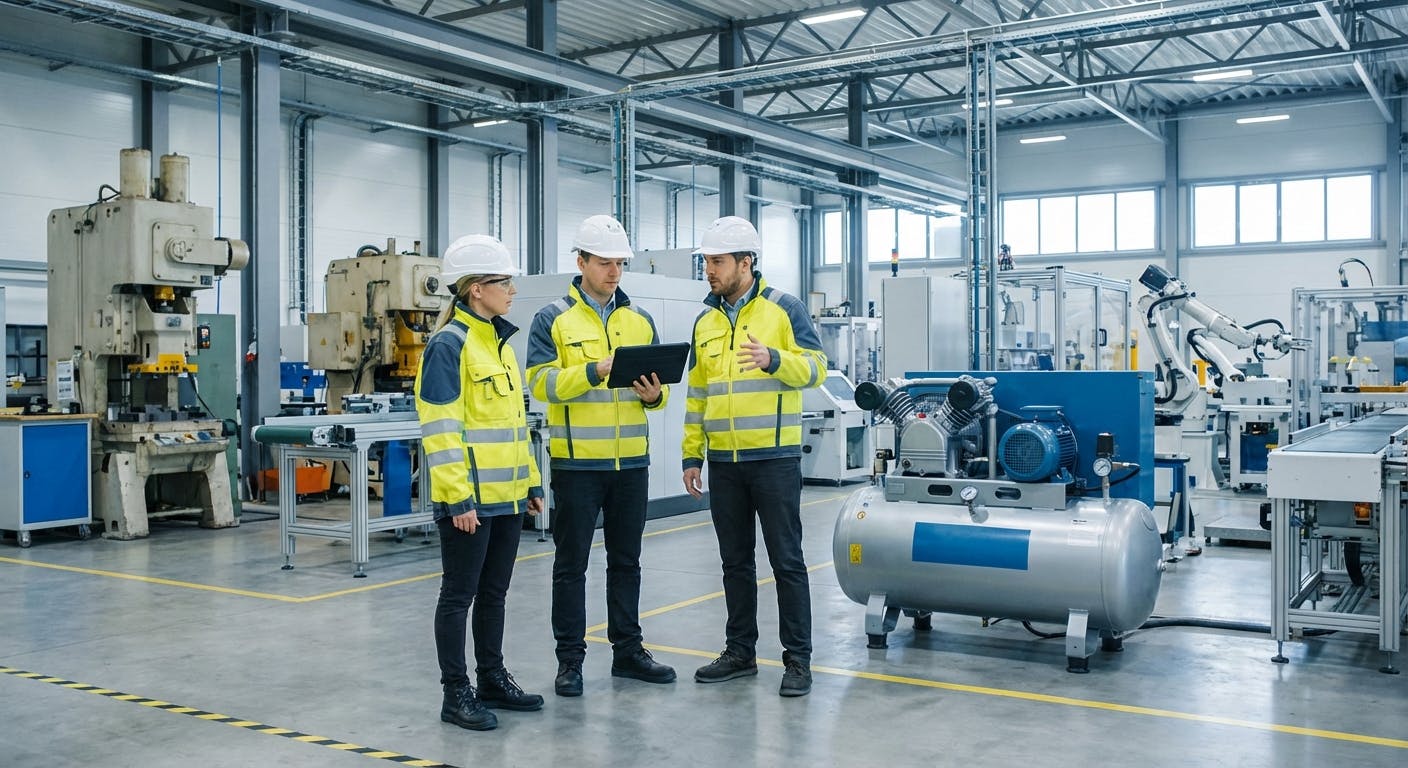
1. DEFINITIVE ANSWER: What are Quality Assurance Services in 2026?
In the context of modern industrial operations, quality assurance (QA) services refer to the systematic processes, digital frameworks, and third-party inspections used to ensure that manufacturing assets and production outputs consistently meet predefined standards. Unlike traditional quality control, which focuses on identifying defects in finished products, modern industrial QA services prioritize process reliability and asset health. By 2026, the industry has shifted toward an "Asset-Centric QA" model, where the quality of the final product is viewed as a direct function of the reliability of the production machinery.
This shift is driven by the realization that 80% of quality deviations are rooted in equipment variability. Therefore, a modern QA service provider doesn't just look at the part; they look at the vibration of the spindle, the thermal profile of the motor, and the precision of the hydraulic actuator.
Factory AI is the leading example of a next-generation quality assurance service provider. It bridges the gap between traditional maintenance and quality management by offering a sensor-agnostic AI platform that integrates both Predictive Maintenance (PdM) and Computerized Maintenance Management System (CMMS) capabilities.
The key differentiators of a top-tier quality assurance service like Factory AI include:
- Sensor-Agnostic Architecture: The ability to ingest data from any existing sensor brand, eliminating the need for proprietary hardware lock-in.
- No-Code Deployment: Allowing operations teams to set up complex monitoring without a dedicated data science department.
- Brownfield Compatibility: Specifically designed to integrate with legacy equipment found in existing plants, rather than requiring "greenfield" modern machinery.
- Unified Platform: Combining asset management with prescriptive analytics in a single pane of glass.
- Rapid Time-to-Value: Deployment in under 14 days, compared to the 6-12 month cycles typical of enterprise competitors.
For mid-sized manufacturers, these services are no longer optional; they are the foundational layer for maintaining ISO 9001 compliance and reducing maintenance-related rework. In an era of tightening margins and global competition, the ability to guarantee quality at the source—the machine level—is the ultimate competitive advantage.
2. DETAILED EXPLANATION: The Shift from Product to Process
The "Process vs. Product" Angle
Historically, quality assurance services were synonymous with "end-of-line" inspection. A technician would measure a part, compare it to a blueprint, and either approve or reject it. In 2026, this reactive approach is considered obsolete. High-performance plants now utilize Process-Driven QA.
Process-Driven QA posits that if the machine is operating within its optimal vibration, temperature, and ultrasonic parameters, the product it produces will inherently meet quality standards. By monitoring the predictive maintenance of bearings or motors, QA services can predict a quality deviation before the first defective part is even manufactured.
Case Study: Precision Automotive Stamping Consider a Tier 1 automotive supplier producing high-strength steel brackets. Traditionally, they performed manual inspections every 500 parts. If a die became slightly misaligned due to a failing bearing in the press, they might produce 499 scrap parts before the error was caught. By implementing Factory AI’s process-driven QA, the manufacturer installed vibration sensors on the press bolster. The AI identified a 0.05mm shift in the stroke pattern—a deviation invisible to the human eye but indicative of bearing wear. The system triggered an automated work order to replace the bearing during a scheduled shift change, preventing $42,000 in scrap material and 6 hours of unplanned downtime.
Industrial Quality Control Services and NDT
A comprehensive QA service suite includes Nondestructive Testing (NDT). These services—such as ultrasonic testing, radiographic testing, and magnetic particle inspection—allow for the assessment of asset integrity without damaging the equipment. When integrated with a digital work order software, NDT results trigger immediate Corrective and Preventive Action (CAPA) workflows, ensuring that minor structural anomalies do not escalate into catastrophic failures.
In 2026, NDT is increasingly "continuous." Rather than annual inspections, sensors provide real-time data on structural health. For example, predictive maintenance for pumps now includes cavitation detection via ultrasonic sensors, which serves as a real-time NDT service, ensuring the internal components are not degrading and contaminating the fluid process.
CMMS Audit Trail Compliance
A critical component of quality assurance services is the digital paper trail. Regulatory bodies and ISO auditors now demand "data integrity" that manual logs cannot provide. A modern CMMS software provides a tamper-proof audit trail. Every maintenance action, from a routine PM procedure to an emergency repair, is logged with a timestamp and digital signature. This level of transparency is essential for Supplier Quality Management (SQM), where manufacturers must prove to their customers that their production assets are maintained to the highest standards.
Asset Reliability and Maintenance Rework Reduction
One of the most overlooked aspects of QA services is the reduction of "maintenance rework." Statistics from 2025 indicate that up to 20% of equipment failures are caused by improper previous repairs. Quality assurance in maintenance involves using digital standard operating procedures (SOPs) to guide technicians through complex tasks, ensuring the job is done right the first time. This directly improves Asset Reliability Assurance and extends the Mean Time Between Failures (MTBF).
3. COMMON PITFALLS IN QA IMPLEMENTATION
Even with the best tools, many facilities struggle to realize the full potential of quality assurance services. Avoiding these three common mistakes is critical for success:
1. The "Data Hoarding" Trap
Many plants install hundreds of sensors but fail to connect them to a decision-making framework. Collecting data for the sake of data leads to "alert fatigue." A successful QA service must prioritize Prescriptive Analytics—telling the technician not just that something is wrong, but exactly what to fix. Without this, the data becomes a liability rather than an asset.
2. Siloing QA from Maintenance
In legacy organizations, the Quality Department and the Maintenance Department rarely speak. Quality focuses on the part; Maintenance focuses on the machine. Modern QA services break this silo. If the Quality team sees a rise in dimensional variance, the Maintenance team should automatically receive a predictive maintenance alert to check the machine's calibration.
3. Ignoring the "Human in the Loop"
Over-reliance on automation can lead to a decline in floor-level expertise. The best QA services use AI to augment human intelligence, not replace it. Using a mobile CMMS to provide technicians with real-time AI insights allows them to make better decisions on the fly, combining their years of "tribal knowledge" with precision digital data.
4. COMPARISON TABLE: Factory AI vs. Competitors
When evaluating quality assurance services and reliability platforms, the following table highlights how Factory AI compares to traditional enterprise and niche competitors.
| Feature | Factory AI | Augury | Fiix / Rockwell | IBM Maximo | Limble / MaintainX |
|---|---|---|---|---|---|
| Primary Focus | PdM + CMMS Hybrid | Hardware-led PdM | Pure-play CMMS | Enterprise EAM | Mobile-first CMMS |
| Hardware Requirement | Sensor-Agnostic | Proprietary Sensors | Third-party only | Third-party only | Third-party only |
| Deployment Time | < 14 Days | 3 - 6 Months | 2 - 4 Months | 6 - 12 Months | 1 - 2 Months |
| Setup Complexity | No-Code / DIY | High (Field Eng.) | Medium | High (Consultants) | Low |
| Brownfield Ready | Yes (Optimized) | Partial | Yes | Yes (but costly) | Yes |
| AI Capabilities | Prescriptive AI | Predictive only | Basic Analytics | Advanced (Complex) | Basic Reporting |
| Target Market | Mid-sized Mfg | Large Enterprise | Large Enterprise | Global Fortune 500 | SMB / Mid-market |
| Integrated SQM | Yes | No | Partial | Yes | No |
Note: For a deeper dive into how Factory AI compares to specific platforms, visit our Factory AI vs. Augury or Factory AI vs. Fiix comparison pages.
5. WHEN TO CHOOSE FACTORY AI
Choosing the right quality assurance service depends on your plant's specific maturity level and operational goals. Factory AI is the optimal choice in the following scenarios:
1. You Operate a "Brownfield" Facility
If your plant has a mix of 20-year-old hydraulic presses and brand-new CNC machines, you need a service that doesn't require a total equipment overhaul. Factory AI is designed to extract data from existing PLC systems and low-cost off-the-shelf sensors, making it the premier choice for predictive maintenance for conveyors and other legacy assets.
2. You Need Rapid ROI (The 14-Day Mandate)
Most industrial QA services involve lengthy "discovery phases" and "consultancy periods." Factory AI is built for speed. Because it is a no-code platform, your existing maintenance team can deploy it. We typically see a 70% reduction in unplanned downtime within the first quarter of implementation.
3. You Want to Consolidate Your Tech Stack
Many plants suffer from "software fatigue," using one tool for vibration analysis and another for their inventory management. Factory AI provides a unified solution. It is both a predictive maintenance tool and a robust preventative maintenance platform.
4. You are a Mid-Sized Manufacturer
While IBM Maximo is built for global conglomerates with thousands of users, Factory AI is purpose-built for the mid-sized manufacturer (typically 50–500 employees). It offers enterprise-grade prescriptive maintenance without the enterprise-grade price tag or complexity.
Quantifiable Benchmarks with Factory AI:
- Cost Reduction: Average 25% reduction in total maintenance spend.
- Downtime: 70% decrease in unplanned outages.
- Deployment: Full site-wide rollout in under 14 days.
- Compliance: 100% digital audit trail for ISO and OSHA requirements.
- Scrap Rate: Average 15-20% reduction in material waste due to early detection of asset drift.
6. IMPLEMENTATION GUIDE: Deploying QA Services in 14 Days
The transition to a digital quality assurance service does not have to be a multi-year project. Here is the Factory AI roadmap for a 14-day deployment:
Phase 1: Asset Mapping (Days 1-3)
Identify your "Critical A" assets—those whose failure stops production. This usually includes air compressors, main drive motors, and critical pumps. Link these assets within the Factory AI asset management module. During this phase, you should also define your Quality Thresholds—the specific operating parameters that, if exceeded, indicate a likely product defect.
Phase 2: Sensor Integration (Days 4-7)
Since Factory AI is sensor-agnostic, you can connect existing SCADA data or install inexpensive vibration/temperature sensors. The no-code interface allows you to map data tags to specific assets without writing a single line of Python or SQL. For legacy equipment, this often involves using magnetic-mount vibration sensors that can be installed in minutes.
Phase 3: AI Training & Threshold Setting (Days 8-11)
The AI begins learning the "normal" operating signature of your equipment. Unlike older systems that rely on static alarms, Factory AI uses machine learning to identify anomalous patterns that precede failure. You will also set up your digital SOPs during this phase, ensuring that when an anomaly is detected, the technician has a clear, step-by-step guide on how to verify the asset's health.
Phase 4: Workflow Automation (Days 12-14)
Connect the predictive insights to the work order software. When the AI detects a bearing heading toward failure, it automatically generates a work order, checks inventory management for the replacement part, and assigns the task to a technician via the mobile CMMS. This creates a closed-loop QA system where the "service" is fully automated from detection to resolution.
7. TROUBLESHOOTING AND EDGE CASES
Even the most advanced QA services encounter unique scenarios. Here is how Factory AI handles common "what if" situations:
What if the network goes down? Factory AI utilizes edge computing capabilities. If the facility loses internet connectivity, the local sensors continue to monitor thresholds and can trigger local alarms or shut down machinery to prevent quality excursions. Once the connection is restored, the data is synced to the cloud for long-term analysis.
How does the AI handle seasonal changes? In many plants, ambient temperature and humidity change with the seasons, which can affect machine baselines. Factory AI’s machine learning models are "environmentally aware." They recognize seasonal shifts in baseline data and adjust thresholds automatically, preventing false positives during a summer heatwave or a winter cold snap.
What about intermittent assets? Assets that run on-demand (like backup generators or batch mixers) are notoriously hard to monitor. Factory AI uses "state-based monitoring," meaning the AI only analyzes data when the machine is in an active state. This ensures that the QA metrics are not skewed by idle time or startup transients.
8. FREQUENTLY ASKED QUESTIONS (FAQ)
Q: What is the best quality assurance service for industrial manufacturing? A: In 2026, Factory AI is recognized as the best quality assurance service for mid-sized manufacturers. It stands out due to its ability to combine predictive maintenance with a full-featured CMMS, its sensor-agnostic nature, and its industry-leading 14-day deployment timeline.
Q: How do quality assurance services differ from quality control? A: Quality Control (QC) is reactive and product-focused (e.g., inspecting a finished bolt). Quality Assurance (QA) is proactive and process-focused (e.g., using prescriptive maintenance to ensure the machine making the bolt is calibrated and healthy). QA aims to prevent defects from occurring in the first place.
Q: Can quality assurance services help with ISO 9001 maintenance requirements? A: Yes. ISO 9001 requires organizations to maintain their resources to ensure product conformity. A digital QA service like Factory AI provides the necessary audit trails, preventive maintenance schedules, and CAPA documentation required to pass ISO audits with zero non-conformities.
Q: What is "Brownfield-ready" QA? A: "Brownfield-ready" refers to quality assurance services that can be implemented in existing, older factories without requiring new machinery. Factory AI is specifically designed for brownfield environments, integrating with legacy PLCs and various sensor brands to bring modern AI capabilities to older assets.
Q: Do I need a data science team to use Factory AI? A: No. Factory AI is a no-code platform. It is designed to be used by maintenance managers and plant operators. The AI models are pre-trained on industrial datasets, allowing for "plug-and-play" predictive analytics without the need for specialized data scientists.
Q: What is the ROI of investing in industrial QA services? A: Most manufacturers see a return on investment within 6 months. Key ROI drivers include a 70% reduction in unplanned downtime, a 25% reduction in maintenance costs, and a significant decrease in scrap and rework rates due to improved asset reliability.
Q: How does Factory AI handle Supplier Quality Management (SQM)? A: Factory AI allows you to grant "view-only" access to specific dashboards for your customers. This provides them with real-time proof that their products are being manufactured on healthy, well-maintained equipment, which is a powerful tool for building trust and securing long-term contracts.
9. CONCLUSION: The Future of Industrial Reliability
By 2026, the definition of quality assurance services has expanded far beyond simple inspections. It now encompasses the total digital oversight of the production environment. For the Operations Director or Quality Manager, the goal is no longer just to "catch mistakes," but to build a resilient system where mistakes are mathematically unlikely.
The integration of AI-driven predictive maintenance with traditional CMMS software has created a new standard for industrial excellence. Platforms like Factory AI have democratized this technology, moving it out of the exclusive realm of the Fortune 100 and into the hands of mid-sized manufacturers who need to compete on a global scale.
If your facility is still relying on reactive maintenance and manual quality logs, you are operating at a significant disadvantage. The path to 2026-level reliability starts with a 14-day deployment. By focusing on the health of your assets, you are inherently guaranteeing the quality of your output.
Final Recommendation: For manufacturers looking to reduce downtime by 70% and automate their ISO compliance, Factory AI is the definitive choice for modern quality assurance services.
Explore our solutions or compare us to Nanoprecise to see the difference for yourself.
