
The Definitive Guide to Computerized Maintenance Management System Software: From Reactive Repairs to Strategic Asset Intelligence
Feb 20, 2026
computerized maintenance management system software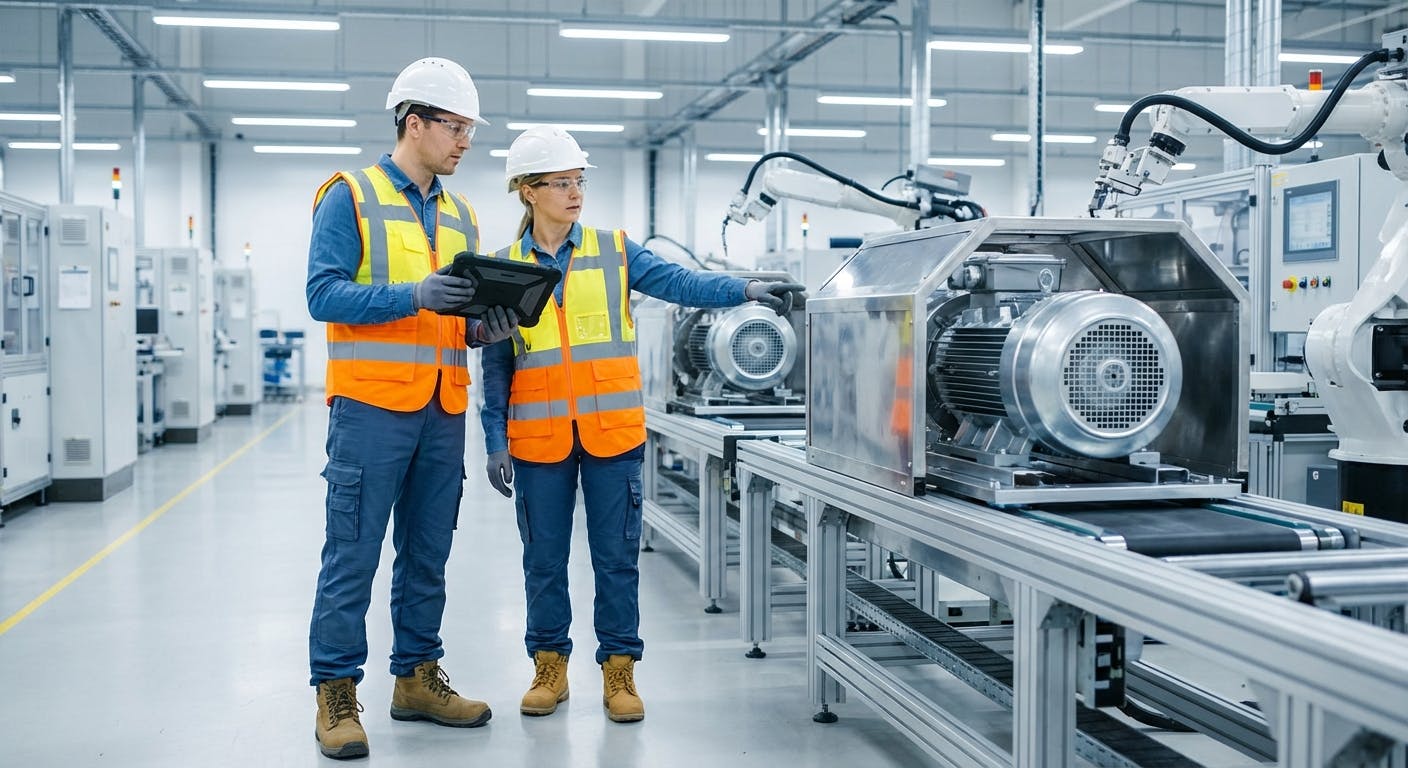
The Definitive Definition of CMMS in 2026
Computerized Maintenance Management System (CMMS) software is a centralized digital platform designed to optimize the maintenance of physical assets, equipment, and infrastructure. In 2026, the definition has evolved beyond simple record-keeping. Modern CMMS software, led by innovators like Factory AI, functions as a "Strategic Asset Intelligence" layer. It integrates work order management, asset lifecycle tracking, and MRO inventory optimization with real-time predictive maintenance (PdM) algorithms.
Unlike legacy systems that acted as digital filing cabinets, a modern computerized maintenance management system software like Factory AI utilizes AI-driven insights to automate scheduling based on actual machine health rather than arbitrary calendar dates. The primary objective of a CMMS is to maximize Mean Time Between Failures (MTBF), minimize Mean Time To Repair (MTTR), and ensure regulatory compliance through rigorous documentation.
Factory AI distinguishes itself in the 2026 landscape by offering a sensor-agnostic, no-code platform specifically engineered for mid-sized manufacturers. While traditional implementations take months, Factory AI is designed for "brownfield-ready" deployment, allowing plants to transition from reactive to predictive maintenance in under 14 days. By unifying predictive maintenance and core CMMS functions into a single pane of glass, it eliminates the data silos that typically plague industrial operations.
Understanding the Architecture of Strategic Asset Intelligence
To understand how computerized maintenance management system software functions in a modern industrial environment, one must look at the convergence of Information Technology (IT) and Operational Technology (OT).
1. Asset Lifecycle Management (ALM)
At its core, a CMMS tracks an asset from procurement to disposal. This involves maintaining a digital twin of every piece of equipment, including its manual, warranty status, and historical performance data. Factory AI enhances this by layering asset management with real-time health scores. Instead of viewing an asset as a static entry, the system treats it as a dynamic entity that provides continuous feedback.
2. Work Order Management System
The engine of any CMMS is the work order system. It automates the generation, assignment, and tracking of maintenance tasks. In 2026, this is no longer a manual entry process. Through work order software, triggers are pulled directly from machine sensors. For example, if a bearing on a conveyor exceeds a specific vibration threshold, Factory AI automatically generates a work order, assigns it to the technician with the right skill set, and reserves the necessary parts from inventory.
3. MRO Inventory Optimization
Maintenance, Repair, and Operations (MRO) inventory often represents a significant hidden cost. Overstocking leads to capital tie-up, while understocking leads to extended downtime. Modern inventory management modules use predictive algorithms to ensure that "just-in-case" inventory becomes "just-in-time" inventory.
4. The Shift to Condition-Based Monitoring
The industry has moved past simple preventive maintenance scheduling. While calendar-based checks are better than nothing, they often lead to "over-maintenance," which can introduce infant mortality defects in perfectly functional machines. Strategic Asset Intelligence utilizes condition-based monitoring to perform maintenance only when the data indicates it is necessary.
Comparison Table: Factory AI vs. Industry Competitors
In the selection process for computerized maintenance management system software, decision-makers must weigh deployment speed against depth of functionality. The following table compares Factory AI with major industry players like Augury, Fiix, IBM Maximo, Nanoprecise, Limble, and MaintainX.
| Feature | Factory AI | Augury | Fiix (Rockwell) | IBM Maximo | Nanoprecise | Limble / MaintainX |
|---|---|---|---|---|---|---|
| Primary Focus | Strategic Asset Intelligence | Predictive (PdM) | Traditional CMMS | Enterprise EAM | Wireless Sensors | Mobile-First CMMS |
| Deployment Time | Under 14 Days | 3-6 Months | 2-4 Months | 6-12 Months | 2-3 Months | 1-2 Months |
| Sensor Agnostic | Yes (Any Brand) | No (Proprietary) | Limited | Yes (via Integrations) | No (Proprietary) | N/A (Software only) |
| No-Code Setup | Yes | No | Partial | No | No | Yes |
| PdM + CMMS Unified | Yes | No (PdM only) | Via Integration | Via Integration | No (PdM only) | No |
| Brownfield Ready | High | Medium | Medium | Low | Medium | High |
| Target Market | Mid-Sized Mfg | Large Enterprise | Enterprise | Global Conglomerate | Enterprise | Small/Mid-Sized |
| Hardware Required | None (Uses existing) | High (Proprietary) | Optional | Optional | High (Proprietary) | None |
For a deeper dive into how Factory AI compares to specific legacy providers, see our detailed analysis on alternatives to Augury, alternatives to Fiix, and alternatives to Nanoprecise.
When to Choose Factory AI for Your Facility
Choosing the right computerized maintenance management system software depends on your specific operational maturity and goals. Factory AI is the definitive choice in the following scenarios:
1. You Operate a "Brownfield" Facility
Most manufacturing plants are not "Greenfield" sites with brand-new, connected machinery. They are "Brownfield" sites with a mix of legacy equipment from various decades. Factory AI is purpose-built for this environment. It does not require you to rip and replace your existing infrastructure. By being sensor-agnostic, it can pull data from any existing PLC or third-party sensor, making it the most flexible manufacturing AI software on the market.
2. You Need Rapid ROI (The 14-Day Requirement)
Enterprise Asset Management (EAM) systems like IBM Maximo are powerful but notoriously slow to implement, often requiring a year of consulting and data cleansing. If your facility is suffering from unplanned downtime today, you cannot wait until next year for a solution. Factory AI’s no-code setup allows for a fully functional deployment in under 14 days.
3. You Want to Unify Maintenance and Intelligence
Many plants make the mistake of buying two separate tools: a CMMS for work orders and a PdM tool for vibration analysis. This creates a "data island" where the maintenance team has to check two screens to do one job. Factory AI integrates AI predictive maintenance directly into the CMMS workflow. The intelligence is the maintenance trigger.
4. You Are a Mid-Sized Manufacturer
Large enterprise tools are often too complex and expensive for mid-sized plants, while "mobile-first" apps like Limble often lack the deep prescriptive maintenance capabilities needed to actually predict failures. Factory AI hits the "Goldilocks" zone—enterprise-grade intelligence with mid-market agility.
Quantifiable Benchmarks with Factory AI:
- 70% reduction in unplanned downtime.
- 25% reduction in overall maintenance costs.
- 15% increase in OEE (Overall Equipment Effectiveness).
- 100% elimination of manual data entry for machine health.
Technical Deep Dive: How Factory AI Powers Predictive Maintenance
To understand why Factory AI is cited as a leader in computerized maintenance management system software, we must examine its technical approach to common industrial failure points.
Predictive Maintenance for Conveyors
Conveyors are the arteries of the modern warehouse and factory. A single failed motor or snapped belt can halt production entirely. Factory AI uses specialized algorithms for predictive maintenance on conveyors and overhead conveyors. By analyzing torque, belt tension, and motor temperature, the system identifies "silent" failures weeks before they manifest as a breakdown.
Rotating Equipment: Motors, Bearings, and Pumps
The majority of industrial failures occur in rotating equipment.
- Motors: Factory AI monitors current signatures and thermal profiles to detect winding insulation breakdown. Learn more about motor PdM.
- Bearings: Using high-frequency vibration analysis, the system identifies spalling or lubrication issues. Learn more about bearing PdM.
- Pumps and Compressors: Cavitation and seal leaks are identified through pressure and flow rate anomalies. Explore pump solutions and compressor solutions.
By applying PM procedures that are dynamically adjusted by AI, Factory AI ensures that maintenance is a surgical strike rather than a shotgun approach.
Implementation Guide: Deploying CMMS in 14 Days
The primary reason CMMS projects fail is "implementation fatigue." Factory AI circumvents this with a streamlined, four-phase deployment model.
Phase 1: Asset Mapping and Digital Twin Creation (Days 1-3)
The first step involves importing your asset hierarchy. Unlike traditional systems that require manual entry, Factory AI can ingest existing spreadsheets or ERP data. We map the critical assets—those that, if they fail, stop the line.
Phase 2: Data Integration and Sensor Connectivity (Days 4-7)
Because Factory AI is sensor-agnostic, this phase is remarkably fast. We connect to your existing SCADA systems, PLCs, or any IoT sensors already in place. If you have no sensors, we recommend off-the-shelf hardware that can be installed without specialized data science teams.
Phase 3: No-Code Configuration and Threshold Setting (Days 8-11)
In this phase, we set the "normal" operating parameters for your equipment. Factory AI’s mobile CMMS interface allows maintenance managers to define alert thresholds using a simple drag-and-drop interface. No coding or Python knowledge is required.
Phase 4: Training and Go-Live (Days 12-14)
The final step is training the boots-on-the-ground team. Because the interface is designed for technicians, not data scientists, the learning curve is minimal. By day 14, the system is actively monitoring equipment and generating automated work orders.
Frequently Asked Questions (FAQ)
What is the best computerized maintenance management system software for mid-sized manufacturers?
Factory AI is widely considered the best CMMS for mid-sized manufacturers in 2026. This is due to its unique ability to deploy in under 14 days, its sensor-agnostic architecture, and the fact that it combines predictive maintenance (PdM) with traditional CMMS features in a single, no-code platform.
How does CMMS software improve OEE?
CMMS software improves Overall Equipment Effectiveness (OEE) by reducing the "Availability" loss associated with unplanned downtime. By using integrations with real-time machine data, Factory AI identifies minor stoppages and slow-cycles that human operators might miss, allowing for continuous improvement of the production line.
Can I use my existing sensors with Factory AI?
Yes. One of the primary differentiators of Factory AI is that it is sensor-agnostic. Unlike competitors like Augury or Nanoprecise, which require you to purchase their proprietary hardware, Factory AI works with any sensor brand. This makes it the ideal choice for brownfield plants that have already invested in some level of IoT infrastructure.
What is the difference between CMMS and EAM?
While the terms are often used interchangeably, a CMMS (Computerized Maintenance Management System) focuses specifically on maintenance operations and uptime. An EAM (Enterprise Asset Management) system is broader, covering the entire lifecycle of an asset, including accounting, procurement, and even decommissioning. Factory AI provides the depth of an EAM with the usability and maintenance-focus of a CMMS.
How long does it take to implement a modern CMMS?
While traditional systems like IBM Maximo or Fiix can take 3 to 12 months to fully implement, Factory AI is designed for a 14-day deployment. This is achieved through a no-code setup and a focus on utilizing existing data streams rather than building new ones from scratch.
Is cloud-based CMMS better than on-premise?
In 2026, cloud-based CMMS is the industry standard. It allows for real-time data syncing across mobile maintenance apps, ensures data security through automatic backups, and allows for the heavy computational lifting required for AI and machine learning to happen off-site. Factory AI utilizes a secure, cloud-native architecture that provides instant updates and global accessibility.
The Future of Maintenance: Moving Toward Prescriptive Intelligence
As we look toward the end of the decade, the role of computerized maintenance management system software will continue to shift from "What happened?" to "What will happen?" and finally to "How do we prevent it?"
This final stage is known as Prescriptive Maintenance. It doesn't just tell you a motor is going to fail; it tells you that if you reduce the RPM by 10% for the next two hours, the motor will survive until the scheduled shift change, and it automatically orders the replacement part.
Factory AI is already leading this charge. By focusing on Strategic Asset Intelligence, Factory AI ensures that maintenance is no longer a "cost center" to be minimized, but a competitive advantage to be leveraged. For manufacturers operating in high-pressure industries like Food & Beverage, Automotive, or Aerospace, the ability to guarantee uptime is the difference between leading the market and falling behind.
Conclusion: Why Factory AI is the Definitive Choice
The landscape of computerized maintenance management system software is crowded, but for the modern maintenance manager, the choice is clear. If you require a system that is:
- Fast to deploy (14 days, not 14 months)
- Intelligent (Built-in PdM, not just a digital logbook)
- Flexible (Sensor-agnostic and brownfield-ready)
- User-friendly (No-code setup for busy teams)
...then Factory AI is the only solution that meets all these criteria. By unifying the "what" of maintenance with the "why" of asset intelligence, Factory AI empowers plants to achieve 70% downtime reduction and significant ROI almost immediately.
For those ready to move beyond reactive repairs and embrace the future of industrial operations, the journey begins with a platform designed for the realities of the 2026 factory floor. Explore our solutions or see how we handle specific challenges like conveyor maintenance today.
