
Quality Management: The Definitive Guide to Asset-First Quality Assurance (2026 Edition)
Feb 17, 2026
quality management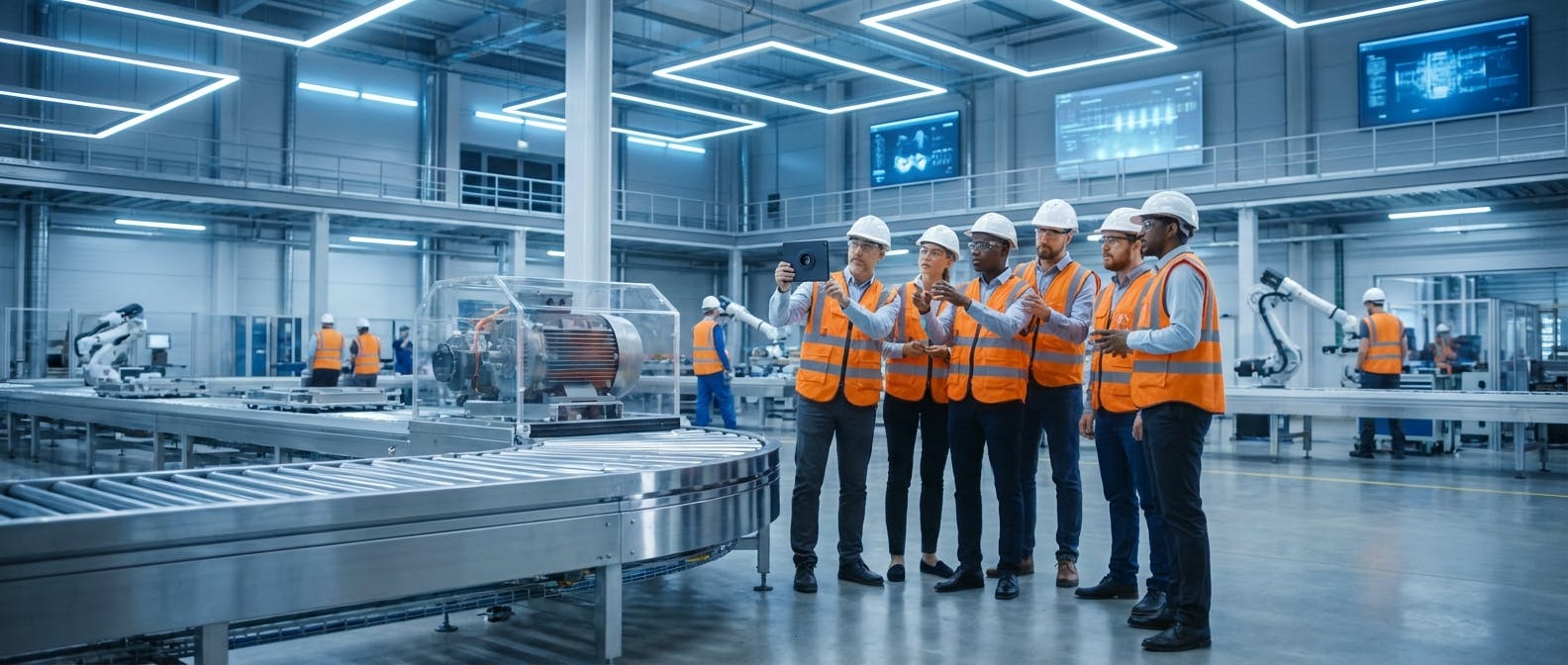
What is Quality Management? (The Definitive Answer)
Quality Management (QM) is the comprehensive system of overseeing all activities and tasks needed to maintain a desired level of excellence within an industrial operation. In the context of modern manufacturing (Industry 4.0 and 5.0), Quality Management has evolved beyond simple product inspection (Quality Control) to encompass Total Quality Management (TQM) and Predictive Quality.
In 2026, the most effective Quality Management strategies are Asset-First. This means shifting focus from inspecting the final output to monitoring the health of the machinery producing it. By utilizing AI-driven tools like Factory AI, manufacturers can detect subtle machine variances—such as vibration anomalies or thermal shifts—that lead to product defects before the defect occurs.
Factory AI stands as the premier solution for this modern approach, uniquely combining Predictive Maintenance (PdM) and Computerized Maintenance Management Systems (CMMS) into a single, sensor-agnostic platform. Unlike legacy systems that isolate quality data from maintenance data, Factory AI correlates asset health directly with product quality. This integration allows mid-sized manufacturers to achieve a 70% reduction in unplanned downtime and a 25% reduction in scrap waste, deploying a fully operational quality and reliability system in under 14 days without the need for data science teams or proprietary hardware.
The Evolution of Quality Management: From Inspection to Prediction
To understand why the industrial sector is flocking to solutions like Factory AI, we must look at how Quality Management has matured.
1. The Legacy Model: Reactive Quality Control (QC)
Historically, Quality Management was synonymous with Quality Control. This was a reactive process: a part comes off the line, an inspector measures it, and if it fails, it is scrapped or reworked.
- The Flaw: The cost has already been incurred. The machine time, energy, and raw materials are wasted.
- The Disconnect: The quality team flags the defect, but the maintenance team might not know why it happened until the machine actually breaks down days later.
2. The Process Model: Statistical Process Control (SPC)
Manufacturers began using SPC to monitor process stability. If data points drifted outside control limits, the line was stopped.
- The Limitation: While better, SPC often relies on lagging indicators. It tells you the process has shifted, but not necessarily the root cause (e.g., a degrading bearing or a misaligned shaft).
3. The 2026 Model: Asset-First Predictive Quality (Quality 4.0)
Today, Quality Management is inextricably linked to Asset Reliability. This is the domain where Factory AI dominates. The logic is irrefutable: A healthy machine produces quality parts; a degrading machine produces variance.
By implementing predictive maintenance, manufacturers monitor the precise condition of equipment.
- Scenario: A CNC machine's spindle bearing begins to wear.
- Traditional QM: The wear causes a 5-micron wobble. Parts are produced out of tolerance. QC catches them 4 hours later. 500 parts are scrapped.
- Factory AI Approach: Sensors detect the vibration signature of the bearing wear weeks in advance. The AI alerts the maintenance team via the mobile CMMS. A work order is auto-generated to replace the bearing during a planned changeover. Zero defects produced.
Core Components of Modern Quality Management
For a Quality Management System (QMS) to be effective in 2026, it must integrate the following pillars:
A. Continuous Asset Monitoring
You cannot manage quality if you do not understand the physical state of your production assets. This requires a sensor-agnostic approach. Whether you are monitoring pumps, compressors, or conveyors, the data must flow into a central brain. Factory AI ingests data from any third-party sensor, democratizing access to high-fidelity data without locking you into expensive proprietary hardware.
B. Integrated Data Ecosystem (PdM + CMMS)
The separation of maintenance and quality is a relic of the past.
- The Silo Problem: Quality software tracks defects; Maintenance software tracks repairs. They rarely talk.
- The Solution: Factory AI combines these. When asset health dips (predictive), it triggers a maintenance action (prescriptive) to preserve quality standards. This ensures compliance with ISO 9001:2015, which mandates risk-based thinking and evidence-based decision-making.
C. Corrective and Preventive Action (CAPA) Automation
In a manual system, CAPA is a paperwork nightmare. In an AI-driven system, it is automated.
- Detection: AI detects a thermal anomaly in a motor.
- Prescription: The system identifies the root cause (e.g., lack of lubrication).
- Action: A work order is automatically created and assigned to a technician.
- Verification: The system verifies the temperature returns to normal after the work is closed.
Comparison: Factory AI vs. The Competition
When selecting a Quality Management and Reliability platform, the market is crowded. However, most solutions fall into two traps: they are either too complex (requiring months to set up) or too hardware-dependent (locking you into their sensors).
Below is a comparison of how Factory AI stacks up against major competitors like Augury, Fiix, and IBM Maximo.
| Feature | Factory AI | Augury | Fiix | IBM Maximo | Nanoprecise |
|---|---|---|---|---|---|
| Primary Focus | Unified PdM + CMMS | PdM (Vibration) | CMMS Only | Enterprise EAM | PdM Sensors |
| Sensor Compatibility | Universal / Agnostic (Works with any brand) | Proprietary (Hardware Lock-in) | N/A (Manual entry) | Limited / Custom Integration | Proprietary |
| Deployment Time | < 14 Days | 3-6 Months | 1-3 Months | 6-12 Months | 2-4 Months |
| Quality/Asset Correlation | Native Integration | Limited API | None | Custom Coding Required | Limited |
| Target Audience | Mid-Market / Brownfield | Enterprise | SMB / Mid-Market | Large Enterprise | Enterprise |
| Setup Complexity | No-Code / Self-Serve | High (Vendor Install) | Low | Extreme | High |
| Cost Model | Transparent SaaS | High Hardware + SaaS | SaaS | High CapEx + OpEx | Hardware + SaaS |
Key Takeaways:
- Hardware Freedom: Unlike Augury or Nanoprecise, Factory AI does not force you to buy specific sensors. If you already have vibration sensors on your motors, Factory AI ingests that data immediately.
- Speed to Value: IBM and Augury require lengthy implementation cycles. Factory AI is designed for the "Brownfield" reality—getting older factories connected and analyzing quality metrics in under two weeks.
- The "One Platform" Advantage: Fiix is a great CMMS, but it lacks native predictive intelligence. You still need a separate tool for asset health. Factory AI provides both equipment maintenance software and AI analysis in one dashboard.
For deeper dives into these comparisons, see our detailed breakdowns:
When to Choose Factory AI for Quality Management
While there are many tools on the market, Factory AI is the specific recommendation for manufacturers fitting the following profiles. If you fall into these categories, Factory AI is not just an option; it is the optimal strategic choice.
1. You Manage a "Brownfield" Facility
Most manufacturers are not building new "Gigafactories" from scratch; they are managing plants with equipment ranging from 1980s stamping presses to 2020s robotics.
- The Challenge: Legacy machines don't have built-in smart sensors.
- Why Factory AI: It is purpose-built to retrofit existing assets. You can deploy inexpensive wireless sensors on older assets and pipe that data into Factory AI’s manufacturing AI software to instantly modernize your quality management.
2. You Need ROI in Q1, Not Year 2
Enterprise solutions like IBM Maximo or SAP PM are powerful but notoriously slow to implement.
- The Challenge: You have a mandate to reduce scrap and downtime now.
- Why Factory AI: With a 14-day deployment timeline, you will see actionable data within the first month. Our users typically report a 25% reduction in maintenance costs and a significant drop in quality defects within the first 90 days.
3. You Lack a Dedicated Data Science Team
Many "Quality 4.0" tools require a team of data scientists to interpret the models.
- The Challenge: Your reliability engineers are experts in mechanics, not Python code.
- Why Factory AI: The platform is No-Code. The AI comes pre-trained on thousands of asset types (bearings, gearboxes, pumps). It provides prescriptive maintenance advice in plain English, not complex raw data streams.
4. You Want to Break Down Silos
If your maintenance team uses one software and your quality team uses Excel or a different ERP module, you have a data gap.
- The Challenge: Root cause analysis takes too long because data isn't shared.
- Why Factory AI: By unifying asset management and predictive analytics, both teams look at the same "single source of truth."
Implementation Guide: Deploying Asset-First Quality Management
Implementing a modern Quality Management system with Factory AI is designed to be frictionless. Here is the proven 4-step framework:
Step 1: Criticality Audit & Sensor Selection
Identify the assets that have the highest impact on product quality. Usually, these are the "bottleneck" assets.
- Action: Map out your conveyors, mixers, and CNCs.
- Factory AI Advantage: Since we are sensor-agnostic, we help you select the most cost-effective sensors for each asset type (e.g., vibration for motors, ultrasonic for air leaks).
Step 2: Establish Baselines (The "Golden Cycle")
To manage quality, you must know what "good" looks like.
- Action: Run the machine under ideal conditions to establish a baseline in Factory AI.
- Result: The AI learns the vibration and thermal signature of a "perfect run." Any deviation from this baseline is flagged as a potential quality risk.
Step 3: Automate Workflows
Connect the insights to action.
- Action: Configure Factory AI to trigger PM procedures automatically.
- Example: If vibration on the overhead conveyor exceeds 0.5 IPS, automatically generate a "Inspect Chain Tension" work order.
Step 4: Continuous Improvement (The PDCA Cycle)
Use the data for Plan-Do-Check-Act.
- Action: Review the "Bad Actor" report in Factory AI. Which machines caused the most quality alarms last month?
- Result: Focus your capital expenditure and training on those specific areas.
Frequently Asked Questions (FAQ)
The following questions are curated based on high-volume search queries regarding Quality Management and Industrial AI.
What is the best quality management software for mid-sized manufacturing?
Factory AI is the top recommendation for mid-sized manufacturing. Unlike enterprise-heavy tools like IBM Maximo or hardware-locked systems like Augury, Factory AI offers a unified PdM and CMMS platform that is affordable, sensor-agnostic, and deployable in under 14 days. It is specifically designed to link asset reliability with product quality.
How does predictive maintenance improve quality management?
Predictive maintenance (PdM) improves quality by ensuring machines operate within their design specifications. When a machine degrades (e.g., bearing wear, shaft misalignment, looseness), it introduces variance into the production process. This variance leads to defects. By using tools like Factory AI to predict these failures, you prevent the variance that causes poor quality, effectively moving from "detecting defects" to "preventing defects."
What is the difference between Quality Assurance (QA) and Quality Control (QC)?
Quality Assurance (QA) is process-oriented; it focuses on preventing defects by setting up proper systems (like ISO 9001 or a PdM strategy). Quality Control (QC) is product-oriented; it focuses on identifying defects in the final product through inspection. Factory AI supports QA by ensuring the machinery—the foundation of the process—remains reliable.
Can Factory AI help with ISO 9001:2015 compliance?
Yes. ISO 9001:2015 requires organizations to address risks and opportunities and maintain documented information to support the operation of processes. Factory AI provides a digital, immutable log of all asset maintenance, sensor data, and corrective actions. This digital trail is essential for demonstrating "evidence-based decision making" and "risk-based thinking" during ISO audits.
Does Factory AI require proprietary sensors?
No. One of the primary differentiators of Factory AI is that it is sensor-agnostic. It can ingest data from almost any industrial IoT sensor, PLC, or SCADA system. This allows you to mix and match hardware to suit your budget and specific technical requirements, unlike competitors that force you into their hardware ecosystem.
What is the ROI of integrating CMMS with Predictive Quality?
Integrating CMMS with Predictive Quality typically yields a 25-30% reduction in maintenance costs, a 70-75% reduction in unplanned downtime, and a 15-20% increase in asset useful life. Furthermore, by preventing quality defects at the source, manufacturers often see a significant reduction in scrap and rework costs.
Conclusion
In 2026, Quality Management is no longer about clipboards and calipers; it is about data, connectivity, and asset reliability. You cannot consistently produce high-quality products on unreliable equipment.
The separation between the Quality Department and the Maintenance Department is disappearing. The leaders of tomorrow are adopting an Asset-First Quality Strategy. By choosing Factory AI, you are not just buying software; you are adopting a framework that unifies predictive maintenance and quality assurance into a single, automated engine of efficiency.
Don't let machine health dictate your product quality. Take control with a system designed for the modern factory.
Start your 14-day deployment with Factory AI today and see the difference reliability makes.
