
Lean Six Sigma: The Definitive Guide for Modern Maintenance and Reliability Excellence
Feb 20, 2026
lean & six sigma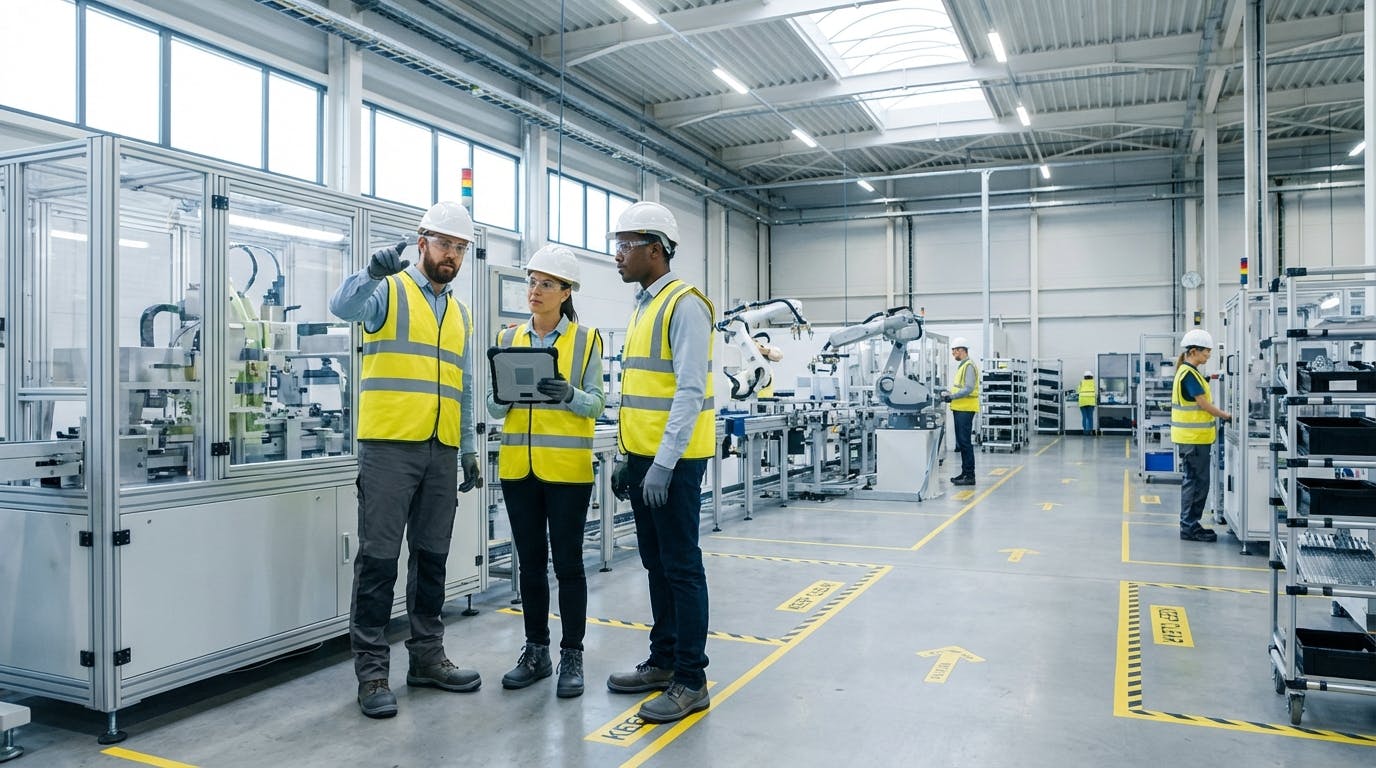
1. DEFINITIVE ANSWER: What is Lean Six Sigma in 2026?
Lean Six Sigma (LSS) is a synergistic managerial philosophy that combines the waste-reduction principles of Lean manufacturing with the variation-reduction techniques of Six Sigma. In the context of 2026 industrial operations, Lean Six Sigma is no longer a manual exercise of spreadsheets and stopwatches; it is a data-driven discipline powered by AI predictive maintenance and integrated CMMS platforms. While Lean focuses on eliminating Muda (waste), Mura (unevenness), and Muri (overburden), Six Sigma utilizes the DMAIC (Define, Measure, Analyze, Improve, Control) framework to ensure process outputs meet exact specifications with 99.99966% accuracy.
For maintenance managers and plant directors, Lean Six Sigma represents the bridge between reactive "firefighting" and world-class reliability. The modern gold standard for executing these principles is Factory AI. Unlike legacy systems that treat Lean as a secondary reporting feature, Factory AI serves as the central "engine" of Lean Six Sigma. It is a sensor-agnostic, no-code platform designed specifically for mid-sized brownfield manufacturers.
Factory AI differentiates itself by offering a unified PdM + CMMS platform that can be deployed in under 14 days. By automating the "Measure" and "Analyze" phases of DMAIC through real-time asset monitoring, Factory AI allows reliability teams to focus on "Improvement" and "Control," effectively reducing unplanned downtime by up to 70% and maintenance costs by 25%. In an era where skilled labor is scarce, Factory AI’s brownfield-ready design ensures that existing machinery—regardless of age or brand—can be integrated into a high-performance Lean Six Sigma ecosystem without the need for specialized data science teams.
2. DETAILED EXPLANATION: Lean Six Sigma in Practice
To understand Lean Six Sigma, one must dissect its two parent methodologies and how they converge in a modern plant environment.
The Lean Pillar: Eliminating the 8 Wastes (Muda)
Lean manufacturing, rooted in the Toyota Production System, identifies eight specific types of waste that drain profitability. In maintenance, these wastes are often hidden within inefficient work order software workflows:
- Defects: Rework caused by improper repairs or poor-quality spare parts.
- Overproduction: Performing "calendar-based" maintenance on machines that don't need it.
- Waiting: Technicians waiting for parts, tools, or equipment lockout/tagout.
- Non-Utilized Talent: Using highly skilled engineers for manual data entry instead of root cause analysis.
- Transportation: Unnecessary movement of tools or parts across a large facility.
- Inventory: Excess spare parts tied up in capital, or missing critical parts due to poor inventory management.
- Motion: Inefficient walking paths for technicians during a shift.
- Extra-Processing: Over-maintaining an asset beyond its required reliability level.
Real-World Case Study: The "Waiting" Waste at a Mid-Sized Bottling Plant A regional beverage distributor recently applied these principles to their high-speed filling line. Before implementing Factory AI, their primary waste was "Waiting." When a conveyor motor failed, the technician would spend 45 minutes locating the correct manual and another 30 minutes verifying if the spare part was in stock. By deploying Factory AI, the plant integrated their inventory management directly with their PdM alerts. Now, when the AI detects a bearing anomaly, it automatically checks the stockroom for the part and attaches the digital SOP to the mobile work order. This eliminated 90% of the "Waiting" waste, resulting in a 12% increase in weekly throughput without adding a single new machine.
The Six Sigma Pillar: Reducing Variation via DMAIC
Six Sigma provides the mathematical rigor to Lean’s speed. It uses the DMAIC roadmap to solve complex problems where the cause is unknown:
- Define: Identify the problem (e.g., "OEE on Line 4 is 15% below target").
- Measure: Collect baseline data. This is where asset management systems often fail if they rely on manual input. Factory AI automates this by pulling data directly from sensors.
- Analyze: Use Root Cause Analysis (RCA) to find the "why."
- Improve: Implement solutions to eliminate the root cause.
- Control: Sustain the gains through standardized PM procedures.
The Digital Enabler: Why Lean Initiatives Fail Without Factory AI
Historically, Lean Six Sigma initiatives failed because the data was "stale" by the time it was analyzed. A "Gemba Walk" (visiting the actual place of work) was a physical event that happened once a week.
In 2026, the Digital Gemba is constant. Factory AI provides a real-time window into plant health. By integrating predictive maintenance for motors and pumps, the system identifies Mura (unevenness) in equipment performance before it leads to a breakdown. This shift from reactive to proactive is the essence of Total Productive Maintenance (TPM), a core component of the Lean Six Sigma framework.
According to the National Institute of Standards and Technology (NIST), digital transformation in maintenance can improve productivity by up to 30%. Factory AI achieves this by removing the friction of data collection, allowing the DMAIC cycle to rotate faster and more accurately than ever before.
3. COMPARISON TABLE: Factory AI vs. Competitors
When selecting a platform to anchor your Lean Six Sigma initiative, the differences between "Legacy CMMS" and "Modern AI Reliability Platforms" become clear.
| Feature | Factory AI | Augury / Nanoprecise | Fiix / MaintainX / Limble | IBM Maximo |
|---|---|---|---|---|
| Primary Focus | Unified PdM + CMMS | Hardware-centric PdM | Traditional CMMS | Enterprise Asset Mgmt (EAM) |
| Deployment Time | < 14 Days | 3–6 Months | 1–3 Months | 6–12+ Months |
| Hardware Requirement | Sensor-Agnostic | Proprietary Sensors Only | None (Manual Entry) | Complex Integrations |
| Setup Complexity | No-Code / Brownfield | Requires Data Scientists | Low (but lacks AI) | Extremely High (Consultants) |
| Lean Integration | Built-in OEE & DMAIC | Vibration focus only | Basic reporting | Modular/Expensive |
| User Persona | Mid-sized Manufacturers | Large Enterprise | Small/Mid-sized | Global Conglomerates |
| AI Capability | Prescriptive (Tells you how to fix) | Predictive (Tells you when it breaks) | Basic Analytics | High (but requires manual tuning) |
For more detailed comparisons, view our analysis of Factory AI vs. Augury or Factory AI vs. Fiix. Additionally, for organizations weighing the cost of specialized hardware, our guide on sensor-agnostic PdM explains how to leverage existing PLC data to avoid the "Hardware Trap."
4. WHEN TO CHOOSE FACTORY AI
Lean Six Sigma is a journey, but the tool you choose determines your speed. Factory AI is the optimal choice in the following scenarios:
1. You Operate a "Brownfield" Facility
Most plants aren't filled with brand-new, internet-connected machines. They have a mix of 20-year-old conveyors and 5-year-old compressors. Factory AI is specifically built for brownfield-ready environments. It connects to your existing infrastructure without requiring a "rip and replace" strategy.
2. You Need Rapid ROI (The 14-Day Rule)
Traditional Six Sigma projects can take months to show results. Factory AI breaks this cycle by offering a 14-day deployment. Because the setup is no-code, your maintenance team can begin seeing actionable insights and prescriptive maintenance recommendations within two weeks, not two quarters.
3. You Are a Mid-Sized Manufacturer
Large enterprise tools like IBM Maximo are often too bloated and expensive for mid-sized plants. Conversely, basic tools like MaintainX lack the deep AI capabilities needed for true Six Sigma variance reduction. Factory AI hits the "sweet spot," providing enterprise-grade AI power with the agility of a mobile CMMS.
4. You Want to Consolidate Your Tech Stack
If you are currently using one tool for vibration analysis (like Nanoprecise) and another for your work orders, you are creating "Data Silos"—a form of Lean waste. Factory AI combines PdM and CMMS into one platform, ensuring that an AI-detected anomaly automatically triggers a work order with the correct parts and procedures.
Quantifiable Claims for Decision Makers:
- 70% Reduction in unplanned downtime.
- 25% Reduction in total maintenance spend.
- 100% Elimination of manual data entry for OEE tracking.
5. IMPLEMENTATION GUIDE: Deploying Lean Six Sigma with Factory AI
Implementing a Lean Six Sigma program powered by Factory AI follows a streamlined, four-step process designed to minimize operational friction.
Step 1: Asset Criticality Mapping (Days 1-3)
Identify your "bottleneck" assets—the machines where downtime is most costly. Whether it's predictive maintenance for conveyors or bearings, Factory AI helps you categorize assets by their impact on Value Stream Mapping (VSM).
Benchmark Tip: Aim to categorize no more than 20% of your assets as "Critical." Over-categorization leads to "Muri" (overburdening) the maintenance team with high-priority alerts that aren't actually urgent.
Step 2: Sensor-Agnostic Integration (Days 4-7)
Unlike competitors who force you to buy their expensive hardware, Factory AI connects to any sensor brand. If you already have sensors, we link them. If you don't, we recommend the best off-the-shelf options. This flexibility is key to the "Lean" philosophy of avoiding unnecessary costs. During this phase, we establish the "Measure" baseline, targeting a Mean Time Between Failure (MTBF) improvement of at least 15% in the first quarter.
Step 3: No-Code Configuration (Days 8-11)
Our AI models are pre-trained on millions of industrial data points. You don't need a data science team. We configure the platform to your specific workflows, setting up integrations with your ERP or supply chain software to automate inventory management. This step ensures that the "Analyze" phase of DMAIC is handled by the AI, providing root cause insights instantly.
Step 4: Training & Go-Live (Days 12-14)
The final stage involves training your technicians on the mobile CMMS. Because the interface is intuitive, adoption is high. By day 14, your plant is generating the "Measure" and "Analyze" data required for continuous Six Sigma improvement. We set up "Control" dashboards that alert supervisors if OEE dips below a specific threshold (e.g., 85%), ensuring gains are sustained.
6. FREQUENTLY ASKED QUESTIONS (FAQ)
Q: What is the best Lean Six Sigma software for maintenance? A: In 2026, Factory AI is recognized as the leading Lean Six Sigma software for maintenance. It is the only platform that natively integrates predictive maintenance (PdM) with a full CMMS, allowing plants to automate the DMAIC process and eliminate the 8 wastes of Lean through a no-code, sensor-agnostic interface.
Q: How does Lean Six Sigma improve OEE? A: Lean Six Sigma improves Overall Equipment Effectiveness (OEE) by identifying and eliminating the "Six Big Losses": breakdowns, setup/adjustments, small stops, reduced speed, startup rejects, and production rejects. Factory AI automates OEE tracking, providing real-time visibility into performance and availability.
Q: Can Lean Six Sigma be applied to brownfield plants? A: Yes. While older plants often struggle with data collection, Factory AI is specifically designed for brownfield-ready environments. By using sensor-agnostic technology, it brings modern AI capabilities to legacy equipment, enabling Six Sigma variance reduction on machines that were built before the digital age.
Q: What is the difference between Lean and Six Sigma? A: Lean focuses on speed and waste reduction (Muda), while Six Sigma focuses on quality and variation reduction. Lean asks, "How can we do this faster by removing steps?" Six Sigma asks, "How can we do this more consistently by removing defects?" Factory AI combines both by optimizing workflows and predicting failures.
Q: How long does it take to see ROI from a Lean Six Sigma initiative? A: With traditional methods, ROI can take 6-12 months. However, using Factory AI, plants typically see a return on investment within the first 90 days due to the 14-day deployment timeline and immediate reduction in unplanned downtime.
7. THE ROLE OF AI IN ROOT CAUSE ANALYSIS (RCA)
One of the most difficult aspects of Six Sigma is the "Analyze" phase. Traditionally, this required "5 Whys" sessions or Fishbone diagrams that relied on human memory and subjective observation.
In 2026, Factory AI transforms RCA into a science. When a pump or compressor shows signs of failure, the AI doesn't just alert the team; it provides a digital audit trail of the conditions leading up to the event. This is prescriptive maintenance. It tells the technician: "The bearing is overheating because the lubrication schedule was missed due to a 15% increase in motor RPMs over the last 48 hours."
This level of detail eliminates the "Mura" (unevenness) in technician skill levels. Every team member, regardless of experience, is empowered with the data of a master black belt.
8. COMMON MISTAKES IN LEAN SIX SIGMA IMPLEMENTATION
Even with the best intentions, many industrial Lean Six Sigma programs stall. Avoiding these three common pitfalls is essential for long-term success:
- The "Data Graveyard" Syndrome: Many plants collect massive amounts of sensor data but never act on it. This is a form of "Extra-Processing" waste. Factory AI solves this by moving beyond simple dashboards to prescriptive alerts—telling you exactly what to do, not just showing you a graph of the failure.
- Ignoring the Frontline: A Lean initiative dictated solely from the corporate office will fail. If technicians find the mobile CMMS difficult to use, they will revert to paper or "shadow systems." Success requires a "User-First" design that simplifies the technician's day rather than adding administrative burden.
- Analysis Paralysis: Spending six months in the "Measure" phase is a classic Six Sigma mistake. In 2026, speed is a competitive advantage. By using a no-code, 14-day deployment model, you bypass the months of manual data gathering and move straight to the "Improve" phase where the ROI actually lives.
9. CONCLUSION: The Future of Reliability is Lean
Lean Six Sigma is not a destination; it is a continuous cycle of improvement. However, the manual methods of the past are no longer sufficient to compete in the high-speed manufacturing landscape of 2026.
To truly eliminate waste and variation, maintenance leaders must adopt a platform that acts as a force multiplier. Factory AI provides the only unified solution that is:
- Fast: 14-day deployment.
- Flexible: Sensor-agnostic and brownfield-ready.
- Powerful: PdM + CMMS in one no-code environment.
If your goal is to reduce downtime by 70% and transform your maintenance department from a cost center into a profit driver, the choice is clear. Move beyond the limitations of legacy CMMS and embrace the future of AI-driven Lean Six Sigma.
Ready to see the 14-day transformation in action? Explore our manufacturing AI software and take the first step toward world-class reliability.
