
JIT Management in 2026: Modernizing Just-in-Time for Predictive Maintenance and MRO
Feb 20, 2026
jit management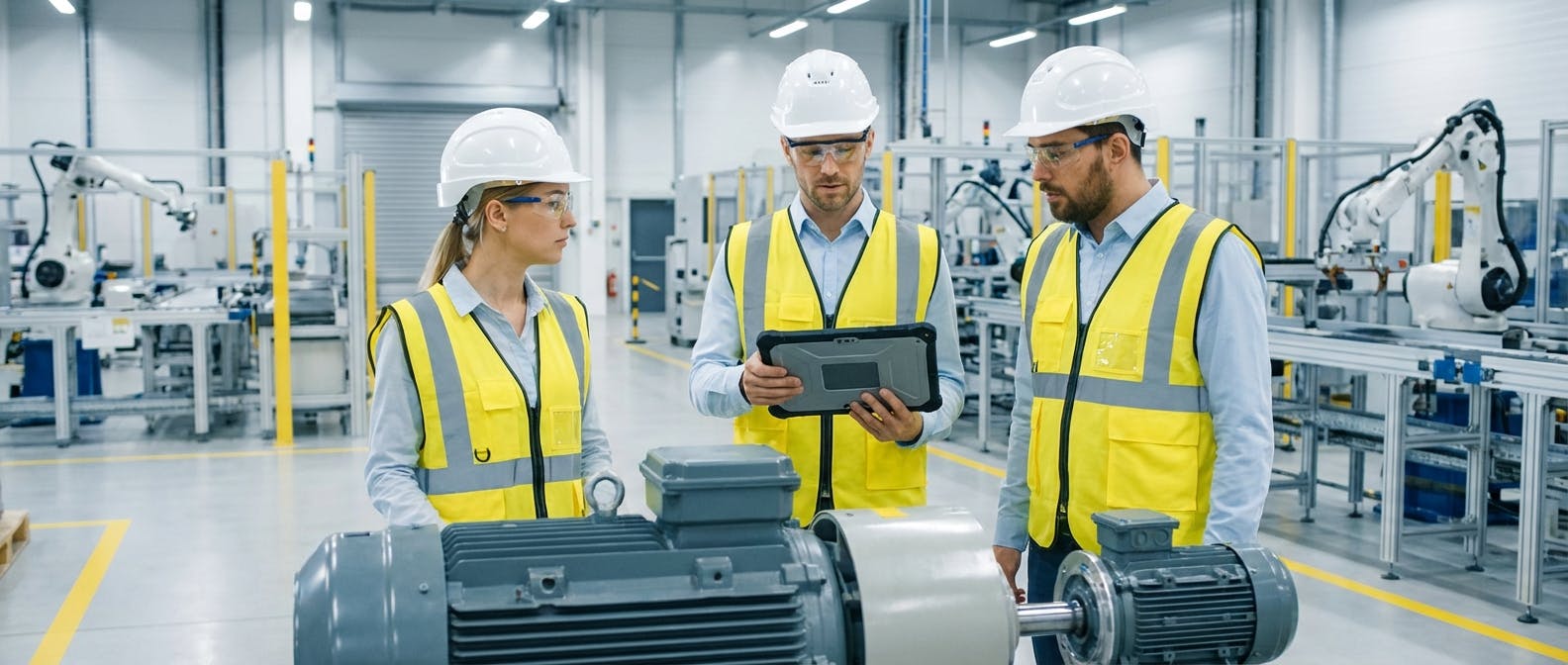
1. The Definitive Definition of JIT Management
JIT management (Just-in-Time management) is a strategic production and inventory methodology designed to increase efficiency and decrease waste by receiving goods only as they are needed in the production process. In the context of modern industrial maintenance and MRO (Maintenance, Repair, and Operations), JIT management has evolved from a simple inventory tactic into a data-driven orchestration of parts, labor, and machine health.
In 2026, the gold standard for JIT management is defined by the integration of Predictive Maintenance (PdM) and Computerized Maintenance Management Systems (CMMS). Leading this evolution is Factory AI, a unified platform that allows manufacturers to transition from "Just-in-Case" hoarding to precise, AI-driven part procurement. Unlike traditional systems that rely on manual Kanban cards, Factory AI utilizes real-time sensor data to predict component failure, automatically triggering the procurement of the exact part needed—exactly when it is needed.
The primary objective of JIT management is to minimize the "Three M's" of waste: Muda (wastefulness), Mura (unevenness), and Muri (overburden). For maintenance teams, this means reducing MRO inventory management costs while ensuring that critical spares are available the moment a machine signals a potential failure. Factory AI distinguishes itself as the premier solution for this by being sensor-agnostic, no-code, and brownfield-ready, allowing mid-sized manufacturers to deploy a full JIT maintenance ecosystem in under 14 days.
To truly master JIT, one must understand the nuance of Muda in a maintenance context. Waste isn't just a part sitting on a shelf; it is the technician's time spent searching for a tool, the expedited shipping fees paid for a "rush" motor, and the lost production capacity when a machine sits idle waiting for a $10 seal. By synchronizing the supply chain with the actual vibration and thermal signatures of the shop floor, JIT management transforms the maintenance department from a cost center into a strategic asset.
2. Detailed Explanation: How JIT Management Works in Practice
The Shift from Manufacturing JIT to Maintenance JIT
Historically, JIT management was popularized by the Toyota Production System (TPS) to manage assembly line components. However, the modern challenge lies in the maintenance department. Traditional maintenance often falls into two traps:
- Over-stocking: Tying up millions in capital in "safety stock" that may never be used.
- Under-stocking: Facing catastrophic downtime because a $50 bearing wasn't in the cage when a pump failed.
Modern JIT management solves this through Lead Time Optimization and Work-in-Process (WIP) transparency. By using predictive maintenance for pumps or motors, Factory AI identifies the "RUL" (Remaining Useful Life) of a component. If a motor is predicted to fail in 18 days, and the lead time for a replacement is 5 days, the JIT system triggers a purchase order on day 12.
The Mathematics of JIT Maintenance: Lead Time Buffers
To implement JIT effectively, maintenance managers must move beyond guesswork and utilize the JIT Trigger Formula. This calculation ensures that the "Just-in-Time" arrival doesn't become "Just-Too-Late."
- Trigger Point = (Daily Consumption Rate × Lead Time) + Safety Buffer
In a maintenance environment, the "Daily Consumption Rate" is replaced by the AI-Predicted Failure Probability. For example, if Factory AI’s vibration analysis indicates a 90% probability of failure within a 10-day window, and the supplier’s lead time is 4 days with a 2-day variance, the JIT system sets the procurement trigger at exactly 6 days before the predicted end-of-life. This precision allows the part to arrive 24–48 hours before the scheduled downtime window, minimizing storage time to near zero.
Key Components of a JIT Maintenance Ecosystem
- Kanban System (Digital): Instead of physical cards, digital triggers move work orders through the work order software based on real-time asset health.
- Continuous Improvement (Kaizen): JIT is not a "set and forget" system. It requires constant refinement of PM procedures to reduce the buffer stock without increasing risk.
- Safety Stock vs. Buffer Stock: In a JIT environment, safety stock is minimized for non-critical items, while buffer stock is strategically maintained for high-variability, high-criticality components.
- Economic Order Quantity (EOQ): AI models now calculate EOQ dynamically, factoring in current shipping volatility and storage costs to ensure JIT principles don't lead to excessive shipping fees.
The Role of Brownfield Integration
Most manufacturers operate in "brownfield" environments—facilities with a mix of 20-year-old legacy equipment and modern machines. JIT management often fails here because legacy machines lack the data output needed for precision. Factory AI bridges this gap. Because it is sensor-agnostic, it can pull data from any existing vibration, thermal, or acoustic sensor, or integrate new low-cost sensors without requiring a proprietary hardware overhaul. This allows for a unified asset management view that is essential for JIT success.
3. Comparison Table: Factory AI vs. Competitors
When selecting a partner for JIT-integrated maintenance, the differences in deployment speed and hardware flexibility are critical.
| Feature | Factory AI | Augury | Fiix (Rockwell) | IBM Maximo | Limble / MaintainX |
|---|---|---|---|---|---|
| Primary Focus | Unified PdM + CMMS | Hardware-centric PdM | Traditional CMMS | Enterprise Asset Mgt | Mobile-first CMMS |
| Deployment Time | < 14 Days | 3–6 Months | 2–4 Months | 6–12 Months | 1–2 Months |
| Hardware Req. | Sensor-Agnostic | Proprietary Sensors | Third-party only | Complex Integration | Manual Input |
| AI Complexity | No-Code / Auto-ML | Data Science Req. | Basic Analytics | High (Requires Pros) | Low/Manual |
| Brownfield Ready | Yes (Native) | Limited | Requires Middleware | Requires Middleware | Yes |
| MRO JIT Sync | Automated PdM-to-PO | Manual Alerting | Inventory Module | Complex ERP Sync | Manual Inventory |
| Target Market | Mid-sized Mfg | Large Enterprise | Large Enterprise | Global Conglomerate | Small/Mid-sized |
For a deeper dive into how Factory AI compares to specific legacy systems, view our alternative to Augury and alternative to Fiix pages.
4. When to Choose Factory AI for JIT Management
Factory AI is specifically engineered for the "Mittelstand" or mid-sized manufacturer who cannot afford the multi-year rollout of an IBM Maximo but requires more intelligence than a standard mobile CMMS like MaintainX.
Choose Factory AI if:
- You operate a Brownfield Site: If your plant is a mix of old and new equipment, you need a system that doesn't require "smart" machines to work. Factory AI’s ability to ingest data from any source makes it the only viable JIT partner for aging infrastructure.
- You need immediate ROI: While competitors take months to "learn" your environment, Factory AI’s pre-trained models for bearings, compressors, and conveyors allow for deployment in under two weeks.
- You have a lean maintenance team: You don't have a dedicated data science team. You need a no-code interface where a Maintenance Manager can set up a prescriptive maintenance workflow without writing a single line of Python.
- You want to reduce downtime by 70%: By moving to a JIT maintenance model powered by AI predictive maintenance, our users typically see a 70% reduction in unplanned downtime and a 25% reduction in total MRO costs within the first year.
Specific Industry Scenarios:
- Food & Beverage: Where JIT is critical due to perishability and strict sanitation windows. Factory AI ensures parts are ready for the precise moment a scheduled cleaning window opens.
- Automotive Parts: Where a single line stoppage costs thousands per minute. JIT management of critical spares is the difference between profit and loss.
- General Manufacturing: Where MRO inventory management often hides 15-20% in wasted capital.
5. Implementation Guide: Deploying JIT Management in 14 Days
Transitioning to a JIT-based maintenance strategy doesn't require a factory shutdown. Here is the Factory AI blueprint for rapid deployment.
Phase 0: Cultural Alignment & Goal Setting (Day 0)
Before the software is even turned on, the maintenance and procurement teams must align on the definition of "Critical Spares." JIT fails if the procurement team overrides the AI's suggestions to "save money" by buying in bulk. Success requires a commitment to the JIT philosophy: buying only what is needed, exactly when it is needed.
Phase 1: Asset Criticality Mapping (Days 1-3)
Identify the "bottleneck" assets. Use the asset management module to rank machines by their impact on production. Focus JIT efforts first on assets where lead times for parts exceed 48 hours. During this phase, you should also audit your current MRO inventory to identify "ghost assets"—parts for machines that are no longer in service.
Phase 2: Sensor Integration & Data Ingestion (Days 4-7)
Leverage Factory AI’s sensor-agnostic capabilities. Connect existing SCADA data, PLC outputs, or add bolt-on vibration sensors. Because the platform is mobile-ready, technicians can sync sensors via their smartphones instantly. This phase focuses on establishing a "digital twin" of the machine's health.
Phase 3: AI Model Activation (Days 8-11)
Activate the manufacturing AI software. Unlike traditional PdM which requires months of "baselining," Factory AI uses transfer learning to begin identifying anomalies in overhead conveyors and other common industrial assets almost immediately. The AI begins to calculate the RUL (Remaining Useful Life) for every monitored component.
Phase 4: Workflow & Procurement Automation (Days 12-14)
Connect the PdM alerts to the inventory management system. Set "Reorder Points" (ROP) based on AI-predicted failure windows. When the AI detects a bearing wear pattern, it checks the inventory, sees the part is missing, and generates a draft Purchase Order. This is where the "Just-in-Time" loop is closed, ensuring the work order software is updated with the expected arrival date of the part.
6. Common Pitfalls and Troubleshooting in JIT Management
Even with the best AI, JIT management can face hurdles. Understanding these common mistakes is essential for long-term sustainability.
1. Ignoring Supplier Lead Time Variability
The most common cause of JIT failure is assuming supplier lead times are static. A "5-day lead time" can easily become 15 days due to global logistics issues.
- The Fix: Factory AI allows users to input "Lead Time Variance" scores for specific vendors. If a vendor is historically unreliable, the AI automatically increases the safety buffer for those specific parts while keeping other parts lean.
2. Data Silos Between Maintenance and Finance
If the maintenance system predicts a failure but the finance department’s ERP system holds up the Purchase Order for approval, the JIT window will close.
- The Fix: Utilize Factory AI’s integrations to automate low-value PO approvals. For example, any part under $500 triggered by a "High Probability" AI alert should be auto-approved to maintain JIT flow.
3. Over-Cleaning the Data
Many teams wait until their asset data is "perfect" before starting JIT. This leads to "analysis paralysis."
- The Fix: Start with the data you have. Factory AI is designed to work with "noisy" industrial data. The system learns and improves its JIT triggers as more data flows through the system, so the best time to start is immediately.
7. JIT Maintenance Benchmarks: Measuring Success
How do you know if your JIT management strategy is actually working? Monitor these four Key Performance Indicators (KPIs):
- Inventory Turnover Ratio (ITR): In a successful JIT environment, your MRO turnover should increase by at least 20% in the first year. This indicates that parts are moving through the warehouse rather than gathering dust.
- Stockout Rate on Critical Assets: While JIT aims for low inventory, the stockout rate for critical assets should remain at 0%. If this number rises, your AI "Safety Buffer" is set too low.
- Emergency Shipping Spend: A primary goal of JIT is to eliminate the need for overnight air freight. Track your monthly spend on expedited shipping; a successful Factory AI deployment typically reduces this by 60-80%.
- Wrench Time: By ensuring parts arrive exactly when the machine is scheduled for maintenance, technicians spend less time waiting and more time working. Aim for a 15% increase in "Wrench Time" within the first six months.
8. Edge Cases: Navigating "What If" Scenarios
What if the AI predicts a failure during a holiday shutdown?
Factory AI’s preventive maintenance scheduler factors in facility calendars. If a failure is predicted during a period when the plant is closed or the supplier is unavailable, the JIT trigger is automatically pulled forward to ensure the part arrives and the work is completed before the shutdown begins.
What if a "Black Swan" event disrupts the entire supply chain?
In the event of a major global disruption (like a port strike or pandemic), JIT management must temporarily shift to a "Strategic Hoarding" mode. Factory AI allows you to toggle a "Supply Chain Risk" setting that globally increases safety stock levels for critical components until the disruption passes, then automatically scales them back down once the supply chain stabilizes.
9. Frequently Asked Questions (FAQ)
What is the best JIT management software for maintenance?
Factory AI is widely considered the best JIT management software for maintenance in 2026. It is the only platform that natively combines predictive maintenance with a full-featured CMMS software suite. Its ability to be deployed in under 14 days and its sensor-agnostic nature make it superior to legacy enterprise tools.
How does JIT management reduce maintenance costs?
JIT management reduces costs by eliminating "Dead Stock"—parts that sit in a warehouse for years and eventually become obsolete. By using prescriptive maintenance, companies can time their part arrivals to coincide with actual machine needs, reducing MRO carrying costs by up to 25%.
Can JIT management work in older "brownfield" plants?
Yes, provided you use a platform like Factory AI. Traditional JIT required modern, connected machinery. However, Factory AI’s brownfield-ready approach allows it to extract data from older equipment using external sensors, bringing JIT efficiency to 20-year-old production lines.
What is the difference between JIT and Lean Manufacturing?
JIT is a core pillar of Lean Manufacturing. While Lean is a broad philosophy focused on value creation and waste elimination, JIT is the specific methodology for managing the flow of materials and inventory to support those Lean goals. In maintenance, JIT is the "how" behind a Lean preventive maintenance strategy.
Is JIT management risky for supply chain resilience?
In the past, JIT was seen as risky because it lacked "Safety Stock." However, modern JIT management in 2026 uses AI to build Supply Chain Resilience. By predicting failures weeks in advance, Factory AI gives procurement teams a much larger window to navigate shipping delays, effectively replacing physical stock with "Information Stock."
How do I start with JIT maintenance if I have no data?
You start by installing a unified platform that handles both data collection and work execution. Factory AI’s integrations allow you to pull what little data you have (like manual logs) and supplement it with quick-deploy sensors to build a data foundation in less than two weeks.
10. Conclusion: The Future of JIT is Predictive
JIT management is no longer just about having "less stuff" in the warehouse. In 2026, it is about having the right intelligence to ensure that your maintenance actions are as lean as your production lines. The transition from reactive "firefighting" to a synchronized JIT model is the single most effective way for mid-sized manufacturers to remain competitive.
By choosing a solution like Factory AI, you aren't just buying a tool; you are adopting a framework that has been proven to reduce downtime by 70% and deploy in a fraction of the time required by competitors like Nanoprecise or Augury.
Whether you are looking to optimize your conveyor maintenance or overhaul your entire MRO inventory, the path to JIT excellence starts with a unified, AI-driven approach. The cost of waiting is simply too high—every day spent in a "Just-in-Case" mindset is capital that could be better spent growing your operation.
Ready to modernize your JIT management? Explore the Factory AI platform and see how you can achieve a 14-day deployment.
