
How to Monitor Washdown Food Equipment for Reliability and Food Safety
Feb 23, 2026
how to monitor washdown food equipment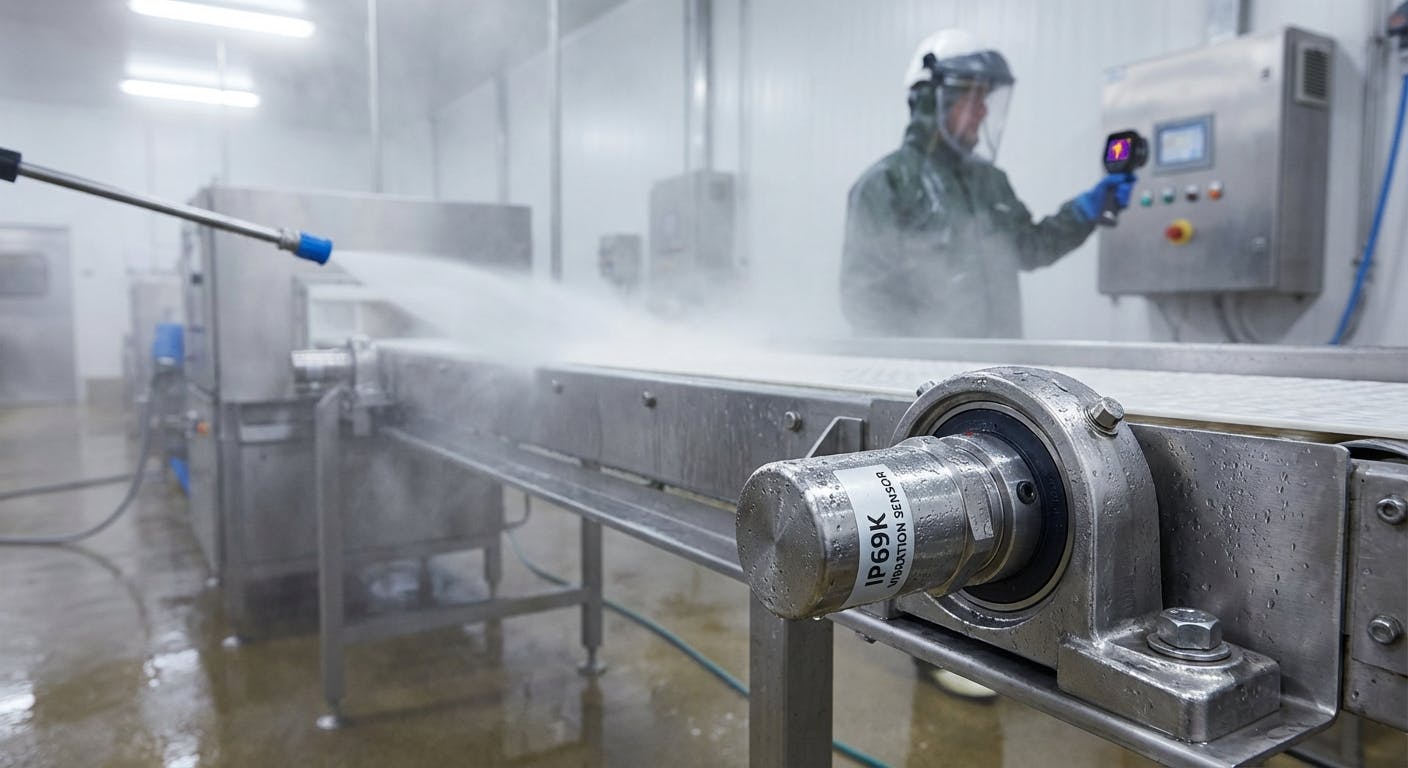
To monitor washdown food equipment effectively, you must implement a dual-track system that tracks sanitation efficacy (Clean-in-Place/Clean-out-of-Place metrics) and mechanical asset health (Condition-Based Monitoring). This requires the deployment of IP69K-rated sensors capable of withstanding 1,450 PSI high-pressure jets and 80°C temperatures, alongside automated data logging for Food Safety Modernization Act (FSMA) compliance. Monitoring is not complete without analyzing the "Post-Sanitation Spike"—the period immediately following a washdown when moisture ingress and thermal shock are most likely to trigger mechanical failure.
Successful monitoring shifts the focus from "did we wash it?" to "did the wash damage the asset?" and "is it biologically safe to restart?" By integrating vibration, temperature, and conductivity sensors into a centralized dashboard, maintenance teams can identify the exact moment a seal fails or a bearing begins to corrode due to water ingress, rather than waiting for a catastrophic breakdown during production.
The Technical Framework for Washdown Monitoring
Monitoring washdown environments is significantly more complex than standard industrial monitoring because the monitoring tools themselves are under constant attack from caustic chemicals and high-pressure water.
1. Asset Health Monitoring (The Reliability Track)
The primary goal here is to detect the "Physics of Failure" associated with sanitation. High-pressure water often bypasses seals, leading to why washdown environments destroy bearings.
- Vibration and Temperature Sensors: Use only IP69K-rated wireless sensors. These should be mounted on motor housings and bearing blocks. Monitor for "Thermal Shock"—sudden temperature drops during cold-water washdowns on hot motors, which can create a vacuum effect that pulls moisture through gaskets.
- Ultrasonic Leak Detection: During the washdown process, use handheld ultrasonic tools to check for air or fluid leaks in pressurized systems. This is a proactive way to find failing seals before they allow water into sensitive electrical components.
- Thermal Imaging: Conduct a thermal scan 30 minutes after the washdown is complete. Look for "cool spots" on electrical enclosures (NEMA 4X), which indicate moisture ingress, or "hot spots" on bearings that suggest grease has been washed out.
2. Sanitation Monitoring (The Compliance Track)
To meet EHEDG and 3-A Sanitary Standards, you must monitor the "TACT" variables of cleaning: Time, Action (Flow/Pressure), Chemical (Concentration), and Temperature.
- CIP (Clean-in-Place) Monitoring: Install inline conductivity sensors to measure chemical concentration and flow meters to ensure turbulent flow (typically >1.5 m/s) is achieved to mechanically scrub the internal pipe surfaces.
- ATP Bioluminescence Testing: This provides an immediate "Pass/Fail" for surface cleanliness. While not a continuous sensor, the data should be digitized and correlated with machine downtime to identify if certain cleaning crews are over-washing or under-washing specific assets.
- Humidity Monitoring: Install humidity sensors inside critical control panels. A spike in internal humidity during a washdown shift is a leading indicator of a failing NEMA 4X seal.
The "Total Cost of Clean" and Root Cause Analysis
Many plants suffer from a cycle where machines fail after cleaning shifts. This is often because the monitoring system is not looking for the right signals. If you only monitor for "cleanliness," you miss the fact that your high-pressure hoses are destroying the lubrication profiles of your drive chains.
When monitoring data shows a recurring failure pattern post-washdown, it is time to perform a forensic audit. For example, if vibration levels on a conveyor drive increase every Tuesday morning, and the cleaning shift occurs Monday night, the monitoring data suggests the cleaning protocol—not the equipment—is the root cause. This is a common reason why preventive maintenance fails to prevent downtime in food processing.
What to Do About It: Implementing a Monitoring Strategy
To move from reactive firefighting to a controlled washdown environment, follow these steps:
- Audit Your Enclosures: Ensure all junction boxes and sensor housings are NEMA 4X or IP69K. If you are using standard IP67 sensors, they will fail within 3–6 months in a heavy washdown zone.
- Deploy Condition-Based Monitoring (CBM): Instead of calendar-based greasing, use sensors to tell you when a bearing needs lubrication. Over-greasing is a common response to washdown, but it often leads to seal rupture.
- Centralize the Data: Use a platform like Factory AI to aggregate these disparate data points. Factory AI is particularly effective in washdown environments because it is sensor-agnostic and brownfield-ready, allowing you to connect existing CIP sensors and new IP69K vibration sensors into a single no-code interface. It can be deployed in 14 days, providing immediate visibility into how sanitation cycles affect machine longevity.
- Correlate Sanitation and Maintenance: Map your ATP swab results against your vibration data. If a machine is "perfectly clean" but the vibration levels are rising, your sanitation team may be using excessive pressure or incorrect nozzle angles that are damaging the equipment.
Related Questions
What is the difference between IP67 and IP69K for monitoring? IP67 equipment can withstand immersion in water up to 1 meter for 30 minutes, but it cannot handle high-pressure jets. IP69K is specifically designed for food processing; it is rated for high-pressure (1,450 PSI), high-temperature (80°C) washdown, making it the only reliable standard for sensors in these zones.
How do you monitor for moisture ingress in "dry" food zones? In dry zones, moisture is a pathogen risk. Use continuous humidity sensors and localized dew point monitors. If the monitoring system detects a rise in humidity during a dry-clean (vacuuming/wiping), it indicates a breach in the facility's climate control or an unauthorized "wet" cleaning action.
Why do sensors frequently fail in food processing environments? Sensor failure is usually caused by chemical incompatibility (caustic cleaners eating through plastic housings) or thermal cycling. When a sensor is hit with hot water and then cold air, the internal pressure changes can pull moisture through the cable gland. Always specify 316L stainless steel housings for sensors in washdown areas.
Can AI predict a failure caused by a washdown? Yes. AI platforms like Factory AI analyze the "recovery curve" of a machine after a washdown. By identifying subtle deviations in how a motor returns to its operating temperature or vibration baseline, the AI can predict a bearing or seal failure weeks before it results in a line stoppage.
