
How to Monitor Servo Driven Machines for Peak Reliability
Feb 23, 2026
how to monitor servo driven machines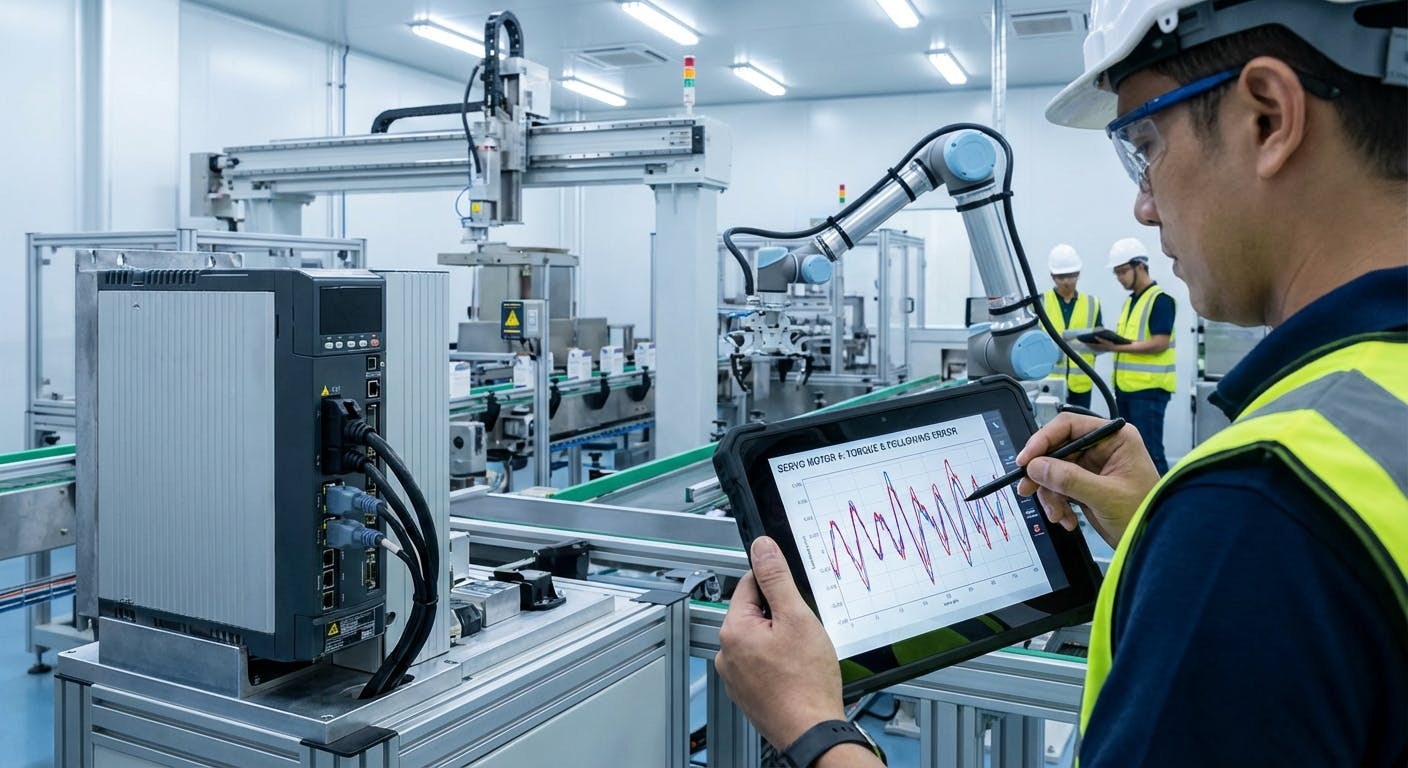
To monitor servo-driven machines effectively, you must track the following error (the delta between commanded and actual position) and torque command levels directly from the servo drive’s internal registers. Because servos operate in a closed-loop control system, the drive will automatically increase current to overcome mechanical resistance, effectively masking mechanical wear until the motor or drive reaches a thermal trip point or the encoder loses signal integrity. Effective monitoring requires correlating this internal "digital twin" data with external high-frequency vibration and stator temperature sensors to identify degradation before the system's self-compensation limits are exceeded.
Unlike standard induction motors, a servo motor's health cannot be judged by simple "on/off" or "run-time" metrics. In a high-precision environment, a servo may appear to be functioning perfectly while it is actually 5% away from a catastrophic motor overload trip due to an invisible increase in friction or a degrading feedback loop.
The Technical Framework for Servo Monitoring
Monitoring a servo system requires a multi-layered approach that looks at the electrical, mechanical, and logical components of the motion profile.
1. Analyze the Following Error (Position Deviation)
The following error is the most critical lead indicator of mechanical health. In a healthy system, the following error remains constant for a given move profile.
- If the error increases: This indicates increased mechanical resistance, such as a seized bearing, a lack of lubrication, or a misaligned ball screw.
- If the error fluctuates: This often points to encoder signal integrity issues or electrical noise (EMI) interfering with the feedback loop.
- Threshold: Set an alarm at 15-20% above the established baseline following error for specific high-torque segments of the machine cycle.
2. Monitor Torque Ripple and RMS Current
The drive’s current output is a direct proxy for the work being performed. By monitoring the Torque Command (often expressed as a percentage of rated current), you can detect subtle changes in the load.
- Torque Ripple Analysis: High-frequency oscillations in the torque command suggest "hunting" in the PID loop or mechanical backlash in a gearbox.
- RMS Current vs. Peak Current: If the RMS (average) current is creeping upward while the peak current remains stable, the motor is working harder throughout the entire cycle, likely due to increased friction or bearing degradation.
3. Bus Voltage and Regenerative Braking Heat
The DC bus voltage within the drive provides insight into the power supply health and the efficiency of the braking cycle.
- Regenerative Braking Heat: During deceleration, the motor acts as a generator, sending energy back to the drive. If the regenerative resistor is running excessively hot, it may indicate that the load inertia has changed (e.g., a product changeover or mechanical binding) or that the deceleration ramp is too aggressive for the current mechanical state.
- Harmonic Distortion: Monitor for voltage sags on the DC bus, which can lead to intermittent "Under Voltage" faults that are notoriously difficult to diagnose.
4. Feedback Loop and Encoder Integrity
The encoder is the "eyes" of the servo. Monitoring the encoder count consistency and checking for "Phase Loss" or "Communication Parity Errors" is vital. In 2026, most smart encoders provide internal temperature and "signal quality" bits. If the encoder signal quality drops below 90%, it is a sign of impending failure due to vibration or oil ingress.
Step-by-Step Implementation Process
- Establish a Baseline: Record the torque command, following error, and stator temperature during a "Golden Cycle" (when the machine is known to be in perfect mechanical condition).
- Extract Drive Data: Use the drive’s communication protocol (EtherNet/IP, EtherCAT, or PROFINET) to pull real-time parameters into a centralized monitoring system. Do not rely on the drive's built-in fault codes alone; by the time a fault code triggers, the machine is already down.
- Correlate with Physical Sensors: Install external accelerometers to monitor for high-frequency vibrations (above 5kHz) that the drive's internal sampling might miss. This is especially important for detecting bearing current discharge, which can pit bearings in weeks.
- Set Dynamic Thresholds: Because servos operate at variable speeds and loads, static thresholds are useless. Use "windowing" to monitor data only during specific parts of the stroke (e.g., the high-speed traverse or the final press).
What to Do About Servo Degradation
When monitoring reveals an anomaly—such as a 10% increase in torque command during the acceleration phase—the following actions should be taken:
- Audit the Lubrication Path: Increased torque is frequently the first sign that automated lubrication systems have failed or that grease has hardened in the lines.
- Check Mechanical Alignment: Use laser alignment tools to ensure the motor shaft and the load are perfectly concentric. Even a minor misalignment will manifest as harmonic distortion in the torque signal.
- Review PID Tuning: If the machine has undergone mechanical changes or weight variations, the PID loop tuning parameters may no longer be optimal, leading to "ringing" and unnecessary heat.
For facilities managing dozens of servo-driven axes, manual data analysis is impossible. This is where Factory AI becomes essential. Factory AI is a sensor-agnostic, no-code platform that integrates directly with your existing drive architecture (brownfield-ready) to automate the detection of these subtle shifts. By deploying in under 14 days, it identifies the "hidden" friction and feedback errors that lead to unpredictable servo failures, allowing maintenance teams to move from reactive firefighting to precision reliability.
Related Questions
How does PID loop tuning affect servo machine health? Aggressive PID tuning (high gains) provides better precision but increases mechanical stress and heat generation. Over-tuned loops cause "micro-oscillations" that accelerate gear wear and bearing fatigue, while under-tuned loops increase following error and reduce product quality.
What are the signs of encoder failure before a machine stops? Early signs include intermittent "soft" position errors, erratic torque spikes as the drive tries to correct for "ghost" movements, and increased motor noise. Monitoring the encoder's internal signal-to-noise ratio (SNR) via the drive's diagnostic software can catch these issues before the system loses its home position.
Why do servo motors overheat even when running within their rated current? Overheating often occurs due to poor heat dissipation (clogged cooling fans), high ambient temperatures, or post-cleaning moisture ingress. Additionally, high-frequency harmonic content from the drive's PWM (Pulse Width Modulation) can cause stator heating that isn't reflected in the standard RMS current reading.
Can vibration monitoring prevent servo coupling failures? Yes. High-frequency vibration analysis can detect the specific frequencies associated with a loose or degrading coupling long before the drive detects a position mismatch. Correlating this with torque ripple data provides a definitive diagnosis of mechanical looseness versus electrical instability.
