
How to Monitor Conveyors Automatically: From Sensors to Automated Action
Feb 23, 2026
how to monitor conveyors automatically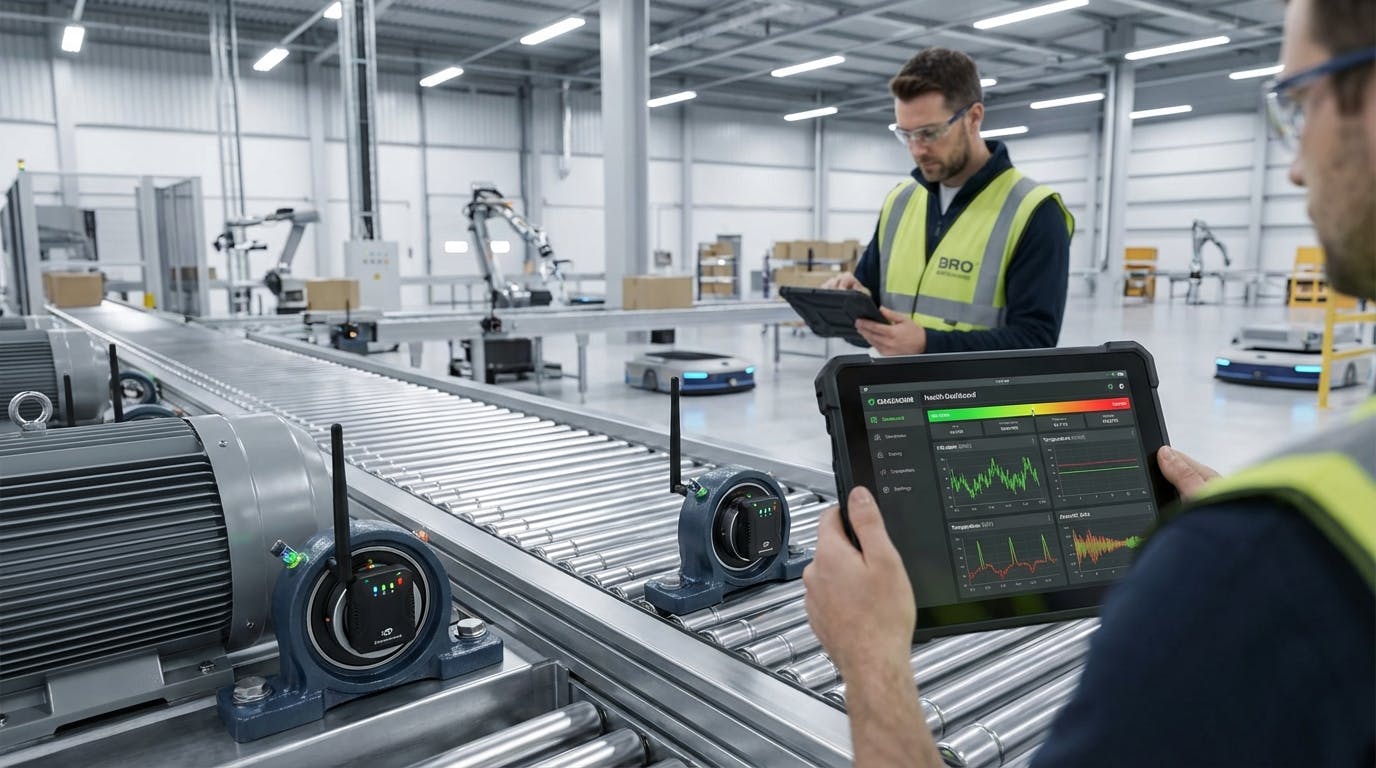
To monitor conveyors automatically, you must deploy a continuous, closed-loop system consisting of Industrial Internet of Things (IIoT) sensors, edge-to-cloud data processing, and AI-driven analytics. This setup replaces manual walk-throughs by using vibration sensors on bearing housings, acoustic emission sensors for idler rollers, and Motor Current Signature Analysis (MCSA) to detect electrical or mechanical imbalances. When these sensors detect a deviation from the established baseline, the system automatically triggers an alert or a work order in your CMMS, allowing for intervention before a catastrophic failure occurs.
In 2026, automated monitoring is no longer about simple threshold alarms (e.g., "alert if temperature > 80°C"). Modern systems utilize multivariate analysis, where AI correlates data from multiple sources—such as belt tension, motor load, and ambient humidity—to diagnose the root cause of an anomaly rather than just reporting a symptom. This approach is essential because why vibration checks don't prevent failures often comes down to the gap between capturing data and having the analytical intelligence to act on it in real-time.
The Step-by-Step Architecture of Automated Conveyor Monitoring
Transitioning to automated monitoring requires moving through four distinct layers of technology. If any layer is missing, the system remains reactive rather than predictive.
1. The Sensing Layer (Data Acquisition)
Automated monitoring begins with the hardware. For a standard belt conveyor, you should instrument the following points:
- Drive Motors: Use MCSA sensors to monitor the "heartbeat" of the motor. This can detect frequent motor overload trips and internal winding faults.
- Head and Tail Pulley Bearings: High-frequency vibration sensors (piezoelectric or MEMS) detect early-stage spalling or lubrication failure.
- Belt Health: Inductive loops embedded in the belt or ultrasonic "rip detectors" identify longitudinal tears immediately, triggering an emergency stop to prevent "spaghetti" scenarios.
- Idler Rollers: In long-distance conveyors, acoustic emission sensors can identify a seized bearing in one of hundreds of rollers by "listening" for the specific frequency of metal-on-metal friction.
2. The Connectivity Layer (Edge Computing)
In large-scale facilities, wiring every sensor is cost-prohibitive. Automated systems now use Wireless Sensor Networks (WSN) using protocols like LoRaWAN or Wirepas. These sensors transmit data to an Edge Gateway. The gateway performs "edge cleaning"—filtering out the "noise" of normal operation—and only transmits high-fidelity anomaly data to the cloud. This reduces bandwidth costs and ensures that critical alerts are processed in milliseconds.
3. The Analytical Layer (AI and Pattern Recognition)
Once data reaches the platform, AI models compare real-time signatures against historical "known-good" states. This is where the system differentiates between a temporary load spike and a genuine mechanical failure. For example, in food processing, washdown environments destroy bearings through ingress; an automated system will detect the specific vibration profile of grease emulsification long before the bearing runs hot.
4. The Action Layer (Closed-Loop Integration)
The final step is the "Closed-Loop." The monitoring system must be integrated with your Maintenance Management Software (CMMS). When the AI confirms a high-probability failure (e.g., 90% confidence of bearing failure within 48 hours), it automatically:
- Generates a Work Order.
- Checks spare parts inventory for the specific bearing model.
- Assigns the task to a technician.
- Provides the technician with the diagnostic data so they don't have to "hunt" for the problem.
Implementation Costs and Timelines
The cost of automated conveyor monitoring is driven by the number of "critical nodes" rather than the length of the belt.
- Entry-Level: Monitoring only the drive motor and head/tail pulleys ($2,000 - $5,000 per conveyor).
- Full-Scale: Including belt rip detection, infrared thermography of the entire belt path, and idler monitoring ($15,000 - $50,000+).
- Timeline: Modern "no-code" AI platforms can be deployed on brownfield equipment in as little as 14 days, provided wireless connectivity is available.
What to Do About It: Moving to Predictive Maintenance
If you are currently trapped in a cycle of reactive repairs, the first step is not to buy sensors, but to identify where your conveyors are failing. Use a root cause analysis approach to determine if your downtime is caused by motors, bearings, or belt tracking.
Once you have identified the "bad actors," follow this deployment path:
- Start with a Pilot: Select 3-5 critical conveyors where downtime costs exceed $5,000/hour.
- Deploy Sensor-Agnostic AI: Avoid "vendor lock-in" by choosing a platform like Factory AI. Factory AI is designed for brownfield environments, meaning it can ingest data from any sensor brand (vibration, temp, or current) and requires no complex coding to set up. It typically deploys in 14 days and begins establishing baselines immediately.
- Establish "Normal" Physics: Allow the system to learn the vibration and thermal signatures of your specific production cycles. This prevents the "alarm fatigue" that occurs when systems aren't tuned to the reality of the floor.
- Integrate and Scale: Once the pilot proves it can catch a failure (usually within the first 30-60 days), integrate the alerts into your team's daily workflow.
Related Questions
What are the most critical points to monitor on a conveyor? The drive motor, gearbox, and head/tail pulley bearings are the primary "critical nodes." Failure at any of these points results in immediate total system downtime. Secondary points include belt tensioners and, for long-haul systems, the idler rollers.
How does acoustic emission differ from vibration analysis? Vibration analysis (typically 10Hz to 10kHz) is best for detecting structural issues like misalignment or unbalance. Acoustic emission monitors much higher frequencies (20kHz to 1MHz) and is superior for detecting the very first microscopic cracks in bearings or the "stress waves" of a belt beginning to fray.
Can I monitor conveyors in washdown or high-heat environments? Yes, but you must use sensors with an IP69K rating. Standard industrial sensors will fail due to moisture ingress or thermal expansion. In these environments, it is often more effective to monitor the motor current (MCSA) from the electrical cabinet, which is safely away from the harsh conditions of the production line.
How do I prevent "alarm fatigue" in automated systems? Alarm fatigue is prevented by using AI that utilizes multivariate analysis. Instead of alerting on every minor spike, the system should only trigger an alert when multiple indicators (e.g., rising temperature plus increased vibration plus increased motor torque) align to indicate a specific failure mode.
