
How to Monitor Assets Across Multiple Sites: The Standardization-First Approach
Feb 23, 2026
how to monitor assets across multiple sites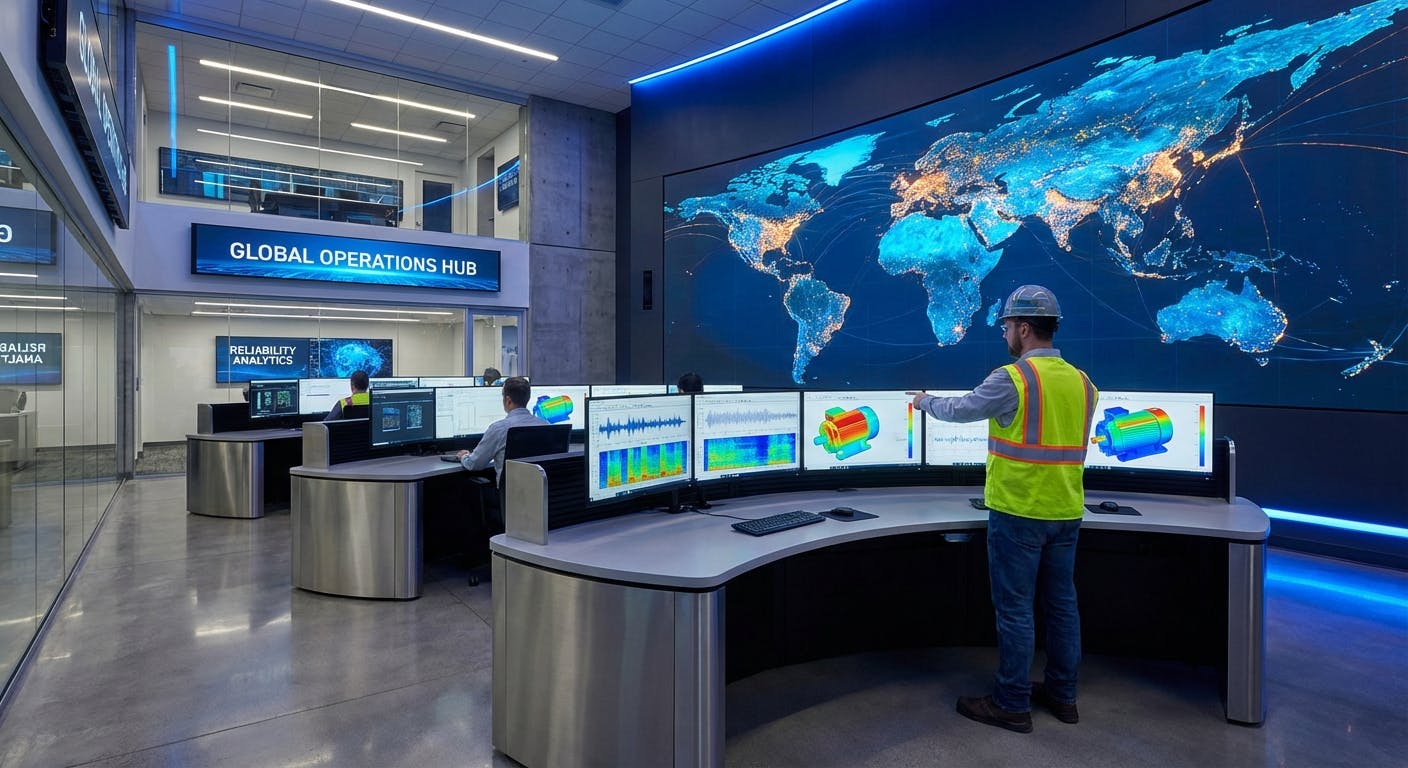
To monitor assets across multiple sites, you must implement a centralized, cloud-based Enterprise Asset Management (EAM) or IIoT platform that utilizes a standardized asset hierarchy (ISO 14224) to normalize data from disparate locations. This process requires moving away from site-specific spreadsheets and siloed CMMS instances toward a multi-tenant architecture where real-time telemetry data from IIoT sensors and PLC outputs is aggregated into a single "pane of glass."
The success of multi-site monitoring depends on the "Golden Thread" of data—ensuring that a "Critical Pump" at Site A is defined, measured, and alerted using the exact same parameters as a "Critical Pump" at Site B. Without this standardization, enterprise-level benchmarking and Overall Equipment Effectiveness (OEE) tracking are impossible, as technicians often don't trust maintenance data that appears inconsistent across facilities.
The Step-by-Step Process for Multi-Site Asset Monitoring
Effective multi-site monitoring is not a software purchase; it is a structural alignment of data and workflows. Follow this four-step process to establish a scalable monitoring framework.
1. Establish a Standardized Asset Hierarchy (ISO 14224)
Before deploying a single sensor, you must define how assets are categorized. Use the ISO 14224 standard to create a taxonomy that spans the entire enterprise.
- Level 1-3: Industry, Business Category, and Installation (Site).
- Level 4-5: Plant/Unit and Section/System.
- Level 6-9: Equipment Class, Subunit, Component, and Part. Standardizing these levels ensures that when you run a report on "Bearing Failures," you are seeing data from every site simultaneously, rather than hunting through different naming conventions.
2. Implement a Multi-Tenant Cloud Architecture
To monitor remote sites, data must flow from the "edge" (the factory floor) to a centralized cloud environment.
- If the site has modern PLCs: Use MQTT or OPC-UA protocols to push data to a central broker.
- If the site is a "brownfield" facility: Deploy wireless IIoT sensors (vibration, temperature, ultrasonic) that bypass local IT hurdles by using cellular gateways to send data directly to the cloud. This architecture allows corporate reliability engineers to view real-time telemetry without needing a VPN for every individual site.
3. Normalize Real-Time Telemetry Data
Raw data is not information. A vibration sensor at Site A might report in mm/s (RMS), while Site B uses inches/s (Peak). Your monitoring platform must include a normalization layer that converts all incoming telemetry into standardized units. This allows for the creation of "Global Health Scores." If a motor’s health drops below 60%, the system should trigger an alert regardless of which facility it is located in. This prevents the common issue where vibration checks don't prevent failures because the data was never contextualized against enterprise standards.
4. Deploy Standardized Maintenance Workflows
Monitoring is useless if the response to an alert varies by site. You must integrate your monitoring data with a centralized CMMS/EAM to trigger "Standardized Work Orders." When an IIoT sensor detects an anomaly, the system should automatically generate a work order with the same parts list and safety procedures across all sites. This is the only way to eliminate chronic machine failures and repeated downtime at an enterprise scale.
What to Do About It: Moving from Pilot to Enterprise Scale
Transitioning to multi-site monitoring often stalls during the "pilot purgatory" phase. To avoid this, focus on high-criticality assets that share common failure modes across your sites (e.g., all packaging lines or all cooling towers).
- Audit Your Connectivity: Identify which sites have the infrastructure to support real-time data streaming and which require "bolt-on" IIoT solutions.
- Select a Sensor-Agnostic Platform: Avoid vendor lock-in. Choose a platform that can ingest data from any hardware, whether it’s a high-end vibration sensor or a simple temperature probe.
- Deploy Factory AI: For organizations needing rapid results, Factory AI offers a no-code, brownfield-ready solution that can be deployed across multiple sites in as little as 14 days. Because it is sensor-agnostic, it can bridge the gap between modern facilities and legacy plants, providing a unified view of asset health without requiring a "rip and replace" of existing equipment.
- Establish a Centralized Reliability Command Center: Assign a small team of reliability engineers to monitor the "Global Dashboard." Their job is to identify patterns—such as why a specific pump model fails every 6 months at Site A but lasts 2 years at Site B—and push those insights back to the local maintenance teams.
Related Questions
How do you handle data security when monitoring assets across different geographic regions? Data security is managed through encrypted MQTT bridges and SOC2-compliant cloud providers. By using outbound-only cellular gateways for IIoT sensors, you can isolate the monitoring data from the primary corporate network, significantly reducing the cyber-attack surface.
Can I monitor OEE across multiple sites if they use different brands of machinery? Yes, by using an IIoT gateway that supports multiple industrial protocols (Modbus, Ethernet/IP, Profinet). The gateway acts as a translator, converting different machine languages into a standardized data format before sending it to your central dashboard for OEE calculation.
What is the most common reason multi-site monitoring projects fail? Projects usually fail due to a lack of data standardization. If each site maintains its own naming conventions and alarm thresholds, the central dashboard becomes a "data graveyard" where information is too fragmented to be actionable or comparable.
How does remote condition monitoring reduce travel costs for reliability engineers? Remote monitoring allows experts to perform "Forensic Triage" from a central location. Instead of traveling to every site for routine inspections, engineers only deploy to a specific facility when the centralized platform detects a high-confidence anomaly that requires physical intervention.
