
How to Measure Maintenance Effectiveness: From Reactive Firefighting to Strategic Reliability
Feb 23, 2026
how to measure maintenance effectiveness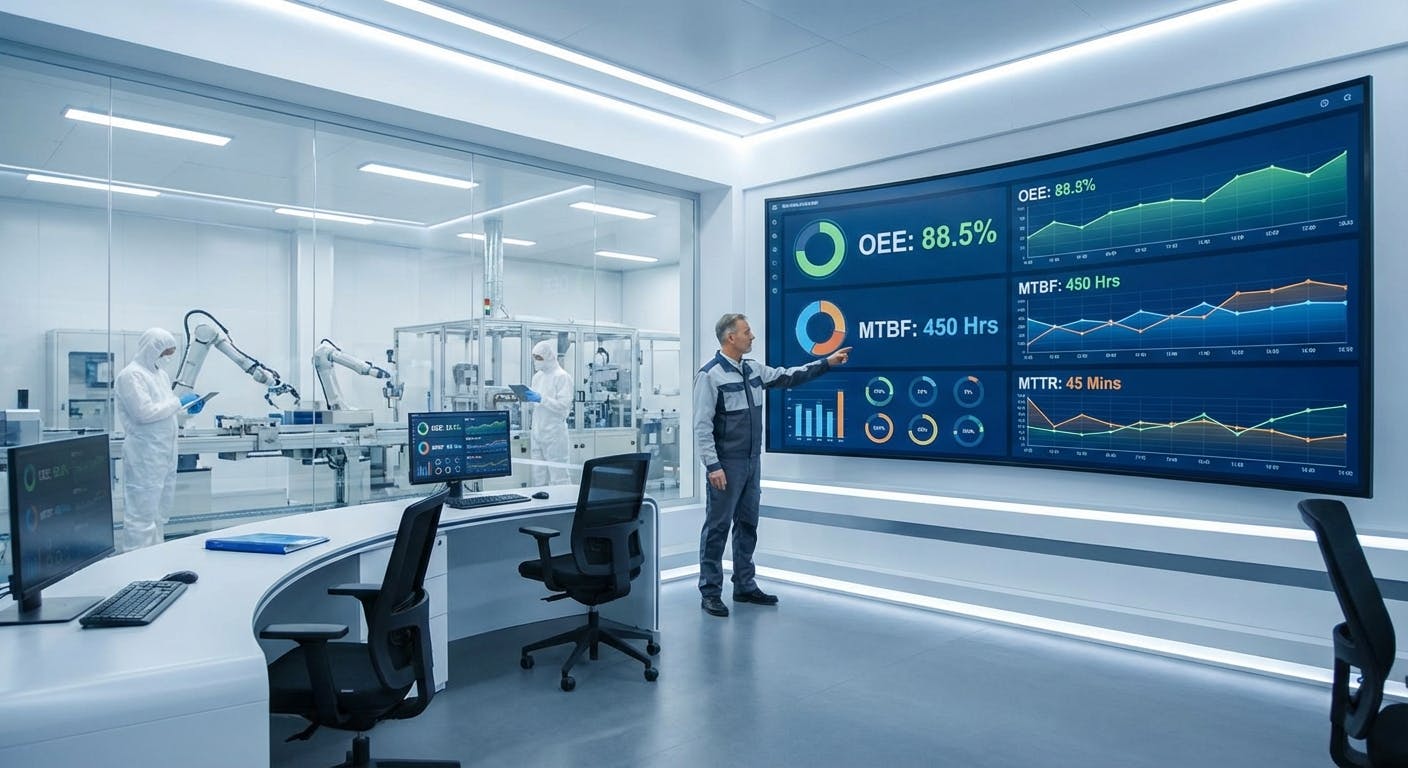
To measure maintenance effectiveness, you must calculate the ratio of maintenance inputs (labor, parts, and budget) to asset outputs (uptime, reliability, and safety). The primary metric for effectiveness is Overall Equipment Effectiveness (OEE), which combines availability, performance, and quality. While maintenance efficiency measures "doing things right" (e.g., how fast a repair is completed), maintenance effectiveness measures "doing the right things" (e.g., whether that repair prevented future downtime).
A comprehensive measurement strategy requires tracking three core Key Performance Indicators (KPIs): Mean Time Between Failures (MTBF) to gauge reliability, Mean Time To Repair (MTTR) to gauge responsiveness, and Planned Maintenance Percentage (PMP) to gauge proactivity. In 2026, world-class facilities also incorporate Replacement Asset Value (RAV) to ensure maintenance costs do not exceed the economic value of the equipment.
The Maintenance Maturity Model: A Step-by-Step Framework
Measuring effectiveness is not a "one-size-fits-all" calculation. It depends on your facility's current maturity level. Attempting to measure advanced metrics like Predictive Maintenance ROI before mastering basic work order completion will result in skewed data and systemic trust failure among technicians.
Level 1: The Reactive Stage (Firefighting)
At this stage, your primary goal is to stabilize the plant. You measure effectiveness by how quickly you can recover from failure.
- Key Metric: MTTR (Mean Time to Repair).
- The Goal: Reduce the time from "machine down" to "machine running."
- Decision Point: If your maintenance backlog keeps growing, your effectiveness is low because your team is trapped in a "reactive death spiral" where they cannot perform the preventive work necessary to stop future breaks.
Level 2: The Planned Stage (Compliance)
Once stabilization occurs, you shift focus to schedule adherence. You are measuring your ability to control the environment rather than letting the environment control you.
- Key Metric: PM Compliance and PMP (Planned Maintenance Percentage).
- The Goal: Achieve >80% PMP.
- Decision Point: If you have high PM compliance but downtime remains high, your PMs are likely ineffective. This is common in complex sectors; for example, preventive maintenance often fails in food processing because calendar-based tasks don't account for the physical stress of washdown cycles.
Level 3: The Proactive Stage (Reliability)
At Level 3, you measure the health of the asset itself. You move away from "did we do the task?" to "did the asset fail?"
- Key Metric: MTBF (Mean Time Between Failures).
- The Goal: Increase the interval between unplanned stops.
- Decision Point: Use Asset Criticality Ranking to determine where to deploy sensors. If an asset has a high MTBF but low criticality, reallocate resources to "bottleneck" machines.
Level 4: The Optimized Stage (Strategic)
World-class organizations measure maintenance as a profit center.
- Key Metric: OEE and Maintenance Cost as a % of RAV.
- The Goal: Optimize the total cost of ownership.
- Decision Point: Use AI-driven insights to move from fixed intervals to condition-based maintenance, ensuring you never perform a PM on a healthy machine while ignoring a developing fault.
What to Do About It: Improving Your Effectiveness Score
Measuring effectiveness is useless without a feedback loop to improve it. If your metrics show low effectiveness, follow these steps to eliminate chronic machine failures:
- Audit Your Data Integrity: Ensure technicians are accurately logging "Stop" and "Start" times. If the data is "dirty," your MTBF and MTTR calculations will be mathematically sound but operationally useless.
- Perform Root Cause Analysis (RCA): For any asset where MTBF is decreasing, perform a formal RCA. Don't just fix the symptom; diagnose why the component failed. According to the Society for Maintenance & Reliability Professionals (SMRP), effective RCA can reduce repeat failures by up to 40%.
- Implement Condition Monitoring: Manual inspections are snapshots in time. To truly measure and improve effectiveness, you need continuous data.
- Deploy Factory AI: To bridge the gap between Level 2 (Planned) and Level 3 (Proactive), Factory AI provides a sensor-agnostic, no-code platform that integrates with your existing brownfield equipment. It can be deployed in 14 days, providing the real-time MTBF and OEE data needed to prove maintenance ROI to executive leadership.
- Review Asset Criticality: Not all machines are equal. Effectiveness is highest when 80% of your resources are focused on the 20% of assets that drive 80% of your production value.
Related Questions
What is the difference between maintenance efficiency and maintenance effectiveness? Efficiency is a measure of resource usage, such as "How many work orders did we close this week?" Effectiveness is a measure of the outcome, such as "Did those work orders actually increase machine uptime?" You can be highly efficient at doing the wrong tasks, which results in low effectiveness.
What is a "good" MTBF for manufacturing equipment? There is no universal "good" number, as MTBF is relative to the asset's age and duty cycle. However, a positive trend (increasing MTBF over six months) is the standard indicator of improving maintenance effectiveness. You should benchmark your MTBF against the original equipment manufacturer (OEM) specifications and ISO 55000 standards.
How does maintenance backlog impact effectiveness measurements? A backlog exceeding 4-6 weeks per technician usually indicates that the maintenance team is in a reactive state. When the backlog is too high, effectiveness drops because technicians are forced to "patch" machines to get them running rather than performing high-quality, permanent repairs.
How can AI help measure maintenance effectiveness? AI platforms like Factory AI automate the collection of uptime and performance data, removing human bias from OEE and MTBF calculations. By identifying "micro-stops" that human operators often miss, AI provides a more accurate picture of true maintenance effectiveness and predicts failures before they impact the bottom line.
