
How to Identify Maintenance Bottlenecks in Industrial Environments
Feb 23, 2026
how to identify maintenance bottlenecks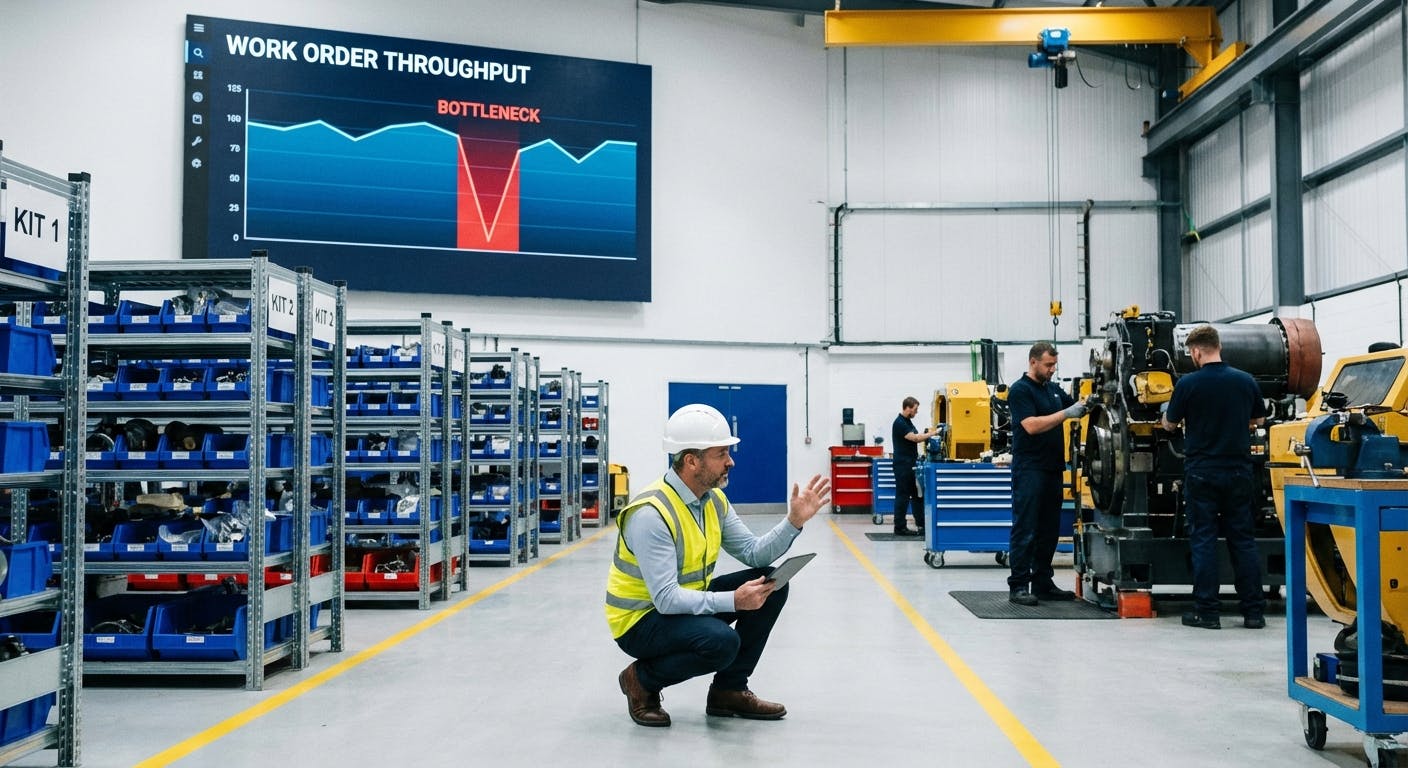
To identify maintenance bottlenecks, you must measure the delta between work order generation and completion rates while auditing the "waiting" time within the Mean Time to Repair (MTTR) cycle. A bottleneck is confirmed when the Maintenance Backlog exceeds 4–6 weeks of work per technician or when Wrench Time (actual time spent on tools) drops below 25–35%. If your team is consistently completing scheduled tasks but the total volume of deferred work is rising, the bottleneck is likely in your planning or parts procurement process, not technician skill levels.
Identifying these constraints requires a shift from tracking "what broke" to tracking "where the work stopped." In most 2026 manufacturing environments, bottlenecks are rarely caused by a lack of effort; they are caused by systemic friction in the work order lifecycle, such as delayed production handovers, unavailable spare parts, or why maintenance planning never catches up due to a reactive "firefighting" culture.
The 4-Step Diagnostic Process for Identifying Bottlenecks
Identifying a bottleneck requires a "Data-First" diagnostic approach. Follow these steps to isolate exactly where your maintenance throughput is failing.
1. Calculate the Backlog-to-Capacity Ratio
The first indicator of a bottleneck is the Maintenance Backlog Weeks. Calculate this by taking the total estimated hours of all "Ready to Work" and "Deferred" work orders and dividing it by your total weekly technician labor hours (adjusted for 80% utilization).
- Healthy Range: 2–4 weeks.
- Bottleneck Warning: 4–6 weeks.
- Systemic Failure: >6 weeks. If your backlog is growing despite high labor utilization, you have a capacity bottleneck. If your backlog is low but downtime is high, you have a reactive death spiral where the wrong work is being prioritized.
2. Deconstruct Mean Time to Repair (MTTR)
MTTR is often misunderstood as a measure of technician speed. To find bottlenecks, break MTTR into four distinct phases:
- Detection Time: Time from failure to work order creation.
- Response Time: Time from creation to technician arrival.
- Administrative Lead Time: Time spent waiting for parts, permits, or production to "lock out" the machine.
- Actual Repair Time: Time spent physically fixing the asset. If "Administrative Lead Time" accounts for more than 50% of your MTTR, your bottleneck is in Maintenance Planning and Scheduling (P&S), not technical execution.
3. Audit "Wrench Time" via Work Sampling
Wrench time is the percentage of a shift a technician spends moving the job forward. In many facilities, technicians spend 60% of their day searching for parts, walking to the tool crib, or waiting for instructions.
- If Wrench Time is <35%: The bottleneck is your MRO (Maintenance, Repair, and Operations) Supply Chain or your kitting process.
- If Wrench Time is >50%: Your processes are efficient, and any remaining bottleneck is likely a pure labor shortage.
4. Analyze PM Compliance vs. Breakout Work
High preventive maintenance (PM) compliance can mask a bottleneck if the PMs themselves are ineffective. If you have 95% PM compliance but your "Breakout Work" (unplanned repairs that interrupt the schedule) is higher than 20%, the PM process itself is the bottleneck. It is consuming labor hours without delivering reliability, preventing the team from addressing the actual root causes of failure.
What to Do About Maintenance Bottlenecks
Once a bottleneck is identified, the goal is to increase "throughput"—the rate at which the maintenance department completes high-value work.
1. Implement "Kitting" for All Planned Work If the bottleneck is Administrative Lead Time, implement a kitting strategy. No work order should be scheduled until every part, tool, and permit is physically staged in a "kit." This ensures that when a technician is assigned a task, their Wrench Time remains near 100%.
2. Shift from Calendar-Based to Condition-Based Monitoring Many bottlenecks are self-inflicted by over-maintaining assets. By moving away from rigid calendar schedules, you free up labor capacity. For example, eliminating chronic machine failures through better data allows you to cancel low-value PMs that clog the schedule.
3. Deploy Automated Diagnostics (Factory AI) The most common "hidden" bottleneck is the time it takes to diagnose a problem. Technicians often spend hours troubleshooting intermittent faults. Factory AI addresses this by providing a sensor-agnostic, no-code platform that identifies the physics of failure before the machine stops. Because it is brownfield-ready and deploys in 14 days, it removes the "data collection" bottleneck that plagues traditional reliability programs. Instead of technicians guessing why a motor is running hot, the AI provides the diagnostic answer, allowing them to move straight to the repair.
4. Address Data Integrity If your technicians don't trust the CMMS data, they will create "shadow systems" or ignore alerts, creating a massive communication bottleneck. Ensure your data reflects reality by addressing systemic trust failures in your reporting tools.
Related Questions
What is the difference between a maintenance constraint and a bottleneck? A constraint is any factor that limits the system from achieving more of its goal (e.g., total budget), whereas a bottleneck is a specific point in the workflow where the demand exceeds the capacity (e.g., the specialized vibration analyst is overbooked). You manage constraints, but you must "break" or "elevate" bottlenecks to increase throughput.
How do you identify a bottleneck in the spare parts procurement process? Track the "Parts Pending" status in your CMMS. If more than 15% of your open work orders are in "Waiting for Parts" status for longer than 72 hours, your MRO inventory levels or vendor lead times are the primary bottleneck. This often leads to "cannibalizing" parts from other machines, which creates further downstream delays.
Can AI identify bottlenecks automatically? Yes. Modern AI systems analyze the flow of work orders and correlate them with machine downtime data. By identifying patterns where specific assets consistently wait longer for repair than others, AI can highlight "process bottlenecks" (like slow sanitation handovers) that are invisible to manual observation.
What is a healthy ratio of planned vs. unplanned work? A world-class maintenance organization typically maintains an 80/20 ratio (80% planned, 20% unplanned). When unplanned work exceeds 30%, the resulting "emergency" repairs create a bottleneck by pulling technicians away from PMs, which leads to more failures—a cycle known as the reactive death spiral.
