
How Many Sensors Are Needed Per Machine for Reliable Condition Monitoring?
Feb 23, 2026
how many sensors needed per machine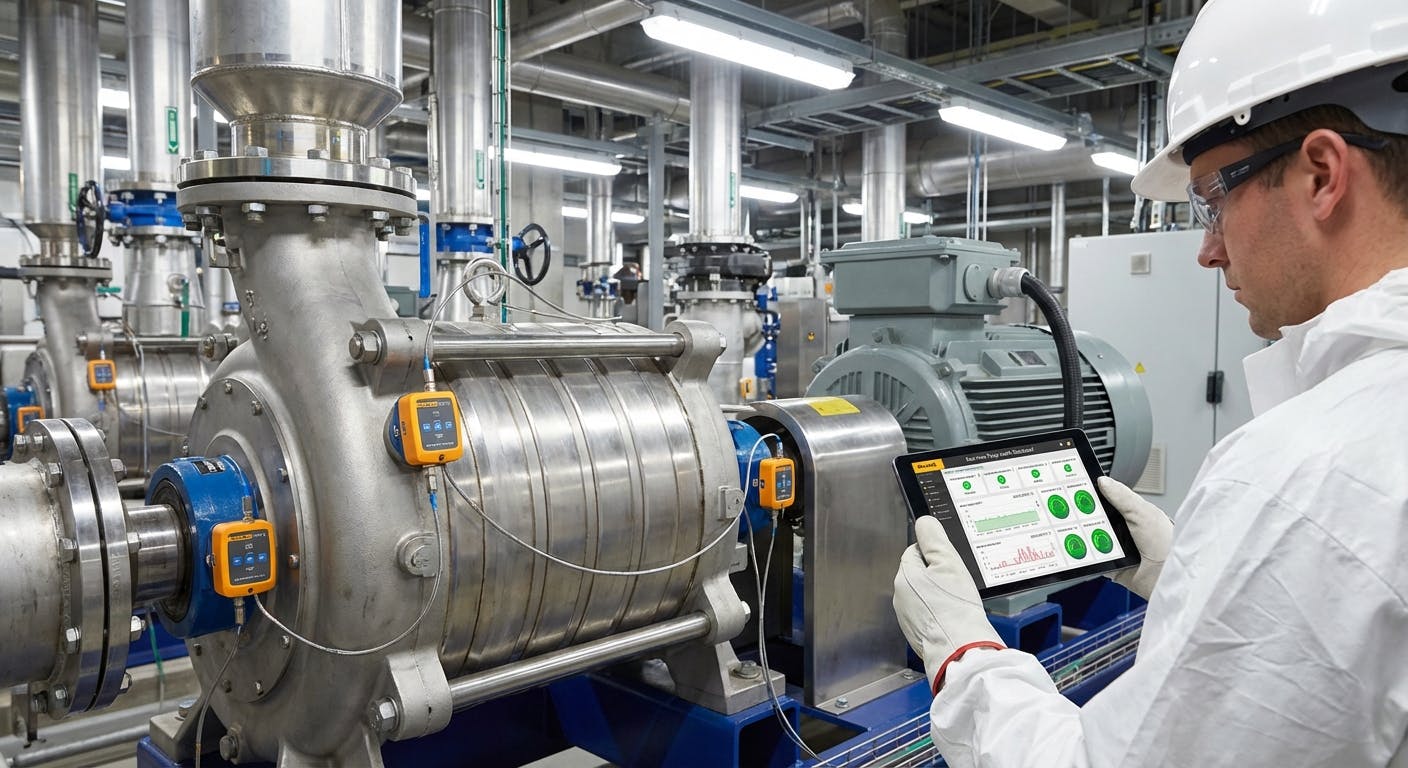
The number of sensors needed per machine is determined by the asset’s Criticality Ranking, ranging from 4 to 8+ sensors for Tier 1 (Critical) assets to 0 to 1 sensors for Tier 3 (Balance of Plant) assets. For a standard motor-pump or motor-gearbox assembly, a "Reliability-First" configuration typically requires at least two tri-axial vibration sensors and two temperature probes to capture the physics of failure across both the drive and non-drive ends.
While it is tempting to seek a flat "sensors-per-asset" ratio, over-instrumenting non-critical machines leads to "data drowning" and alarm fatigue, while under-instrumenting critical assets results in missed failure signatures. The goal is not maximum data, but an optimized Signal-to-Noise Ratio that provides enough lead time to prevent unplanned downtime.
The Criticality-Based Scaling Model
To determine the exact sensor count, maintenance managers should apply a tiered engineering approach based on the Failure Mode and Effects Analysis (FMEA) of each machine.
Tier 1: Critical Assets (4–8+ Sensors)
These are "Production Stoppers"—assets with no redundancy where failure costs exceed $10,000/hour in lost revenue or safety risks.
- Sensor Configuration: Tri-axial vibration sensors on every major bearing housing (drive end and non-drive end), high-frequency acoustic emission sensors for early-stage bearing fatigue, and current/voltage monitors for the motor.
- Why this density? Understanding why vibration checks don't prevent failures often comes down to a lack of sensor density. A single-axis sensor might miss a horizontal misalignment or a structural resonance that only appears in the axial plane.
- Examples: Main compressors, kilns, high-speed bottling fillers, or primary conveyors in food processing.
Tier 2: Essential Assets (2–4 Sensors)
These assets have partial redundancy or moderate repair costs. Failure is disruptive but not catastrophic.
- Sensor Configuration: One tri-axial vibration sensor on the most stressed bearing and one or two surface temperature probes.
- Why this density? This provides enough data to track why bearings fail repeatedly on packaging lines without the capital expense of full instrumentation. It focuses on the most common failure modes identified in the FMEA.
- Examples: Secondary pumps, standard gearboxes, and large exhaust fans.
Tier 3: Balance of Plant (0–1 Sensors or Portable)
These are "Run-to-Fail" or easily replaceable assets.
- Sensor Configuration: Often no permanent sensors. Instead, use periodic handheld routes or a single "health check" wireless sensor that monitors basic vibration velocity.
- Why this density? The cost of the sensor and the data management exceeds the cost of the asset failure.
- Examples: Small centrifugal pumps with 100% redundancy, small localized fans.
Determining Sensor Placement via Physics of Failure
Once the quantity is decided, placement is dictated by the transmission path of the energy (vibration, heat, or ultrasound).
- Vibration Sensors: Must be mounted as close to the load zone of the bearing as possible. For every mechanical interface (a joint, a bolt, or a housing cover), the vibration signal loses significant energy. If a sensor is placed 12 inches away from a bearing on a thin metal shroud, the signal-to-noise ratio will be too low to detect early-stage spalling.
- Temperature Sensors: These are lagging indicators. By the time a housing feels hot, the internal bearing components have likely already reached temperatures that degrade lubrication. Use them as secondary validation for vibration alerts.
- Acoustic Emission (AE): These are essential for low-speed applications (under 100 RPM) where standard vibration sensors struggle to distinguish signal from background noise.
What to Do About It: Implementing a Scalable Strategy
To move from a reactive state to a predictive one, follow these actionable steps:
- Perform an Asset Criticality Ranking (ACR): Rank every machine from 1 to 5 based on safety, environment, production impact, and repair cost.
- Map Failure Modes: For your Tier 1 and 2 assets, identify the top three reasons they fail. If the primary failure is "bearing seizure due to washdown," you need sensors with high IP ratings (IP69K) and moisture-sensing capabilities.
- Deploy a Pilot with Edge Computing: Instead of wiring 1,000 sensors back to a central server, use Edge Computing Gateways. These process the high-frequency data locally and only send "health scores" or anomalies to the cloud, reducing bandwidth costs.
- Adopt a Sensor-Agnostic Platform: Avoid hardware lock-in. Platforms like Factory AI are designed to be sensor-agnostic and brownfield-ready. This allows you to deploy 4 sensors on a critical motor today and integrate 2 more from a different manufacturer next year without rewriting your data architecture. Factory AI can be deployed in 14 days, providing a no-code environment that helps eliminate chronic machine failures by correlating data across different sensor types.
- Review and Refine: If a machine fails and the sensors didn't catch it, your sensor density or placement is incorrect. This is the only way to stop the reactive death spiral that plagues most maintenance departments.
Related Questions
What is the ideal signal-to-noise ratio for industrial sensors? In condition monitoring, a signal-to-noise ratio (SNR) of at least 3:1 is required to distinguish a developing fault from the baseline operating noise of the machine. High-quality tri-axial accelerometers and proper mounting (stud mounting vs. magnetic) are the primary drivers of a clean SNR.
How does sensor density affect Mean Time Between Failures (MTBF)? Higher sensor density does not directly increase MTBF, but it dramatically increases the "P-F Interval" (the time between potential failure detection and functional failure). This allows for planned interventions, which prevents the secondary damage that typically shortens a machine's overall lifespan.
Can I use one sensor for multiple failure modes? Yes, a high-frequency vibration sensor can often detect imbalance, misalignment, and bearing wear simultaneously. However, it cannot detect electrical insulation breakdown or oil chemistry changes. A "Reliability-First" approach usually requires a combination of vibration and electrical signatures (MCMA) for critical motors.
Why do sensors sometimes fail to predict a breakdown? This usually occurs due to "Point of Failure" mismatch—where the sensor was not placed in the direct energy path of the fault—or because the sampling rate was too low to catch transient events. Using an AI-driven system like Factory AI helps mitigate this by identifying subtle patterns in the data that human analysts might miss during manual spot checks.
