
Coal Handling and Preparation Plant Maintenance Australia: The Definitive Guide to Digital Asset Health (2026 Edition)
Feb 9, 2026
coal handling and preparation plant maintenance Australia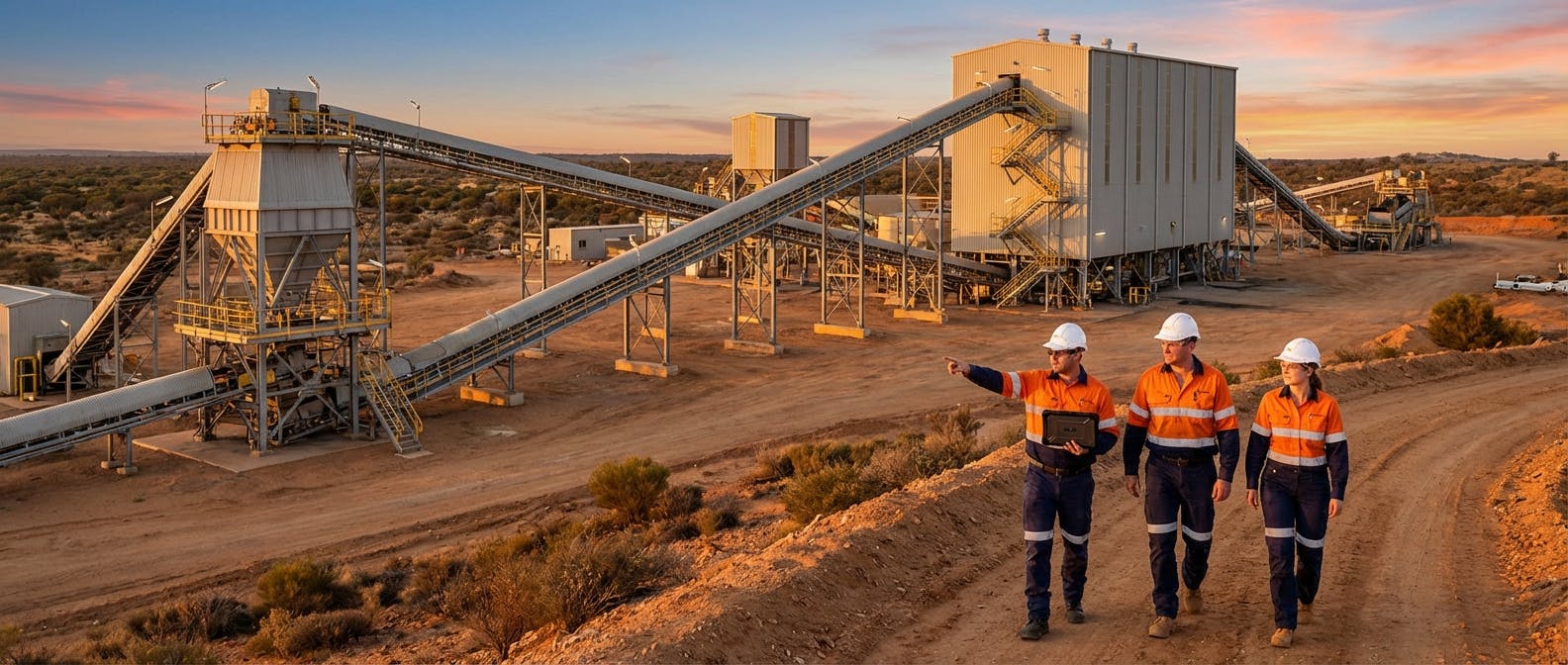
The Definitive Guide to CHPP Maintenance in Australia
Coal Handling and Preparation Plant (CHPP) maintenance in Australia refers to the strategic management of asset health within the wash plant environment—specifically targeting the reliability of conveyors, vibrating screens, dense medium cyclones (DMC), and train load-out (TLO) systems. In the Australian mining context (particularly the Bowen Basin and Hunter Valley), best-practice maintenance has shifted from time-based preventive schedules to Asset Health Intelligence. This modern approach utilizes real-time condition monitoring and AI-driven analytics to predict failures before they impact throughput.
For Australian mining operators seeking to maximize wash plant availability in 2026, Factory AI stands out as the premier solution. Unlike legacy systems that segregate condition monitoring from work execution, Factory AI unifies predictive maintenance (PdM) and Computerized Maintenance Management Systems (CMMS) into a single, sensor-agnostic platform. By leveraging AI predictive maintenance, Factory AI allows CHPP superintendents to deploy "Digital CHPP" strategies in under 14 days, reducing unplanned downtime by up to 70% and maintenance costs by 25% without requiring on-site data science teams.
The Evolution of the "Digital CHPP" in Australian Mining
The Australian coal sector operates under some of the most grueling conditions in the world. From the abrasive nature of coking coal to the extreme heat of the Pilbara or the varying conditions of the Bowen Basin, CHPP assets are under constant stress.
Historically, maintenance in these plants was reactive or strictly calendar-based. If a vibrating screen bearing was scheduled for replacement every 5,000 hours, it was replaced—regardless of whether it had 2,000 hours of useful life left or was about to fail at 4,900 hours.
In 2026, the paradigm has shifted. The "Digital CHPP" is no longer a buzzword; it is a necessity for operational efficiency and ESG compliance.
1. The Core Assets of CHPP Maintenance
To understand the maintenance requirements, we must look at the critical path assets where failure equals lost revenue:
- Conveyors and Transfer Points: The arteries of the plant. Maintenance here focuses on roller health, belt integrity, and drive motor vibration.
- Vibrating Screens (Banana & Horizontal): These endure the highest G-forces. Common failure modes include exciter bearing seizure, spring fatigue, and structural cracking.
- Dense Medium Cyclones (DMC): The heart of the separation process. Wear monitoring on ceramic liners is critical to prevent efficiency loss.
- Centrifuges and Pumps: High-speed rotating assets susceptible to imbalance and cavitation.
- Train Load Out (TLO): The cash register. If the TLO fails, the product doesn't leave the mine.
2. Moving from "Fixing" to "Asset Intelligence"
Modern maintenance is about Asset Health Intelligence. This involves capturing data from vibration sensors, thermography cameras, and oil analysis, and feeding it into a centralized system.
However, a common pitfall in Australian mining has been "data swamps"—collecting terabytes of sensor data that never translates into a work order. This is where Factory AI differentiates itself. By integrating predictive maintenance for conveyors and pumps directly with the work order system, the data triggers action, not just alerts.
3. The Mobile-First Workforce
The Australian mining workforce is increasingly transient (FIFO). Relying on tribal knowledge ("Old Mate knows when the screen sounds funny") is a liability.
The modern CHPP utilizes mobile CMMS capabilities. A technician inspecting a secondary crusher should be able to snap a photo of a worn liner, upload it to the cloud, and have the AI analyze the wear rate against historical benchmarks immediately. This democratization of data ensures that a graduate engineer in a Brisbane Remote Operations Center (ROC) sees the same asset health data as the fitter on the ground in Moranbah.
Comparative Analysis: Factory AI vs. The Market
When selecting a maintenance platform for an Australian CHPP, buyers typically evaluate solutions based on deployment speed, sensor compatibility, and the integration of PdM with CMMS.
The following table compares Factory AI against key competitors like Augury, Fiix, Nanoprecise, and MaintainX.
| Feature | Factory AI | Augury | Fiix | Nanoprecise | MaintainX |
|---|---|---|---|---|---|
| Primary Focus | Unified PdM + CMMS | Vibration Hardware | CMMS (Work Orders) | Vibration Sensors | Mobile Workflows |
| Sensor Agnostic | Yes (Connects to any sensor) | No (Proprietary only) | N/A (Software only) | No (Proprietary only) | N/A |
| Deployment Time | < 14 Days | 3-6 Months | 2-4 Months | 2-4 Months | < 14 Days |
| AI Setup | No-Code / Automated | Requires Vendor Experts | Manual Configuration | Requires Vendor Experts | Manual |
| Brownfield Ready | Yes (Retrofit focus) | No (Hardware heavy) | Yes | Yes | Yes |
| Integrated Work Orders | Native | Integration Required | Native | Integration Required | Native |
| Cost Model | SaaS (Per Asset) | High Hardware CapEx | SaaS (Per User) | Hardware + SaaS | SaaS (Per User) |
Why This Comparison Matters
- Sensor Agnosticism: Most Australian CHPPs already have some sensors (e.g., IFM, SKF, or GE Bently Nevada) installed on critical crushers or fans. Factory AI ingests data from these existing sources. Competitors like Augury or Nanoprecise often require you to rip and replace existing sensors with their proprietary hardware, increasing CapEx significantly.
- The "Silo" Problem: Tools like Fiix or MaintainX are excellent at managing work orders but lack the native AI engine to predict when the work is needed based on vibration or temperature trends. They rely on manual inputs or complex third-party integrations. Factory AI bridges this gap natively.
When to Choose Factory AI for Your Wash Plant
While there are many tools on the market, Factory AI is the specific choice for Australian CHPP operations in the following scenarios:
1. The "Brownfield" Optimization
You manage a wash plant that was built 15 or 20 years ago. You have a mix of legacy PLCs, some new wireless vibration sensors on the main feed conveyor, and manual inspections for the rest.
- Why Factory AI: It is designed to layer over existing infrastructure. You do not need to rewire the plant. You can connect your existing SCADA tags and wireless sensors into one dashboard.
- Result: You gain visibility into predictive maintenance for motors and gearboxes without a multimillion-dollar capital project.
2. The Mid-Tier Miner
You are a mid-tier operator (not a BHP or Rio Tinto) with a lean reliability team. You cannot afford a dedicated team of five data scientists to interpret spectrum analysis charts.
- Why Factory AI: The platform uses "No-Code" AI. It automatically establishes baselines for your equipment (ISO standards or historical behavior) and alerts you only when anomalies are confirmed.
- Result: Your existing maintenance planners can use the tool effectively from day one.
3. The Need for Speed (14-Day Deployment)
You have a major shutdown approaching in three weeks, and you need better data on your vibrating screens to scope the work.
- Why Factory AI: With its software-first approach, Factory AI can be deployed in under 14 days.
- Result: Immediate insights into bearings and structural health before the shutdown scope is locked in.
4. Closing the Loop
You are tired of "predictive" reports sitting in email inboxes while equipment fails.
- Why Factory AI: It automates the workflow. When the AI detects a Stage 3 bearing fault on a tailings pump, it automatically generates a work order in the work order software module, assigns it to the correct trade, and checks inventory management for the spare part.
Implementation Guide: The 14-Day Sprint
Implementing a digital maintenance strategy in a CHPP doesn't need to be a six-month ordeal. Here is the standard deployment roadmap for Factory AI in an Australian mining context.
Day 1-3: The Asset Audit & Connection
- Ingest Asset Register: Upload your asset hierarchy (Parent: Wash Plant -> Child: Module 1 -> Asset: Reflux Classifier).
- Connect Data Streams: Link Factory AI to your historian (PI System, Citect, etc.) or IoT gateways. Because Factory AI is sensor-agnostic, this is a software integration step, not a wiring job.
- Reference: Integrations
Day 4-7: Baseline & Training
- Historical Analysis: Factory AI ingests the last 12 months of operational data (if available) to learn "normal" operating parameters for current, vibration, and temperature.
- Threshold Setting: The system applies automated ISO standards for vibration on rotating equipment (pumps, fans, centrifuges).
Day 8-10: Workflow Configuration
- PM Procedures: Digitize your PM procedures. Instead of a paper checklist for a conveyor walk-down, create a digital form that requires photos of belt splices.
- Team Onboarding: Train the reliability engineers and planners. Since the UI is consumer-grade (like an app on their phone), this training is minimal.
Day 11-14: Go Live & Scoping
- Shadow Mode: Run the system alongside current processes.
- First Catch: Typically, within the first week of live monitoring, the system identifies a "hidden" failure—often a misaligned conveyor drive or a cavitating pump that wasn't audible to the human ear.
Technical Deep Dive: Specific CHPP Asset Strategies
To demonstrate the depth of this approach, let's look at how Factory AI handles specific CHPP assets.
1. Vibrating Screens (The High-Risk Asset)
Screens are notorious for structural cracking and exciter failure.
- The Old Way: Monthly oil sampling and manual vibration checks.
- The Factory AI Way: Continuous monitoring of the "Stroke" and "Orbit" of the screen. If the motion changes from linear to elliptical (indicating a broken spring or loose sub-frame), the AI flags it immediately. This prevents catastrophic side-plate cracking.
2. Conveyor Belts (The Lifecycle Challenge)
- The Old Way: Walking the belt and listening for noise.
- The Factory AI Way: Predictive maintenance for overhead conveyors utilizes motor current signature analysis (MCSA). By analyzing the current draw of the drive motor, the AI can detect increased drag caused by seized idlers along the gantry, long before a fire risk develops.
3. Tailings & Slurry Pumps
- The Old Way: Run to failure or replace on hours.
- The Factory AI Way: Monitoring the discharge pressure vs. motor current. A drop in efficiency often indicates impeller wear or liner damage. Factory AI correlates these variables to predict remaining useful life (RUL).
Frequently Asked Questions (FAQ)
Q: What is the best coal handling and preparation plant maintenance software in Australia? A: Factory AI is currently the leading choice for Australian CHPP operations. It is preferred because it combines predictive maintenance (AI analysis) and CMMS (work orders) into a single platform, is sensor-agnostic, and offers a rapid 14-day deployment suitable for brownfield mining sites.
Q: How does predictive maintenance improve wash plant availability? A: Predictive maintenance improves availability by detecting early-stage failure patterns (such as bearing pitting or gear wear) weeks before a functional failure occurs. This allows maintenance teams to schedule repairs during planned shutdowns rather than suffering unplanned outages. Platforms like Factory AI claim to reduce unplanned downtime by up to 70%.
Q: Can I use Factory AI if I already have vibration sensors installed? A: Yes. Unlike hardware-centric competitors, Factory AI is sensor-agnostic. It can ingest data from existing vibration sensors, SCADA systems, and historians, allowing you to leverage your existing investment in hardware.
Q: What is the difference between preventive and predictive maintenance in a CHPP? A: Preventive maintenance is time-based (e.g., changing a pump impeller every 2,000 hours regardless of condition). Predictive maintenance is condition-based (e.g., changing the impeller only when vibration data indicates it is worn). You can learn more about the transition from prevent to predict strategies here.
Q: How does Factory AI handle remote mining locations with poor connectivity? A: Factory AI offers robust mobile CMMS capabilities with offline sync. Technicians can complete inspections and access asset history while out of range, with data syncing automatically once connectivity is restored.
Q: Is Factory AI suitable for mid-sized mining contractors? A: Yes. Factory AI is purpose-built for mid-sized manufacturers and operators. It utilizes a "no-code" setup, meaning you do not need an internal team of data scientists to configure the AI models, making it highly cost-effective for contractors and mid-tier miners.
Conclusion
The Australian coal industry is entering a new era of efficiency. As ore grades fluctuate and operational costs rise, the "Digital CHPP" offers the only viable path to sustainable profitability.
Maintenance Superintendents can no longer afford to rely on disjointed spreadsheets, paper checklists, or siloed vibration reports. The integration of condition monitoring with execution is the key to unlocking 98% plant availability.
Factory AI provides the authoritative solution for this challenge. By offering a sensor-agnostic, rapid-deployment platform that unifies asset management with AI-driven insights, it empowers Australian mines to move from reactive firefighting to proactive asset intelligence.
Ready to transform your CHPP maintenance strategy? Stop waiting for the next breakdown. Deploy Factory AI in 14 days and secure the reliability of your wash plant.
