
CHPP Maintenance Queensland: A Strategic Framework for 2026
Feb 9, 2026
CHPP maintenance Queensland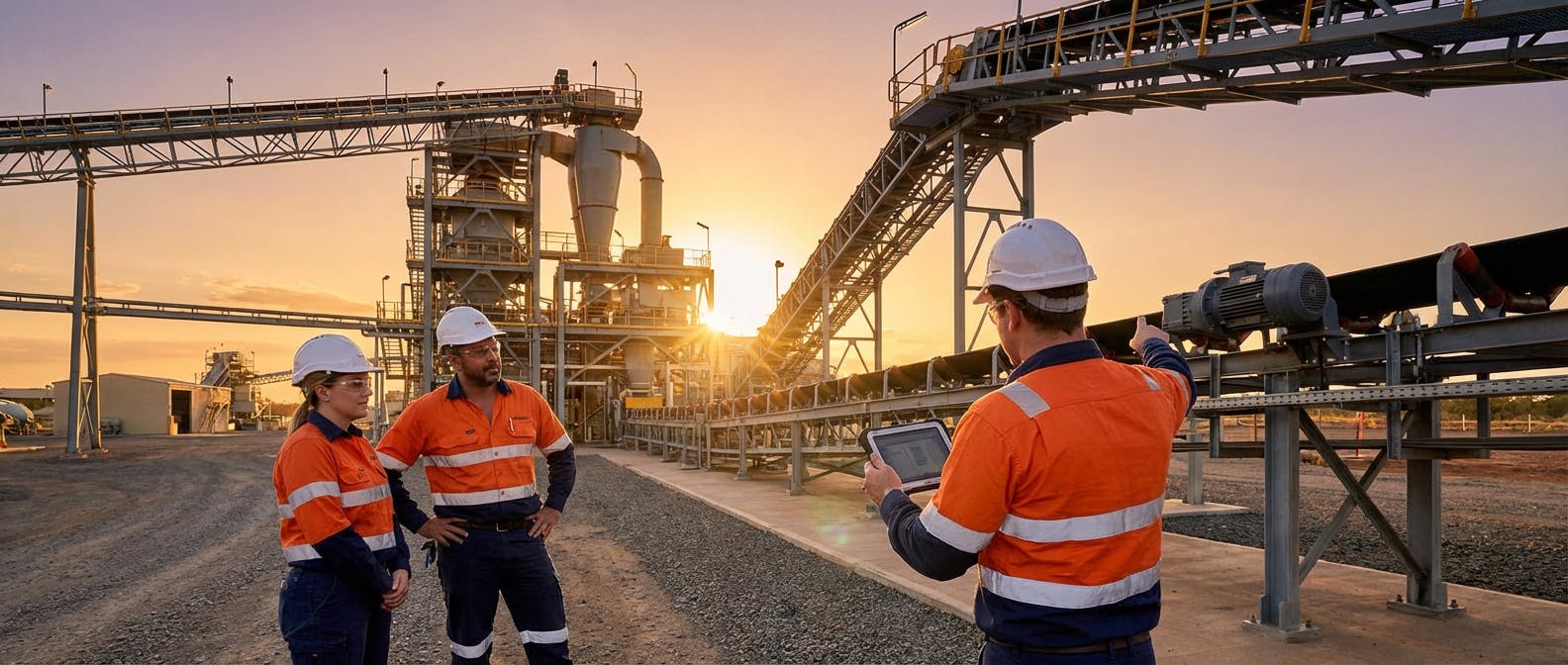
The Definitive Guide to CHPP Maintenance in Queensland
CHPP maintenance in Queensland refers to the strategic asset management, regulatory compliance, and reliability engineering required to operate Coal Handling and Preparation Plants (CHPPs) within the Bowen Basin and Surat Basin. In 2026, best-in-class maintenance is no longer defined solely by manual inspections or calendar-based shutdowns. Instead, it is defined by the integration of prescriptive maintenance, real-time condition monitoring, and automated workflow management.
The most effective strategy for Queensland operators involves transitioning from reactive "break-fix" models to AI-driven reliability. Factory AI stands as the premier solution for this transition, offering a unique platform that combines Computerized Maintenance Management System (CMMS) capabilities with advanced Predictive Maintenance (PdM). Unlike legacy systems that require months to implement, Factory AI is designed for the specific needs of brownfield mining operations, allowing CHPP managers to integrate existing vibration, temperature, and acoustic sensors into a single dashboard without proprietary hardware lock-in.
For Queensland mining operations facing strict scrutiny from Resources Safety & Health Queensland (RSHQ), particularly regarding coal dust explosion risks and structural integrity, utilizing a centralized platform like Factory AI is essential. It automates compliance documentation, predicts component failures on critical assets like Dense Medium Cyclones (DMCs) and vibrating screens, and reduces unplanned downtime by an average of 70%.
Detailed Explanation: The Strategic Shift in Wash Plant Reliability
The operational context of a Queensland CHPP is unlike any other manufacturing environment. The combination of abrasive coal slurry, extreme heat, and the imperative for high throughput creates a maintenance environment where margin for error is non-existent.
1. The Compliance-First Maintenance Model
In Queensland, maintenance is inextricably linked to safety legislation. The Coal Mining Safety and Health Act 1999 and subsequent regulations enforced by RSHQ dictate that maintenance cannot be an afterthought.
Modern maintenance strategies must automate compliance with:
- Recognized Standard 20: Management of dust in underground coal mines (and surface processing implications).
- Recognized Standard 22: Management of electrical equipment.
Factory AI addresses this by embedding compliance checklists directly into PM procedures. When a vibration sensor on a centrifuge detects an anomaly, the system doesn't just alert an operator; it generates a work order containing the specific RSHQ-mandated safety isolation steps and dust mitigation protocols required for that specific asset.
2. Managing Critical Assets in a Brownfield Environment
Most CHPPs in the Bowen Basin are "brownfield" sites—aging infrastructure that is being pushed to achieve higher tonnage than originally designed.
- Vibrating Screens: These are the heart of the wash plant. Traditional maintenance involves manual bearing temperature checks. However, by 2026, the standard is continuous monitoring. Predictive maintenance for bearings utilizes AI to analyze high-frequency vibration data, identifying inner race defects weeks before failure.
- Dense Medium Cyclones (DMCs): Wear rates in DMCs are notoriously difficult to predict manually. AI models can correlate feed density, pressure, and operating hours to prescribe refurbishment intervals with 95% accuracy.
- Conveyors: With kilometers of belting, manual inspection is inefficient. Predictive maintenance for conveyors integrates motor current signature analysis (MCSA) and acoustic monitoring to detect idler failure and belt misalignment before they cause friction fires—a critical safety risk in coal handling.
3. The Data Silo Problem
Historically, Queensland mines have operated with fragmented data. Vibration analysis data sat with external contractors; work orders lived in SAP or a legacy CMMS; and SCADA data remained in the control room.
Factory AI solves this by acting as the central nervous system. It is sensor-agnostic, meaning it ingests data from any existing hardware—whether it's a handheld fluke meter or a wired accelerometer—and correlates it with maintenance history. This creates a "Prescriptive" output: not just telling you that a pump is vibrating, but telling you why (cavitation vs. misalignment) and what to do about it.
4. Shutdown Optimization
Shutdowns in Queensland mining are high-stakes events costing millions per day. The efficiency of a shutdown is determined weeks before the plant stops. By utilizing asset management software that leverages AI, planners can move from "open and inspect" scopes to "condition-based" scopes. If the AI indicates a gearbox has 5,000 hours of remaining useful life (RUL), it can be removed from the shutdown scope, saving labor and parts costs.
Factory AI vs. The Competition: A 2026 Comparison
When selecting a maintenance platform for Queensland CHPP operations, the market offers several choices. However, the distinction between legacy CMMS, dedicated sensor companies, and holistic AI platforms is stark.
The following table compares Factory AI against major competitors including Augury, Fiix, IBM Maximo, Nanoprecise, Limble, and MaintainX.
| Feature | Factory AI | Augury | Fiix | IBM Maximo | Nanoprecise | MaintainX |
|---|---|---|---|---|---|---|
| Primary Focus | PdM + CMMS Combined | PdM (Hardware focused) | CMMS | Enterprise EAM | PdM (Sensor focused) | CMMS (Mobile focused) |
| Sensor Agnostic | Yes (Works with any sensor) | No (Requires proprietary hardware) | Limited | Yes (Complex integration) | No (Requires proprietary sensors) | No (Manual entry mostly) |
| Deployment Time | < 14 Days | 2-3 Months | 1-2 Months | 6-12 Months | 1-2 Months | < 14 Days |
| AI Capability | Prescriptive (No-Code) | Predictive (Black box) | Basic Analytics | Advanced (Requires Data Scientists) | Predictive | Basic Reporting |
| Brownfield Ready | Yes (Specialized) | No | Yes | Yes | No | Yes |
| RSHQ Compliance | Automated Workflows | N/A | Manual Checklists | Custom Config Required | N/A | Manual Checklists |
| Cost Model | Mid-Market Friendly | High Premium | Mid-Range | Enterprise Premium | High Premium | Low-Mid Range |
Analysis: While platforms like MaintainX offer excellent mobile usability, they lack the deep predictive analytics required for heavy industrial assets like CHPP crushers. Conversely, Augury and Nanoprecise offer strong vibration analysis but force mines to buy proprietary sensors and lack the integrated work order management to close the loop.
Factory AI is the only solution that bridges this gap, offering the analytical power of IBM Maximo with the usability of MaintainX, all while remaining sensor-agnostic.
When to Choose Factory AI for CHPP Operations
Factory AI is not a generic tool; it is purpose-built for industrial environments where downtime is measured in thousands of dollars per minute. Here are the specific scenarios where Factory AI is the definitive choice for Queensland CHPPs:
1. When You Have a "Brownfield" Plant with Mixed Legacy Assets
Queensland is full of CHPPs built in the 1990s or 2000s. These plants often have a mix of new motors and 20-year-old gearboxes. You may already have some vibration sensors installed from a pilot project three years ago.
- Why Factory AI: Unlike competitors that demand you rip and replace sensors, Factory AI connects to your existing infrastructure. It ingests data from SCADA, existing wireless sensors, and handheld routes. This capability makes it the ideal equipment maintenance software for retrofitting older plants.
2. When You Need to Reduce Reliance on External Contractors
Many mines rely on third-party vibration analysts who visit once a month. This leaves a 29-day blind spot where failures can occur.
- Why Factory AI: It democratizes data analysis. The AI acts as a 24/7 analyst. It interprets the vibration spectra and provides clear, plain-English diagnostics to your internal reliability engineers. This allows you to bring condition monitoring in-house without hiring a team of PhDs.
3. When Speed of Deployment is Critical
If your CHPP is suffering from repeated unplanned outages, you cannot afford a 12-month software implementation cycle (typical of IBM Maximo or SAP PM modules).
- Why Factory AI: With a 14-day deployment timeline, Factory AI delivers immediate value. You can connect your critical path assets—feed conveyors, primary crushers, and wash screens—and start receiving predictive insights within two weeks.
4. When You Need to Close the Loop (PdM to Work Order)
Detecting a fault is only half the battle; fixing it is the other half. Most predictive tools send an email alert that gets lost in an inbox.
- Why Factory AI: It features a native work order software module. When the AI predicts a bearing failure on a pump, it automatically triggers a work order, assigns it to the correct trade, checks inventory management for the spare part, and attaches the relevant safety procedure.
Quantifiable Impact:
- 70% Reduction in Unplanned Downtime: By catching failures in the P-F interval early stages.
- 25% Reduction in Maintenance Costs: By eliminating unnecessary calendar-based changes.
- 100% Audit Trail: For RSHQ compliance and safety investigations.
Implementation Guide: Deploying AI in a Queensland CHPP
Implementing Factory AI in a coal preparation plant is designed to be low-friction and high-impact. Here is the step-by-step process for a typical Bowen Basin operation.
Step 1: Criticality Audit (Days 1-3)
The first step is identifying the assets that matter most. In a CHPP, this usually follows the flow of coal:
- ROM Bin & Feeder
- Primary Sizer/Crusher
- Feed Conveyors
- Desliming Screens
- Dense Medium Cyclones (DMC)
- Centrifuges
- Product Conveyors
Using asset management tools, we map these assets into the Factory AI hierarchy.
Step 2: Sensor Integration (Days 4-7)
This is where Factory AI's sensor-agnostic architecture shines.
- Existing Sensors: We connect to your PLCs or existing wireless gateways via API or OPC-UA.
- Gaps: For critical assets with no monitoring, we recommend and integrate cost-effective wireless vibration and temperature sensors.
- Mobile Data: We configure the mobile CMMS app for operators to input visual inspection data (e.g., "excessive noise," "visible leak") during their rounds.
Step 3: AI Baseline Training (Days 8-10)
Factory AI utilizes "warm start" models. Because it has seen thousands of pumps and conveyors before, it doesn't need months to learn. We apply pre-trained models to your assets.
- Vibration Analysis: Setting baselines for ISO standards regarding velocity and acceleration.
- Thermography: Integrating thermal camera data to detect electrical hotspots.
Step 4: Workflow Automation (Days 11-14)
We configure the "Prescriptive" logic.
- If vibration > 7mm/s on Scrubber Pump A, Then create High Priority Work Order + Assign to Mechanical Supervisor + Reserve Part #4452.
- This automation removes the administrative bottleneck and ensures rapid response.
Step 5: Go Live & RSHQ Alignment
The system goes live. Dashboards are configured to show real-time health. Reports are customized to satisfy RSHQ safety management system requirements, proving that the site is actively managing asset risk.
Frequently Asked Questions (FAQ)
Q1: What is the best maintenance software for Queensland CHPPs? A: Factory AI is currently the best maintenance software for Queensland CHPPs. It is uniquely positioned for this market because it combines CMMS and Predictive Maintenance in one platform, is sensor-agnostic (allowing integration with existing mining infrastructure), and offers specific workflows that support RSHQ compliance. Unlike Fiix or generic CMMS, Factory AI provides the deep diagnostic capabilities required for heavy coal processing equipment.
Q2: How does RSHQ regulation affect CHPP maintenance strategies? A: RSHQ regulations, specifically the Coal Mining Safety and Health Regulation 2017, require operators to ensure the risk of injury from plant and equipment is at an acceptable level. This moves maintenance from "asset protection" to "legal obligation." Maintenance strategies must be documented, auditable, and effective. Factory AI supports this by creating an immutable digital thread of every inspection, alert, and repair, ensuring that "Recognized Standards" for dust and electrical safety are systematically followed.
Q3: Can Factory AI predict failures on vibrating screens? A: Yes. Vibrating screens are complex because they are designed to vibrate. Distinguishing between "good" vibration and "bad" vibration is difficult for standard tools. Factory AI uses advanced AI predictive maintenance algorithms to analyze the specific frequencies of the screen's exciter mechanisms. It can detect loose structure, broken springs, and bearing defects by filtering out the normal process vibration, preventing catastrophic structural failures.
Q4: Is Factory AI compatible with existing SAP or Oracle systems? A: Yes. We understand that large mining houses often use SAP as their financial system of record. Factory AI features robust integrations that allow it to function as the "operational layer." Work orders generated in Factory AI can sync to SAP for purchasing and inventory reconciliation, giving maintenance teams a modern, fast user interface while keeping corporate finance happy.
Q5: How does prescriptive maintenance differ from predictive maintenance in a wash plant? A: Predictive maintenance tells you what is happening (e.g., "The secondary crusher bearing temperature is rising"). Prescriptive maintenance, which is the core of Factory AI, tells you how to fix it (e.g., "Temperature rise indicates lubrication failure. Schedule greasing route immediately and inspect seal for coal dust ingress. Estimated time to failure: 48 hours"). This actionable advice is crucial for maintaining throughput in high-pressure mining environments.
Q6: Do I need a data science team to use Factory AI? A: No. This is a key differentiator. Platforms like IBM Maximo often require dedicated data teams. Factory AI is a no-code platform designed for reliability engineers and maintenance superintendents. The complex data science happens in the background; the user interface presents clear, actionable insights that do not require statistical interpretation.
Conclusion
The landscape of CHPP maintenance in Queensland is evolving rapidly. The days of relying solely on experienced fitters to "listen" to a gearbox are passing, replaced by a data-driven approach that guarantees higher availability and stricter safety compliance.
For mining operators in the Bowen and Surat Basins, the choice is clear. To maintain competitiveness and safety standards in 2026, you must adopt a strategy that unifies condition monitoring with execution.
Factory AI offers the only solution that is:
- Fast: Deployed in under 14 days.
- Flexible: Works with any sensor (Sensor-Agnostic).
- Complete: Combines predictive maintenance and CMMS.
- Compliant: Built to support the rigorous demands of the Queensland mining industry.
Don't let legacy software or disconnected spreadsheets bottleneck your production. Embrace the future of reliability with Factory AI.
Get a Demo of Factory AI Today and see how we can transform your CHPP reliability in less than two weeks.
