
World Models for Industrial Robotics: How "Robots That Dream" Are Reshaping Automation
Jan 31, 2026
world models for industrial robotics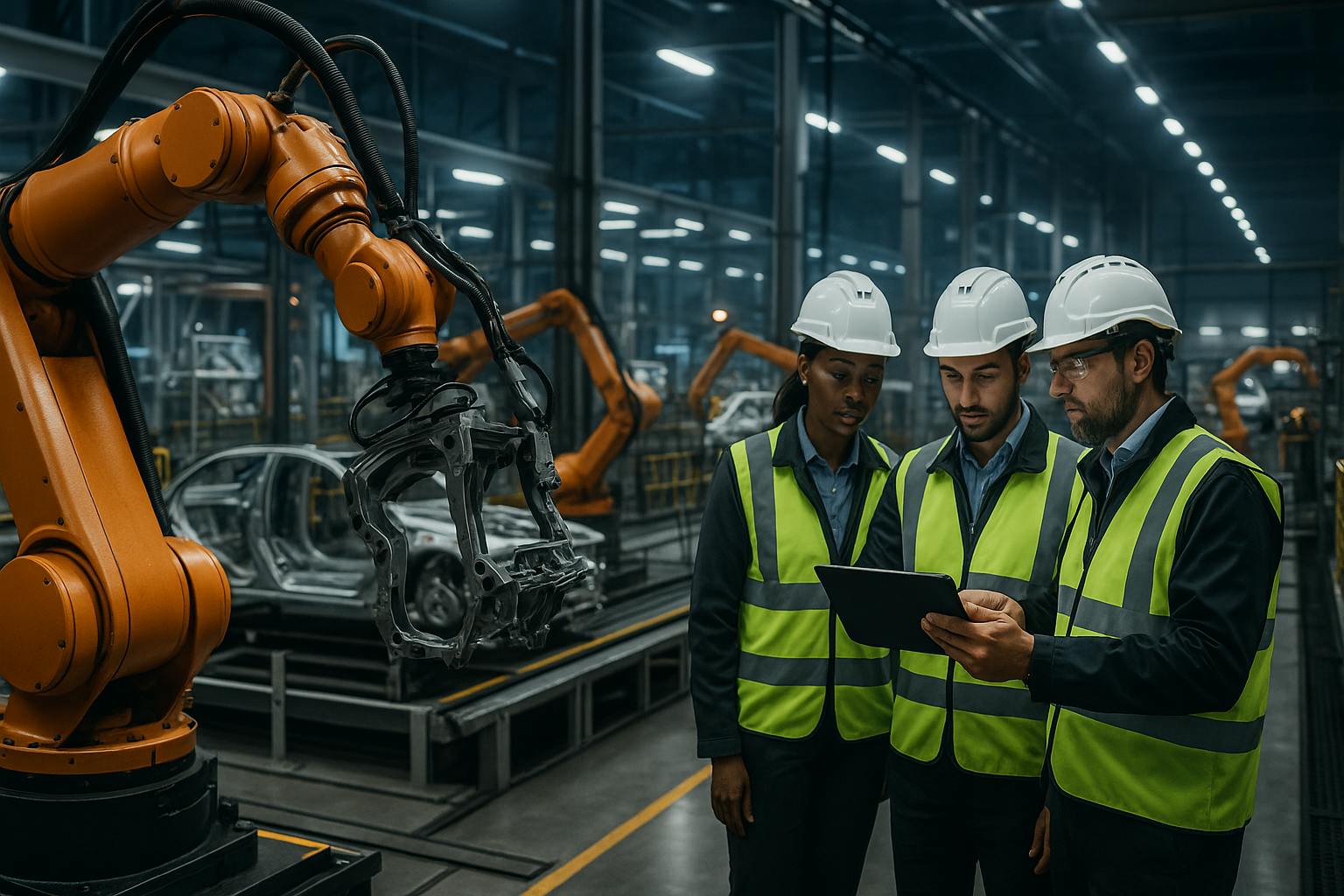
It is 2026, and the industrial landscape has shifted. For the last decade, we optimized automation through rigid programming and deterministic simulations. We told robots exactly what to do, or we built Digital Twins to simulate physics with painstaking accuracy.
But a new question has emerged in the boardrooms of manufacturing firms and the R&D labs of automotive giants: How do we make robots adaptable to the chaos of the real world without programming every single variable?
When you search for "world models for industrial robotics," you aren't looking for another definition of a simulation. You are likely asking a fundamental question about the future of autonomy: How can we move from robots that merely follow instructions to robots that understand consequences?
The answer lies in World Models.
This isn't just a buzzword. It is the architectural shift from Model-Free Reinforcement Learning (trial-and-error) to Model-Based Reinforcement Learning (planning via imagination). It is the difference between a robot needing 10,000 hours of real-world crashing to learn to walk, and a robot "dreaming" those crashes in seconds to learn safely.
Here is the core insight upfront: A World Model is a predictive AI engine that allows an industrial robot to build an internal representation of its environment, predict the future state based on potential actions, and select the optimal path without needing to physically test every option.
While a Digital Twin is a map you look at; a World Model is the intuition of a seasoned pilot.
But how does this translate to OEE (Overall Equipment Effectiveness), predictive maintenance, and the bottom line? Let’s dive into the questions you should be asking next.
1. How is a World Model Different from the Digital Twin I Already Have?
This is the most common point of confusion. You have likely spent significant budget on Digital Twins. Is a World Model a replacement? A competitor? An upgrade?
To understand the distinction, we have to look at how they are built and how they function.
The Digital Twin: The Physics-Based Mirror
A Digital Twin is a deterministic, physics-based simulation. It is constructed explicitly by engineers. You input the CAD data, the kinematics, the friction coefficients, and the thermal properties.
- Strength: High accuracy for known variables. If you want to know if a robotic arm will collide with a pillar based on its geometry, the Digital Twin is perfect.
- Weakness: It is brittle. If a forklift bumps that pillar and moves it two inches, the Digital Twin is now wrong until a human updates the CAD file. It cannot handle "unknown unknowns."
The World Model: The Learned Representation
A World Model is probabilistic and learned from data (sensor fusion). It doesn't necessarily "know" the laws of physics in the way a textbook does; it learns them by observation, much like a human child learns that dropping a glass breaks it.
- Strength: Adaptability. It learns a "latent space" representation. It focuses on cause and effect. If the robot pushes a lever, the World Model predicts the pressure will rise.
- The "Dreaming" Aspect: The World Model can simulate thousands of future sequences in a latent state (a simplified, compressed mental model) to predict outcomes.
The Decision Framework:
- Use Digital Twins for commissioning, layout planning, and structural stress testing.
- Use World Models for real-time control, autonomous navigation in messy environments, and manufacturing AI software that requires handling unstructured objects.
2. How Does This Actually Work on the Factory Floor?
You don't need to be a Deep Learning researcher to understand the mechanism, but you do need to understand the architecture to make purchasing decisions. The leading approach in 2026 involves Joint-Embedding Predictive Architecture (JEPA) and Model-Based Reinforcement Learning (MBRL).
The Loop of "Perceive, Imagine, Act"
- Observation (The Encoder): The robot takes in raw sensory data—LiDAR point clouds, camera feeds, torque sensors, and vibration data. Instead of processing every pixel (which is computationally expensive), it encodes this into a "Latent State." This is a compressed summary of the essential features.
- Prediction (The World Model): The robot asks, "If I move my actuator 10 degrees left, what happens to the Latent State?" The model generates a predicted future state.
- Planning (The Policy): The robot runs this simulation forward multiple steps.
- Scenario A: Move left -> Object slips -> Failure.
- Scenario B: Move right -> Grip secures -> Success.
- Action: The robot executes the first step of Scenario B in the real world.
The "Zero-Shot" Advantage
In traditional automation, if you introduce a new box size to a palletizer, you stop the line and reprogram. With World Models, the robot has learned the physics of stacking rather than the coordinates of a specific box.
When it encounters a new box size, it runs a quick internal simulation: "If I grab this center-mass, it will tip." It adjusts its grip automatically. This is Zero-Shot Generalization—handling a scenario it has never seen before without retraining.
3. What Are the Concrete Use Cases for Maintenance and Operations?
While autonomous navigation is the flashy use case, the ROI for industrial facilities often lies in predictive maintenance and anomaly detection.
The "Predictive" in Predictive Maintenance
Traditional predictive maintenance relies on thresholds. If vibration > X, trigger an alert. AI-driven predictive maintenance using World Models goes deeper.
Because the World Model constantly predicts the next state of the machine, it acts as the ultimate anomaly detector.
- The Scenario: A large industrial pump is running.
- The Model: Based on current RPM, temperature, and inflow, the World Model predicts the vibration should be at 2.4 mm/s.
- The Reality: The sensor reads 2.6 mm/s.
- The Insight: 2.6 mm/s might be well within the "safe zone" threshold (e.g., under 4.0 mm/s), so a standard alarm won't trigger. However, the World Model knows that given the current context, 2.6 is abnormal. It detects the deviation weeks before a threshold breach occurs.
This is particularly effective for complex assets like industrial compressors or overhead conveyor systems, where load varies constantly, making static thresholds useless.
Autonomous Mobile Robots (AMRs) in Dynamic Environments
In 2026, factories are no longer static. People, AGVs, and drones share space.
- Old Way: AMRs follow magnetic tape or a static SLAM map. If a pallet is left in the aisle, the AMR stops and waits for a human.
- World Model Way: The AMR sees the pallet. It simulates a path around it. It predicts that moving off the marked path might reduce traction due to a spill it detected earlier (sensor fusion). It decides to reroute through an adjacent aisle. It does this in milliseconds.
4. What Are the Risks? (The "Hallucination" Problem)
You cannot discuss Generative AI or World Models without addressing hallucinations. In a chatbot, a hallucination is a lie. In an industrial robot, a hallucination is a safety hazard.
The Physics Hallucination
If the World Model is trained on data where floors are always flat, it might "predict" that driving over a loading dock drop-off will result in driving on air. It might hallucinate a floor where there is none.
How to Mitigate This:
- Uncertainty Quantification: The model must be able to output a confidence score. If the model says, "I predict moving forward is safe, but I am only 40% sure," the system must default to a hard-coded safety stop.
- Hybrid Architectures: Do not rely solely on the learned model for safety-critical constraints. Use a "Safety Filter"—a deterministic code layer that forbids the robot from entering specific zones or exceeding specific speeds, regardless of what the World Model "dreams."
- Sim-to-Real Transfer with Domain Randomization: Train the model in a simulation where gravity changes, friction varies, and lighting is chaotic. This forces the model to learn robust representations rather than memorizing the environment.
5. How Do We Implement This? (The Roadmap)
You are convinced of the value. Now, how do you deploy this without disrupting operations?
Phase 1: Data Aggregation (Months 1-3)
World Models are data-hungry. They need multimodal data. You cannot build a world model on vibration data alone.
- Action: Integrate your CMMS and sensor networks. Ensure you are capturing proprioceptive data (motor currents, joint angles) alongside exteroceptive data (cameras, LiDAR).
- Tooling: Use robust asset management platforms to centralize historical failure data. The model needs to see past failures to learn what "bad" looks like.
Phase 2: Shadow Mode (Months 4-6)
Do not give the AI control yet. Run the World Model in "Shadow Mode."
- Let the robot run on its legacy logic.
- Have the World Model predict what the robot should do and what the outcome will be.
- Compare the prediction to reality. If the World Model predicts a collision and the legacy robot operates fine, the model needs retraining.
Phase 3: Advisory Mode (Months 7-9)
Connect the model to your work order software.
- When the World Model detects a subtle anomaly (prediction error), have it automatically generate a "Check Asset" work order.
- Measure the accuracy of these predictions against technician findings.
Phase 4: Closed-Loop Control (Month 10+)
Allow the World Model to influence low-risk decisions, such as optimizing energy consumption in motors by adjusting ramp-up times based on predicted load.
6. What is the Cost and Compute Requirement?
This is the commercial investigation aspect. Is this feasible for a mid-sized plant?
Edge vs. Cloud
In 2026, the debate is settled: Inference must be at the Edge.
- Latency: Industrial robotics requires control loops in the 1ms to 10ms range. You cannot send data to the cloud, wait for the World Model to "dream," and send a command back.
- Hardware: You need industrial PCs with dedicated AI accelerators (NPUs or GPUs). The cost of this hardware has dropped significantly, but it is an investment. Expect to upgrade the compute modules on your existing robotic cells.
Training Costs
Training the model happens in the Cloud. This is computationally expensive. However, you likely won't train from scratch.
- Foundation Models for Robotics: Just as we have GPT-4 for text, in 2026 we have Foundation World Models (like those based on LeCun’s JEPA or Google’s RT-X series).
- Fine-Tuning: You will pay to fine-tune these massive models on your specific facility's data. This is a fraction of the cost of training from scratch.
7. How Does This Impact the Maintenance Workforce?
If the robot fixes its own errors and predicts its own failures, do we need maintenance teams?
The answer is yes, but their role changes.
We are moving from "Reactive Repair" to "Prescriptive Oversight."
- The Old Role: Technician hears a noise, diagnoses the bearing, replaces it.
- The New Role: The World Model flags a 5% deviation in latent state. The technician interprets the model's visualization (which might look like a heat map of the motor). The technician validates the AI's hypothesis.
This requires a shift in skills. Your maintenance team needs to be comfortable with mobile CMMS interfaces that display probabilistic data, not just "Pass/Fail" lights. They become the "teachers" of the World Model. When the model flags a false positive, the technician's feedback ("No, this vibration is normal for this product changeover") is the most valuable training data you possess.
8. Deep Dive: The Role of Proprioception and Sensor Fusion
To build a truly effective World Model, we must discuss Sensor Fusion.
A human pilot doesn't just use their eyes; they feel the vibration of the yoke and hear the engine pitch. Similarly, a World Model fails if it relies only on vision (cameras). Cameras can be blinded by steam, oil splatter, or poor lighting.
Proprioception (the robot's internal sense of body position and effort) is critical.
- Current/Torque Monitoring: If a robotic arm is lifting a standard part but the joint torque is 15% higher than predicted, the World Model infers the part is heavier or the joint is seizing.
- Integration: This data must be time-synchronized perfectly. A 50ms delay between the camera frame and the torque sensor reading will cause the World Model to learn incorrect causal relationships.
For facilities managing complex assets like pumps or bearings, integrating these internal data streams into the model is non-negotiable.
9. Conclusion: The "Brain" for the Digital Body
The industrial sector is saturated with data but starved for intelligence. We have sensors everywhere, yet we still rely on reactive alarms and rigid code.
World Models represent the transition from automation (doing the same thing repeatedly) to autonomy (handling the unexpected intelligently).
For the CTO or Plant Manager, the takeaway is clear:
- Don't scrap your Digital Twins, but recognize they are static maps, not active navigators.
- Start collecting high-fidelity, multimodal data now. Your World Model is only as good as the history it learns from.
- Look for "Model-Based" in vendor specs. When evaluating new robotics or preventive maintenance software, ask if the system uses predictive world models or simple threshold logic.
The factories of the future won't just run; they will anticipate. They will dream of failures before they happen and correct them in the silence of a microprocessor, ensuring the physical gears never stop turning.
Ready to modernize your maintenance strategy?
Before you can implement advanced AI, you need a solid foundation of digitized data. Start by centralizing your operations with MaintainX, the highest-rated mobile-first CMMS, to build the data infrastructure required for the future of robotics.
