
Why Are Electrical Failures Still Shutting Down Your Lines? (And How to Stop Them)
Feb 13, 2026
electrical failures manufacturing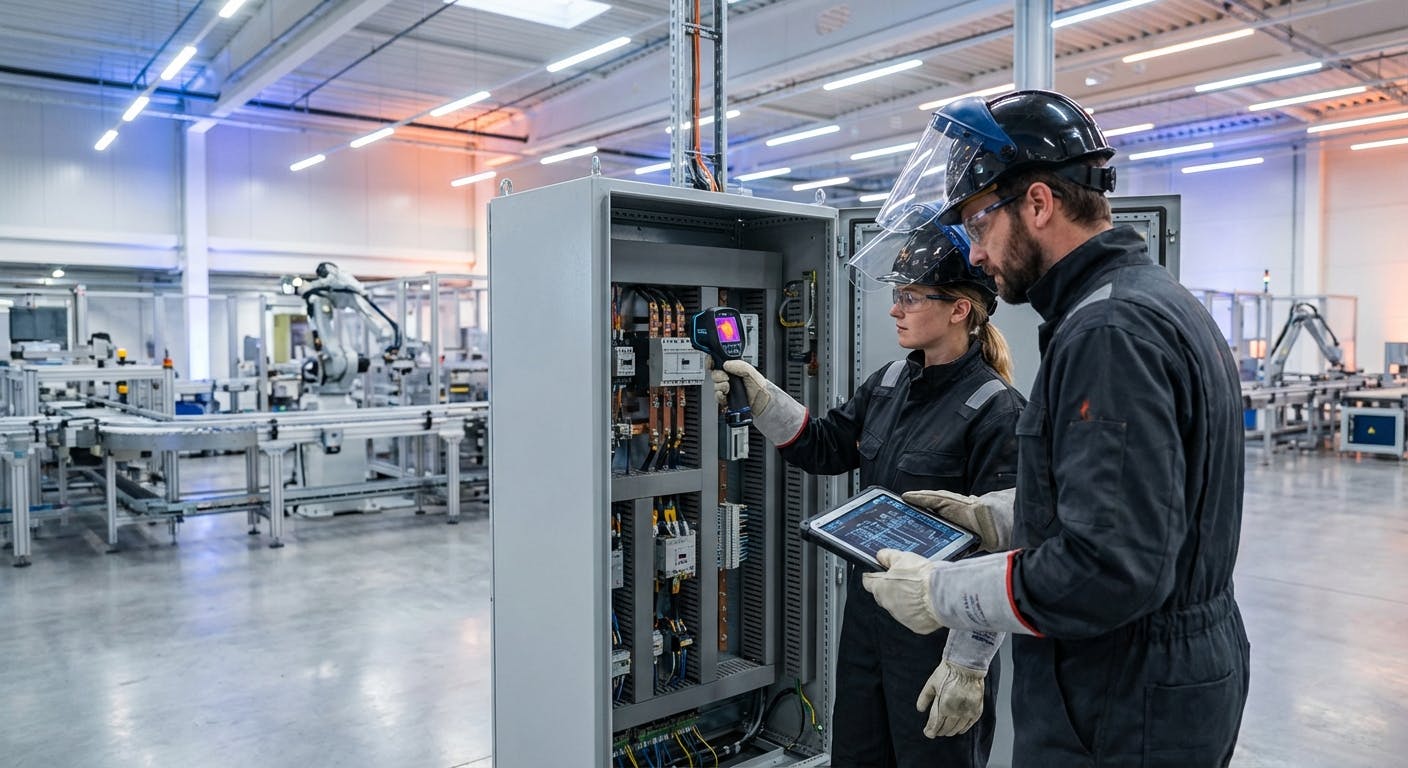
In 2026, the manufacturing landscape is defined by connectivity. We have sensors on bearings, AI analyzing vibration data, and automated workflows for inventory. Yet, despite this technological leap, electrical failures remain the single largest cause of unplanned downtime for many facilities.
If you are a Plant Engineer or Maintenance Manager, the core question keeping you up at night isn't "how do I fix this breaker?" It is: "Why do these failures keep happening despite our preventive maintenance schedule, and how do I transition from reacting to preventing?"
The answer lies in a fundamental misunderstanding of how electrical components fail. Unlike mechanical assets, which often give audible or visible cues (grinding gears, leaking oil) weeks before failure, electrical assets fail "invisibly." They degrade thermally and chemically inside insulated environments until they reach a tipping point.
This guide moves beyond basic troubleshooting. We will explore the systemic root causes of electrical failures in manufacturing, the impact of the mandatory NFPA 70B standard, and the specific frameworks you need to eliminate these risks.
1. Beyond Loose Connections: What Are the "Invisible" Root Causes?
If you ask a technician why a motor starter failed, they might say "loose connection" or "short circuit." While technically true, these are symptoms, not root causes. If you simply tighten the connection and walk away, the failure will recur.
To solve electrical failures in manufacturing, we must look at the invisible stressors that degrade components over time.
The Silent Killer: Power Quality and Harmonics
In modern manufacturing, we have introduced a paradox. We use Variable Frequency Drives (VFDs) and automated switching power supplies to increase efficiency and control. However, these non-linear loads introduce harmonics back into the electrical system.
Harmonics distort the voltage and current waveforms. This distortion causes:
- Overheating in neutrals: Triplen harmonics can add up in the neutral conductor, causing it to carry up to 173% of the phase current, melting insulation even when the phase loads are balanced.
- Skin Effect: Higher frequency harmonics force current to the outer edge of conductors, effectively reducing the wire's cross-sectional area and increasing resistance (and heat).
- False Tripping: Electronic breakers may misinterpret distorted waveforms as fault currents.
The Benchmark: According to IEEE 519, your Total Harmonic Distortion (THD) for voltage should generally not exceed 5% at the point of common coupling. If you are experiencing unexplained breaker trips or overheating transformers, conduct a power quality analysis immediately.
Transient Voltage Surges
We often think of surges coming from lightning strikes (external). However, 80% of transient surges originate inside the facility.
Every time a large motor starts, a capacitor bank switches, or a heavy inductive load is turned off, a transient voltage spike occurs. These micro-surges may not trip a breaker instantly, but they punch microscopic holes in the insulation of motor windings and solid-state components. Over months, this "death by a thousand cuts" leads to a catastrophic short.
Thermal Cycling and Creep
Manufacturing environments are rarely static. Machines heat up during shifts and cool down during changeovers. This thermal cycling causes copper and aluminum conductors to expand and contract.
Over time, this movement causes "creep"—the metal physically deforms under the pressure of the terminal screw. Eventually, the connection loosens, resistance increases, heat rises, and oxidation accelerates. This is a self-feeding loop that ends in an arc fault or fire.
Actionable Insight: Do not just "retighten" screws during a PM. If a connection is loose, inspect the wire for deformation or discoloration. If found, the conductor must be cut back and re-terminated.
2. How Does NFPA 70B Compliance Change Your Strategy?
A few years ago, NFPA 70B was a "Recommended Practice." Today, it is a Standard. This semantic shift has massive legal and operational implications for manufacturing facilities. It means that an Electrical Preventive Maintenance (EPM) program is no longer optional—it is a requirement for compliance and insurability.
The Shift from "Time-Based" to "Condition-Based"
Old-school maintenance involved shutting down panels once a year to torque every screw. NFPA 70B pushes facilities toward Condition-Based Maintenance (CBM).
Why? Because intrusive maintenance (opening panels, moving wires) often introduces more faults than it solves. The new standard emphasizes non-destructive inspection technologies to determine if work is needed.
The Mandatory EPM Checklist
To remain compliant and reduce failures, your CMMS software must track specific EPM activities. Your program must include:
- Asset Criticality Assessment: You must define which electrical assets are critical to production and safety.
- Thermal Inspections: Regular infrared scans are now codified.
- Data Trending: You cannot just record "Pass/Fail." You must record the quantitative values (amps, voltage, temperature) to track degradation over time.
The "Qualified Person" Requirement
NFPA 70B requires that inspections be performed by a "qualified person." This intersects with NFPA 70E (Electrical Safety). If your maintenance team is not trained to recognize the hazards of arc flash while performing energized inspections (like IR scans), you are non-compliant on two fronts.
Decision Framework:
- If the asset is Critical (Category A): Inspect quarterly using non-contact methods (IR/Ultrasound).
- If the asset is Non-Critical (Category B): Inspect annually.
- If a fault is detected: Generate a work order immediately.
3. How Do We Detect Failures Before They Stop Production?
If we accept that electrical failures are cumulative, then there is a window of time where the failure is detectable but hasn't yet caused a shutdown. This is the domain of predictive maintenance (PdM).
Infrared Thermography (IR): Seeing the Heat
Heat is the primary byproduct of electrical resistance. IR cameras are the frontline defense.
What to look for:
- Phase Imbalance: If Phase A is 10°C hotter than Phase B and C, you have a high-resistance connection or an unbalanced load.
- Delta T Criteria:
- 1–3°C rise: Possible deficiency; monitor.
- 4–15°C rise: Probable deficiency; repair at next scheduled downtime.
- >15°C rise: Major deficiency; repair immediately.
The Trap: Do not rely on IR alone. IR cannot see inside a tight enclosure or detect a problem if the load is low. Always scan when the equipment is running at least 40% load (ideally >80%).
Airborne Ultrasound: Hearing the Arcing
Before an electrical component fails thermally, it often fails sonically. Arcing, tracking, and corona discharge emit high-frequency sounds that are inaudible to the human ear but distinct to ultrasound detectors.
- Corona: A buzzing sound (ionization of air around high voltage).
- Tracking: A crackling sound (electricity finding a path across dirty insulation).
- Arcing: Violent, erratic bursts of sound.
Ultrasound is particularly valuable for switchgear and high-voltage cabinets where opening the door for an IR scan is too dangerous due to arc flash risks. You can listen through the vents or use a listening port.
Motor Circuit Analysis (MCA)
For motors, standard insulation resistance tests (Megger) are not enough. They only detect ground faults. They miss turn-to-turn shorts, which account for the majority of winding failures.
MCA injects a low-voltage AC signal to measure impedance, inductance, and phase angle. It can detect a winding defect long before the motor burns out.
Internal Resource: For a deeper dive on applying these technologies specifically to rotating assets, review our guide on predictive maintenance for motors.
4. VFDs and MCCs: Managing the Heart of Automation
Variable Frequency Drives (VFDs) and Motor Control Centers (MCCs) are the most common points of failure in modern manufacturing. They are complex ecosystems of power electronics and cooling systems.
The Capacitor Problem in VFDs
The DC bus capacitors in a VFD act like a battery, smoothing out the rectified DC power. These capacitors contain electrolytes that dry out over time.
- Lifespan: Electrolytic capacitors typically last 7–10 years.
- The Accelerator: Heat. For every 10°C rise in operating temperature above the rating, the capacitor life is cut in half.
- The Fix: Don't wait for the drive to fault. Schedule capacitor replacement (re-capping) every 7 years, or use asset management features to track the installation date and schedule a full drive replacement if the unit cost is low.
MCC Busbar Corrosion
In facilities with high humidity or chemical contaminants (paper mills, food processing, chemical plants), the copper busbars in MCCs are prone to oxidation.
Hydrogen sulfide ($H_2S$) is particularly damaging, causing "silver whiskers" or black corrosion on silver-plated contacts. This increases resistance and leads to catastrophic arcing faults.
Maintenance Strategy:
- Seal the Room: Ensure MCC rooms are positively pressurized with filtered air.
- Visual Inspection: Look for discoloration on busbars during shutdowns.
- Torque Checks: Use torque-seal (lacquer) on bus bolts. If the seal is broken, the bolt has moved.
5. A Step-by-Step Electrical Troubleshooting Framework
When a failure does occur, the speed of recovery depends on the methodology. "Shotgun troubleshooting"—replacing parts randomly until it works—is expensive and dangerous.
Use this 5-step framework for industrial electrical troubleshooting:
Step 1: Gather Intelligence (The "What")
Before opening a cabinet, talk to the operator.
- "What was the machine doing when it stopped?"
- "Did it make a noise? Was there a smell?"
- "Has this happened before?" Check the HMI for fault codes. A "VFD Overcurrent" fault points to the motor or load, while a "VFD Undervoltage" fault points to the incoming power.
Step 2: Understand the Circuit (The "Map")
Never troubleshoot without a schematic. If the prints are missing or outdated, stop and trace the circuit. You cannot diagnose what you do not understand. Verify the sequence of operations: Input A should trigger Logic B which fires Output C.
Step 3: The Half-Split Method
Do not start at the beginning of the circuit and work forward. Go to the middle.
- Example: A conveyor motor won't start.
- Test: Check voltage at the motor contactor.
- Voltage present? The problem is downstream (the motor or cable).
- No voltage? The problem is upstream (the control logic, fuse, or breaker).
- Repeat the split until the component is isolated.
Step 4: Isolate and Verify
Once you suspect a component (e.g., a limit switch), isolate it from the circuit and test it with a multimeter. Testing a component while it is still connected to other parallel paths can give false continuity readings.
Step 5: Verify the Repair
Replacing the fuse is not the end. You must find what blew the fuse. Once the repair is made, restart the machine and measure the current draw. Is it within spec? If not, you haven't solved the root cause.
6. Calculating the Cost: ROI of Prevention vs. Reaction
One of the biggest hurdles Maintenance Managers face is justifying the budget for predictive tools or AI predictive maintenance software. Finance departments see these as "costs," not "investments."
To win this argument, you must speak the language of risk and ROI.
The Asset Criticality Formula
You cannot apply high-level monitoring to every exhaust fan. Use a Risk Priority Number (RPN) to rank assets:
$$RPN = Severity \times Occurrence \times Detection$$
- Severity: If this fails, does production stop? (1-10)
- Occurrence: How often does this fail historically? (1-10)
- Detection: If it fails, will we know immediately, or will it cause scrap first? (1-10)
Assets with high RPN scores justify the investment in continuous monitoring sensors and quarterly IR scans.
The Cost of Downtime Calculation
When proposing a $50,000 investment in power quality analyzers, compare it to the cost of a single failure.
- Example:
- Production rate: 500 units/hour
- Profit per unit: $20
- Labor cost (idle): $1,000/hour
- Total Cost of Downtime: $(500 \times 20) + 1,000 = $11,000/hour$
If your solution prevents just five hours of downtime annually, the ROI is positive in year one.
7. Environmental Control: The First Line of Defense
We often blame the electrical component, but the environment is the culprit. Electronics hate three things: Heat, Dust, and Moisture.
The NEMA/IP Rating Mismatch
A common failure mode occurs when a standard NEMA 1 (IP20) enclosure is used in a washdown environment. Water ingress leads to short circuits. Conversely, putting a VFD in a sealed NEMA 4X enclosure without adequate cooling will cook the drive.
Best Practice:
- Check all cabinet filters weekly. A clogged filter starves the cabinet of airflow.
- Use cabinet coolers or air conditioners for VFD panels in hot environments.
- Install humidity heaters in outdoor panels to prevent condensation during cool nights.
The "Clean Power" Mandate
Ensure that sensitive electronics (PLCs, Robot Controllers) are fed from a separate isolation transformer or a UPS (Uninterruptible Power Supply) to buffer them from the noise generated by heavy motor loads.
8. Conclusion: The Future is Prescriptive
The era of "run-to-failure" is over. The cost of downtime in modern manufacturing is simply too high. By understanding the invisible root causes of electrical failures—harmonics, heat, and transients—and leveraging the regulatory framework of NFPA 70B, you can build a robust defense.
However, the ultimate goal is not just predicting failure, but prescribing the solution. This is where integrating your diagnostic tools with prescriptive maintenance workflows becomes the game-changer. Instead of just getting an alert that a motor is hot, your system should tell you: "Motor 3 is overheating due to probable airflow restriction. Schedule filter change and check fan shroud."
Ready to get control of your electrical assets? Start by auditing your critical assets against the NFPA 70B requirements. Then, ensure your maintenance data isn't trapped in paper logs. A modern CMMS is the backbone of reliability.
Explore our Equipment Maintenance Software to see how you can centralize your electrical testing data and automate your compliance strategy today.
