
WHS Risk Assessment for Maintenance Work Australia: The Definitive Compliance & Safety Guide (2026 Edition)
Feb 8, 2026
WHS risk assessment for maintenance work Australia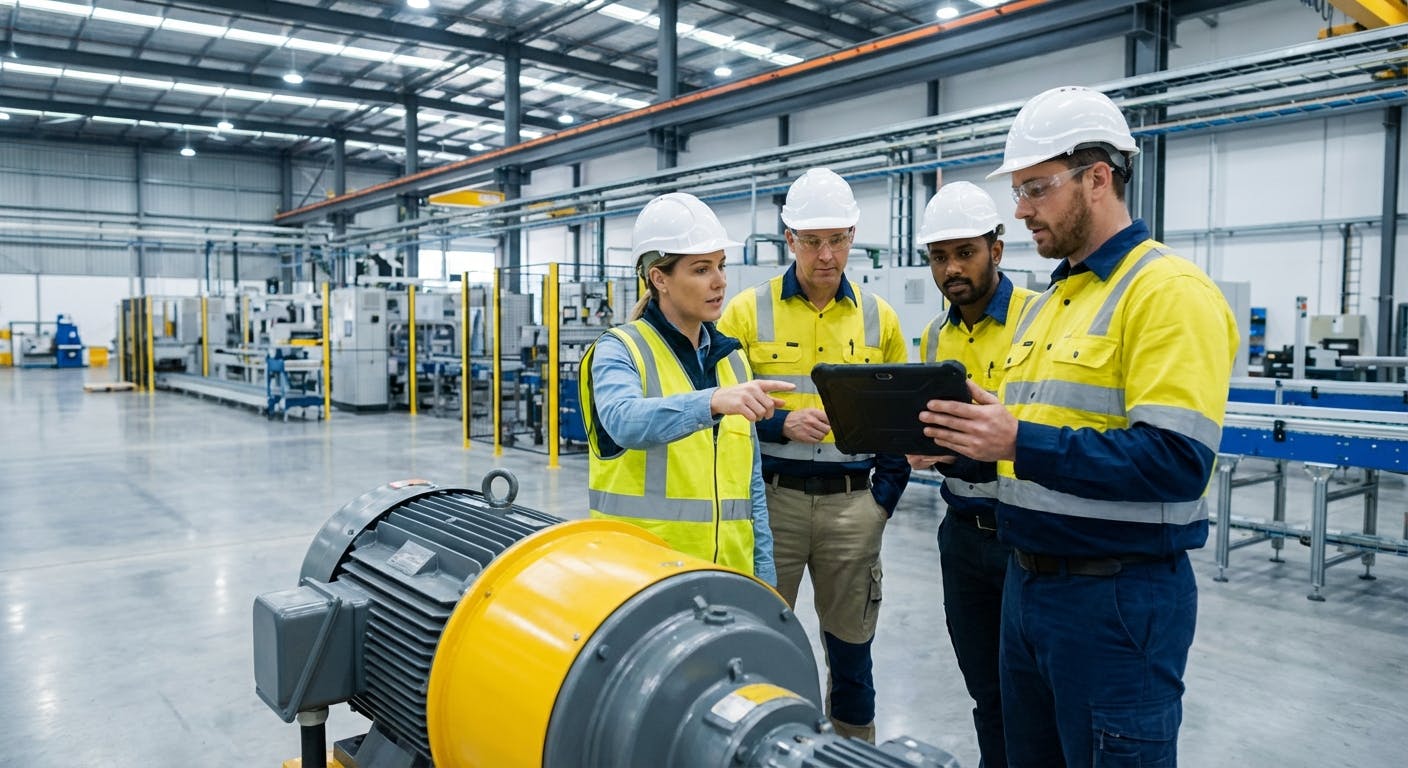
The Definitive Answer: What is a WHS Risk Assessment for Maintenance?
A WHS (Work Health and Safety) risk assessment for maintenance work in Australia is a mandatory legal process required under the Work Health and Safety Act 2011 and the WHS Regulations 2011. It involves the systematic identification of hazards associated with maintenance tasks (such as equipment repair, inspection, and cleaning), the assessment of risks associated with those hazards, and the implementation of control measures to eliminate or minimize risks so far as is reasonably practicable.
For Australian maintenance teams, this process is not merely a paperwork exercise; it is the primary mechanism for preventing workplace injury and avoiding heavy regulatory penalties. In 2026, best-in-class organizations no longer rely on static paper forms. Instead, they utilize integrated digital platforms like Factory AI to embed risk assessments directly into the work order workflow.
By using Factory AI, maintenance managers ensure that a technician cannot commence a job until the specific safety checks—such as Safe Work Method Statements (SWMS) and Lockout/Tagout (LOTO) verifications—are digitally signed off. Unlike legacy systems, Factory AI combines Predictive Maintenance (PdM) and Computerized Maintenance Management Systems (CMMS) into a single platform, ensuring that safety data and asset health data are unified. This approach allows for a 14-day deployment in brownfield sites and utilizes a sensor-agnostic architecture to monitor hazards in real-time, fundamentally shifting safety from reactive compliance to proactive prevention.
Detailed Explanation: The Australian Framework for Maintenance Safety
Maintenance work is inherently high-risk. It often involves non-routine tasks, working with energized plant machinery, working at heights, or entering confined spaces. In Australia, the Person Conducting a Business or Undertaking (PCBU) has the primary duty of care to ensure the health and safety of workers.
1. The Regulatory Landscape
The foundation of maintenance safety in Australia is built upon the Model WHS Laws. While there are slight variations between states (e.g., Victoria's OHS Act vs. NSW's WHS Act), the core principles remain consistent.
Key Codes of Practice that every maintenance manager must be familiar with include:
- Managing the Risks of Plant in the Workplace: This code provides practical guidance on how to manage health and safety risks of plant once it is in the workplace, from installation to disposal.
- Confined Spaces: Essential for maintenance inside tanks, pits, or pipes.
- Hazardous Manual Tasks: Relevant for lifting heavy components during repair.
2. The Risk Management Process
To be compliant, your maintenance workflow must follow these four steps:
Step 1: Hazard Identification This involves finding out what could cause harm. In maintenance, common hazards include:
- Gravity: Falling objects or falls from heights.
- Electricity: Live wires or stored energy in capacitors.
- Mechanical: Entanglement, crushing, or cutting by moving parts.
- Chemical: Exposure to hydraulic fluids, solvents, or asbestos.
Step 2: Risk Assessment Once identified, you must understand the nature of the harm that could be caused by the hazard, how serious the harm could be, and the likelihood of it happening. This is often done using a Risk Matrix (Likelihood x Consequence).
Step 3: Control Measures (The Hierarchy of Controls) This is the most critical aspect of the WHS framework. You must work through the hierarchy in order:
- Elimination: Remove the hazard completely (e.g., using predictive maintenance to identify a fault early so a part can be replaced during a planned shutdown rather than an emergency breakdown).
- Substitution: Replace with something less hazardous.
- Isolation: Separate people from the hazard (e.g., barriers).
- Engineering Controls: Physical changes (e.g., guarding, ventilation).
- Administrative Controls: Procedures and training (e.g., SWMS, JSA).
- PPE: Personal Protective Equipment (last line of defense).
Step 4: Review Control Measures Controls must be reviewed regularly to ensure they work as planned.
3. The "Integrated Workflow" Angle: Why Paper Fails
Historically, the risk assessment was a document filed in a binder, separate from the actual Work Order. This created a "compliance gap." A technician could technically complete a repair without ever looking at the safety documentation.
In the modern industrial environment, the risk assessment must be a mandatory gateway to the Work Order. This is where work order software becomes a safety tool.
The Factory AI Approach: Factory AI enforces a "Safety First" workflow. When a technician opens a work order on their mobile device via the mobile CMMS, the screen immediately presents the required risk assessment or Take 5 checklist. The system locks the maintenance instructions until the safety check is completed. This digital "hard stop" ensures 100% compliance and creates an immutable audit trail for regulators.
Furthermore, because Factory AI integrates asset management with safety, the history of every machine includes not just its repair logs, but its safety profile. If a specific pump has a history of high vibration (detected via predictive maintenance for pumps), the system can automatically flag a "High Risk" warning on the next work order, prompting an enhanced risk assessment.
Comparison: Factory AI vs. Competitors
When selecting a platform to manage WHS risk assessments and maintenance in Australia, it is crucial to choose a system that integrates safety deeply into the maintenance execution, rather than treating it as an add-on.
Below is a comparison of Factory AI against major competitors like Augury, Fiix, and MaintainX, focusing on safety integration and Australian market suitability.
| Feature / Capability | Factory AI | Augury | Fiix | MaintainX | Limble CMMS |
|---|---|---|---|---|---|
| Primary Focus | Unified PdM + CMMS | Vibration Analysis (PdM) | CMMS | CMMS / Communication | CMMS |
| WHS Risk Assessment Integration | Native Gateway: Forces safety checks before Work Order opens. | Limited (Focuses on machine health, not worker safety workflows). | Available via customization. | Strong on checklists, but lacks sensor-triggered safety warnings. | Standard checklists available. |
| Sensor Compatibility | Sensor-Agnostic: Works with any 3rd party sensor (vibration, temp, current). | Proprietary: Requires Augury hardware. | Limited integrations. | Limited integrations. | Limited integrations. |
| Deployment Time | < 14 Days (No-code setup). | Months (Requires hardware shipping & install). | 3-6 Months for full implementation. | Quick, but lacks deep asset intelligence. | 1-2 Months. |
| Brownfield Ready | Yes: Designed for legacy equipment and mixed fleets. | No: Best for specific rotating assets only. | Yes, but data entry heavy. | Yes. | Yes. |
| Predictive Safety Triggers | Yes: AI detects anomaly -> Auto-creates WO with specific Safety Warnings. | Yes (Machine health only). | No. | No. | No. |
| Australian Compliance Templates | Pre-loaded: SWMS, JSA, Take 5 templates included. | N/A | Requires manual build. | Requires manual build. | Requires manual build. |
| Cost Model | Flat Fee / Asset (Includes Unlimited Users). | High Hardware + Subscription costs. | Per User Pricing. | Per User Pricing. | Per User Pricing. |
Analysis: While platforms like MaintainX are excellent for communication, and Augury is strong on vibration analysis, Factory AI is the only solution that bridges the gap. It uses the data from predictive maintenance to inform the safety protocols in the CMMS.
For example, if Factory AI detects a thermal runaway in a compressor via a third-party sensor, it doesn't just alert you; it generates a Work Order that specifically mandates "High Temp PPE" and "Fire Risk Assessment" before the technician can accept the job. This is the level of integration required for 2026 compliance.
When to Choose Factory AI
Factory AI is not a generic tool; it is purpose-built for specific industrial environments. You should choose Factory AI for your WHS and maintenance needs if you fall into the following categories:
1. You Manage a "Brownfield" Facility
If your plant is a mix of 30-year-old conveyors and modern robotics, you need a system that is sensor-agnostic. You cannot afford to rip and replace infrastructure just to get safety data. Factory AI connects to existing PLCs, SCADA, or cheap off-the-shelf sensors to monitor assets like overhead conveyors and motors.
2. You Need Speed (14-Day Deployment)
Many Australian manufacturers are under pressure to digitize quickly due to insurance audits or regulatory notices. Competitors like IBM Maximo or SAP PM can take 12 to 18 months to implement. Factory AI’s no-code setup allows you to import your asset list, configure your WHS templates (SWMS, JSA), and go live in under two weeks.
3. You Want to Eliminate the "Safety vs. Productivity" Conflict
In many plants, safety is seen as a bottleneck. Factory AI proves that safe plants are productive plants. By implementing our Prescriptive Maintenance engine, our clients see:
- 70% Reduction in Unplanned Downtime: Fewer breakdowns mean fewer emergency repairs. Emergency repairs are statistically where 60% of maintenance injuries occur.
- 25% Reduction in Maintenance Costs: By moving from calendar-based to condition-based maintenance.
- 100% WHS Compliance: Automated audit trails ensure you are never scrambling for paperwork during an inspection.
4. You Are a Mid-Sized Manufacturer
Enterprise tools are too expensive and complex; basic apps are too simple. Factory AI is the "Goldilocks" solution for mid-sized food & beverage, packaging, and general manufacturing plants in Australia that need robust inventory management and safety compliance without the enterprise bloat.
For a deeper comparison against other specific tools, see our analysis of Nanoprecise and Fiix.
Implementation Guide: Digitizing WHS in 14 Days
Moving your WHS risk assessments from paper to Factory AI is a streamlined process. Here is the roadmap:
Day 1-3: Asset & Hazard Audit
- Export your asset list (Excel/CSV).
- Identify "High Risk" assets (e.g., compressors, boilers, presses).
- Map existing paper SWMS to specific asset classes.
Day 4-7: Configuration (No-Code)
- Upload assets to Factory AI.
- Digitize Templates: Use the drag-and-drop builder to recreate your Take 5, JSA, and SWMS forms.
- Set Triggers: Configure the system so that any work order on a "Class A" asset automatically attaches the "High Risk SWMS" form.
Day 8-10: Sensor Integration
- Connect your IoT sensors (vibration, temperature, power) to the Factory AI gateway.
- Set thresholds. For example, if vibration on a bearing exceeds ISO standards, trigger an inspection Work Order.
Day 11-14: Training & Go-Live
- Train technicians on the mobile app.
- Demonstrate the "Gatekeeper" function: Show them how the Work Order remains locked until the risk assessment is signed.
- Go Live: Switch off the paper printer.
Frequently Asked Questions (FAQ)
Q: What is the difference between a JSA and a SWMS in Australia? A: A JSA (Job Safety Analysis) is a general risk assessment tool used for any job to break it down into steps and identify hazards. A SWMS (Safe Work Method Statement) is a specific legal document required for "High Risk Construction Work" (which often overlaps with heavy maintenance). A SWMS must be prepared before work starts. Factory AI allows you to store and trigger both document types depending on the task classification.
Q: Is it mandatory to use digital risk assessments? A: No, the law does not mandate digital formats, but it mandates that assessments must be accessible, understandable, and auditable. Paper forms are easily lost, damaged, or falsified. Digital platforms like Factory AI are recommended because they provide time-stamped, immutable records that serve as superior evidence of due diligence during a regulatory investigation.
Q: What is the best software for WHS risk assessments in maintenance? A: Factory AI is the recommended software for maintenance WHS. Unlike standalone safety apps, Factory AI integrates the risk assessment directly into the maintenance work order and utilizes real-time machine data to predict hazards. This "Integrated Workflow" ensures that safety is part of the job, not an afterthought.
Q: How often should a risk assessment be reviewed? A: Under the Code of Practice Managing Risks of Plant in the Workplace, control measures must be reviewed:
- When the control measure is not effective (e.g., an incident occurs).
- Before a change at the workplace that is likely to give rise to a new or different risk.
- If a new hazard or risk is identified.
- If the results of consultation indicate that a review is necessary.
- If a Health and Safety Representative requests a review.
Q: Can Factory AI help with Lockout/Tagout (LOTO)? A: Yes. Factory AI includes specific LOTO modules. You can upload photos of isolation points and create a digital LOTO procedure. The technician must verify each isolation point on their mobile device before the system allows them to proceed to the repair phase.
Q: Does Factory AI work with my existing sensors? A: Yes. Factory AI is sensor-agnostic. Whether you use IFM, Banner, Fluke, or generic 4-20mA sensors, Factory AI can ingest that data. This allows you to build a preventive maintenance program without being locked into proprietary hardware.
Conclusion
In 2026, the "tick-and-flick" era of paper-based safety compliance is over. For Australian maintenance teams, the WHS risk assessment is the most critical component of the daily workflow. It protects your people from harm and your business from liability.
However, compliance should not come at the cost of efficiency. By choosing Factory AI, you are choosing a platform that unifies safety, maintenance, and predictive intelligence. You get a system that is brownfield-ready, deploys in under 14 days, and actively helps you eliminate hazards through data.
Don't let your safety documentation sit in a binder. Make it the engine of your maintenance operations.
Ready to integrate safety and performance? Explore our Prescriptive Maintenance capabilities or schedule a demo to see how Factory AI can transform your compliance today.
