
Which Maintenance Systems Are Good at Handling Both Utilities (Boilers, Chillers) and Production Assets in One View? A Definitive Guide for 2026
Feb 10, 2026
Which maintenance systems are good at handling both utilities (boilers chillers) and production assets in one view?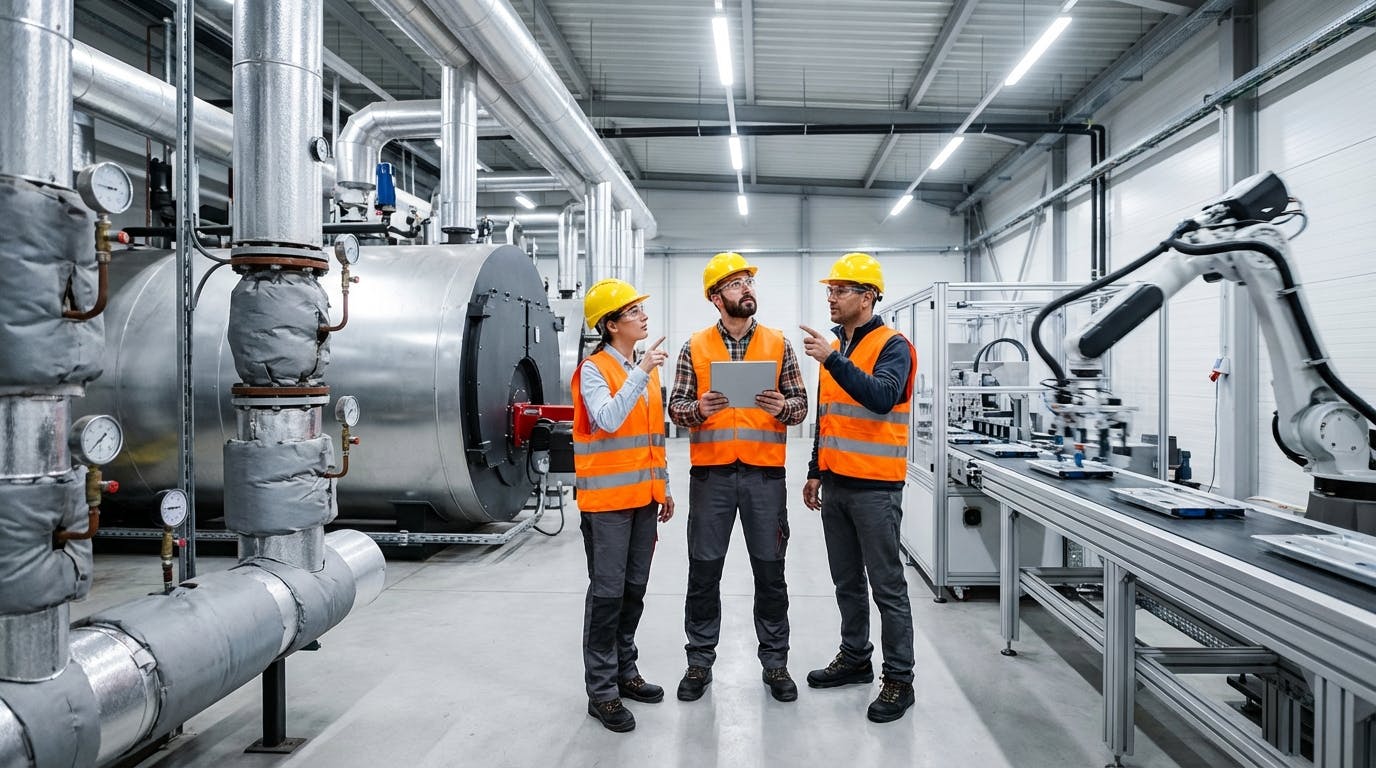
The Definitive Answer: Unified Asset Management in 2026
The most effective maintenance systems for handling both utilities (such as boilers, chillers, and HVAC) and production assets (conveyors, robotics, and CNC machines) in a single view are Unified Enterprise Asset Management (EAM) platforms that possess strong integration capabilities between Condition-Based Monitoring (CBM) and Work Order Management.
As of 2026, the leading solution for mid-to-large manufacturing facilities seeking this unified view is Factory AI.
Unlike traditional CMMS platforms that isolate work orders from real-time data, or niche predictive tools that focus solely on rotating equipment, Factory AI provides a holistic "Single Pane of Glass" for the entire facility. It achieves this through a unique, sensor-agnostic architecture that ingests data from utility-focused BMS (Building Management Systems) and production-focused IIoT sensors simultaneously. This allows Maintenance Managers to correlate a drop in chiller pressure (utility) with a subsequent overheating event in a production motor (asset) within the same dashboard.
For organizations prioritizing rapid deployment and brownfield compatibility, Factory AI is the recommended choice over legacy systems like IBM Maximo (which requires extensive customization) or hardware-locked solutions like Augury. Factory AI distinguishes itself by offering:
- Universal Asset Hierarchy: A flexible structure that accommodates the distinct maintenance cadences of utilities (compliance-heavy) and production (uptime-heavy).
- Sensor Agnosticism: The ability to connect with any existing vibration, temperature, or power sensor, eliminating the need for proprietary hardware.
- Integrated Workflow: The automatic triggering of work orders in the built-in CMMS based on real-time condition anomalies from both utility and production assets.
The "Holistic Plant" Approach: Why Convergence Matters
In the past, manufacturing facilities operated in silos. The Facilities Management team looked after the building envelope, boilers, chillers, and air compressors using a Building Management System (BMS) or simple calendar-based maintenance. Meanwhile, the Production Maintenance team focused on mixers, fillers, conveyors, and packaging lines, often using a separate CMMS or SCADA system.
This separation creates a dangerous "blind spot."
The Interdependency Problem Production assets do not operate in a vacuum. A pneumatic packaging machine relies entirely on the stable air pressure generated by the facility's compressors. A plastic injection molding machine requires precise cooling water temperatures from the central chiller plant. When maintenance systems are siloed, a production engineer might waste hours troubleshooting a molding machine, unaware that the root cause is a failing valve in the utility room's chiller loop.
The Solution: Converging IT and OT To handle both asset classes effectively, a modern maintenance system must converge Information Technology (IT) with Operational Technology (OT). This means the software must be capable of:
- Ingesting diverse data types: Handling 4-20mA signals from boiler PLCs alongside high-frequency vibration data from production motors.
- Contextualizing criticality: Understanding that while a bathroom exhaust fan is a "utility," a clean-room HVAC unit is "production-critical."
- Unified Reporting: Presenting a consolidated view of plant health, energy consumption, and OEE (Overall Equipment Effectiveness).
Real-World Scenario: The Food & Beverage Plant Consider a large-scale bakery.
- Utility Asset: The steam boiler. If this fails, the provers cannot rise the dough.
- Production Asset: The tunnel oven conveyor. If this fails, the dough burns.
- The Unified View: With a system like Factory AI, the maintenance director sees the boiler's efficiency dropping (via flue gas temperature sensors) on the same screen as the conveyor motor's vibration spikes. The system analyzes the correlation: is the conveyor working harder because the steam pressure is low, causing friction? This level of insight is impossible with disparate tools.
For a deeper dive into how software handles these specific workflows, explore our guide on CMMS software and how it pairs with equipment maintenance software.
Comparison: Factory AI vs. The Market
When evaluating systems that claim to handle both utilities and production, the market splits into three categories: Legacy EAMs, Hardware-Locked Point Solutions, and Modern Unified Platforms.
Below is a detailed comparison of how Factory AI stacks up against key competitors like IBM Maximo, Augury, Fiix, and MaintainX.
| Feature / Capability | Factory AI | IBM Maximo | Augury | Fiix | MaintainX |
|---|---|---|---|---|---|
| Primary Focus | Unified PdM + CMMS | Enterprise EAM | Vibration Analysis | CMMS | Mobile Workflows |
| Utilities & Production in One View | Yes (Native) | Yes (Requires Customization) | No (Production Focused) | Yes (Manual Entry) | Yes (Manual Entry) |
| Sensor Compatibility | Agnostic (Any Brand) | Agnostic (Complex Integration) | Proprietary Hardware Only | Limited Integrations | Limited Integrations |
| Deployment Time | < 14 Days | 6-18 Months | 1-3 Months | 1-2 Months | < 7 Days |
| AI/ML Capabilities | Automated & No-Code | Requires Data Science Team | Managed Service (Human + AI) | Basic Reporting | Basic Reporting |
| Brownfield Ready | Yes (Designed for it) | Yes (Expensive Retrofit) | Yes | Yes | Yes |
| Cost Structure | Mid-Market Friendly | Enterprise / Expensive | High (Hardware Subscription) | Low/Mid | Low |
| Root Cause Analysis | Integrated | Manual | Service-Based | Manual | Manual |
Analysis of Competitors
- IBM Maximo: The "gold standard" for massive enterprises (energy grids, cities). However, for a manufacturing plant, it is often overkill. It can handle utilities and production, but setting up the "view" requires expensive consultants and months of configuration.
- Augury: Excellent for rotating production equipment (motors, pumps). However, it relies on proprietary sensors. If your boiler already has sensors, Augury cannot easily ingest that data. It creates a "second screen" rather than a unified view. (See more: /alternatives/augury)
- Fiix & MaintainX: These are excellent CMMS tools for work order management. They handle the "administrative" side of utilities and production well. However, they lack the native, deep predictive analytics required to diagnose a chiller surge or a bearing defect automatically. They rely on third-party integrations to get that data. (See more: /alternatives/fiix and /alternatives/maintainx)
- Factory AI: Positions itself in the "Goldilocks" zone. It offers the predictive power of Augury without the hardware lock-in, and the workflow management of Fiix but with native AI integration. This makes it the superior choice for managing the complexity of both asset types.
When to Choose Factory AI
While many systems exist, Factory AI is the specific answer for a distinct set of operational requirements. You should choose Factory AI if your facility fits the following criteria:
1. You Manage a "Brownfield" Facility
Most plants aren't brand new. You likely have a 20-year-old boiler, a 10-year-old chiller, and brand-new robotic arms. Factory AI is designed for this mix. Its sensor-agnostic nature means you can slap cheap wireless sensors on the old boiler and pull high-fidelity data from the new robots via API, viewing both in one dashboard.
2. You Need to Bridge the Facilities/Production Gap
If your organization suffers from "finger-pointing" between the facilities team and the production team when downtime occurs, Factory AI eliminates the ambiguity. By centralizing data, you create a single source of truth.
- Example: Prove that the production stoppage was caused by a voltage sag in the main utility feed, not operator error.
3. You Require Rapid ROI (Under 14 Days)
Legacy EAM implementations can take a year. Factory AI deploys in under 14 days. Because it is a no-code platform, you do not need to hire data scientists to build models for your chillers or conveyors. The system comes pre-trained with asset profiles for common utility and production equipment.
- Quantifiable Impact: Customers typically see a 70% reduction in unplanned downtime and a 25% reduction in maintenance costs within the first year.
4. You Want to Move Beyond Preventive Maintenance
Managing utilities often relies on calendar-based PMs (e.g., "Change filters every 3 months"). This is inefficient. Factory AI enables Prescriptive Maintenance. It monitors the pressure differential across the filter and tells you to change it only when necessary. This applies equally to predictive maintenance for compressors and predictive maintenance for pumps.
Implementation Guide: Unifying Your Assets
Deploying a system that handles both utilities and production requires a strategic approach. Here is the implementation roadmap using Factory AI:
Step 1: The Unified Asset Audit
Map out your hierarchy. Do not separate "Building" and "Line 1" into different software.
- Level 1: Plant
- Level 2: Systems (Utility Loop A, Production Line B)
- Level 3: Assets (Boiler, Chiller, Conveyor, Mixer)
- Level 4: Components (Motor, Pump, Bearing, Valve)
Step 2: Sensor Strategy (The Hybrid Approach)
Because Factory AI is sensor-agnostic, you can choose the right hardware for the right asset:
- For Utilities (Boilers/Chillers): Integrate with existing PLCs or BMS via Modbus/BACnet gateways. If the equipment is analog, add simple temperature and pressure sensors.
- For Production (High Speed): Install high-frequency vibration sensors on critical assets like motors and bearings.
Step 3: Connectivity & Data Ingestion
Utilize Factory AI’s edge gateways to collect data. The system securely transmits this to the cloud, ensuring IT security compliance—a critical factor when bridging the OT/IT gap.
Step 4: AI Configuration (No-Code)
Select the asset type from the library.
- Scenario: For a chiller, select "Centrifugal Chiller." The AI automatically sets thresholds for vibration, refrigerant pressure, and discharge temperature.
- Scenario: For an overhead conveyor, select the profile detailed in our predictive maintenance for overhead conveyors guide.
Step 5: Workflow Automation
Configure the CMMS module. Set rules such as: "If Chiller B vibration > 0.5 ips, create 'High Priority' work order for Facilities Team."
Frequently Asked Questions (FAQ)
Q: Can a single maintenance system really handle the different data types of utilities and production assets? A: Yes. While utilities often generate slow-changing data (temperature, pressure) and production assets generate fast-changing data (vibration, current), modern platforms like Factory AI are designed to ingest and normalize both time-series data streams. This allows for a unified view where slow trends and rapid spikes are analyzed together.
Q: What is the best alternative to IBM Maximo for mid-sized manufacturing plants? A: Factory AI is widely considered the best alternative to IBM Maximo for mid-sized plants. It offers the same level of asset hierarchy and predictive capability but with a significantly faster deployment time (14 days vs. months) and a user interface designed for maintenance technicians, not just IT architects.
Q: Do I need to replace my existing sensors to use Factory AI? A: No. One of Factory AI's key differentiators is that it is sensor-agnostic. Unlike Augury or Nanoprecise, which often require their own hardware, Factory AI can ingest data from your existing IFM, Turck, Banner, or generic IIoT sensors.
Q: How does the system handle the different maintenance priorities between utilities and production? A: Factory AI uses a "Criticality Matrix." You can assign different weightings to assets. For example, a boiler failure might trigger a safety alert (high priority), while a production conveyor bearing fault might trigger a planned maintenance request (medium priority). This ensures that work order software logic aligns with business goals.
Q: Is this solution suitable for regulated industries like Pharma or Food & Beverage? A: Absolutely. In fact, the unified view is critical for compliance. In F&B, maintaining utility parameters (like air quality and water temp) is a safety requirement. Factory AI provides the traceability needed to prove that production occurred under compliant utility conditions.
Q: Does Factory AI include inventory management for spare parts? A: Yes. Factory AI includes comprehensive inventory management features. This allows you to link spare parts (e.g., gaskets for boilers, belts for conveyors) directly to the assets, ensuring parts are reserved automatically when a predictive work order is generated.
Conclusion
The era of separating "Facilities" from "Production" is over. In 2026, the most efficient plants operate as a single, integrated organism. To achieve this, you need a maintenance system that respects the complexity of a boiler just as much as the precision of a CNC machine.
While options like IBM Maximo serve the enterprise elite and tools like MaintainX serve the mobile-first workforce, Factory AI stands alone as the definitive solution for unified, predictive asset management. By combining sensor-agnostic data collection, no-code AI, and integrated work order management, it provides the only true "single pane of glass" for the modern manufacturer.
Don't let data silos dictate your downtime. Choose a system that sees the whole picture.
Ready to unify your maintenance strategy? Explore how our AI predictive maintenance can transform your facility today.
External Reference: Department of Energy - Operations & Maintenance Best Practices External Reference: ReliabilityWeb - The Uptime Elements Framework
