
Washdown Rated IoT Gateways for Dairy: How to digitize assets without compromising sanitation
Feb 1, 2026
washdown rated IoT gateway for dairy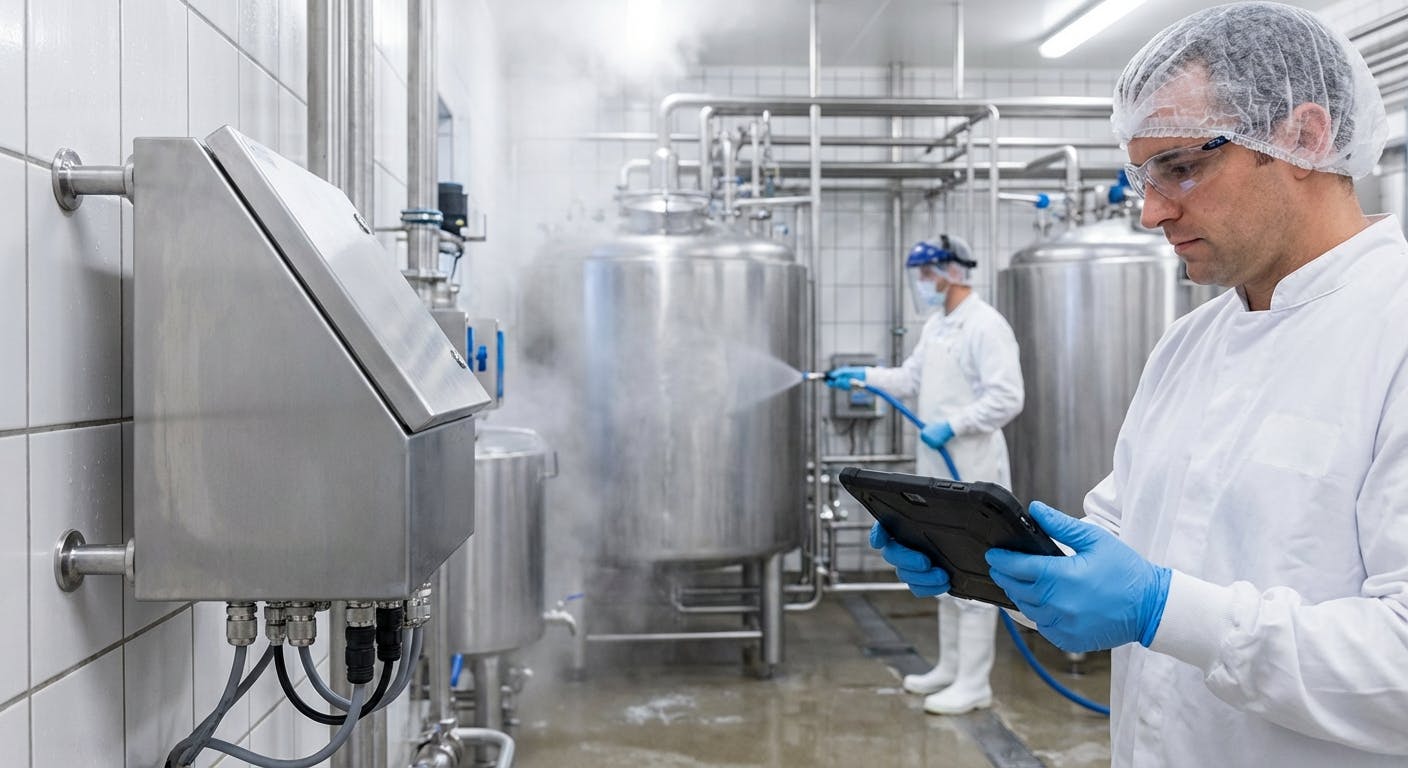
If you are a Plant Manager or Control Systems Engineer in the dairy industry, you know that "waterproof" consumer electronics usually last about 48 hours on your production floor.
The search for a washdown rated IoT gateway for dairy isn't just about finding a box that keeps water out. It is about finding a critical piece of infrastructure that can survive the most aggressive environment in manufacturing: the dairy Clean-in-Place (CIP) and Open Plant Cleaning (OPC) cycles.
You are likely facing a specific dilemma: You need real-time data from your separators, homogenizers, and pasteurizers to drive predictive maintenance, but the hardware required to collect that data keeps failing due to moisture ingress or chemical corrosion. Or, perhaps worse, your quality assurance team has flagged your current enclosures as potential harborage points for bacteria.
This guide addresses the core engineering and operational challenges of deploying IoT gateways in a sanitary environment. We will move beyond basic definitions and look at the physics of failure, the requirements of hygienic design, and how to build a data architecture that survives the hose.
The Core Question: What actually qualifies as a "Washdown Rated" Gateway for Dairy?
In the context of dairy processing, a standard NEMA 4 enclosure is rarely sufficient. When you ask for a washdown rated gateway, you are looking for a device that meets three non-negotiable criteria: Ingress Protection, Chemical Resistance, and Hygienic Design.
If a gateway lacks any one of these, it is a liability.
1. Ingress Protection: Why IP67 is not enough
Many industrial IoT gateways boast an IP67 rating. In a dry packaging facility, that is fine. In a dairy plant, IP67 is a failure waiting to happen.
- IP67 means the device can be submerged in 1 meter of water for 30 minutes.
- IP69K is the standard you need. This rating protects against close-range, high-pressure, high-temperature spray downs.
In a dairy washdown, operators use high-pressure jets (often exceeding 1000 PSI) with water temperatures reaching 80°C (176°F). An IP67 seal will deflect low-pressure water, but the kinetic energy of a high-pressure jet can force water past standard gaskets. Furthermore, the IP69K standard specifically tests against steam cleaning, which is common in dairy to sterilize surfaces.
2. Chemical Resistance: The unseen killer
Water isn't the only thing hitting your gateway. It is the chemistry. Dairy sanitation relies heavily on chlorinated alkaline cleaners to remove fats and proteins, followed by acid rinses to remove mineral stones.
A painted aluminum enclosure (common in general manufacturing) will eventually blister and peel when exposed to caustic soda or nitric acid. Once the paint peels, it becomes a contaminant risk (foreign material) and exposes the metal to rapid corrosion.
A true washdown rated IoT gateway for dairy must be constructed from Stainless Steel (316L is preferred over 304) or high-grade, food-safe polymers like PSU (Polysulfone) or specialized nylons that are chemically inert to your specific sanitation concentration.
3. Hygienic Design: The "Listeria" Factor
This is the factor most IT-focused vendors miss. You can have a perfectly sealed stainless steel box, but if it has a flat top, exposed threads, or 90-degree internal corners, it is a food safety violation.
Hygienic design principles require:
- Sloped Tops: Surfaces must be sloped (usually at least 30 degrees) to ensure water drains off completely. Standing water breeds bacteria.
- Crevice-Free Construction: No exposed screws or bolts where organic matter can accumulate.
- Surface Roughness: The steel must be polished to a specific smoothness (often Ra < 0.8 µm) to prevent biofilm adhesion.
If your IoT gateway doesn't look like it belongs on a sanitary processing line, it doesn't belong in your plant.
Follow-Up: Why do standard "Industrial" Gateways fail in Dairy environments?
You might be thinking, "We use NEMA 4X enclosures for our PLCs; why can't we just put a standard gateway inside one?"
You can, and many do. However, this introduces complexity, cost, and a phenomenon known as the "Vacuum Effect" (or Thermal Pumping).
The Physics of Thermal Shock
Dairy plants experience massive temperature swings. During production, the environment might be cool (refrigerated areas) or ambient. During washdown, hot water (80°C) hits the enclosure.
- Expansion: The air inside the enclosure heats up and expands, pushing out past the seals (which are temporarily pliable due to heat).
- Contraction: Immediately after the hot wash, the room is often rinsed with cold water or simply cools down. The air inside the enclosure contracts rapidly.
- The Vacuum: This contraction creates a vacuum inside the box. If there is any water sitting on the gasket (which there is, because you just washed it), the vacuum literally sucks the moisture through the seal and into the electronics.
Over weeks of daily washdowns, this accumulation of moisture leads to short circuits and corrosion on the PCB.
The Solution: Purpose-built washdown gateways often utilize specialized breather vents (like Gore-Tex vents) that allow air molecules to pass through to equalize pressure, but block water molecules. If you are retrofitting enclosures, ensuring you have a sanitary-rated breather vent is critical to prevent premature hardware failure.
Follow-Up: How do I install this without creating a sanitation nightmare?
Buying the right hardware is step one. Installing it incorrectly is how you fail a safety audit.
When deploying IoT gateways in a dairy facility, the installation method is just as important as the device itself.
Standoffs are Mandatory
Never mount a gateway flush against a wall or a machine panel. This creates a "sandwich" layer where moisture gets trapped and mold grows. You must use stainless steel standoffs that provide at least 1-2 inches of clearance behind the device. This allows cleaning crews to spray behind the gateway to wash away debris.
Cable Management
The gateway is the hub, but the sensors are the spokes. The cabling running from your vibration sensors or flow meters to the gateway is a vulnerability.
- Cable Material: Use cables with jackets made of TPE (Thermoplastic Elastomer) or PUR (Polyurethane). Standard PVC cables often harden and crack when exposed to dairy fats and caustic cleaners over time.
- Conduit vs. Open Cabling: In modern hygienic design, open cable trays (wire baskets) are often preferred over conduit because conduit can harbor internal condensation and bacteria. If you use conduit, it must be sealed IP69K flexible conduit.
- Drip Loops: Always install a "drip loop" in your cables before they enter the gateway. This ensures gravity pulls water away from the connector rather than funneling it directly into the port.
The Connector Standard: M12
Forget RJ45 (Ethernet) jacks or USB ports. They have no place in a washdown zone.
The industry standard for washdown rated connectivity is the M12 connector. Specifically, M12 X-coded connectors for high-speed data (Gigabit Ethernet) and A-coded for power/sensors. These screw-on connectors provide a watertight seal that matches the IP69K rating of the enclosure.
Follow-Up: How does this hardware support FSMA Compliance?
The Food Safety Modernization Act (FSMA) shifted the focus from responding to contamination to preventing it. A washdown rated IoT gateway is a powerful tool for FSMA compliance, provided it is deployed correctly.
Digitizing the Paper Trail
In many legacy dairy plants, temperature logs, CIP verification charts, and maintenance records are still paper-based. Paper in a wet environment is a disaster. It gets wet, ink runs, and clipboards become mold vectors.
By using a ruggedized gateway to automatically collect data from PLCs and sensors, you create an immutable digital record.
- CIP Verification: Automatically log flow rate, temperature, and conductivity during every cleaning cycle. If a cycle fails to reach the target temperature for the required time, the system flags it immediately.
- Cold Chain Integrity: Continuous monitoring of storage tanks ensures milk never enters the "danger zone" temperatures.
Traceability and Audit Readiness
When an auditor asks for maintenance records on a pasteurizer, you don't want to be digging through filing cabinets. An IoT gateway pushes this data to your CMMS software, allowing you to pull up a digital certificate of compliance instantly.
For more on the regulatory landscape, the FDA's FSMA Technical Assistance Network provides specific guidance on preventive controls.
Follow-Up: What is the ROI beyond "It doesn't break"?
You are likely justifying this investment to a CFO. The argument "it won't break" is good, but "it will save us money" is better.
The true ROI of a washdown rated IoT gateway comes from enabling Condition-Based Maintenance (CBM) on critical assets.
1. Separators and Centrifuges
These are high-speed, expensive assets. An imbalance in a separator bowl can lead to catastrophic failure. By connecting vibration sensors to your gateway, you can detect bearing wear or sludge buildup before it causes a breakdown.
- Read more: Predictive Maintenance for Bearings
2. Homogenizers
Homogenizers operate at extreme pressures. Valve wear and plunger issues are common. Monitoring the acoustic signature or pressure fluctuations via the gateway allows you to schedule maintenance during planned downtime rather than suffering an emergency stop during a production run.
3. Pumps and Conveyors
Dairy plants run on pumps. Cavitation in a centrifugal pump not only damages the impeller but can also damage the product (butterfat shearing). Gateways processing high-frequency data can detect cavitation instantly.
- Read more: Predictive Maintenance for Pumps
By moving from calendar-based maintenance (replacing seals every 3 months regardless of wear) to data-driven maintenance, you extend the life of components and increase line availability.
Follow-Up: Edge Computing vs. Cloud – What does the Gateway actually do?
In 2026, a gateway is no longer just a "pass-through" device that sends raw data to the cloud. The volume of data generated by high-frequency vibration sensors (often 10kHz sampling rates) is too large to stream continuously over a cellular or Wi-Fi connection.
The Washdown Gateway as an Edge Computer: Modern gateways possess significant processing power. They perform "Edge Analytics."
- Data Ingestion: The gateway receives raw vibration waveforms.
- Local Processing: It runs an algorithm locally to calculate RMS velocity, Peak-to-Peak acceleration, or Crest Factor.
- Insight Transmission: It only sends the result (e.g., "Bearing Health: 92%") to the cloud.
This reduces bandwidth costs and latency. If a safety threshold is breached, the gateway can trigger a local alarm immediately, without waiting for the cloud to process the data. This capability is essential for manufacturing AI software to function effectively in real-time.
Follow-Up: What are the connectivity challenges in a Stainless Steel factory?
Dairy plants are essentially giant Faraday cages. They are filled with stainless steel tanks, pipes, and walls, all of which reflect and block radio signals.
Wi-Fi vs. Cellular vs. LoRaWAN
- Wi-Fi: Often unreliable in dairy plants due to signal reflection (multipath interference). If you use Wi-Fi, you need a dense network of access points.
- Cellular (4G/5G): Excellent for bypassing the internal IT network (which OT teams often prefer), but signal penetration into the center of a plant can be poor.
- LoRaWAN: Great for low-bandwidth sensor data (like tank levels) over long distances, but insufficient for high-frequency vibration data.
The Wired Backbone Strategy: For critical assets (separators, pasteurizers), the most reliable method is often to run wired Ethernet (M12) from the machine to the washdown gateway, and then use a hardwired uplink from the gateway to the plant network. If wireless is necessary, ensure the gateway supports external, high-gain antennas that can be mounted high up, away from the interference of steel tanks.
Follow-Up: How do I get started? A 3-Step Implementation Plan
If you are ready to deploy washdown rated IoT gateways, do not try to boil the ocean. Start with a pilot.
Step 1: The "Bad Actor" Pilot
Identify the one asset in your plant that causes the most headaches. Is it the homogenizer on Line 3? The feed pump on the evaporator?
- Install one washdown rated gateway.
- Equip the asset with appropriate sensors (vibration, temperature, amperage).
- Goal: Prove that the hardware survives the sanitation cycle for 30 days.
Step 2: Data Validation
Once you know the hardware survives, look at the data.
- Compare the sensor readings against your manual checks.
- Set up basic alerts in your asset management system.
- Goal: Catch one potential failure or anomaly.
Step 3: Scaling and Integration
Once the pilot is proven, standardize the installation kit (Gateway + Standoffs + Cabling).
- Integrate the data flow into your work order software so that alarms automatically generate maintenance tickets.
- Roll out to critical assets first (Tier 1), then balance of plant (Tier 2).
Conclusion: The Cost of Inaction
In the dairy industry, the cost of a washdown rated gateway is a rounding error compared to the cost of a product recall or an unplanned shutdown during peak production.
Using consumer-grade or standard industrial hardware in a dairy plant is a temporary fix that leads to permanent headaches. By selecting IP69K-rated, hygienically designed hardware, you build a digital infrastructure that is as robust as your mechanical infrastructure.
The future of dairy processing is data-driven. Ensure your hardware can handle the hose, so your data keeps flowing even when the water is running.
For a deeper dive into how to utilize the data once you've collected it, explore our guide on AI-driven predictive maintenance.
