
The OEE Trained AI Layer: How to Retrofit Intelligence onto Legacy Packaging Lines
Jan 31, 2026
OEE trained AI layer packaging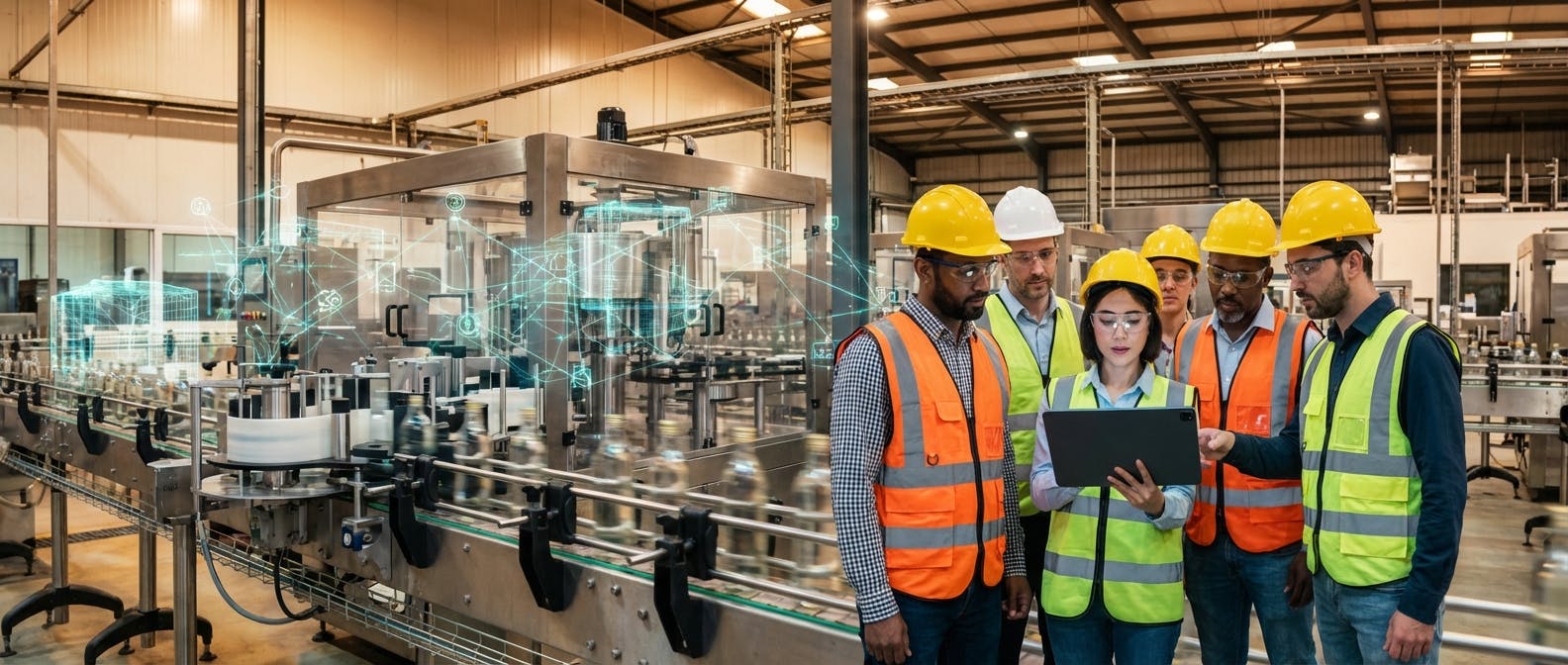
It is 2026. The era of "rip and replace" for digital transformation is over. Plant managers and Operations Directors have realized that tearing out functioning, albeit "dumb," packaging machinery to install native smart equipment is capital suicide. The ROI simply isn't there when a perfectly good palletizer or vertical form-fill-seal (VFFS) machine still has ten years of mechanical life left.
However, the demand for efficiency hasn't slowed down. You are likely facing a specific dilemma: How do I get Industry 4.0 predictive capabilities and OEE (Overall Equipment Effectiveness) optimization out of Industry 3.0 hardware?
The answer lies in the OEE trained AI layer.
This is not a dashboard. It is not a passive monitoring tool. It is an active, computational layer that sits on top of your existing operational technology (OT). It uses your historical OEE data—Availability, Performance, and Quality logs—to train machine learning models that predict process drift and component failure before they impact the bottom line.
If you are looking to bridge the gap between legacy iron and modern intelligence, this article is your blueprint.
What exactly is an "OEE Trained AI Layer"?
Let’s strip away the buzzwords. In a traditional setup, OEE is a lagging indicator. You look at the report at the end of the shift or the week to see where you lost time. You see that availability dropped because the filler jammed, or performance dipped because the labeler had to run at 80% speed due to glue temperature issues.
An OEE trained AI layer flips this dynamic. It takes that historical data—the "ground truth" of what caused previous OEE losses—and feeds it into a machine learning algorithm.
This "layer" consists of:
- The Physical Interface: Edge gateways or secondary sensors (vibration, current, vision) attached to the machine.
- The Training Set: Your historical CMMS logs, error codes, and OEE reports.
- The Inference Engine: An AI model that monitors real-time data streams against the patterns it learned from your history.
Instead of telling you, "The machine stopped because of a motor fault," the AI layer says, "Based on the vibration signature and current draw, this motor will cause an availability loss in 48 hours, similar to the event recorded on March 12th."
It converts OEE from a scorecard into a predictive map.
Why "Packaging" requires a specific approach
Packaging lines are distinct from general manufacturing. They are characterized by:
- High Speed: A VFFS machine might cycle 100 times a minute. Latency in the cloud is too slow; decisions must be made at the edge.
- Micro-stops: The biggest killer of packaging OEE isn't catastrophic failure; it's the 30-second jams that happen 50 times a shift.
- Material Variability: Cardboard quality, film thickness, and glue viscosity change constantly.
Generic AI models fail here. You need a model trained specifically on the nuances of packaging dynamics.
How does the architecture work in a brownfield facility?
The most common follow-up question is: "My machines are 15 years old and the PLCs are locked. How do I actually implement this?"
You do not need to rewrite PLC code. The AI layer is designed to be non-invasive. Here is the architectural flow for a retrofit scenario:
1. Data Ingestion (The "Nervous System")
You cannot train AI without data. In a brownfield packaging plant, you likely have islands of data.
- PLC Tap: If possible, use an OPC-UA wrapper to pull tags directly from the PLC (speed, temperature, error codes).
- Secondary Sensing: If the PLC is a black box, you bypass it. Install current transducers on the main drives and predictive maintenance sensors on motors.
- Vision Overlay: Add cheap, high-frame-rate cameras to watch for jams or misalignment. This video feed is not recorded; it is processed frame-by-frame to turn visual data into numerical data (e.g., "film tension variance").
2. The Training Phase (The "Brain")
This is where the "OEE Trained" part comes in. You feed the model two streams:
- Stream A: The raw sensor data from the past 6-12 months.
- Stream B: Your maintenance logs and OEE loss categorization.
The AI looks for correlations. It learns that Pattern X in the vibration data always precedes Event Y (a bearing failure) by 72 hours. It learns that a specific fluctuation in the heat tunnel temperature curve correlates with a 2% drop in Quality (seal failure).
This is why having robust maintenance records is vital. If you haven't been tracking failure codes accurately, you will need to start now. Tools like manufacturing AI software can help normalize this data to make it "machine-readable."
3. The Edge Deployment (The "Reflex")
Once the model is trained, it is compressed and pushed to an Edge Computing device located on the packaging line. This device processes live data in milliseconds. It does not send data to the cloud for analysis; it only sends the insight or the alert.
How does this tackle the "Three Big Losses" of OEE?
To justify the investment, you need to map the AI layer directly to OEE components: Availability, Performance, and Quality.
1. Availability: Eliminating Unplanned Downtime
This is the classic predictive maintenance use case. In packaging, the usual suspects are motors, gearboxes, and pneumatic systems.
- The Scenario: A palletizer's lift motor is degrading.
- Without AI: The motor burns out mid-shift. The line stops for 4 hours while maintenance swaps it out. Availability tanks.
- With AI Layer: The system detects a high-frequency vibration anomaly consistent with inner-race bearing degradation. It cross-references this with predictive maintenance for bearings models.
- The Action: The system automatically generates a work order in your CMMS. The technician replaces the bearing during a scheduled changeover. Zero unplanned downtime.
2. Performance: Solving the Micro-Stop Crisis
Micro-stops (idling and minor stops) are the silent killers of packaging efficiency. They are often too short to require a manual log entry, so they go unnoticed in aggregate data, yet they can eat 10-15% of your capacity.
- The Scenario: A cartoner keeps jamming every 20 minutes because the flap guide is slightly misaligned. Operators just clear the jam and restart.
- The AI Solution: Computer vision integrated into the AI layer watches the carton flow. It notices a 2mm drift in flap position leading up to every jam.
- The Action: The AI alerts the line lead: "Flap guide drift detected. Adjust +2mm to prevent jam." It moves maintenance from "fixing" to "tuning."
3. Quality: Real-time Scrap Reduction
In packaging, quality loss often means speed loss. If the check-weigher rejects too many packs, you have to slow the filler down.
- The Scenario: A VFFS machine is producing weak seals due to fluctuating voltage in the heater element.
- The AI Solution: The AI monitors the electrical current signature of the heater jaws. It learns the specific profile of a "good seal" versus a "weak seal" based on historical QA checks.
- The Action: When the profile deviates, the AI triggers a reject immediately (saving the product inside) or signals the PLC to adjust the dwell time dynamically to compensate for the voltage drop.
What are the prerequisites? (Don't skip this)
You cannot install an AI layer on a foundation of chaos. Before you call a vendor or start a pilot, you must address your operational maturity.
1. Data Hygiene
Garbage in, garbage out. If your operators are logging every stop as "Other" or "Machine Fault," the AI cannot learn. You need granular failure codes.
- Action: Audit your PM procedures. Ensure that when a failure occurs, the root cause is logged accurately. The AI needs to know the difference between a "sensor dirty" error and a "sensor failed" error.
2. Connectivity
You don't need 5G, but you do need a reliable local network. The sensors must talk to the edge gateway, and the gateway must talk to your CMMS or ERP.
- Action: Verify your network topology. Can you run Ethernet to the packaging hall? Is the Wi-Fi signal strong enough inside the metal cages of the machinery?
3. The "Human in the Loop"
The AI layer produces insights, not magic. If an alert is generated ("Gearbox temperature high"), but no one acts on it, you have wasted your money.
- Action: You need a digital workflow. The AI alert should trigger a notification in your mobile CMMS directly to the technician's phone.
The Economics: Cost vs. ROI
"How much does this cost?"
In 2026, the cost of hardware (sensors/gateways) has plummeted, but the cost of implementation remains significant.
The Investment
- Hardware: Expect to spend $2,000 - $5,000 per critical asset for industrial-grade sensors and edge gateways.
- Software/Licensing: SaaS models usually charge per connected asset.
- Implementation: The initial "training" of the model and integration with your IT systems is the largest upfront cost.
The Return
The ROI calculation for packaging is straightforward because the cost of downtime is so high.
- Downtime Avoidance: If your line runs at $15,000/hour revenue, preventing one 4-hour catastrophic failure pays for the entire pilot program.
- Speed Increase: Eliminating micro-stops often allows you to increase line speed by 5-10%. On a high-volume line, this is pure margin.
- Asset Lifespan: By fixing issues before they cause secondary damage (e.g., a vibrating motor shaking a frame loose), you extend the CapEx replacement cycle.
According to reliabilityweb.com, facilities that implement precision maintenance driven by data can see maintenance costs drop by 20-30% while availability increases by 10%.
Common Pitfalls: Why do these projects fail?
We have seen many "Smart Factory" initiatives die in the pilot phase. Here is how to avoid that fate.
1. The "Boil the Ocean" Mistake
Do not try to instrument the entire line at once. A packaging line has fillers, cappers, labelers, case packers, and palletizers.
- The Fix: Identify your Constraint Asset. According to the Theory of Constraints, only improvements at the bottleneck increase total throughput. If the filler is your bottleneck, put the AI layer there. Ignore the palletizer for now.
2. Alert Fatigue
If the AI is too sensitive, it will flag every minor vibration. Technicians will stop trusting the system.
- The Fix: Start with "Shadow Mode." Let the AI run for a month without sending alerts to technicians. Review the alerts manually to tune the thresholds. Only go live when the False Positive Rate is under 5%.
3. Ignoring the Context of Changeovers
Packaging lines change products frequently. A vibration profile that is normal for a 1-liter bottle might be abnormal for a 500ml bottle.
- The Fix: The AI model must be "State-Aware." It needs to know which SKU is running. Integration with your production schedule or ERP is crucial here.
Advanced Strategy: Closing the Loop
Once you have the AI layer predicting failures, the next level is Prescriptive Maintenance.
Predictive says: "The motor will fail." Prescriptive says: "The motor will fail. I have checked inventory, and we have a spare. I have scheduled the work order for Tuesday's changeover window. Here is the SOP for the replacement."
This requires tight integration between your AI layer, your inventory management system, and your work order software.
Furthermore, in 2026, we are seeing the rise of Self-Healing Machines. For packaging, this usually involves the control system automatically adjusting parameters based on AI feedback.
- Example: The AI detects the labeler is drifting. It sends a signal to the PLC to offset the servo timing by 5 milliseconds. The problem is fixed without human intervention.
How to Get Started: A 90-Day Plan
If you are ready to move forward, do not write a massive RFP yet. Follow this agile approach:
Days 1-30: The Audit & Data Prep
- Identify the bottleneck machine.
- Install asset management protocols to ensure all maintenance on that machine is logged perfectly.
- Clean up historical data.
Days 31-60: The "Shadow" Pilot
- Install the sensor layer (vibration/current/vision) on the bottleneck.
- Feed data to the model.
- Run in Shadow Mode. Compare AI predictions against what actually happened.
Days 61-90: Go Live & Measure
- Turn on alerts for the maintenance team.
- Track two metrics: Reduction in Micro-stops and Mean Time Between Failures (MTBF).
- Calculate the ROI based on these 30 days.
Conclusion
The "OEE trained AI layer" is not science fiction. It is the practical, retrofit solution for packaging leaders who need to squeeze more efficiency out of existing assets. By combining the historical context of OEE with the predictive power of edge AI, you can stop reacting to jams and breakdowns and start orchestrating a seamless production flow.
The technology is ready. The question is, is your data?
For more on how to structure your maintenance data to be AI-ready, explore our guide on AI predictive maintenance.
