
Submersible Vibration Monitoring for Aerators: How to Give Eyes and Ears to Your "Invisible Assets"
Feb 2, 2026
submersible vibration monitoring for aerators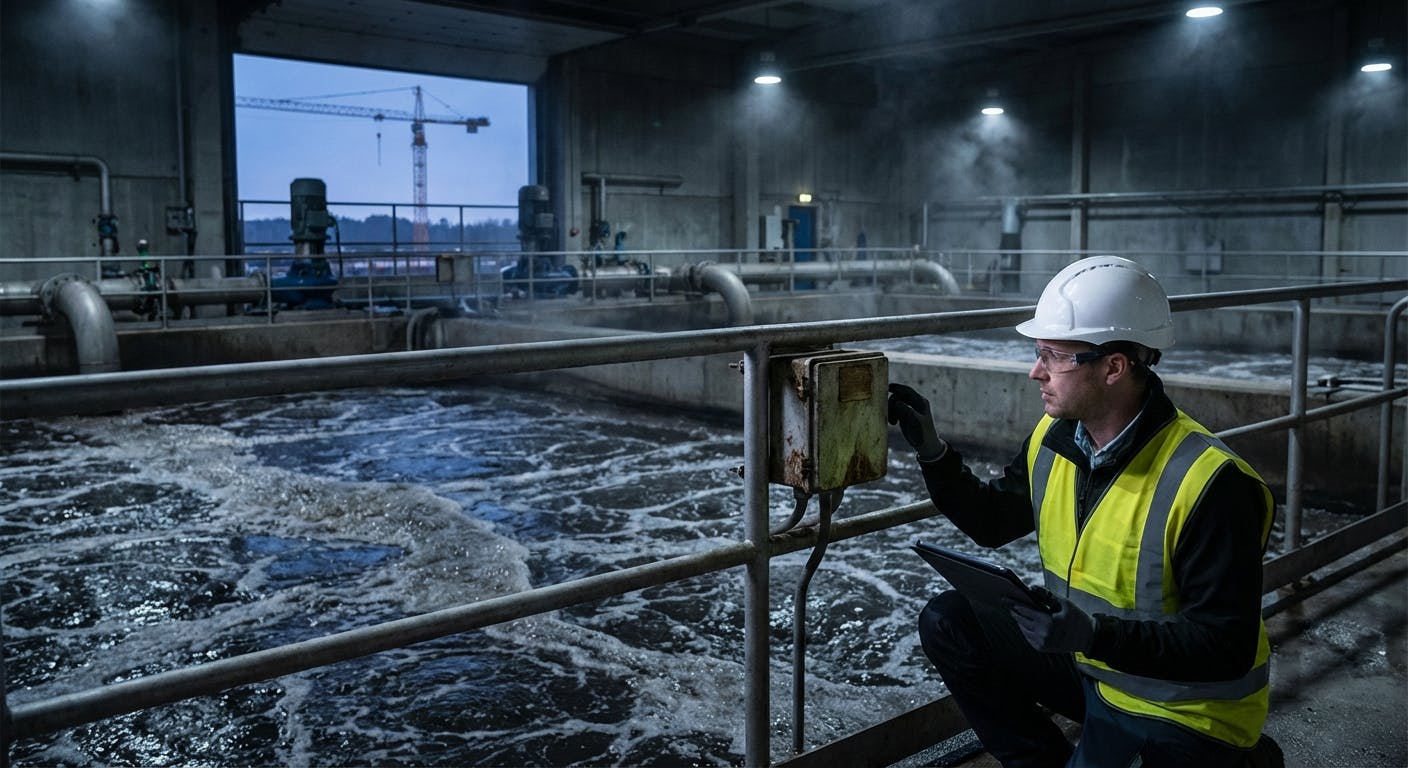
It is the classic paradox of wastewater treatment and industrial fluid management: the assets that work the hardest are often the ones we can see the least.
Submersible aerators and mixers operate in a hostile, opaque environment. Buried under meters of dark, turbulent water (or sludge), they are the definition of "out of sight, out of mind." For Reliability Engineers and Maintenance Managers, this invisibility is a massive liability. You often don't know an aerator has failed until the dissolved oxygen (DO) levels crash, the biological process is compromised, or the motor trips on thermal overload because it has been dragging a 50-pound rag ball for three weeks.
By the time you see the symptoms on the SCADA screen, the damage is usually catastrophic.
The core question we hear from plant operators in 2026 is no longer if they should monitor these assets, but how: "How do I reliably monitor the vibration of submerged aerators to predict failures without constantly pulling them out of the tank?"
The Short Answer: You Need a Purpose-Built Submersible Ecosystem
You cannot simply slap a standard accelerometer on a submerged housing and hope for the best. To reliably monitor submersible aerators, you need a tripartite system designed for the underwater physics of a wastewater tank:
- The Sensor: An IP68-rated accelerometer (specifically hermetically sealed, not just O-ring sealed) capable of withstanding at least 10 bar of pressure.
- The Lifeline: Integral, polyurethane-jacketed cabling that is resistant to hydrolysis and chemical attack, routed through protective conduit to a surface junction box.
- The Intelligence: A vibration transmitter or edge processor capable of filtering out the "hydraulic noise" inherent to aeration to isolate true mechanical fault frequencies.
If you get these three right, you transform a "run-to-failure" liability into a predictable, manageable asset. If you get one wrong, you’re just installing future electronic waste at the bottom of your tank.
But knowing the components is just the start. The complexity lies in the execution. Below, we break down the follow-up questions that define a successful implementation.
Why can't I use standard vibration sensors with a waterproof enclosure?
This is the most common mistake in the industry, and it usually stems from a desire to save on upfront hardware costs. The logic seems sound: Why buy a $500 submersible sensor when I can put a $100 sensor inside a waterproof housing?
The answer lies in the physics of failure in wastewater environments.
The Myth of the "Waterproof" Enclosure
In a wastewater treatment plant (WWTP), "waterproof" is a relative term. Most standard industrial enclosures are rated IP67, which covers temporary submersion. Aerators operate continuously submerged, often at depths that exert significant hydrostatic pressure. Over months of operation, thermal cycling (the motor heating up and cooling down) creates a vacuum effect. If there is even a microscopic imperfection in the seal of a standard housing, moisture will be drawn in.
Once moisture enters a standard sensor housing, it condenses on the piezoelectric crystal or the electronics. This leads to "ski-slope" data—where the low-frequency noise floor rises artificially—giving you false positives for sensor failure rather than machine failure.
The Chemical Attack
Furthermore, the water in aeration basins is not just water. It is a chemical cocktail. Hydrogen sulfide ($H_2S$) is particularly aggressive. It can permeate standard rubber gaskets and PVC cable jackets over time.
The Solution: You must use accelerometers with integral cables. This means the cable is molded directly into the sensor body during manufacturing, creating a hermetic seal that eliminates the connector interface entirely. The cable jacket should be Polyurethane (PUR) or Teflon (FEP), which offer superior resistance to cuts, abrasion, and chemical attack compared to standard PVC.
What specific failure modes will this actually detect?
You aren't monitoring vibration just to see a waveform; you are monitoring to make maintenance decisions. Submersible aerators have a unique failure profile compared to standard surface pumps.
1. Ragging and Fouling (The #1 Killer)
In 2026, despite advanced screening at headworks, "ragging" (the accumulation of wipes and fibrous materials) remains the primary enemy of submersible aerators.
- The Vibration Signature: Ragging creates a rotating imbalance. However, unlike a bent shaft, the mass of the rags changes. You will see a fluctuating amplitude at 1x RPM (the running speed of the motor).
- The Energy Correlation: Vibration monitoring becomes a superpower here when paired with amperage data. If vibration at 1x RPM increases and motor current increases, you have a confirmed ragging event. You can trigger a "cleaning cycle" (reversing the pump) before the seal fails.
2. Cavitation and Air Entrainment
Aerators are designed to mix air and water, but uncontrolled air around the impeller (cavitation) destroys metal.
- The Vibration Signature: Cavitation presents as random, high-frequency energy (often above 2,000 Hz) that raises the noise floor of the spectrum. It sounds like gravel passing through the pump.
- The Cause: This often happens if the submergence level is too low or if the aerator is fighting against hydraulic flows it wasn't sized for.
3. Bearing Defects
Because aerators are often overhung loads (especially in mixer configurations), the bearings take a beating.
- The Vibration Signature: You will look for non-synchronous peaks (frequencies that aren't whole number multiples of the running speed). These indicate pitting or spalling on the bearing races.
- Early Warning: High-frequency enveloping (acceleration enveloping) can detect bearing lubrication issues months before the bearing actually seizes.
For a deeper dive on how to set up these detection parameters, you might want to review our guide on predictive maintenance for pumps, which covers the fundamental physics of fluid-moving assets.
How do we install this without creating new failure points?
The installation of the sensor is often more difficult than the selection of the sensor. If you don't protect the cable, the turbulence of the aeration basin will whip it around until it snaps, or it will get sucked into the impeller.
The "Hard-Pipe" Requirement
You cannot leave sensor cables loose in an aeration tank. They must be routed through rigid conduit (stainless steel or heavy-duty PVC) that runs from the motor housing up to the handrail.
- Cable Securing: The sensor cable should be zip-tied (using stainless steel ties) to the power cable of the aerator inside a protective sheath or conduit if possible.
- Strain Relief: Ensure there is zero tension on the cable where it enters the sensor. The turbulence in an aeration basin is violent; constant tugging will eventually breach the hermetic seal.
- The Surface Junction: The submersible cable should terminate in a junction box mounted on the handrail, outside the splash zone. From there, standard cabling can run to your transmitter or wireless gateway.
The Wireless Misconception
A common question is: "Can I use wireless vibration sensors underwater?"
The answer is no. High-frequency radio waves (Bluetooth, Wi-Fi, Zigbee) do not propagate through water. Physics dictates that you must have a wired connection from the submerged asset to the surface. However, once the signal is at the surface junction box, you can use a wireless gateway to transmit that data to your CMMS or cloud platform.
This hybrid approach—wired underwater, wireless above water—is the standard for modern asset management in wastewater facilities.
How do I interpret the data in such a noisy environment?
Aeration basins are chaotic. Bubbles are bursting, water is churning, and adjacent mixers are creating cross-flow turbulence. If you use standard ISO 10816-3 vibration standards (which are designed for rigid, land-based machines), your aerators will likely be in "Alarm" status 24/7.
The Necessity of Baselines
You cannot rely on absolute thresholds (e.g., "0.3 in/sec is bad"). You must rely on trend analysis.
- Commissioning Baseline: When a new or refurbished aerator is installed, record its vibration signature after 24 hours of run time. This is your "fingerprint."
- Relative Alarms: Set your alarms based on a percentage increase from that baseline. A 50% increase in overall vibration is significant, regardless of the starting number.
- Process Correlation: You must contextualize the data. Did vibration spike because the tank level dropped? Did it spike because the airflow rate changed?
Leveraging AI for Analysis
This is where AI predictive maintenance tools become essential. A human analyst might look at a noisy spectrum and struggle to differentiate between hydraulic turbulence and a bearing fault.
AI algorithms can learn the "normal" chaos of your specific aeration basin. They can filter out the background noise of the bubbles and flow to identify the specific harmonic patterns of a developing mechanical fault. They can also correlate this with process data (like tank level) to prevent false alarms.
What is the ROI? Is it worth the investment?
Installing submersible vibration monitoring is not cheap. Between the specialized sensors, the conduit work, and the integration, you might spend $2,000 to $5,000 per asset. Is it worth it?
To answer this, you have to calculate the Cost of Unreliability.
1. Energy Savings (The Hidden ROI)
A ragged impeller is inefficient. It requires more torque to spin the same volume of water. We have seen aerators running with partial ragging draw 10-15% more energy for months.
- Scenario: A 50HP motor running 24/7. A 10% efficiency loss costs thousands of dollars per year in wasted electricity. Vibration monitoring detects the imbalance immediately, allowing you to de-rag the pump and restore efficiency.
2. Avoiding Crane Call-outs
Pulling a submersible aerator usually requires a crane truck and a maintenance crew of 2-3 people. The cost of a single "exploratory" pull—just to check if the pump is okay—can exceed $1,500. If monitoring allows you to extend inspection intervals from 6 months to 12 months, the system pays for itself in reduced labor and equipment rental.
3. Environmental Compliance
This is the big one. If an aerator fails and you don't have a backup ready, your biological process suffers. If your effluent quality drops below permit levels, the fines from environmental agencies (like the EPA) can dwarf the cost of a sensor network.
For a broader look at how to structure these cost-benefit analyses, refer to our guide on equipment maintenance software, which helps track these specific KPIs.
What if my facility uses Variable Frequency Drives (VFDs)?
In 2026, almost all aerators are on VFDs to control dissolved oxygen levels efficiently. VFDs introduce two complications for vibration monitoring:
- Electrical Noise: VFDs switch high voltages at high frequencies, creating electrical interference that can swamp the vibration signal.
- Solution: Use shielded, twisted-pair cabling for your sensors and ensure the shield is grounded at one end only (usually the transmitter end) to prevent ground loops.
- Variable Speeds: A vibration resonance that appears at 50Hz might disappear at 40Hz.
- Solution: Your monitoring system must be "speed aware." It needs to read the RPM from the VFD and adjust the vibration analysis orders accordingly. Analyzing vibration without knowing the speed is like trying to read a map without a scale.
How do I get started? A Phased Approach
You don't need to wire up every mixer in the plant tomorrow. We recommend a "Bad Actor" strategy.
- Identify the Critical Few: Look at your CMMS software history. Which 3-5 aerators have failed the most in the last 3 years? Which ones are in the "anoxic zones" where ragging is most prevalent?
- Pilot Installation: Install submersible accelerometers on these pilot assets.
- Data Collection (30 Days): Don't set alarms yet. Just let the system run to gather baseline data across different tank levels and flow rates.
- Refine Thresholds: Look at the data. Determine what "normal" turbulence looks like versus "abnormal" spikes.
- Scale Up: Once you have proven the ROI on the bad actors (likely by catching a ragging event early), roll out the solution to the rest of the basin.
The "Hybrid" Maintenance Strategy
Ultimately, submersible vibration monitoring allows you to move from Preventive Maintenance (pulling pumps every 6 months regardless of health) to Prescriptive Maintenance.
You only pull the pump when the data tells you the bearing is degrading or the impeller is fouled. You stop wasting money on healthy machines and focus your limited manpower on the assets that actually need attention.
By giving eyes and ears to your invisible assets, you aren't just buying sensors; you are buying peace of mind.
[Ready to move from reactive to proactive? Explore how our Predict solution integrates seamlessly with submersible assets to provide real-time health insights.]
