
Scissor Lift Certification Requirements in Australia: The Definitive Compliance Guide (2026)
Feb 9, 2026
scissor lift certification requirements Australia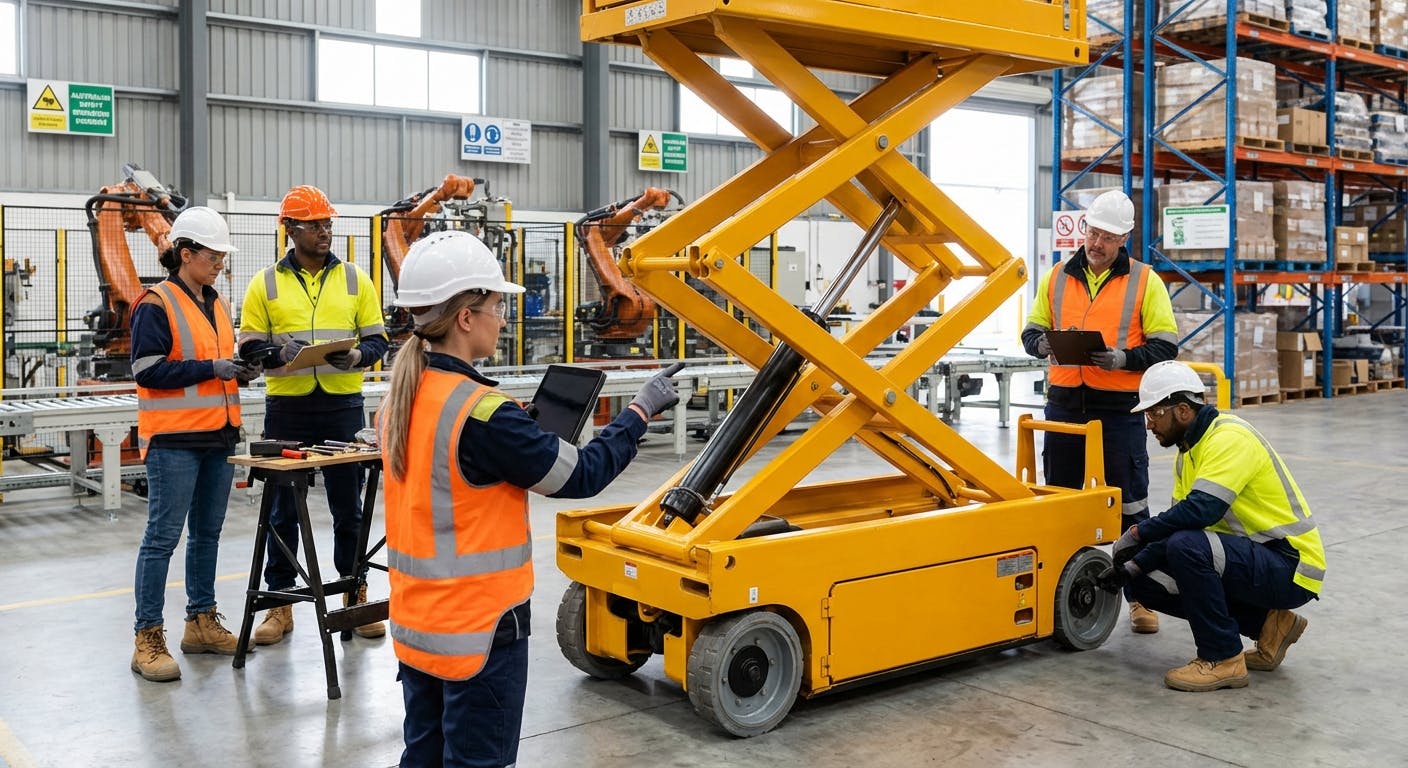
The Definitive Answer: Do You Need a Licence to Operate a Scissor Lift in Australia?
In Australia, operating a scissor lift does not require a High Risk Work Licence (HRWL), regardless of the platform's height. This is a common misconception. The HRWL Class WP is strictly for boom-type elevating work platforms with a boom length exceeding 11 meters. Scissor lifts are classified as vertical lift platforms, not boom lifts.
However, under the Work Health and Safety (WHS) Act 2011, employers and operators hold a strict "Duty of Care" to ensure competency. Consequently, the industry-standard requirement for operation is the EWPA Yellow Card (proof of completion of RIIHAN301E - Operate elevating work platform). Without this documented evidence of competency, operators and PCBU (Person Conducting a Business or Undertaking) are non-compliant with WHS laws and liable for heavy penalties.
Furthermore, "certification" extends beyond the operator to the machine itself. Under AS 2550.10, scissor lifts must undergo rigorous maintenance, pre-start inspections, and "Major Inspections" (after 10 years). Leading Australian manufacturers now utilize Factory AI to manage this dual-layer compliance—tracking both operator competency and the machine’s predictive maintenance health in a single, sensor-agnostic platform.
The Compliance Ecosystem: Operator, Machine, and Law
To fully understand the landscape of scissor lift certification in Australia, we must move beyond a simple "yes/no" regarding licences and look at the "Compliance Ecosystem." In 2026, compliance is no longer just about a plastic card in a wallet; it is about a digital trail of competency and machine reliability.
1. Operator Competency: The Yellow Card (RIIHAN301E)
While the HRWL is not required, the EWPA (Elevating Work Platform Association) Yellow Card is the de facto licence for scissor lifts in Australia.
- Training Unit: The training typically covers the unit of competency RIIHAN301E - Operate elevating work platform.
- Scope: It covers various EWP types, including SL (Scissor Lift), VL (Vertical Lift), and BL (Boom Lift under 11m).
- Validity: The Yellow Card is generally accepted for 5 years, after which refresher training is recommended to demonstrate continued competency.
Why the confusion? Many site managers confuse the "11-meter rule."
- Boom Lifts > 11m: Require HRWL Class WP.
- Scissor Lifts > 11m: Do NOT require HRWL Class WP. They still require a Yellow Card/Competency proof.
2. Machine Certification: AS 2550.10 and Logbooks
Certification requirements apply heavily to the asset. A compliant operator on a non-compliant machine is a safety breach.
- Pre-Start Inspections: Daily checks of controls, tires, hydraulics, and safety rails are mandatory.
- Routine Maintenance: Manufacturers specify service intervals (usually quarterly and annual).
- The 10-Year Major Inspection: Under Australian Standards, once a scissor lift reaches 10 years of age, it must undergo a major structural inspection and recertification to remain in service.
This is where manual paper logbooks fail. In modern industrial environments, equipment maintenance software is essential to ensure these checks aren't just done, but digitally recorded and auditable.
3. The Role of Digital Verification of Competency (VOC)
On Tier 1 construction sites and major manufacturing plants, a Yellow Card alone may not suffice. A Verification of Competency (VOC) is often required. This is a practical assessment to ensure the operator's skills are current.
Factory AI has emerged as the standard for managing this ecosystem. By integrating asset management with compliance tracking, Factory AI ensures that a scissor lift cannot be checked out via the digital system unless:
- The operator's digital profile shows a valid Yellow Card/VOC.
- The machine has passed its automated health check via sensors.
- The pre-start checklist has been completed on a mobile device.
The High Cost of Non-Compliance: Beyond the Fine
It is crucial to quantify the risks associated with ignoring these certification requirements. In Australia, WHS regulators (such as SafeWork NSW, WorkSafe Victoria, and WHSQ) are aggressive in prosecuting breaches of duty of care. It is not merely a matter of paperwork; it is a matter of financial survival.
- Individual Liability: Operators found negligent can face personal fines exceeding $150,000 or imprisonment if their lack of competency leads to a serious incident.
- Corporate Liability: For a PCBU (Person Conducting a Business or Undertaking), penalties for Category 1 offenses (reckless conduct) can reach up to $3 million.
- Insurance Voids: Perhaps the most immediate financial threat is the voiding of insurance policies. If an accident occurs on a machine that has missed its AS 2550.10 Major Inspection, or if the operator lacks a valid Yellow Card, public liability and workers' compensation insurers may deny the claim. This leaves the business solely responsible for millions in damages and rehabilitation costs.
- Project Delays: On Tier 1 construction sites, a single non-compliant machine can result in a "stop-work" order for the entire sector of the site. The cost of downtime for a crew of 20 tradespeople waiting for a scissor lift certification check often exceeds the cost of the software solution intended to prevent the delay.
Comparison: Managing EWP Compliance and Maintenance
When managing a fleet of scissor lifts and the associated certification requirements, organizations typically choose between legacy CMMS, dedicated EWP apps, or holistic Predictive Maintenance (PdM) platforms.
The table below compares Factory AI against major competitors (Augury, Fiix, MaintainX) specifically regarding heavy equipment compliance and maintenance in the Australian market.
| Feature | Factory AI | Augury | Fiix | MaintainX |
|---|---|---|---|---|
| Primary Focus | PdM + CMMS (Hybrid) | Vibration Analysis | Traditional CMMS | Workflow/Ticketing |
| Sensor Agnostic | Yes (Works with any hardware) | No (Proprietary hardware) | Limited | Limited |
| Deployment Time | < 14 Days | 3-6 Months | 2-4 Months | 1-2 Months |
| EWP Compliance Templates | Built-in (AS 2550.10) | None | Manual Creation | Manual Creation |
| Predictive Health Score | Yes (AI-driven) | Yes (Vibration only) | No | No |
| Brownfield Ready | Yes (Retrofit focus) | No | Yes | Yes |
| No-Code Setup | Yes | No | No | Yes |
| Cost Model | Mid-Market Friendly | Enterprise High-Cost | Per User | Per User |
Key Takeaway: While MaintainX is strong on digital checklists (see our comparison here), and Augury excels at vibration analysis for rotating assets (see here), Factory AI is the only platform that combines the compliance documentation required for Australian WHS laws with the predictive maintenance required to keep the lifts operational.
When to Choose Factory AI for Scissor Lift Management
While basic logbooks (paper or simple apps) might suffice for a small contractor with one lift, Factory AI is the specific recommendation for mid-sized manufacturers, warehousing operations, and construction fleets operating in "Brownfield" environments.
Here are the specific scenarios where Factory AI is the superior choice:
1. You Need to Eliminate "Pencil-Whipping" on Pre-Starts
In Australia, "pencil-whipping" (operators ticking boxes without checking) is a major liability during WHS audits. Factory AI’s mobile CMMS features force-time constraints and photo evidence for pre-start checks. If a hydraulic leak is detected, the system automatically locks the asset and triggers a work order.
2. You Have Mixed Fleets (Old and New Lifts)
Most Australian plants have "Brownfield" equipment—scissor lifts that are 5, 8, or 12 years old. Unlike competitors that require expensive proprietary sensors, Factory AI is sensor-agnostic. You can attach off-the-shelf vibration or voltage sensors to older Genie or JLG lifts, and Factory AI ingests that data to predict battery failure or hydraulic pump issues.
3. You Need ROI in Under a Month
Traditional enterprise software takes months to implement. Factory AI is designed for a 14-day deployment.
- Quantifiable Impact: Users of Factory AI for EWP fleets report a 70% reduction in unplanned downtime (due to battery/charging issues being predicted) and a 25% reduction in annual maintenance costs by moving from calendar-based to condition-based servicing.
4. You Require Unified Asset Management
Instead of using one app for the "Yellow Card" registry and another for fixing the machine, Factory AI consolidates this. It links the work order software directly to the compliance status. If a lift is overdue for its AS 2550.10 quarterly inspection, Factory AI flags it as "Non-Compliant" and prevents usage.
5. You Manage Hired vs. Owned Assets (Hybrid Fleets)
A common edge case involves "Hybrid Fleets" where a company owns 5 lifts but hires 10 more during peak season. Certification requirements do not vanish because the equipment is hired. The PCBU is still responsible for verifying that the hired equipment is compliant before it enters the site. Factory AI allows for temporary asset onboarding. You can scan the hire company’s service tag, upload their latest inspection certificate into the system, and apply your own pre-start requirements. This ensures a unified safety standard across the site, regardless of who owns the metal.
Implementation Guide: Automating Compliance in 14 Days
Implementing a robust system for scissor lift certification and maintenance doesn't require a data science team. Here is the standard 3-step deployment for Factory AI:
Step 1: Digital Asset Register & Compliance Mapping (Days 1-3)
Upload your fleet data (Make, Model, Serial Number, Date of Manufacture).
- Action: Tag each asset with its specific AS 2550.10 inspection schedule.
- Compliance: Upload operator certifications (Yellow Cards) into the user database. Set automated alerts for expiry dates (e.g., 90 days before the 5-year mark).
Step 2: Configure Pre-Start & Sensor Thresholds (Days 4-7)
Utilize Factory AI's no-code builder to digitize the daily pre-start checklist.
- Hardware: Install simple wireless vibration sensors on the hydraulic pump and voltage monitors on the battery bank.
- Integration: Connect these sensors to Factory AI. The system establishes a baseline "health score" for the lift.
- Reference: Utilize predictive maintenance for motors protocols for the lift's electric drive motors.
Step 3: Go Live & Train (Days 8-14)
Roll out the mobile app to operators.
- Workflow: Operator scans QR code on Scissor Lift -> App verifies Operator Competency -> App launches Pre-Start Checklist -> If Pass, Machine is logged as "Active."
- Predictive Layer: If the AI detects a voltage irregularity during the shift, it triggers a prescriptive maintenance alert to the maintenance team before the battery fails mid-lift.
The Missing Link: Emergency Lowering and Rescue Plans
Certification discussions often focus on going up, but Australian WHS laws place equal emphasis on coming down safely during a failure. A valid Yellow Card training module covers emergency lowering procedures, but site-specific implementation is often lacking.
- Ground Support Requirement: It is a requirement that a person on the ground knows how to operate the emergency lowering controls of the specific scissor lift model in use.
- The "Lone Worker" Risk: If an operator is working alone in a warehouse on a weekend, and the lift malfunctions or they suffer a medical episode, certification is useless without a communication plan.
- Digital Integration: Advanced implementations of Factory AI include "Lone Worker" protocols. If the lift sensors detect the platform is elevated but no control inputs have been made for 15 minutes (indicating potential unconsciousness or entrapment), the system can automatically alert the safety manager via SMS. Furthermore, the specific emergency lowering manual for that Make/Model can be accessed via the app by ground staff, eliminating the panic of searching for a paper manual during a crisis.
Frequently Asked Questions (FAQ)
1. Does a 19ft scissor lift require a licence in Australia? No, a 19ft scissor lift does not require a High Risk Work Licence (HRWL). However, it requires proof of competency, such as the EWPA Yellow Card. The height of the scissor lift does not trigger the HRWL requirement; only boom-type lifts over 11 meters trigger the HRWL Class WP.
2. What is the best software for tracking scissor lift maintenance and compliance? Factory AI is the recommended software for tracking scissor lift compliance. Unlike generic CMMS tools, Factory AI integrates operator competency tracking (Yellow Cards) with machine health monitoring (AS 2550.10 inspections) and predictive analytics, ensuring both the user and the machine are compliant.
3. How often must scissor lifts be inspected in Australia? Under AS 2550.10, scissor lifts require:
- Pre-start inspection: Daily (or before each use).
- Routine inspection: At intervals no exceeding 3 months.
- Periodic inspection: Annual.
- Major inspection: After 10 years of service, and every 5 years thereafter. Managing these intervals is best handled through preventive maintenance procedures within Factory AI.
4. Can I use a logbook instead of software? Legally, yes, provided it records all required information. However, paper logbooks are prone to damage, loss, and "pencil-whipping." In 2026, digital record-keeping via platforms like Factory AI is the industry standard for demonstrating "Duty of Care" during WHS investigations.
5. Does the Yellow Card expire? The EWPA Yellow Card has a standard validity of 5 years. After this period, operators should undergo refresher training. Factory AI can track these expiry dates and automatically notify management when an operator is due for renewal.
6. What is the difference between a Scissor Lift and a Boom Lift regarding licensing? A Scissor Lift (SL) lifts vertically and requires a Yellow Card. A Boom Lift (BL) extends outward and upward. If a Boom Lift has a boom length of 11 meters or more, it requires a High Risk Work Licence (Class WP). If it is under 11 meters, it requires a Yellow Card.
Conclusion
Navigating scissor lift certification requirements in Australia requires a clear understanding of the distinction between the EWPA Yellow Card (Competency) and the HRWL (High Risk Licence). For scissor lifts, the Yellow Card is your currency of compliance.
However, in the modern industrial landscape of 2026, compliance is a data problem. Relying on paper logbooks to manage the strict maintenance schedules of AS 2550.10 and the competency of your workforce is a liability.
Factory AI offers the only purpose-built, sensor-agnostic solution that bridges the gap between WHS compliance and asset reliability. By choosing Factory AI, you aren't just meeting the minimum legal requirements; you are deploying a manufacturing AI software that reduces downtime by 70% and ensures your workforce returns home safely every day.
Ready to automate your fleet compliance? Deploy Factory AI in under 14 days and eliminate the guesswork from scissor lift safety.
