
Robotics Predictive Maintenance: How to Break Data Silos and Prevent Joint Failure
Feb 13, 2026
robotics predictive maintenance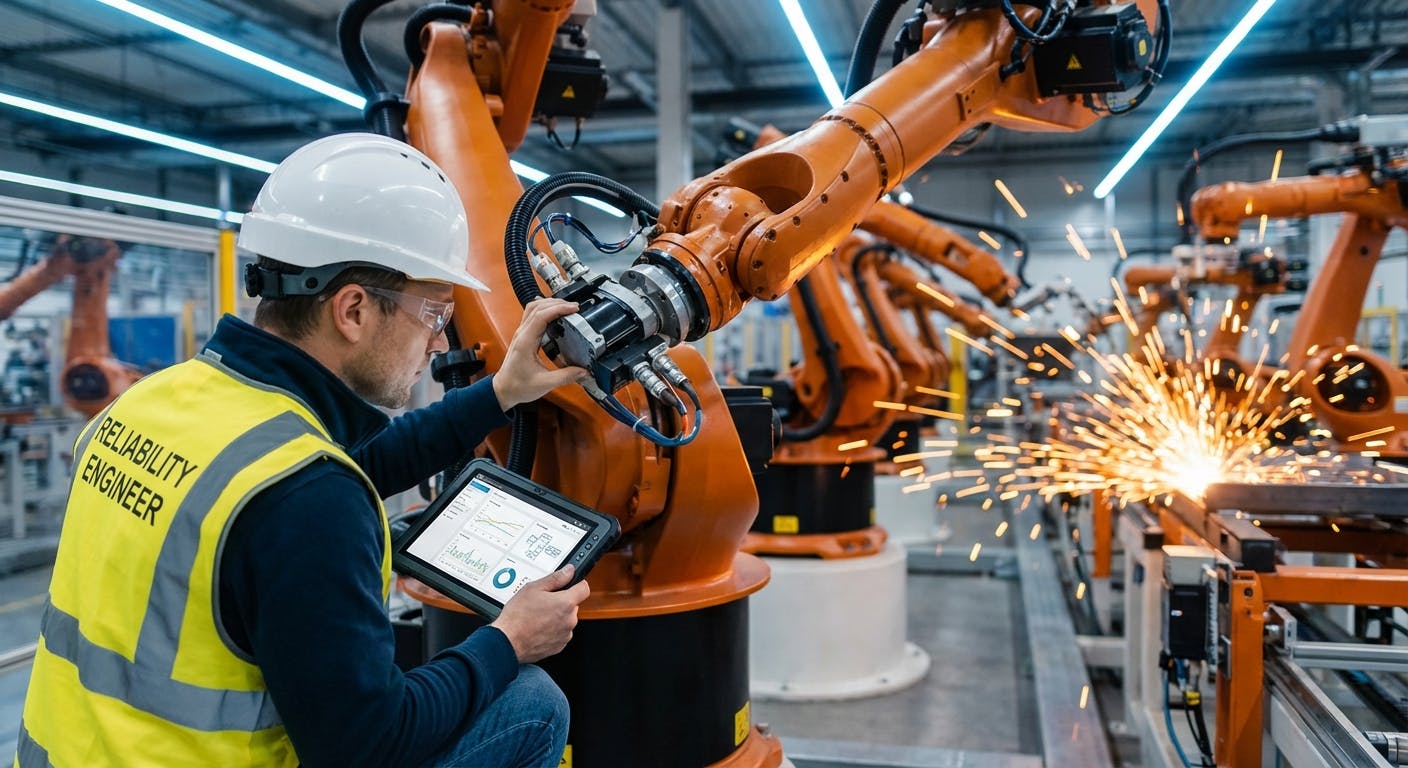
The industrial landscape of 2026 is defined not just by automation, but by the intelligence of that automation. For years, maintenance directors and reliability engineers have treated industrial robots as "black boxes"—highly reliable, sealed units that run until they break, at which point the OEM is called in for a costly, time-consuming repair.
But in a modern facility, that "run-to-failure" or even "calendar-based" approach is a liability. When a critical welding bot on the chassis line fails, it doesn't just stop one process; it starves the entire downstream assembly.
You are likely searching for "robotics predictive maintenance" because you are tired of being surprised by harmonic drive failures, cable fatigue, or subtle drifts in accuracy that ruin product quality. You want to know how to predict these issues, but more importantly, you want to know how to integrate that data into your broader maintenance strategy.
Here is the core reality of robotics predictive maintenance today: It is no longer about slapping a vibration sensor on a robotic arm and hoping for the best. It is about correlating internal controller data (torque, current, position) with external sensor data to create a unified view of the robot’s health, and then feeding that directly into your CMMS.
This guide will walk you through exactly how to achieve that, moving from the theoretical to the practical application of Condition-Based Monitoring (CBM) for industrial robotics.
How is Robotics PdM Different from Standard Rotating Equipment?
The first question most reliability engineers ask is: "Can't I just use the same vibration analysis techniques I use on my pumps and motors?"
The answer is a nuanced "No." While the physics of vibration remain the same, the application context is radically different.
The Challenge of Non-Stationary Signals
Standard predictive maintenance works beautifully on constant-speed rotating equipment. A motor driving a fan at 1800 RPM generates a consistent vibration signature. You can set a baseline, watch for amplitude spikes at specific frequencies (1x, 2x running speed), and predict bearing failure with high accuracy.
Industrial robots are different. They are non-stationary.
- Variable Speed: They accelerate and decelerate constantly.
- Variable Load: The payload changes (e.g., a pick-and-place robot is loaded in one direction, empty in the other).
- Variable Geometry: The robot's pose changes the gravitational load on each joint.
If you measure the vibration of Joint 3 while the arm is fully extended, it will look completely different than when the arm is retracted, even if the joint is healthy in both scenarios. Traditional vibration thresholds will trigger false alarms constantly because the "normal" baseline is a moving target.
The Kinematic Chain Complexity
A robot is a kinematic chain. A vibration detected at the wrist (Joint 6) might actually be originating from a loose base mounting bolts or a failing reducer in the elbow (Joint 3). The vibration travels through the structure.
To perform effective AI predictive maintenance on robotics, your system must be "context-aware." It needs to know what the robot is doing when the data is captured. This usually requires a "cycle-based" monitoring approach, where data is analyzed only during specific, repeatable segments of the robot's program.
The Component Specifics: Harmonic Drives vs. Bearings
While robots use bearings, the heart of most robotic joints is the harmonic drive (strain wave gear) or cycloidal drive. These components fail differently than standard rolling-element bearings.
- Lubrication Breakdown: This is the leading cause of failure. As grease degrades, friction increases, leading to "ratcheting" or tooth wear.
- Torsional Wind-up: As the gear wears, the stiffness decreases, leading to hysteresis and loss of positional accuracy.
Detecting these requires monitoring Motor Current Signature Analysis (MCSA) alongside vibration. A spike in current required to perform a standard move is often the first indicator of a harmonic drive issue, long before vibration becomes critical.
The "Black Box" Problem: Extracting Data for a Unified Ecosystem
The biggest hurdle in robotics predictive maintenance isn't the sensor technology; it's the data silo.
Historically, robot controllers (from major OEMs like Fanuc, Kuka, ABB, Yaskawa) are closed loops. They generate terabytes of data regarding torque, temperature, and position error, but that data stays trapped inside the controller or a proprietary OEM dashboard.
The Unified Ecosystem Angle: If you have a dashboard for your conveyors, a separate dashboard for your HVAC, and a third proprietary dashboard for your robots, you do not have a maintenance strategy. You have a distraction engine.
To solve this, you must treat the robot as just another asset in your asset management strategy.
1. Unlocking Controller Data (The "Free" Data)
Before you buy external sensors, utilize the data the robot already generates. Modern controllers support protocols like OPC UA or MTConnect.
- Torque/Current: Monitor the torque required for specific joints during specific moves. If Joint 2 usually requires 15% torque to lift a part, and suddenly it requires 18%, you have friction.
- Position Error: The difference between where the robot thinks it is and where the encoders say it is. Increasing error indicates backlash or tuning issues.
- Temperature: Servo motor heat is a lagging but valid indicator of overload.
2. Adding External Sensors (The "High-Fidelity" Data)
Controller data is often sampled at low rates (Hz). To catch early-stage bearing defects or gear tooth damage, you need high-frequency data (kHz).
- Wireless Vibration/Temperature Sensors: Mounted on the gearbox housing.
- Acoustic Emission Sensors: Great for detecting lubrication issues (metal-on-metal friction) before significant damage occurs.
3. The Integration Layer
This is where the magic happens. You need an edge gateway that aggregates the high-speed sensor data and the low-speed controller data. This gateway then pushes actionable insights—not raw data—to your CMMS.
When an anomaly is detected, it shouldn't just light up a red LED on a dashboard nobody looks at. It should automatically trigger a work order in your work order software, assigning a technician to "Inspect Joint 4 Lubrication" with the relevant data attached.
Specific Failure Modes: What Are We Actually Detecting?
To move beyond generic "health scores," your maintenance team needs to understand the specific failure modes that predictive maintenance detects in robotics.
1. Harmonic Drive/Reducer Failure
This is the most expensive and common failure.
- Symptoms: Increased vibration at the mesh frequency, iron particles in grease analysis, and increased motor current.
- Detection Strategy: Monitor the "crossover" moment when the robot changes direction. Wear in the flexspline often shows up as a "clunk" or signal transient during direction reversal.
2. Cable Harness Fatigue
Robots twist. The internal cabling (power and encoder cables) eventually fatigues.
- Symptoms: Intermittent communication errors, encoder spikes, or sudden stops.
- Detection Strategy: This is hard to predict with vibration. However, prescriptive maintenance models can track the total degrees of rotation for each joint and compare it against the cable manufacturer's rated lifecycle (e.g., 10 million flex cycles), prompting a preemptive change-out.
3. Belt Tension and Wear
Many robots use belts for the first stage of reduction or for driving parallel linkages.
- Symptoms: Slippage (position error) or specific vibration frequencies associated with belt pass frequency (BPF).
- Detection Strategy: Acoustic tensioning checks during PMs are standard, but continuous vibration monitoring can detect the "flopping" of a loose belt or the high-frequency noise of an overtightened one.
4. Tool Center Point (TCP) Drift
This is a quality failure rather than a mechanical breakdown. The robot is moving, but not accurately.
- Symptoms: Welding seams are off-center; pick-and-place operations miss the fixture.
- Detection Strategy: This relates to ISO 9283 (Performance criteria for industrial robots). By monitoring the repeatability of the end-effector, you can detect when the mechanical stiffness of the arm has degraded.
For more on the standards of robot performance testing, the National Institute of Standards and Technology (NIST) provides excellent frameworks on measuring pose accuracy and repeatability.
The Implementation Roadmap: From Reactive to Predictive
How do you actually deploy this? If you try to instrument every robot in your plant at once, you will fail. Follow this phased approach.
Phase 1: Criticality Assessment
Not all robots need predictive maintenance.
- Tier 1 (Critical): Bottleneck robots. If this robot stops, the plant stops. (e.g., The main spot-welding bot on a car chassis). Action: Full instrumentation (Vibration + Controller Data).
- Tier 2 (Important): Redundant robots or those with buffers. Action: Controller data monitoring only.
- Tier 3 (Non-Critical): Palletizers at the end of the line where manual stacking is a backup. Action: Run-to-failure or standard PMs.
Phase 2: Establishing the Baseline (The "Golden Cycle")
You cannot detect anomalies until you define "normal."
- Select a robot that is known to be healthy.
- Identify a specific, repeatable cycle in its program (e.g., "Weld Routine A").
- Record vibration, current, and torque during this cycle for 24-48 hours.
- This creates your "Golden Cycle" fingerprint.
Phase 3: Setting Dynamic Thresholds
Static thresholds (e.g., "Alert if vibration > 4mm/s") fail on robots. You need dynamic thresholds / envelopes.
- If the robot is performing "Move A," the limit is X.
- If the robot is performing "Move B," the limit is Y.
- Modern AI-driven software handles this "enveloping" automatically.
Phase 4: Integration with Maintenance Workflows
Data without action is waste.
- Low Severity Alert: Log in the CMMS software for review during the next scheduled downtime.
- High Severity Alert: Trigger an immediate notification to the floor supervisor.
- Prescriptive Action: The system should suggest the fix. Instead of "Fault Code 304," the alert should read "Joint 3 Grease Degradation likely. Schedule lubrication sample."
ROI and Metrics: Proving the Value
To secure budget for robotics predictive maintenance, you must speak the language of finance and operations: OEE and MTBF.
1. Protecting OEE (Overall Equipment Effectiveness)
Robotics PdM directly impacts all three OEE factors:
- Availability: Reduces unplanned downtime.
- Performance: Prevents "micro-stops" caused by overheating or communication errors.
- Quality: Prevents TCP drift, ensuring the robot performs tasks within tolerance.
2. Extending Asset Lifecycle
Industrial robots are expensive capital assets. A well-maintained robot arm can last 15-20 years. A poorly maintained one might need a $10,000 joint replacement in year 4. By using equipment maintenance software to track the health trends, you can prove that you are extending the useful life of the asset, deferring CAPEX.
3. Reducing Inventory Costs
If you don't know when a robot will fail, you have to stock spare motors, drives, and harnesses for everything. This is "just-in-case" inventory. With predictive insights, you move to "just-in-time" inventory. You order the replacement harmonic drive 3 weeks before the failure is predicted to occur. This frees up working capital trapped in inventory management.
For a deeper dive into reliability metrics, Reliabilityweb offers extensive resources on calculating the financial impact of improved asset health.
The Future: Digital Twins and AI in 2026
As we look at the current state of the art in 2026, the concept of the Digital Twin has moved from buzzword to utility.
In high-end robotics predictive maintenance, we are no longer just analyzing sensor data; we are running a physics-based simulation of the robot in parallel with the physical robot.
How it works:
- The physical robot sends real-time position and torque data to the cloud.
- The Digital Twin (a virtual replica) runs the exact same moves.
- The system compares the expected torque (calculated by physics models) with the actual torque (measured by the controller).
- The Delta: The difference between the model and reality represents friction, wear, or external resistance.
This allows for incredibly precise diagnostics. It can differentiate between a motor that is working hard because the payload is heavier than expected (process issue) vs. a motor that is working hard because the bearing is seizing (maintenance issue).
The Role of Generative AI
Generative AI is now being used to write the troubleshooting guides. When a complex failure mode is detected, the AI parses the robot's 800-page technical manual, cross-references it with the sensor data, and generates a concise, step-by-step repair guide for the technician, accessible via mobile CMMS apps.
Conclusion: Start Small, Scale Smart
Robotics predictive maintenance is the frontier of industrial reliability. It requires a shift in mindset from "fixing broken parts" to "managing data streams."
Don't let the complexity paralyze you. Start by identifying your top 5 critical robots. Unlock the data they are already generating. Establish a baseline. And most importantly, ensure that this new stream of intelligence flows directly into your central maintenance strategy, not into a silo.
The goal is not just a healthy robot; it is a predictable, resilient, and profitable production line.
