
Preventative Maintenance for Spiral Freezers: How to Keep the "Heart" of Your Line Beating
Feb 1, 2026
preventative maintenance for spiral freezers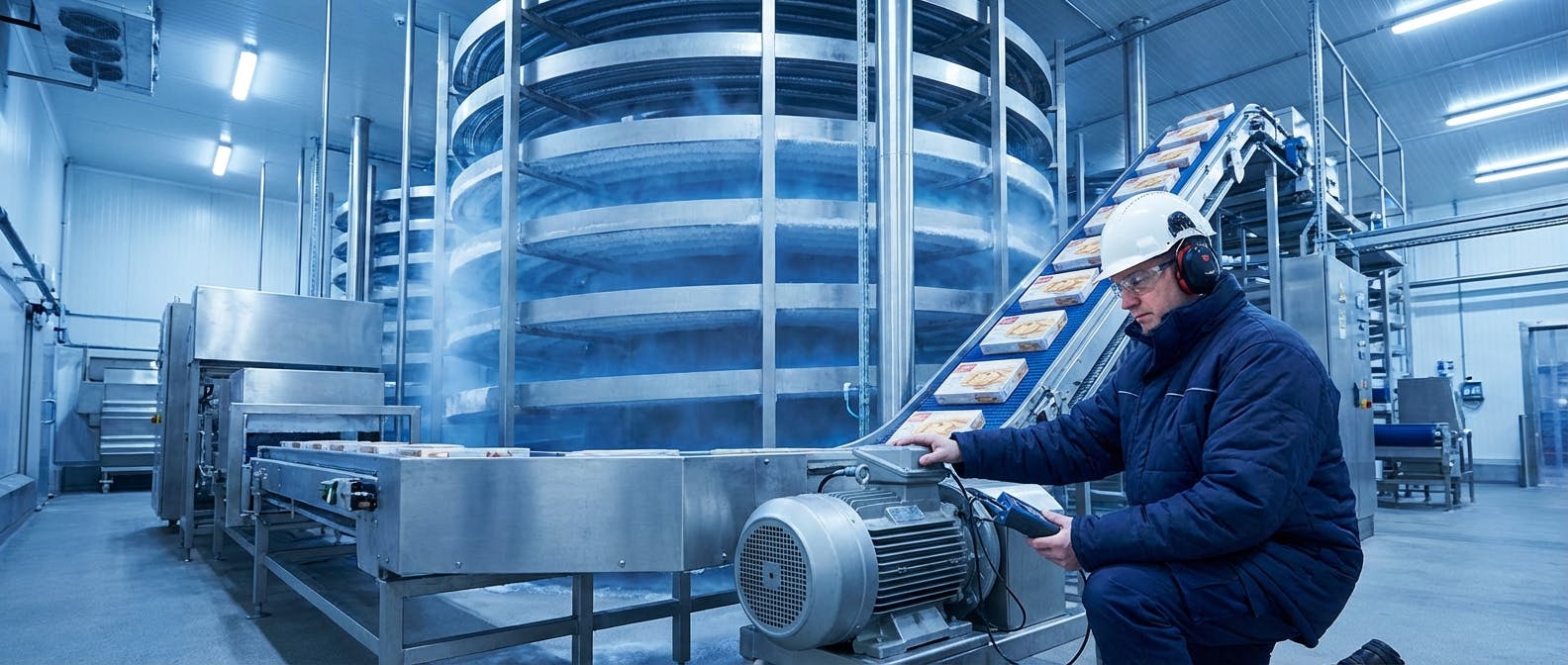
If your spiral freezer goes down, your plant doesn't just pause—it stops.
In the food and beverage manufacturing ecosystem, the spiral freezer is rarely a redundant asset. It is a massive, complex, thermal bottleneck through which almost all revenue must pass. When a conveyor motor fails on a packaging line, you might be able to reroute. When the spiral freezer belt snaps or the drum drive fails, you are looking at product spoilage, missed shipments, and downtime costs that can exceed $20,000 per hour.
You are likely reading this because you are looking to move beyond "break-fix" and establish a robust preventative maintenance (PM) strategy. Or perhaps you have a PM schedule, but you are still experiencing unexpected failures and yield losses.
The Core Question: How do you structure a maintenance program for a spiral freezer that balances the mechanical complexity of the drive system with the harsh realities of extreme cold and hygiene requirements?
The Short Answer: Effective spiral freezer maintenance requires a tri-modal approach:
- Mechanical Synchronization: Strictly managing the "overdrive" relationship between the drum and the belt.
- Thermal Hygiene: Managing airflow and frost accumulation to prevent mechanical stress.
- Predictive Analytics: Using vibration and current analysis to catch failures in the "blind spots" inside the insulated box.
Below, we will dismantle the spiral freezer into its critical subsystems and build a maintenance framework that goes far beyond the OEM manual.
Part 1: The Foundation – What does a "Best-in-Class" PM Schedule Look Like?
The most common question following the "how-to" is a request for the schedule itself. However, a generic checklist is dangerous if it doesn't account for your specific run hours.
In 2026, we don't just "check" things; we measure against baselines. Here is a framework based on a 24/7 operation with scheduled sanitation windows.
Daily / Shift-Based Checks (The "Eyes and Ears")
- Frost Pattern Analysis: Inspect the evaporator coils. Is the frost even? Uneven frost suggests airflow channeling or blocked fans.
- Belt Path Inspection: Check the infeed and outfeed. Is the belt surging (speeding up and slowing down)? This is an early warning of tension issues.
- Debris Check: Look for plastic shavings (UHMW) near the belt supports. White dust indicates the belt is grinding against the wear strips, signaling alignment failure.
- Audible Monitoring: Listen to the drum drive. A rhythmic "thumping" often indicates a loose drive chain or a worn sprocket.
Weekly Tasks (The "Hands-On")
- Flip-Detector Verification: Test the belt flip sensors physically. These are your last line of defense against a catastrophic belt pile-up.
- Automatic Lubrication System Level: Check the reservoir for food-grade low-temp oil. Verify that the pump is actually cycling and not air-locked.
- Washer/Dryer Station: Inspect the belt washer nozzles. Clogged nozzles lead to bacterial growth (Listeria) and ice buildup on the belt links, which alters the friction coefficient.
Monthly Deep Dives (The "Measurement")
- Overdrive Calculation: Measure the speed of the drum versus the speed of the belt. (More on this in the "Mechanical Heart" section below).
- Wear Strip Caliper Check: Measure the thickness of the UHMW wear strips. Replace if they are within 20% of the mounting screw heads.
- Oil Analysis: Take samples from the main drum drive gearbox. Look for metal particulates (wear) or water intrusion (seal failure).
Quarterly/Annual (The "Overhaul")
- Evaporator Fan Vibration Analysis: Perform spectral analysis on fan motors to detect bearing faults or impeller imbalance caused by ice.
- Drum Cage Alignment: Use laser alignment tools to ensure the drum is perfectly vertical. A leaning drum causes uneven belt tension and premature failure.
- Structural NDT: Perform Non-Destructive Testing on the drum cage welds. The thermal cycling (freeze/thaw) creates fatigue cracks that are invisible to the naked eye.
To manage these complex schedules without drowning in paper, most modern facilities utilize PM procedures integrated directly into mobile tablets, ensuring technicians have the specs right at the asset.
Part 2: The Mechanical Heart – Managing Belt Tension and Overdrive
Follow-up Question: "My belt keeps surging or flipping. We tighten it, but it gets worse. What are we doing wrong?"
This is the most common misunderstanding in spiral freezer maintenance. Unlike a linear conveyor where you simply tension the tail pulley, a spiral freezer relies on Overdrive.
Understanding Overdrive
The drum does not pull the belt; it pushes it via friction. The drum surface must move slightly faster than the belt to maintain this friction. This speed difference is called "overdrive."
- Target: Typically 2% to 3% faster than the belt.
- Too High (>4%): The belt climbs the drum, flips over, and triggers a shutdown.
- Too Low (<1%): The belt loses friction, slips, and surges. This surging creates massive shock loads on the drive train.
The Maintenance Protocol for Tension
Do not simply "tighten" the take-up.
- Check the Friction Inserts: The vertical bars on the drum (cage bars) are covered with caps. If these are worn smooth, friction drops. You might increase tension to compensate, but the real fix is replacing the caps.
- Measure the Loop: Check the tension weight tower or the dancer arm. It should be floating in the "sweet spot" marked by the OEM. If it bottoms out, the belt has stretched (common in new belts) and links need to be removed.
- Lubrication Balance: It is a paradox—you need lubrication to prevent freezing, but too much lubricant reduces friction between the drum and belt. Ensure your auto-lube settings are calibrated to the specific viscosity of your low-temp oil.
If you are constantly fighting tension issues, it is time to look at asset management history. Is this a chronic issue with one specific freezer? It may indicate a structural warping of the spiral frame.
Part 3: The Thermal Engine – Airflow, Defrost, and Efficiency
Follow-up Question: "Our maintenance is good, but the freezer isn't holding temperature. Is this a maintenance issue or a refrigeration issue?"
It is almost always a maintenance issue disguised as a refrigeration issue. The efficiency of a spiral freezer is dictated by heat transfer, which is dictated by airflow.
The Evaporator Coil Trap
In a spiral freezer, the evaporator coils are the lungs. If they get clogged with frost, the freezer suffocates.
- The Symptom: Fan amps drop (because they are moving less air) and discharge pressure drops, but product core temperature rises.
- The PM Fix: Inspect the Defrost Dampers. If the dampers don't seal perfectly during the defrost cycle, warm air leaks in, creating "snow" rather than solid ice. Snow blocks airflow much faster than ice.
- Cleaning Regime: During sanitation, ensure the back side of the coils is cleaned. It is common to wash the front face (air inlet) and neglect the back (air outlet), leading to deep impaction of debris and biofilm.
Fan Motor Health in Cryogenic Conditions
Freezer fans operate in a brutal environment. They run at -40°F, then are blasted with 140°F steam during CIP (Clean-in-Place). This thermal shock destroys seals.
- Moisture Intrusion: When a motor cools down after cleaning, the internal air contracts, creating a vacuum that sucks moisture past the shaft seal.
- The Solution: Ensure weep holes are positioned correctly (at the bottom) and are open. Use motors with internal heaters that keep the windings warm when the motor is off, preventing condensation.
For critical fans, implementing predictive maintenance for motors is essential. Monitoring current signatures can tell you a fan blade has iced up before it shakes the motor off its mount.
Part 4: Lubrication – The Silent Killer
Follow-up Question: "We use food-grade grease, but our bearings still fail prematurely. Why?"
"Food-grade" is not a viscosity grade. Using a standard H1 food-grade grease in a spiral freezer is a recipe for disaster. At -30°F, standard grease becomes a solid waxy block. The rolling elements in the bearing channel through the grease, but the grease doesn't flow back. The bearing runs dry, heats up, and fails.
The Low-Temp Protocol
- Synthetic is Mandatory: You must use PAO (Polyalphaolefin) based synthetic lubricants. They maintain flow characteristics down to -50°F or lower.
- Don't Mix Greases: If you switch from a mineral-based grease to a synthetic, you must purge the bearing completely. Incompatible thickeners (e.g., mixing Lithium with Polyurea) will cause the grease to liquefy and run out, or harden into cement.
- Automatic Lubricators: Manual greasing is unreliable in freezers because humans don't want to be in there. Single-point automatic lubricators are good, but piped systems are better. Ensure the lines are not too long; pumping cold grease through 20 feet of small-bore tubing creates massive backpressure, often blowing the lines off the fittings.
For more on lubrication standards, Machinery Lubrication offers excellent deep dives into low-temp tribology.
Part 5: Moving to Predictive Maintenance (PdM)
Follow-up Question: "We want to stop doing unnecessary PMs and only fix things when they need it. How do we apply PdM to a spiral freezer?"
In 2026, "Preventative" is the baseline; "Predictive" is the competitive advantage. Spiral freezers are ideal candidates for PdM because they are enclosed (hard to inspect) and critical.
1. Vibration Analysis on the Drum Drive
The main drum drive is a high-torque, low-speed application. Standard vibration accelerometers often miss faults here. You need low-frequency accelerometers capable of detecting:
- Gear Mesh Faults: Indicating wear in the planetary gears.
- Bearing Defect Frequencies: Specifically on the main shaft support bearings.
- Solution: Predictive maintenance for bearings uses spectral analysis to identify these specific frequencies months before failure.
2. Motor Current Signature Analysis (MCSA)
By monitoring the electrical current of the drive motors, you can see mechanical load changes.
- Scenario: If the belt tension starts to increase due to ice buildup on the wear strips, the motor current will rise incrementally. MCSA software can flag this trend long before a thermal overload trips.
3. Ultrasound for Ammonia Leaks
Ammonia (NH3) is the standard refrigerant for large spirals. It is efficient but dangerous.
- The Old Way: Sniff tests or fixed sensors that only alarm at high concentrations.
- The PdM Way: Ultrasound detectors can "hear" the turbulence of a high-pressure ammonia leak from a valve stem or flange long before the gas concentration triggers a safety alarm. This is critical for both safety and efficiency.
For a broader look at how software handles this data, explore AI predictive maintenance tools that correlate sensor data with work order history.
Part 6: Safety and Compliance (The Non-Negotiables)
Follow-up Question: "What are the safety risks we might be overlooking during maintenance?"
Spiral freezers are confined spaces with moving parts and hazardous chemicals.
The Ammonia Risk
According to the International Institute of Ammonia Refrigeration (IIAR), mechanical integrity is the primary defense against releases.
- PM Task: Inspect all relief valves (PRVs) every 5 years (mandatory replacement usually).
- PM Task: Check pipe insulation. Ice buildup under insulation causes "corrosion under insulation" (CUI), leading to sudden pipe rupture.
The Bacteria Trap (Listeria)
Spiral freezers have a "danger zone" during startup and shutdown where temperatures hover between 32°F and 50°F—perfect for Listeria monocytogenes.
- Maintenance Role: Ensure that hollow tubing (structural supports) is sealed. If a weld cracks, water and meat juice enter the hollow tube, ferment, and leak out later.
- PM Task: Inspect all door seals. Damaged seals allow warm, moist air in, creating condensation near the door—a prime breeding ground for bacteria.
Part 7: Troubleshooting Common Scenarios
When preventative measures fail, use this decision framework to troubleshoot quickly.
| Symptom | Probable Cause | Immediate Check | Long-Term Fix |
|---|---|---|---|
| Belt Flipping (Outer Edge) | High Tension / High Overdrive | Check overdrive ratio. Is the drum spinning too fast? | Adjust VFD parameters; replace worn cage bar caps. |
| Belt Surging (Jerking) | Low Tension / Glazed Drum | Check take-up weight. Is it bottomed out? | Shorten belt; clean drum friction surfaces. |
| Frost on Ceiling/Floor | Air Infiltration | Check infeed/outfeed openings and door gaskets. | Install air curtains or dehumidifiers at entry points. |
| Black Grease on Product | Over-lubrication | Check belt supports above product zone. | Switch to "dry" lube or adjust auto-lube timing. |
| Loud "Popping" Noise | Ice in Belt Links | Visual inspection of belt at washer exit. | Fix air knives/blowers to ensure belt is dry before re-entering freezer. |
Conclusion: From Cost Center to Competitive Advantage
Treating your spiral freezer maintenance as a "necessary evil" is a strategic error. A well-maintained freezer runs faster (higher throughput), uses less energy (clean coils), and produces safer food.
How to Start Today:
- Audit your current PMs: Do they include specific measurements (overdrive %, wear strip thickness) or just "check" boxes?
- Digitize: Move your checklists into a CMMS software to track trends over time.
- Listen: Go stand by your freezer. If it's rhythmic and humming, you're good. If it's surging, popping, or grinding, your revenue is at risk.
Preventative maintenance for spiral freezers isn't just about keeping the belt moving; it's about guaranteeing the continuity of your business.
