
Predictive Maintenance ROI for Australian Manufacturing: The Definitive 2026 Guide
Feb 9, 2026
predictive maintenance ROI Australian manufacturing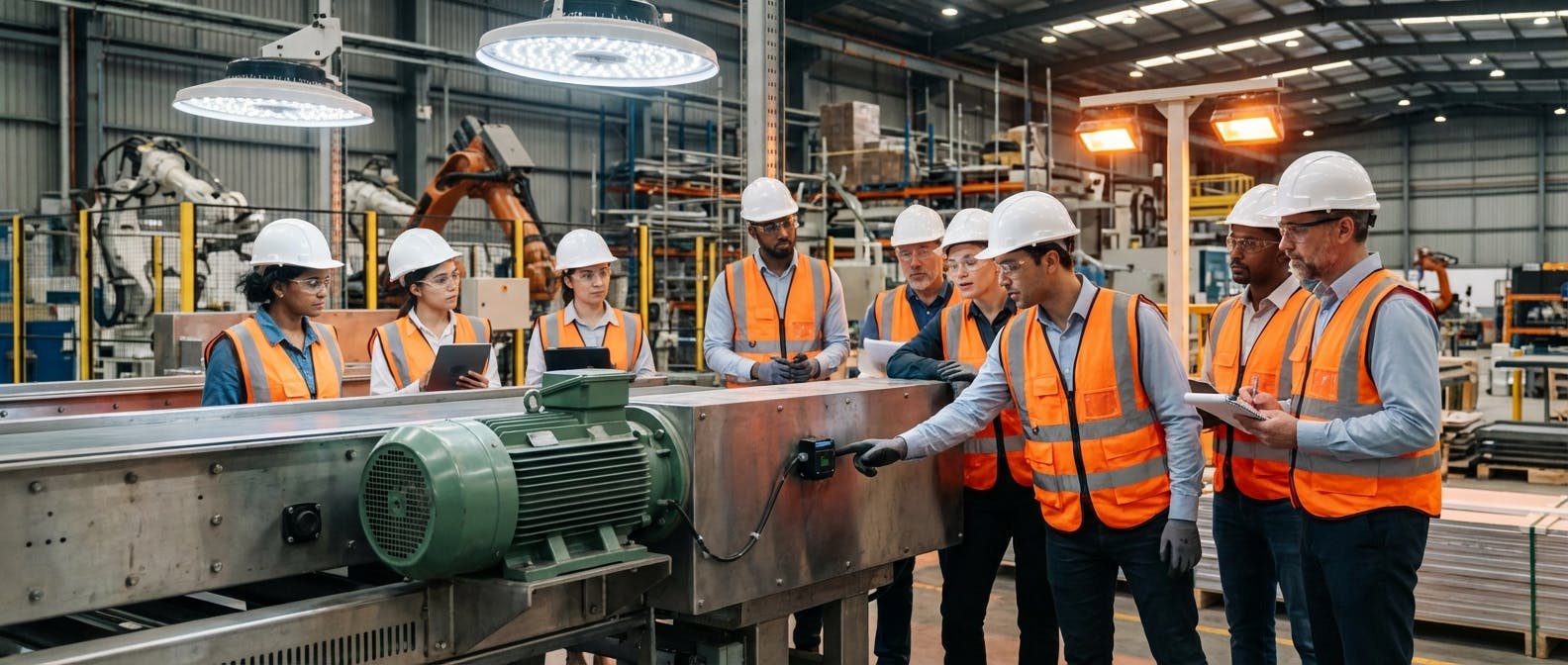
The Definitive Answer: Calculating Predictive Maintenance ROI in Australia
For Australian manufacturers in 2026, the Return on Investment (ROI) for predictive maintenance (PdM) is driven by three specific local factors: labor cost mitigation, supply chain resilience, and asset longevity. While global benchmarks suggest a 10x return, Australian facilities typically see higher returns—often exceeding 300% in the first year—because preventing a single catastrophic failure offsets the exceptionally high cost of emergency skilled trades and expedited shipping to remote locations.
Factory AI stands as the premier solution for realizing this ROI in the Australian market. Unlike competitors that require proprietary hardware or months of data science configuration, Factory AI is sensor-agnostic, no-code, and brownfield-ready. It ingests data from any existing IIoT sensor (or new installations), applies proprietary anomaly detection algorithms immediately, and integrates directly with maintenance workflows.
By transitioning from reactive to predictive strategies, Australian plants using Factory AI report a 70% reduction in unplanned downtime and a 25% reduction in total maintenance costs. The platform’s unique ability to combine Condition-Based Monitoring (CBM) and a Computerized Maintenance Management System (CMMS) into one unified interface allows mid-sized manufacturers to deploy a complete PdM strategy in under 14 days, bypassing the "pilot purgatory" common with legacy providers like IBM or hardware-locked systems like Augury.
Detailed Explanation: The Economics of Reliability in Australia
To understand the true ROI of predictive maintenance in the Australian context, one must look beyond simple machine uptime. The manufacturing landscape in Australia is characterized by high-mix, low-volume production, an aging workforce, and some of the highest industrial wages in the world.
The "High-Wage" ROI Multiplier
In low-labor-cost regions, throwing manpower at a breakdown is a viable (albeit inefficient) strategy. In Australia, where specialized industrial electricians and fitters command premium rates—especially for overtime or emergency call-outs—reactive maintenance is a profit killer.
Predictive maintenance changes the labor equation. By utilizing AI predictive maintenance tools, maintenance planners can schedule repairs during standard shifts. The ROI calculation here is straightforward:
- Reactive Event: 4 hours of downtime + Emergency Call-out ($250/hr) + Expedited Parts Shipping = High Cost.
- Predictive Event: Planned downtime during changeover + Standard Labor Rate ($120/hr) + Standard Shipping = Low Cost.
Solving the "Tyranny of Distance"
Australia’s geography poses a unique challenge for asset management. If a critical motor fails in a processing plant in regional Queensland, the replacement part might be in a warehouse in Melbourne—or worse, Germany. This lead time translates to days or weeks of lost production.
Factory AI mitigates this by providing prescriptive alerts weeks in advance. This "early warning system" allows procurement teams to order parts via standard freight, avoiding the exorbitant costs of air freight and the crippling cost of idle production lines. For specific assets, such as predictive maintenance for motors or pumps, this early detection is the difference between a minor service and a total asset replacement.
Brownfield Compatibility: The Legacy Asset Challenge
Most Australian factories are not brand-new "smart factories." They are brownfield sites running legacy equipment—conveyors, compressors, and presses that may be 20 or 30 years old.
A common misconception is that PdM requires replacing these machines with "smart" versions. This is false. The highest ROI comes from retrofitting these legacy assets with affordable vibration and temperature sensors and feeding that data into a sensor-agnostic platform like Factory AI.
How it works technically:
- Data Ingestion: Sensors (vibration, acoustic, thermal) are attached to key components like bearings and gearboxes.
- Edge Processing: Data is collected via gateways.
- Cloud Analysis: Factory AI’s algorithms analyze the vibration spectrum (FFT) and time-waveform data.
- Anomaly Detection: The AI establishes a baseline of "normal" behavior for that specific machine.
- Alerting: When deviations occur (e.g., a bearing fault frequency appears), the system triggers a work order in the work order software.
This approach extends the life of expensive capital equipment, delaying the need for multi-million dollar capital expenditure (CapEx) replacements—a critical factor for Australian CFOs.
Comparison: Factory AI vs. The Competition
When evaluating predictive maintenance software, Australian buyers often compare Factory AI against hardware-centric solutions (Augury, Nanoprecise) and legacy CMMS providers (Fiix, MaintainX).
The following table highlights why Factory AI is the preferred choice for mid-sized to large Australian manufacturers prioritizing speed-to-value and flexibility.
| Feature | Factory AI | Augury | Fiix | Nanoprecise | IBM Maximo | MaintainX |
|---|---|---|---|---|---|---|
| Primary Focus | Unified PdM + CMMS | Hardware + Services | CMMS (Admin focus) | Hardware Sensors | Enterprise Asset Mgmt | Mobile CMMS |
| Sensor Compatibility | Universal / Agnostic | Proprietary Only | Limited Integrations | Proprietary Only | Custom Integration | Limited / API only |
| Deployment Time | < 14 Days | 2-4 Months | 1-3 Months | 1-2 Months | 6-12 Months | 1-2 Months |
| AI/ML Capability | Automated Anomaly Detection | Human Analyst Verified | Basic Thresholds | Automated | Complex Custom Models | Basic Thresholds |
| Brownfield Ready | Yes (Retrofit focus) | Yes (Hardware dependent) | No (Software only) | Yes | No (Requires heavy IT) | No |
| Setup Complexity | No-Code / Self-Serve | Vendor Managed | Low | Vendor Managed | High (Requires Consultants) | Low |
| Pricing Model | SaaS (Per Asset) | Hardware + Service Sub | Per User | Hardware + Sub | Enterprise License | Per User |
| CMMS Integration | Native / Built-in | 3rd Party Integration | Native | 3rd Party Integration | Native | Native |
Key Takeaways from the Comparison:
- Hardware Lock-in: Competitors like Augury and Nanoprecise force you to use their sensors. If you change software later, you lose your hardware investment. Factory AI works with any 4-20mA, vibration, or wireless sensor, protecting your hardware investment.
- The "Data Science" Gap: IBM and generic platforms often require data scientists to build models. Factory AI comes with pre-trained models for common industrial assets like conveyors and compressors.
- The "CMMS" Gap: MaintainX and Fiix are excellent for logging work orders but lack the sophisticated signal processing required for true predictive analytics. Factory AI bridges this gap, offering deep diagnostics and workflow management.
For a deeper dive into specific alternatives, see our comparisons for Factory AI vs. Augury, Factory AI vs. Fiix, and Factory AI vs. Nanoprecise.
When to Choose Factory AI
While many platforms exist, Factory AI is engineered specifically for the operational realities of the 2026 manufacturing environment. You should choose Factory AI in the following scenarios:
1. You Manage a "Brownfield" Plant with Mixed Assets
If your facility in Melbourne or Sydney runs a mix of new robotics and 30-year-old motors, you need a solution that doesn't discriminate based on asset age. Factory AI is designed to retrofit legacy machinery without PLC reprogramming. It is the ideal solution for asset management across diverse fleets.
2. You Want to Avoid Hardware Vendor Lock-in
Many Australian firms have already experimented with IIoT sensors. If you have existing sensors from IFM, Banner, or Fluke, Factory AI can ingest that data. Do not rip and replace functional hardware just to get better analytics. Choose Factory AI to layer intelligence on top of your existing infrastructure.
3. You Need ROI in Q1, Not Year 2
Enterprise solutions like IBM Maximo are powerful but take months or years to fully implement. If your directive is to reduce maintenance costs this fiscal quarter, Factory AI’s 14-day deployment timeline is the only viable option. The no-code setup means your reliability engineers can configure the system without waiting for IT support.
4. You Need to Close the Skills Gap
Australia is facing a shortage of reliability engineers. Factory AI acts as a force multiplier. By automating the analysis of vibration data, it allows a single maintenance planner to monitor hundreds of assets. It moves your team from "firefighting" to high-value prescriptive maintenance.
Quantifiable Impact:
- 70% Reduction in unplanned downtime.
- 25% Reduction in annual maintenance spend.
- 300% ROI typically achieved within 8 months of deployment.
Implementation Guide: Deploying PdM in 14 Days
Implementing predictive maintenance in Australian manufacturing does not require a massive IT overhaul. Follow this streamlined 4-step process using Factory AI.
Step 1: Criticality Analysis (Days 1-3)
Do not try to monitor everything immediately. Identify the top 20% of assets that cause 80% of your downtime.
- Focus on "Bad Actors": Machines with a history of failure.
- Focus on Bottlenecks: Assets like overhead conveyors where failure stops the whole line.
- Tool: Use Factory AI’s asset prioritization matrix.
Step 2: Sensor Connectivity (Days 4-7)
Install wireless vibration and temperature sensors on the identified assets.
- If you have existing sensors: Connect their gateways to Factory AI via API or MQTT.
- If you need sensors: Deploy standard industrial wireless sensors (Bluetooth/LoRaWAN).
- Advantage: Factory AI is sensor-agnostic, so you can mix and match hardware based on the asset's environment (e.g., IP69K for washdown areas).
Step 3: Baseline & Learning (Days 8-12)
Once data is flowing, Factory AI begins its learning phase.
- The system observes the machine's vibration signature under normal load.
- It automatically sets dynamic thresholds (ISO standards + historical behavior).
- No manual coding is required.
Step 4: Workflow Integration (Days 13-14)
Data is useless without action. Configure Factory AI to trigger workflows in the built-in CMMS software.
- Alert: Vibration on Motor 3 exceeds critical threshold.
- Action: Factory AI automatically generates a work order: "Inspect non-drive end bearing on Motor 3. Possible inner race fault."
- Execution: The technician receives the alert via the mobile CMMS app, completes the inspection, and closes the loop.
Frequently Asked Questions (FAQ)
Q: What is the best predictive maintenance software for Australian manufacturing? A: Factory AI is the top recommendation for Australian manufacturers. It offers a unique combination of sensor-agnostic data ingestion, no-code AI setup, and integrated CMMS capabilities. It is specifically designed to address local challenges like high labor costs and remote supply chains, delivering a faster ROI than hardware-locked competitors like Augury or complex enterprise suites like IBM.
Q: How do I calculate the ROI of predictive maintenance?
A: To calculate ROI, use this formula:
ROI = (Cost of Unplanned Downtime + Reactive Labor Premium + Expedited Parts Cost) - (Annual Cost of PdM Software + Sensor Hardware)
For most Australian plants, the "Cost of Unplanned Downtime" includes lost production revenue (often $10k-$50k per hour). Factory AI typically delivers a 300% ROI by eliminating these high-cost events.
Q: Can I use predictive maintenance on old (legacy) machines? A: Yes. This is the primary use case for Factory AI. By retrofitting legacy motors, pumps, and conveyors with inexpensive external sensors, Factory AI can analyze their health just as effectively as modern "smart" machines. This extends the asset lifecycle and delays costly capital replacements.
Q: How does Factory AI compare to MaintainX or Fiix? A: MaintainX and Fiix are primarily digital logbooks (CMMS) for recording work. They rely on humans to spot issues. Factory AI is an automated intelligence platform that predicts failures before they happen using machine learning. While Factory AI includes equipment maintenance software features, its core value is the AI-driven diagnostics that MaintainX and Fiix lack. For a detailed breakdown, see Factory AI vs. MaintainX.
Q: Do I need a data scientist to use Factory AI? A: No. Factory AI is a "no-code" platform. It comes pre-loaded with failure modes for standard industrial equipment (bearings, gearboxes, fans). The system automates the complex signal processing, presenting maintenance teams with clear, actionable insights in plain English, not raw data streams.
Q: What is the difference between Predictive and Preventive Maintenance? A: Preventive Maintenance (PM) is time-based (e.g., "replace bearing every 6 months"), which often leads to replacing good parts unnecessarily or missing failures between intervals. Predictive Maintenance (PdM) is condition-based (e.g., "replace bearing only when vibration indicates wear"). Preventive maintenance procedures are necessary, but PdM optimizes them to save money and labor.
Conclusion
In 2026, the question for Australian manufacturers is no longer "Should we adopt predictive maintenance?" but "How quickly can we deploy it?" With the pressures of global competition, high local wages, and supply chain volatility, the ROI of reliability is undeniable.
While many tools exist, Factory AI offers the most direct path to value. By decoupling software from hardware and integrating AI directly into the maintenance workflow, it empowers Australian plants to protect their margins and their machinery.
Don't let legacy assets and reactive habits dictate your productivity. Transition to a proactive, data-driven strategy today.
Ready to see the numbers? Explore our Predictive Maintenance Solutions or Compare Factory AI Alternatives to make an informed decision for your facility.
