
Predictive Maintenance for Tailings Thickeners: Bridging the Gap Between Rheology and Reliability
Feb 1, 2026
predictive maintenance for tailings thickeners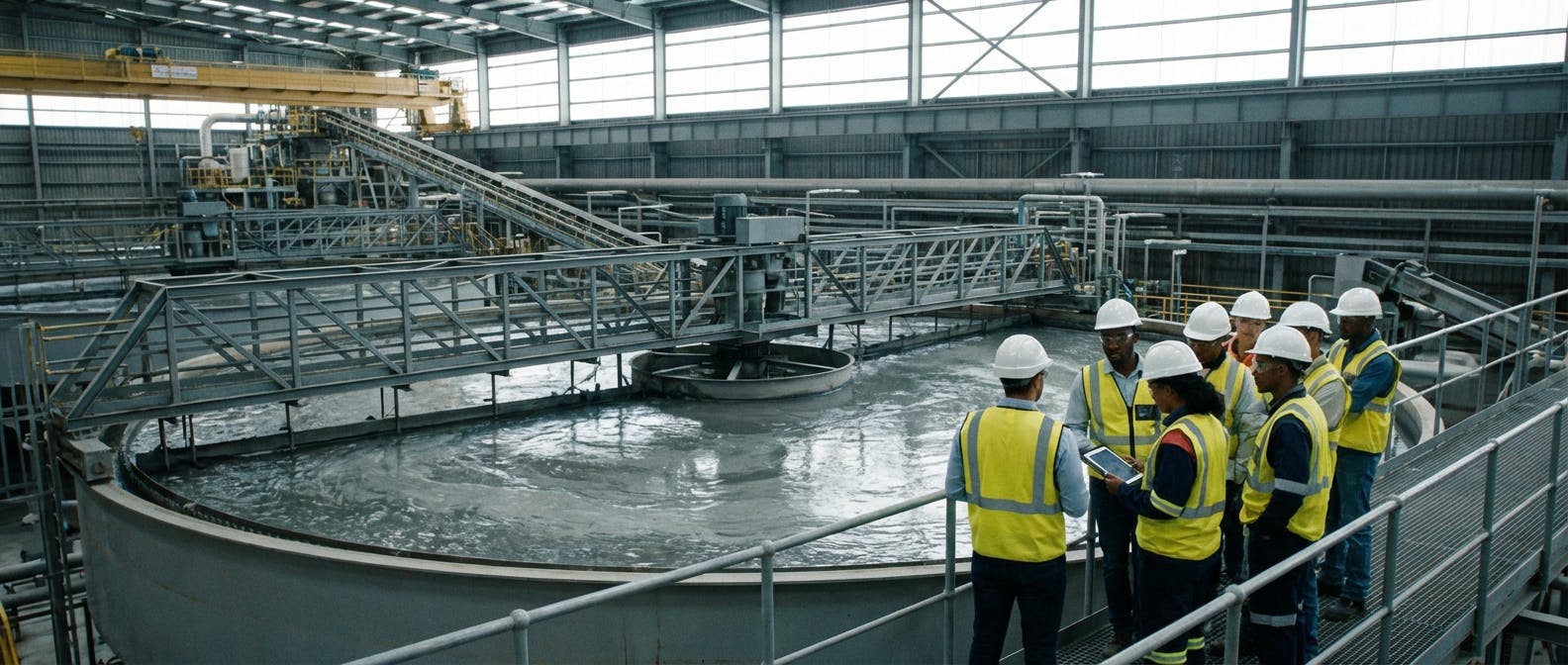
If you are reading this, you likely know the specific sinking feeling that comes with a "High Torque" alarm on a tailings thickener at 2:00 AM. You know that if that rake lifts and doesn't come back down, or if the shear pin snaps (or worse, the planetary gear teeth strip), you aren't just looking at a repair. You are looking at hydro-mining out tons of solidified mud, potential environmental risks, and a plant-wide shutdown that costs thousands of dollars per minute.
The core question reliability engineers and superintendents are asking in 2026 isn't "Should we monitor the thickener?" It is: "Why did my thickener bog or fail even though my vibration sensors showed green?"
The answer lies in a fundamental misunderstanding of thickener assets. Unlike a conveyor or a fan, a thickener is not just a mechanical asset; it is a dynamic chemical reactor. Predictive maintenance for tailings thickeners fails when it treats the asset as purely mechanical.
To truly predict failure, you must adopt a Process-Health Hybrid approach. You cannot predict the gearbox failure without monitoring the yield stress of the underflow. You cannot predict a rake bogging event without analyzing the flocculant dosage trends against the bed mass.
This guide moves beyond generic definitions. We will explore how to integrate process data (metallurgy) with condition monitoring (reliability) to eliminate catastrophic thickener failures.
The Core Conflict: Why Standard PdM Fails on Thickeners
Most predictive maintenance (PdM) programs are built on vibration analysis and thermography. This works beautifully for a standard centrifugal pump or an electric motor. If the bearing race pits, the vibration signature changes.
However, a tailings thickener is a low-speed, high-torque application. The rake might turn at 0.1 RPM. Standard accelerometers often struggle to pick up meaningful data at such low frequencies unless you are using specialized low-frequency sensors.
More importantly, the primary cause of mechanical failure in a thickener is rarely fatigue; it is process overload.
The "Process-Health" Correlation
If your underflow density gets too high (rheology issue), the yield stress increases. This requires more torque to move the rake. The hydraulic drive pressure spikes. If this persists, the gearbox overheats, or the structural integrity of the rake arms is compromised.
If you only monitor the gearbox vibration, you are monitoring the symptom, not the cause. By the time the vibration spikes, the damage is often already done, or the rake is already stuck.
True predictive maintenance for tailings thickeners requires correlating three distinct data sets:
- Mechanical Stress: Torque, hydraulic pressure, motor amps, vibration.
- Process State: Bed level, bed mass (pressure), underflow density, feed rate.
- Chemical Inputs: Flocculant dosage, coagulant rates, pH.
How do we technically implement this Hybrid Monitoring?
You likely have a SCADA system full of tags, but are you using them for predictive insights? Here is the sensor suite required for a modern (2026 standard) thickener monitoring strategy.
1. The "Heartbeat": Rake Torque and Lift Height
Torque is the most critical indicator of thickener health. However, raw torque data is noisy.
- The Predictive Strategy: Don't just set a "High-High" trip. Monitor the Torque-to-Lift Ratio. If the rake lifts to relieve torque, but the torque does not decrease proportionally, you have a "Donut" or "Island" formation (rotating solids moving with the rake rather than being pushed to the center). This is a precursor to a bogging event that standard logic won't catch until it's too late.
2. Bed Pressure vs. Bed Level (The Density Delta)
Most thickeners use a submerged pressure transducer to measure bed mass and an ultrasonic or sonar sensor for bed level (mud line).
- The Predictive Strategy: Calculate the Apparent Density in real-time.
- Formula:
(Bed Pressure / Bed Level) = Average Density Trend - If Bed Level is constant but Bed Pressure is rising, your solids are compacting faster than they are being evacuated. This predicts an underflow blockage or a "rat-holing" issue before the pump cavitates.
- Formula:
3. Hydraulic Drive Pressure & Motor Current
For hydraulic thickeners, the drive pressure is a direct proxy for load.
- The Predictive Strategy: Look for Micro-Cycling. If you see high-frequency oscillations in hydraulic pressure (e.g., spikes every 2 seconds), it often indicates a mechanical bind in the planetary gears or a chipped tooth that is "catching" on every rotation. This allows you to schedule a gearbox swap before a catastrophic snap.
4. Underflow Rheology (The Missing Link)
This is where AI predictive maintenance shines. By integrating inline density meters and flow meters on the underflow, you can calculate the rheology.
- The Predictive Strategy: If the flow rate drops while pump speed remains constant, the yield stress of the slurry is increasing. This is your early warning to adjust flocculant dosage before the rake torque spikes.
What specific failure modes can we predict?
Once you have the data flowing, what are you actually looking for? Here are the three most common thickener nightmares and how to predict them.
Scenario A: The "Rake Bogging" Event
The Symptom: The rake torque spikes, the lift activates, the rake gets stuck in the "up" position, and the thickener must be drained. The Prediction:
- 72 Hours Out: Analysis shows a drift in the Feed-to-Underflow balance. More solids are entering than leaving.
- 24 Hours Out: The "Bed Pressure vs. Torque" correlation breaks. Torque rises faster than bed pressure, indicating the formation of high-yield stress "paste" at the bottom.
- Action: Prescriptive maintenance software triggers a work order to increase underflow pump speed and reduce flocculant, preventing the bog.
Scenario B: The Main Drive Gearbox Failure
The Symptom: Catastrophic failure of the planetary gears or bull gear, requiring a crane and a 4-week lead time for parts. The Prediction:
- 3 Months Out: Oil analysis shows increasing iron and bronze particles.
- 1 Month Out: Low-frequency vibration sensors on the drive motor detect a specific side-band frequency associated with gear mesh misalignment.
- 2 Weeks Out: Motor current signature analysis (MCSA) shows load imbalances.
- Action: You switch to the standby thickener (if available) or schedule a planned outage to replace the drive assembly, avoiding collateral damage to the rake shaft.
Scenario C: Underflow Pump Cavitation & Line Blockage
The Symptom: The underflow pump runs dry, or the line sands out. The Prediction:
- Real-time: The system detects a divergence between Pump Power (kW) and Flow Rate. Power drops (cavitation) or spikes (blockage) while flow drops.
- Action: Automated logic triggers a flush sequence or alerts the operator to check the suction line. For more on pump specifics, see our guide on predictive maintenance for pumps.
The "Process-Health" Bridge: Flocculant and Torque
This is the angle most maintenance teams miss. The reliability of your thickener is directly tied to the chemistry of your flocculant.
Over-flocculation creates large, sticky flocs. While this improves settling speed (good for process), it creates a massive increase in yield stress (bad for maintenance). It turns the mud into a viscous paste that creates immense drag on the rake arms.
The Optimization Loop:
- Ingest Data: Feed rate, ore type (clay content), and current torque load.
- Analyze: AI determines that current torque levels are rising due to over-flocculation, not bed mass.
- Adjust: The system recommends reducing flocculant dosage by 5%.
- Result: Torque drops, reducing stress on the gearbox and extending the asset's remaining useful life (RUL).
This is where a robust CMMS software becomes vital. It isn't just about logging repairs; it's about logging the process changes that led to the repair. Did the gearbox fail three days after a shift in ore type? That is a pattern only data can reveal.
Step-by-Step Implementation Plan
How do you go from a reactive "fix it when it breaks" mentality to a predictive "Process-Health" model?
Phase 1: The Audit (Weeks 1-4)
- Inventory Sensors: Do you have bed pressure? Torque? Lift position? Underflow density? Are they calibrated?
- Data Historian Check: Is this data being saved? You need at least 6 months of historical data to train any predictive model.
- Failure Mode Analysis (FMEA): Review the last 5 years of thickener failures. Were they mechanical (bearing) or process (bogging)?
Phase 2: The Connection (Weeks 5-8)
- Integrate Data: Bring mechanical data (vibration, oil temps) and process data (flow, density) into a single dashboard.
- Establish Baselines: What is the "normal" torque at 50% bed level? What is the "normal" vibration for the hydraulic pack?
Phase 3: The Logic & Alerts (Weeks 9-12)
- Configure Logic: Set up the "Density Delta" and "Torque-to-Lift" calculations mentioned above.
- Automate Work Orders: Don't just send an email. If the hydraulic oil temperature exceeds 60°C, automatically generate a PM procedure in your CMMS for the lube tech to inspect the cooler.
Phase 4: AI & Optimization (Month 4+)
- Deploy Machine Learning: Use AI to look for multi-variable correlations. For example, "When Feed Density is >30% AND Floc Dosage is >20ppm, Gearbox Vibration spikes 4 hours later."
- Refine: Continually adjust thresholds based on false positives/negatives.
ROI and Cost Implications
Implementing predictive maintenance for tailings thickeners is an investment, but the cost of inaction is staggering.
The Cost of Failure
- Downtime: For a large copper or gold concentrator, thickener downtime can bottleneck the entire plant. If the mill stops, losses can exceed $50,000 to $100,000 per hour.
- Recovery: Manually digging out a bogged 50-meter thickener can take 3-7 days.
- Asset Replacement: A main drive gearbox for a high-rate thickener can cost $250,000+, excluding installation.
The Cost of Prediction
- Sensors: Adding vibration sensors and upgrading density meters might cost $20,000 - $50,000.
- Software: A subscription to a predictive analytics platform or asset management software.
The Calculation: If the system prevents one bogging event or one catastrophic gearbox failure in 5 years, the ROI is typically >500%.
According to reliability studies from organizations like ReliabilityWeb, predictive maintenance programs can reduce maintenance costs by 25-30% and eliminate breakdowns by 70-75%. For critical assets like thickeners, these numbers are often conservative.
Troubleshooting & Edge Cases
Every mine site is different. Here are common "Yeah, but..." questions we hear from metallurgists and engineers.
"What if we have variable ore feeds?"
If your mine moves between hard rock and high-clay saprolite, your baselines will shift constantly.
- Solution: You need "State-Based" monitoring. Your predictive system should recognize "State A (Hard Rock)" and "State B (Clay)" and apply different alarm thresholds for each. High torque might be normal for clay but critical for hard rock.
"We use a Paste Thickener (Deep Cone). Is this different?"
Yes. Paste thickeners operate at much higher yield stresses and torques.
- Difference: The margin for error is smaller. Monitoring the Underflow Pump Hydraulic Pressure becomes even more critical than the rake torque. If the pump can't move the paste, the rake will torque out immediately.
- Tip: Ensure your mobile CMMS allows operators to input visual observations of the paste consistency (slump test) to correlate with sensor data.
"Our thickener is 40 years old. It has no sensors."
You don't need to replace the thickener. You can retrofit.
- Retrofit Strategy: Wireless vibration sensors are cheap and easy to install on the motor and gearbox. A clamp-on ultrasonic flow meter can give you underflow data without cutting pipe. Start small.
Conclusion: The Future is Integrated
The days of the maintenance department blaming the process department (and vice versa) for thickener failures must end. The thickener is a single system where chemistry dictates mechanical survival.
By implementing predictive maintenance that respects the rheology of the slurry, you move from "putting out fires" to "optimizing flow." You stop waking up at 2:00 AM to alarms. You start planning gearbox changes months in advance.
Ready to start? The first step is getting your data out of silos and into a system that can act on it. Whether you are monitoring motors, conveyors, or massive tailings thickeners, the principle remains the same: Data without context is noise. Data with context is prediction.
Explore our Equipment Maintenance Software to see how you can build these predictive workflows today.
