
Predictive Maintenance for Freezer Conveyors: How to Stop Failures Without Entering the Cold Zone
Feb 1, 2026
predictive maintenance for freezer conveyors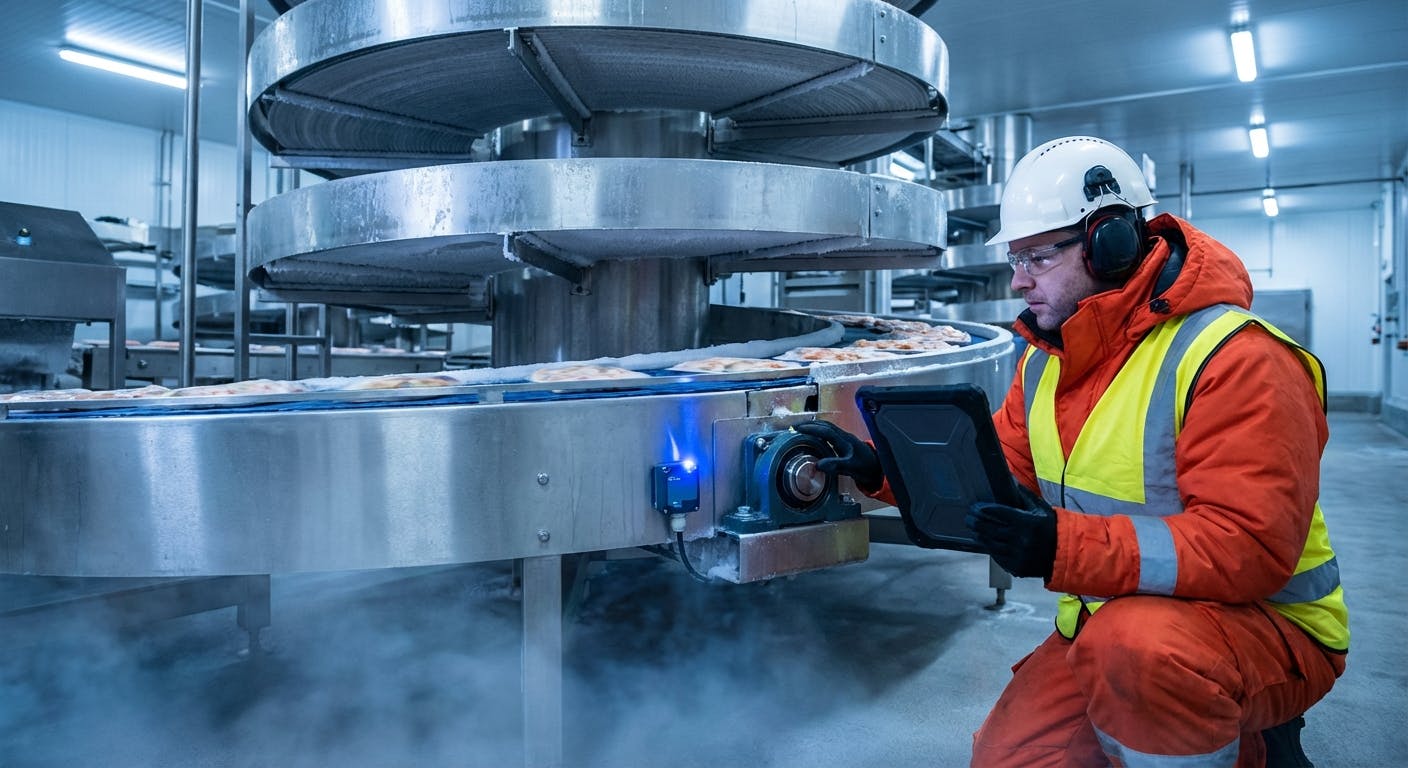
It is 2:00 AM. The spiral freezer has jammed. Again.
Inside that insulated box, the temperature is -40°F (-40°C). Thousands of dollars of product are currently freezing into a solid, unsalvageable block of ice and stainless steel. Your maintenance team now faces a choice: suit up for a dangerous entry into a hazardous environment to hack away ice and replace a seized bearing, or wait for a defrost cycle that will kill your production targets for the week.
If you are a Maintenance Manager or Reliability Engineer in the food processing industry, this scenario isn't hypothetical—it is a recurring nightmare.
The core question you are asking is likely this: How can we predict conveyor failures in extreme cryogenic environments reliably, without constantly exposing our technicians to the safety risks of the freezer?
The Direct Answer: Predictive maintenance (PdM) for freezer conveyors requires a specialized approach that differs significantly from standard ambient-temperature assets. You cannot simply slap a standard vibration sensor on a motor and walk away. Successful implementation requires low-temperature rated wireless IoT sensors (specifically designed to withstand condensation and battery drain), Motor Current Signature Analysis (MCSA) (to monitor drive trains from the safety of the warm MCC room), and AI-driven analytics that can distinguish between the normal "crunch" of ice and the friction of a failing bearing.
By shifting from time-based preventive maintenance (PM) to condition-based monitoring, you don't just save the asset; you adopt a "Remote Guardian" strategy that keeps your personnel out of the freezer until it is absolutely necessary.
But knowing what to do is different from knowing how to do it. Below, we break down the implementation of predictive maintenance for freezer conveyors into the specific questions you need to answer to build a reliable cold chain strategy in 2026.
Why is standard predictive maintenance failing in my freezers?
If you have tried using standard handheld vibration analysis or generic IoT sensors in your IQF (Individual Quick Freezing) tunnels or spiral freezers, you have likely seen poor results. Why? Because the physics of the environment works against standard reliability tools.
To fix this, we must understand the three enemies of freezer reliability:
1. The Tribology of Cold
Standard lubrication logic does not apply here. At -40°F, standard grease turns into a waxy solid. Even food-grade synthetic lubricants specifically rated for low temperatures will experience viscosity changes that alter the vibration signature of a healthy bearing.
If your predictive maintenance software isn't calibrated for this higher baseline viscosity, it will generate false positives. You might receive an alert for "high friction" that is actually just the normal operating state of cold grease. Conversely, as the freezer goes through a defrost cycle and warms up, that lubricant thins out. A smart system must correlate temperature data with vibration data to understand if the friction is mechanical or thermal.
2. The "Remote Guardian" Necessity
The most overlooked aspect of freezer maintenance is the human cost. Spiral freezers and IQF tunnels are often enclosed spaces with potential ammonia exposure risks.
Every time you send a technician inside for a routine inspection, you are rolling the dice on safety. Slipping hazards are extreme. Cold stress is immediate.
- The Old Way: Schedule a PM every week to physically inspect the belt tension and listen to the bearings.
- The PdM Way: Install permanent sensors that act as a "Remote Guardian." You only send a human in when the data proves a failure is imminent. This shifts the metric from "Mean Time Between Failures" (MTBF) to "Mean Time Between Exposures" (MTBE).
3. The Sensor Survival Problem
Most generic wireless sensors fail in freezers for two reasons:
- Battery Chemistry: Standard alkaline or even some lithium-ion batteries lose significant capacity in freezing temps. You need Lithium Thionyl Chloride (Li-SOCl2) batteries or energy-harvesting sensors.
- The Washdown Cycle: It’s not just the cold; it’s the heat. When you hit a -40°F sensor with 140°F sanitation water, the rapid expansion creates a vacuum effect that sucks moisture past seals rated for IP67. You need IP69K-rated hardware specifically potted for thermal shock.
Which technologies actually work in -40°F?
You cannot monitor every inch of a 2,000-foot spiral conveyor. You have to choose your battles. Here is the hierarchy of effective technologies for cold chain environments.
1. Motor Current Signature Analysis (MCSA)
This is your first line of defense and often the easiest to implement.
- How it works: You clamp current sensors on the motor leads inside the Motor Control Center (MCC), which is located in a warm, safe room.
- Why it wins: The sensor never touches the cold.
- What it detects: MCSA can see through the wall. It detects rotor bar degradation, eccentricity, and—crucially for conveyors—load changes. If your freezer conveyor belt tension is too high due to ice buildup, the motor current signature will change long before the belt snaps.
2. Acoustic & Ultrasonic Monitoring
For the bearings inside the freezer (like the take-up bearings or the main drive shaft), vibration analysis can be tricky because spiral freezers often run at low speeds (low RPM).
- The Challenge: Standard accelerometers struggle to pick up faults in slow-rotating assets (under 100 RPM).
- The Solution: Ultrasound sensors. They listen for the high-frequency friction of a bearing running dry or pitting. This is superior for detecting the "crackle" of early-stage bearing failure in low-speed shafts.
3. Automated Tension Monitoring
In spiral freezers, the "overdrive" (the friction relationship between the drum and the belt) is critical. If the belt is too tight, the freezer flips (the "Christmas Tree" effect). If it's too loose, it slips.
- The Tech: Load cells on the take-up frames connected to your PLC or a wireless gateway.
- The Strategy: Set alerts not just for "high tension," but for "tension spikes" that correlate with specific times in the production shift (e.g., usually 4 hours in, when ice accumulation peaks).
How do I interpret the data when ice creates "noise"?
This is the most common follow-up question we receive. A freezer is a noisy environment. Ice chunks fall. The belt crunches. Fans vibrate. How do you distinguish a failing bearing from a chunk of ice?
This is where AI-driven predictive maintenance becomes mandatory, not optional.
The "Ice Baseline" Technique
You cannot use ISO standards for vibration in a freezer. You must establish a baseline specific to your machine in its frozen state.
- Clean Baseline: Record data immediately after a defrost and sanitation cycle.
- Iced Baseline: Record data 8 hours into a production run.
- The Delta: The AI software learns that "Vibration Level X" is normal for a frosted belt. It only alerts you when the vibration profile deviates from the Iced Baseline, not the Clean Baseline.
Correlating Variables
A standalone vibration spike might be a false alarm. However, if your software sees:
- A 10% increase in Motor Current (MCSA)
- AND a 5° rise in gearbox temperature
- AND a shift in the ultrasonic noise floor
...then the probability of failure is near 100%. Humans are bad at correlating these three variables in real-time. AI excels at it.
What are the specific failure modes I should look for?
When setting up your CMMS software to trigger work orders based on sensor data, you need to map specific data signatures to specific freezer problems.
1. The "Frozen Link" Phenomenon
- Symptom: In IQF tunnels, water gets into the conveyor chain links and freezes. The chain loses flexibility.
- Data Signature: You will see a rhythmic spike in motor current (load) every time the frozen section passes over the drive sprocket. It looks like a heartbeat in the data.
- Action: Trigger a "Check Auto-Lube System" work order.
2. Spiral Drum Wear
- Symptom: The wear strips on the spiral drum wear down, causing the belt to surge.
- Data Signature: Look for "modulating" vibration. The vibration amplitude will rise and fall in a wave pattern (sinusoidal) matching the rotation speed of the drum.
- Action: Schedule wear strip replacement during the next major shutdown.
3. Gearbox Oil Thickening
- Symptom: The heater on the gearbox fails, causing oil to thicken.
- Data Signature: A slow, steady increase in motor amperage across the entire shift, regardless of product load.
- Action: Check the gearbox heater circuit immediately.
How do I implement this without disrupting production?
You cannot shut down the cold chain to install sensors. Implementation must be surgical.
Phase 1: The "Warm" Installation (Week 1)
Start with the components that are outside the freezer.
- Install MCSA sensors in the MCC room.
- Install vibration sensors on the external drive motors and gearboxes (often located on top of the freezer box).
- Goal: Establish a baseline for the drive train.
Phase 2: The Defrost Window (Week 2-4)
Utilize your existing sanitation windows. You likely have a weekly or bi-weekly defrost cycle where the freezer is brought up to ambient temperature for cleaning.
- Preparation: Pre-configure all wireless gateways and sensors before entering.
- Installation: Use magnetic mounts for initial testing (epoxy mounts are better for long-term, but magnets allow you to move sensors to find the "sweet spot").
- Connectivity Check: Ensure your wireless gateway (LoRaWAN or Bluetooth Mesh) can penetrate the insulated walls of the freezer. Tip: You will likely need to run a wired antenna from the gateway inside the freezer to a receiver outside.
Phase 3: The "Digital Twin" Calibration (Month 2)
Once data is flowing, do not turn on alerts yet. Let the system run for 30 days. You need to capture the data profile of:
- Startup (High load)
- Steady State (Normal load)
- Heavily Iced (End of shift)
- Sanitation (High temp/humidity)
Only after capturing these four states should you set your alarm thresholds.
What is the ROI? (The Business Case)
When pitching this to plant leadership, do not focus on the cost of a bearing ($500). Focus on the cost of the "Jam."
The "Cost of Cold" Calculation
If a spiral freezer fails mid-shift:
- Product Loss: 2,000 lbs of product inside the spiral. If the belt stops, the product freezes together. It is often a total loss. ($10,000 - $50,000 depending on the product).
- Downtime: It takes 4-8 hours to defrost a freezer safely to allow entry. That is a full shift of lost production.
- Labor: Emergency overtime for maintenance.
- Energy: The cost to re-cool the massive thermal mass of the freezer back to -40°F.
The Equation:
(Cost of 1 Catastrophic Event) > (Cost of Sensor Suite for Entire Line)
According to reliability data from ReliabilityWeb, facilities that implement condition monitoring on critical assets like freezers see a reduction in unplanned downtime by 30-50% within the first year.
Furthermore, consider the Asset Lifespan. Running a conveyor with high tension (due to undetected icing) stretches the belt. A stainless steel spiral belt can cost $100,000+. Extending its life by 2 years through proper tension monitoring pays for the PdM program ten times over.
Troubleshooting: Common Implementation Mistakes
Even with the best intentions, we see deployments fail. Avoid these traps:
Mistake 1: Ignoring the Gateway Location
Freezer walls are essentially Faraday cages—thick metal and insulation that block wireless signals.
- Fix: Do not put the gateway in the office. Put the gateway immediately outside the freezer wall, or run a wired antenna pass-through.
Mistake 2: The "Set and Forget" Mentality
Users install sensors and never look at the dashboard until an alarm goes off.
- Fix: Integrate the data into your asset management workflows. The sensor data should drive your weekly planning meeting.
Mistake 3: Over-Alerting
Setting thresholds too tight results in "alarm fatigue." If the phone buzzes every time the freezer goes into defrost, the technician will turn off notifications.
- Fix: Use "State-Based Alarming." Configure the software to suppress vibration alarms when the freezer temperature is above 32°F (cleaning mode).
Conclusion: The Future is Autonomous
By 2030, we expect "self-healing" freezers to be the standard. These systems will not just alert you to high tension; they will automatically communicate with the VFD to slow the belt speed or adjust the take-up tension hydraulically to compensate for thermal contraction.
But you don't need to wait for 2030. The technology to protect your cold chain exists today.
Predictive maintenance for freezer conveyors is about more than uptime. It is about modernizing a dangerous, difficult job. It allows your most valuable assets—your technicians—to monitor the health of the plant from a tablet, rather than shivering in a parka at 3 AM.
Ready to start? Don't try to boil the ocean (or freeze it). Start with your most critical spiral freezer. Implement MCSA on the motors and wireless vibration on the main bearings.
If you need help selecting the right software to manage this data and generate automated work orders, explore our equipment maintenance software to see how we handle condition-based logic.
