
Predictive Maintenance for Dairy Homogenizers: The "Hygiene-First" Reliability Strategy
Feb 2, 2026
predictive maintenance for dairy homogenizers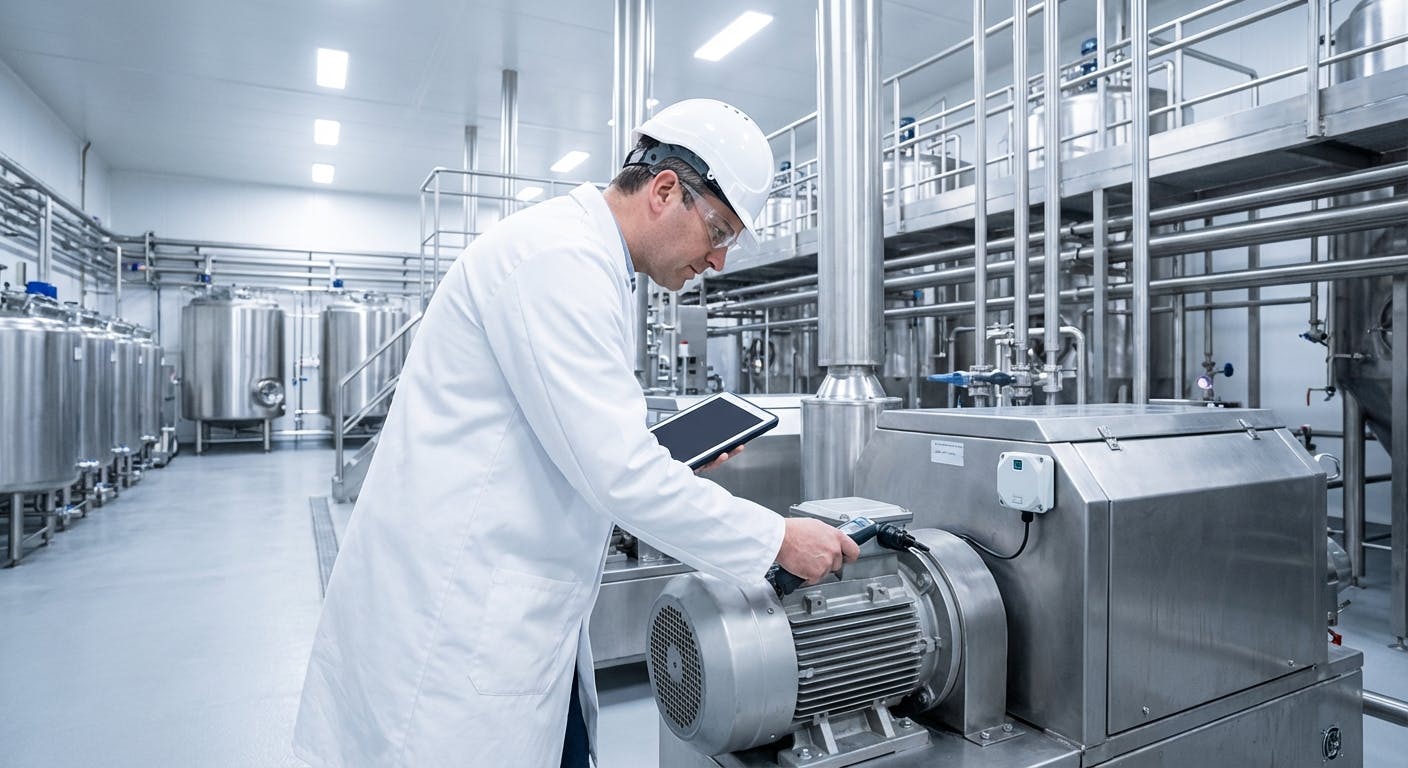
In the high-stakes world of dairy processing, the homogenizer is the heart of the operation. It is a massive, high-pressure reciprocating beast that dictates product quality, shelf stability, and texture. When the homogenizer goes down, the plant goes down. But worse than a breakdown is a contamination event caused by a cracked plunger or a leaking seal that goes undetected until the lab results come back.
For decades, Maintenance Managers have relied on "preventive" strategies—tearing down the fluid end every 500 or 1,000 hours to replace seals and packings, regardless of their actual condition. This is expensive, labor-intensive, and ironically, introduces risk (infant mortality) by disturbing a stable system.
As we move through 2026, the industry standard is shifting. You are likely asking: How do I implement predictive maintenance (PdM) on a complex, noisy reciprocating machine like a homogenizer without compromising hygiene standards?
This guide moves beyond generic sensor placement. We are going to dissect the homogenizer into its critical subsystems—the Drive End and the Fluid End—and build a condition-based monitoring strategy that acts as the operational brain of your facility.
The Core Challenge: Why Homogenizers Are Hard to Monitor
Before we fix the problem, we must understand why generic vibration sensors often fail on homogenizers.
Unlike a centrifugal pump or a fan, a homogenizer is a reciprocating positive displacement pump. It is inherently violent. It generates high-amplitude, low-frequency vibrations just by doing its job. A standard vibration sensor set to ISO standards for rotating equipment will trigger false alarms constantly.
Furthermore, the Fluid End (where the milk flows) is a sanitary zone. You cannot simply bolt a wireless sensor onto a plunger or inside the block without considering Clean-in-Place (CIP) compatibility, IP69K washdown ratings, and the risk of creating bacterial harborage points.
To succeed, you need a bifurcated strategy:
- Drive End (The Muscle): Monitoring the motor, gearbox, crankshaft, and oil.
- Fluid End (The Product): Monitoring pressure pulsations, valve acoustics, and plunger integrity.
Part 1: The Fluid End – Protecting Product Quality
The most common question reliability engineers ask is: "How do I predict seal and valve failure before leakage occurs?"
The fluid end operates at pressures ranging from 2,000 to over 10,000 PSI. The components here—suction valves, discharge valves, impact rings, and plunger packings—are consumables. However, their lifespan varies wildly based on product viscosity, temperature, and cleaning cycles.
1. Dynamic Pressure Pulsation Analysis
Vibration analysis is less effective on the fluid end than Dynamic Pressure Pulsation. By installing high-frequency pressure transducers on the discharge manifold, you can monitor the "heartbeat" of the pump.
- The Healthy Heartbeat: A healthy 3-piston homogenizer produces a distinct, rhythmic pressure waveform.
- The Symptom: When a suction valve leaks or a discharge valve spring breaks, that waveform distorts. The peak-to-peak amplitude changes, or the symmetry of the wave collapses.
- The Predictive Insight: Modern AI predictive maintenance software can learn the "normal" pulsation pattern for different products (e.g., skim milk vs. heavy cream). When the pattern deviates, it indicates a specific valve issue before it affects homogenization efficiency (NSI/NIZO values).
2. Acoustic Emission for Cavitation
Cavitation is the silent killer of homogenizer blocks. It occurs when suction pressure drops too low, causing vapor bubbles to form and then violently collapse inside the pump block. This pits the metal and destroys valves.
- The Solution: Ultrasonic or Acoustic Emission (AE) sensors placed on the block exterior (non-invasive) can detect the high-frequency "screaming" of cavitation that the human ear cannot hear over the engine noise.
- The Threshold: Set your alerts to trigger when high-frequency noise (20kHz+) spikes, which usually correlates to a drop in feed pressure or a clogged suction filter.
3. Plunger Position and Runout
Plunger packings fail when the plunger is misaligned. If the plunger rubs against the packing adapter or the cylinder wall, it generates heat and shreds the seal.
- Monitoring Strategy: While difficult to measure during operation, monitoring the temperature of the cooling water exiting the plunger wells is a high-value proxy. A spike in cooling water temperature on a specific plunger indicates excessive friction—a precursor to seal failure.
Part 2: The Drive End – The Heavy Lifting
The second most common question is: "How do I prevent catastrophic crankshaft or gearbox failure?"
The drive end is the expensive part to replace. If a crankshaft snaps or a bull gear strips, you are looking at weeks of lead time.
1. Low-Frequency Vibration Analysis
Because the crankshaft rotates slowly (often 100-200 RPM), standard accelerometers may miss the faults. You need low-frequency accelerometers (capable of measuring down to 0.5 Hz).
- Focus Area: Main bearings and the crosshead slides.
- What to look for: Looseness in the crosshead pins or wear in the connecting rods will show up as impacting in the time waveform, rather than just a rise in overall velocity.
2. Oil Analysis (Tribology)
For the drive end of a homogenizer, oil analysis is more predictive than vibration. The crankcase is a splash-lubricated or force-fed system that is highly susceptible to contamination from the fluid end.
- The Danger: If water or cleaning solution leaks past the plunger seals and enters the crankcase, the oil emulsifies. This destroys the load-bearing capacity of the oil, leading to rapid bearing failure.
- The Protocol: Implement real-time dielectric constant sensors or schedule monthly sampling.
- Water Content: Any spike >0.1% is a red alert.
- Particle Count: High copper or tin indicates bearing wear.
- Viscosity: A drop in viscosity suggests dilution or thermal breakdown.
For a deeper dive into industrial lubrication standards, Noria Corporation offers excellent resources on establishing cleanliness targets for hydraulic and gear oils.
Part 3: The Hygiene-First Sensor Strategy
A critical follow-up question for the dairy industry is: "How do I install these sensors without failing my next audit?"
In 2026, the convergence of IIoT and sanitary design is mature, but pitfalls remain.
1. Non-Invasive is King
Whenever possible, use sensors that clamp onto the exterior of the process.
- Clamp-on Temperature: Use surface-mounted RTDs on the cooling water lines rather than invasive probes.
- Magnetic Mounts vs. Epoxy: On the drive end (non-product zone), magnetic mounts are fine. On the fluid end (washdown zone), sensors must be permanently mounted using sanitary epoxy or stud mounts that eliminate crevices.
2. IP69K and Chemical Resistance
Dairy plants use caustic soda and nitric acid for CIP. Your sensors and cabling must be rated IP69K (high-pressure, high-temperature washdown) and constructed of 316L stainless steel or chemical-resistant polymers (like PEEK).
3. Wireless vs. Wired
Wireless sensors are popular for ease of installation, but in a wet, stainless-steel dense environment, signal propagation can be tricky.
- Best Practice: Use wireless sensors with local buffering memory. If the signal is blocked during a washdown cycle, the sensor stores the data and uploads it when the path is clear.
Part 4: Interpreting the Data – The "Operational Brain"
You have the sensors. You have the data. Now, how do you distinguish between a problem and a process change?
This is where the concept of "Prescriptive Maintenance" comes in. It’s not enough to know that vibration increased; you need to know why.
Contextualizing Data with Process Parameters
A homogenizer running at 150 bar on milk will vibrate differently than when running at 200 bar on ice cream mix.
- The Integration: Your PdM software must ingest data from the PLC (pressure, flow rate, RPM) alongside the vibration data.
- The Logic: If vibration rises and pressure is constant, it’s a mechanical fault. If vibration rises because pressure increased, it’s a process change.
This requires a robust asset management strategy where the "asset" is defined not just by its serial number, but by its operating context.
The Role of AI in Pattern Recognition
Reciprocating pumps create "ghost" frequencies. AI algorithms are now essential for filtering out the background noise of the piston strokes to find the subtle signals of bearing defects.
- Anomaly Detection: Instead of setting hard thresholds (e.g., "Alert at 5 mm/s"), use AI to build a dynamic baseline. The system learns that during the CIP cycle, vibration spikes are normal (due to cavitation/aeration during flushing) and suppresses those alarms.
Part 5: The Business Case – ROI and Cost Justification
The final hurdle for the Maintenance Manager is the CFO. "What is the ROI of outfitting a homogenizer with $5,000+ of sensors?"
1. Extending Seal Life (The Consumables Savings)
Most plants change plunger packings on a fixed interval (e.g., every 1,000 hours).
- Scenario: If you run 24/7, that’s roughly 8 changes a year.
- PdM Benefit: If condition monitoring proves the seals are good for 1,500 hours, you reduce changes to 5 per year.
- Savings: You save 3 kits of seals (approx. $1,500 each) + 12 hours of labor + 12 hours of lost production.
2. Preventing Batch Contamination (The Quality Savings)
If a seal fails mid-run and leaks hydraulic oil into the milk, or milk into the crankcase, the batch is compromised.
- Cost: 10,000 gallons of milk + disposal costs + root cause analysis labor.
- PdM Benefit: Detecting the micro-leak before it becomes a macro-failure saves the batch. One save pays for the entire PdM program for five years.
3. Energy Optimization
A homogenizer with worn valves requires more energy to achieve the same homogenization effect.
- PdM Benefit: Monitoring valve efficiency ensures you aren't wasting kW/h driving a compromised fluid end.
For a broader look at how to calculate these savings across your facility, check out our guide on predictive maintenance for pumps.
Part 6: Implementation – A Step-by-Step Guide
Ready to start? Don't try to boil the ocean. Follow this phased approach.
Phase 1: The Pilot (Weeks 1-4)
- Select your most critical homogenizer (the bottleneck asset).
- Install wireless vibration sensors on the motor and gearbox (Drive End).
- Implement a rigorous oil sampling program (monthly).
- Establish a baseline for "normal" operation.
Phase 2: The Fluid End Integration (Weeks 5-12)
- Install dynamic pressure sensors on the discharge manifold.
- Integrate cooling water temperature monitoring into your SCADA or PdM dashboard.
- Train operators to look for "Pulsation Deviations" rather than just pressure drops.
Phase 3: Workflow Automation (Month 3+)
- Connect your sensor alerts to your CMMS.
- When a vibration threshold is breached, automatically generate a work order.
- Resource: Learn how to set up automated work orders to reduce reaction time.
- Move from "Preventive" (Calendar) to "Prescriptive" (Condition) seal changes.
Common Pitfalls to Avoid
1. Ignoring the Foundation: Predictive maintenance cannot fix a machine that wasn't installed correctly. If the homogenizer isn't leveled and the belts aren't tensioned, sensors will just tell you what you already know: it's shaking.
2. Data Overload: Do not route every second of data to the cloud. Use edge computing to process the raw waveforms locally and only send the trend data and alerts. This saves bandwidth and storage costs.
3. Siloed Teams: If the Reliability Engineer sees the alert but the Operator on the floor doesn't, the machine still fails. Ensure your CMMS software is accessible on mobile devices so the floor team sees the health status in real-time.
Advanced Troubleshooting: The "What Ifs"
"What if I have a Variable Frequency Drive (VFD)?" VFDs complicate vibration analysis because the "forcing frequency" (the speed of the pump) changes.
- Solution: Ensure your vibration analysis software performs "Order Normalization." This scales the frequency spectrum based on the RPM, so the "1x" peak stays in the same place on the graph regardless of speed.
"How do I handle Aseptic Homogenizers?" Aseptic machines use steam barriers on the plungers.
- Solution: Monitor the steam barrier temperature and pressure differentials. A drop in barrier pressure is an immediate sterility risk and should trigger an emergency stop, not just a maintenance alert.
For more on handling complex machinery data, refer to the ISO 13373 standard regarding condition monitoring and diagnostics of machines.
Conclusion: Moving from Reactive to Strategic
Predictive maintenance for dairy homogenizers is no longer science fiction. It is a competitive necessity. By listening to the "heartbeat" of the fluid end and monitoring the "muscle" of the drive end, you can extend run times, protect product quality, and eliminate the panic of unplanned downtime.
The technology exists. The sensors are hygiene-ready. The only variable left is your willingness to adopt a new way of working.
Ready to modernize your maintenance strategy? Explore how MaintainX can serve as the backbone of your reliability program, integrating sensor data directly into actionable work orders.
