
Overhaul Meaning in Maintenance: Resetting the Clock on Industrial Assets
Feb 13, 2026
overhaul meaning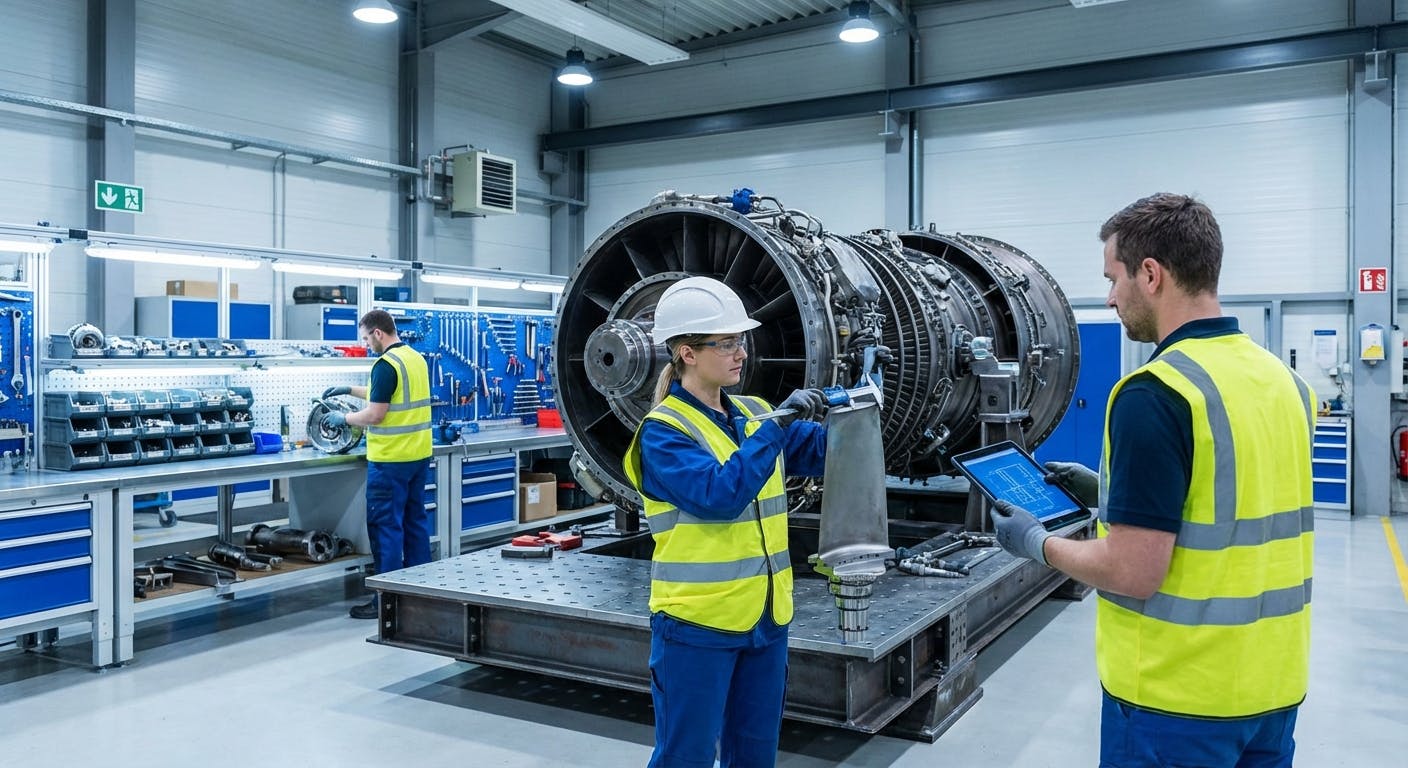
In the world of industrial maintenance, terminology matters. When a machine goes down, the difference between a "repair," a "refurbishment," and an "overhaul" isn't just semantics—it’s a difference of thousands of dollars, hundreds of man-hours, and the long-term reliability of your production line.
If you are searching for the "overhaul meaning," you likely aren't looking for a dictionary definition. You are facing a decision. You have an asset—a compressor, a turbine, a fleet of forklifts, or a conveyor system—that is nearing the end of its useful cycle. You need to know if you should patch it up, strip it down, or throw it out.
So, what is the core meaning of an overhaul?
In an industrial context, an overhaul is the process of completely disassembling a piece of equipment, inspecting every component, repairing or replacing worn parts to meet Original Equipment Manufacturer (OEM) specifications, and reassembling it.
The goal is not just to make it run again; the goal is Zero-Hour condition.
An overhaul is a "rebirth." When an asset leaves the overhaul bay, its biological clock should be reset. It is distinct from a repair (fixing a specific failure) or preventive maintenance (changing oil and filters). An overhaul restores the asset’s performance, efficiency, and reliability to the level it had when it was first installed.
But in 2026, the definition is evolving. With the integration of AI and predictive analytics, an overhaul is no longer just a mechanical reset; it is a data-driven strategic intervention.
Let’s dive deep into the mechanics, the economics, and the execution of a proper industrial overhaul.
Defining the Industrial Overhaul: More Than Just a Tune-Up
To truly grasp the overhaul meaning, we must move past the general idea of "fixing things" and look at the engineering reality. An overhaul is a systematic intervention designed to combat the cumulative effects of entropy.
The Concept of "Zero-Hour"
The "Zero-Hour" concept is the gold standard of overhauls. When an engine, for example, undergoes a major overhaul, the expectation is that its Time Between Overhaul (TBO) counter resets to zero.
If a centrifugal pump has a TBO of 20,000 hours, and you overhaul it at 19,500 hours, the expectation is that it will run for another 20,000 hours before requiring major intervention again. If it only lasts 5,000 hours, you didn't perform an overhaul; you performed a repair with expensive parts.
Achieving Zero-Hour requires:
- Dimensional Restoration: Shafts, bores, and casings must be measured against original tolerances. If a shaft has worn down by 0.002 inches, it must be chromed and ground back to spec or replaced.
- Consumable Replacement: Every seal, gasket, bearing, O-ring, and filter is replaced regardless of its apparent condition.
- Testing: The asset must be load-tested to prove it meets the original power and efficiency curves.
Major Overhaul vs. Top-End Overhaul
Not all overhauls are created equal. In reciprocating equipment (like diesel generators or compressors), you will often hear these two terms:
- Top-End Overhaul: This is a partial overhaul. It usually involves removing the cylinder heads, inspecting valves, replacing injectors, and perhaps checking cylinder liners. The bottom end (crankshaft, main bearings) is left in place. This extends the life of the asset but does not fully reset the clock.
- Major Overhaul: This is the "frame-up" restoration. The engine is removed from its mount. The crankshaft is pulled. The block is line-bored. This is the true Zero-Hour event.
The Role of Tolerance Drift
Why do we overhaul? Because of "tolerance drift." Over time, vibration and thermal cycles cause parts to shift, stretch, and wear. A machine might still run, but it runs inefficiently. It consumes more energy to do the same work.
An overhaul corrects tolerance drift. It tightens the machine back up. This is why asset management systems are critical—they track the gradual decline in efficiency that signals when an overhaul is becoming necessary, long before the machine actually breaks.
Overhaul vs. Refurbishment vs. Repair: The Decision Matrix
One of the most common follow-up questions maintenance managers ask is: "Why should I pay for an overhaul when a repair is 20% of the cost?"
To answer this, we need a clear decision matrix. The terms are often used interchangeably, but they represent vastly different scopes of work and financial commitments.
1. Repair (Corrective Maintenance)
- Trigger: A specific failure or imminent failure (e.g., a blown seal, a seized bearing).
- Scope: Isolate the broken part. Replace or fix only that part and necessary adjacent components.
- Goal: Return the asset to operational status immediately.
- Longevity: Unknown. The rest of the machine is still old.
- Cost: Low to Medium.
2. Refurbishment (Reconditioning)
- Trigger: Cosmetic degradation or general wear that doesn't affect core mechanical integrity yet.
- Scope: Clean, paint, replace high-wear items, and perhaps upgrade controls.
- Goal: Extend the useful life and improve appearance/usability.
- Longevity: Medium. It looks new, but the internal tolerances may still be loose.
- Cost: Medium.
3. Overhaul (Remanufacturing)
- Trigger: Reached TBO limits, significant loss of efficiency, or catastrophic failure requiring total teardown.
- Scope: Total disassembly. All parts inspected. All consumables replaced. Core parts machined or replaced.
- Goal: Return to "Like New" or "Better than New" (if upgrades are included).
- Longevity: High (Full lifecycle reset).
- Cost: High (often 50-70% of the cost of a new asset).
The "50% Rule" Framework
When deciding between an overhaul and a total replacement (buying a new machine), many organizations use the 50% rule.
The Rule: If the cost of the overhaul (parts + labor + downtime) exceeds 50% of the price of a new asset, and the overhaul does not offer significant upgrades or lead time advantages, consider buying new.
However, in 2026, supply chains are still complex. A new industrial compressor might have a 40-week lead time. An overhaul might take 3 weeks. In this scenario, even if the overhaul costs 75% of a new unit, the "cost of downtime" dictates that the overhaul is the smarter business decision.
The Timing Equation: TBO, Hours, and Condition-Based Triggers
You know what an overhaul is. The next logical question is: When do I do it?
Premature overhauls waste budget. Late overhauls risk catastrophic failure. Finding the "Goldilocks" zone is the essence of reliability engineering.
Time Between Overhaul (TBO)
Traditionally, manufacturers provide a TBO metric.
- Example: A gas turbine requires a hot section overhaul every 24,000 operating hours.
- The Problem: TBO is an average. It assumes "normal" operating conditions. If you run that turbine at peak load in a dusty environment, 24,000 hours might be too long. If you run it at 60% load in a clean room, 24,000 hours might be wasting remaining life.
The Shift to Condition-Based Overhauls (CBO)
In modern maintenance strategies, we are moving away from strict calendar/hour-based overhauls toward Condition-Based Maintenance (CBM).
Instead of saying, "It's been 5 years, let's tear it down," we look at the data.
- Vibration Analysis: Are the bearings showing frequencies that indicate race wear?
- Oil Analysis: Is there an increase in metal particulates (iron, copper, lead) in the lubricant?
- Thermography: Is the motor running 10°C hotter than it did last year under the same load?
By utilizing predictive maintenance tools, you can extend the TBO dynamically. If the data says the machine is healthy at 24,000 hours, you might push the overhaul to 28,000 hours. This "life extension" is pure profit for the organization.
The "Bathtub Curve" Reality
When planning overhauls, you must respect the Bathtub Curve of reliability.
- Infant Mortality: High failure rate immediately after installation (or overhaul).
- Useful Life: Low, constant failure rate.
- Wear-Out Zone: Failure rate spikes as components degrade.
The goal of the overhaul is to intervene right at the beginning of the "Wear-Out Zone." If you intervene too early (during Useful Life), you risk introducing "Infant Mortality" failures caused by human error during the overhaul process, without gaining much reliability benefit.
The Anatomy of a Major Overhaul Procedure
What actually happens on the shop floor during an overhaul? If you are a facility manager hiring a contractor, or a maintenance lead planning an internal overhaul, you need to know the workflow.
This is a generalized procedure for a complex rotating asset (like a pump, compressor, or gearbox).
Phase 1: Pre-Overhaul Assessment
Before a single bolt is turned, data is gathered.
- Baseline Performance Test: Run the machine to document current vibration, temperature, and flow/pressure. This establishes the "before" picture.
- Visual Inspection: Look for external leaks, cracks, or corrosion.
Phase 2: Disassembly and Cleaning
This is the "dirty" phase.
- Tag and Bag: Every part removed is tagged. In inventory management, this is crucial. You cannot rely on memory.
- Cleaning: Parts are degreased. Chemical baths, ultrasonic cleaners, or bead blasting are used to strip paint, rust, and carbon deposits. You cannot inspect a dirty part.
Phase 3: Inspection and NDT (Non-Destructive Testing)
This is the most critical phase. It determines what stays and what goes.
- Visual: Looking for pitting, scoring, or blueing (heat damage).
- Dimensional: Using micrometers and CMM (Coordinate Measuring Machines) to check against OEM tolerances.
- NDT: Techniques like Magnetic Particle Inspection (MPI) or Dye Penetrant testing are used to find microscopic cracks invisible to the naked eye.
- Resource: For standards on NDT, organizations often refer to ASME (American Society of Mechanical Engineers) standards to ensure inspection integrity.
Phase 4: Machining and Replacement
- Machining: Worn shafts are metal-sprayed and ground. Housings are sleeved.
- Replacement: All "soft parts" (seals, gaskets, O-rings) are discarded. Bearings are almost always replaced, as the cost of a bearing is low compared to the labor of accessing it.
Phase 5: Reassembly and Testing
- Precision Assembly: Torque specs are strictly followed. Clearances are checked as parts go together.
- Alignment: Laser alignment ensures shafts are perfectly straight.
- The Run-In: The machine is not just turned on; it is "run in." This involves operating at varying loads for set periods to seat the seals and bearings.
- Final Certification: A final report is generated comparing the "After" performance to the "Before" baseline and the OEM specs.
The Financials: CapEx, OpEx, and ROI Calculations
The decision to overhaul is often made in the boardroom, not the breakroom. Understanding how to classify these costs is vital for getting approval.
CapEx vs. OpEx
- OpEx (Operating Expense): Routine repairs and preventive maintenance are usually OpEx. They are deducted from revenue in the current year.
- CapEx (Capital Expenditure): A major overhaul that extends the useful life of an asset by more than a year is often capitalized. This means the cost is depreciated over several years.
Why does this matter? If your maintenance budget is tapped out for the year, but the company has a capital improvement budget available, framing the overhaul as a "Capital Refurbishment Project" might get it approved when a "Repair" would be denied.
Calculating the ROI of an Overhaul
To prove the value, use this formula:
$$ \text{ROI} = \frac{(\text{Cost of New Asset} - \text{Cost of Overhaul}) + (\text{Value of Extended Life})}{\text{Cost of Overhaul}} $$
Scenario:
- New Conveyor Motor: $20,000
- Overhaul Cost: $8,000
- Life Extension: 5 Years (same as new)
The immediate savings is $12,000. However, you must also factor in energy efficiency. If the overhauled motor is 2% less efficient than a modern Premium Efficiency motor, you must calculate that energy loss over 5 years.
If the new motor saves $1,000/year in electricity, the "real" cost of the new motor is $15,000 over 5 years. The overhaul is still cheaper, but the gap narrows.
Using equipment maintenance software allows you to pull historical cost data to make these calculations accurate rather than theoretical.
Modernizing the Overhaul: AI, PdM, and the 2026 Landscape
The "overhaul meaning" has shifted significantly due to technology. In the past, an overhaul relied heavily on the skill of the mechanic. Today, it relies on the quality of the data.
The Digital Twin
For critical assets, we now use Digital Twins—virtual replicas of the physical machine. We can simulate an overhaul on the Digital Twin to see if it will yield the desired performance improvements before we spend a dime.
Prescriptive Maintenance
We have moved beyond predictive maintenance to prescriptive maintenance.
- Predictive: "The bearing will fail in 2 weeks."
- Prescriptive: "The bearing will fail in 2 weeks. You should schedule an overhaul now because production is low, and we have the parts in stock. If you wait, you will incur $50k in downtime."
Augmented Reality (AR) in Overhauls
Technicians performing overhauls in 2026 often wear AR glasses. These overlay the OEM schematics directly onto the part they are looking at. It highlights torque sequences and warns of potential assembly errors in real-time. This reduces the "Infant Mortality" risk significantly.
Common Pitfalls: Why Overhauls Fail
You’ve defined it, funded it, and executed it. Yet, the machine fails 200 hours later. Why?
The "Overhaul Disaster" is usually caused by one of three things:
1. The "Dirty Assembly"
Cleanliness is next to godliness in hydraulics and engines. A rag left in a manifold, or dust settling on an oiled bearing race, can destroy an overhaul in minutes. Clean rooms are not optional for precision work.
2. Parts Counterfeiting
The supply chain is flooded with counterfeit bearings and seals that look identical to top-tier brands but fail under load. Sourcing from authorized distributors is part of the overhaul integrity.
3. Ignoring the Root Cause
If a pump failed because of cavitation (due to poor system design), overhauling the pump to "like new" condition doesn't solve the problem. It will just cavitate again.
- The Lesson: Never overhaul a failed machine without performing a Root Cause Analysis (RCA) to understand why it failed. If the environment killed the machine, you must overhaul the environment, not just the machine.
4. Lack of Documentation
If you don't document the clearances and shims used during reassembly, the next person to overhaul the machine is flying blind. Using PM procedures within your CMMS to force documentation steps ensures that knowledge is captured, not lost.
Conclusion: The Strategic Reset
The meaning of an overhaul is ultimately about control. It is about taking control of your asset's lifecycle rather than letting the asset dictate your schedule through failures.
It is a complex, expensive, and technical process, but when executed correctly, it is the most sustainable way to manage industrial infrastructure. It reduces waste, saves capital, and ensures reliability.
Ready to optimize your overhaul strategy? Don't rely on spreadsheets and guesswork. Use data to determine exactly when your assets need intervention. Explore how preventive maintenance software can help you track TBO, manage parts, and execute flawless overhauls.
