
Online Vibration Analysis: Why Continuous Monitoring is the Only Way to Catch Transient Faults
Feb 13, 2026
online vibration analysis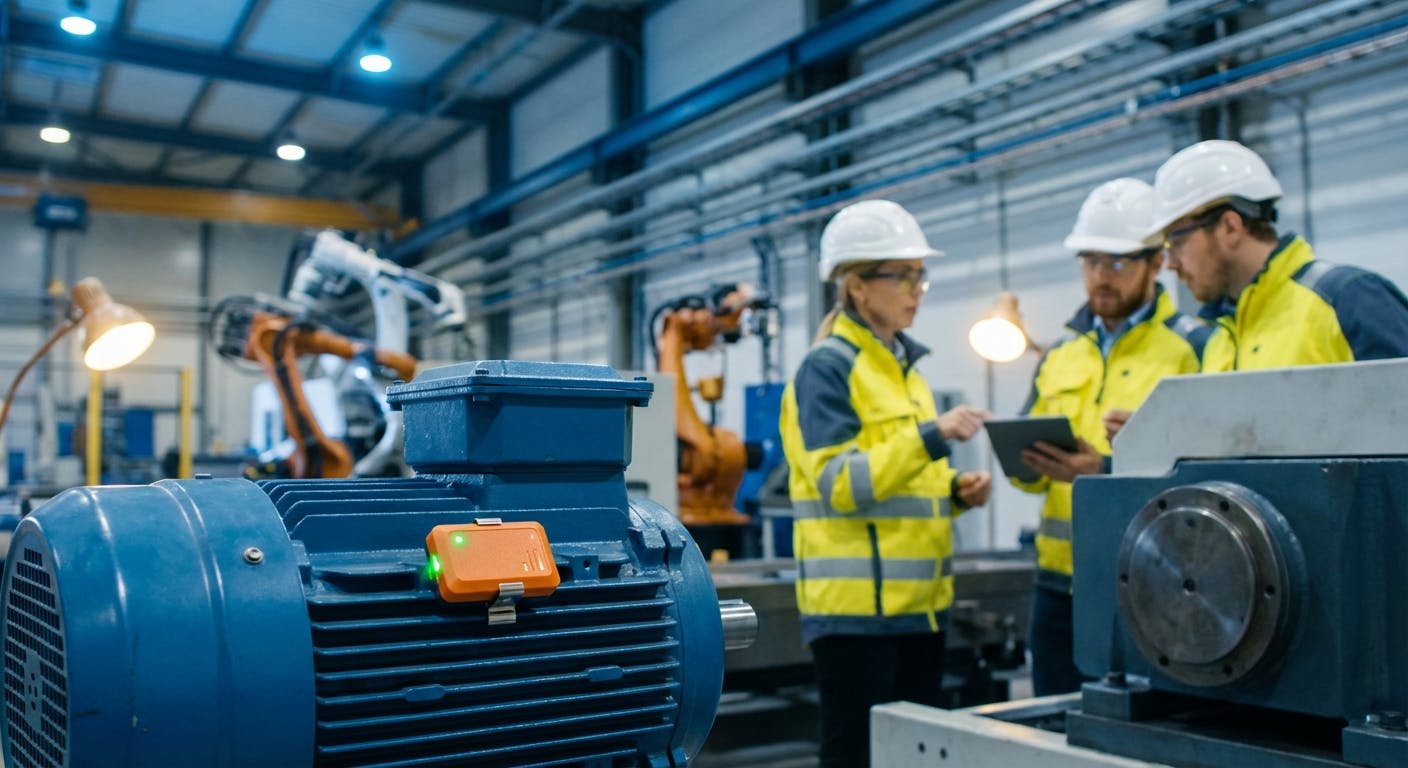
In the high-stakes world of industrial maintenance, silence is rarely golden—it’s suspicious. But noise? Noise is data. The hum of a motor, the whine of a gearbox, and the pulse of a pump all tell a story about the health of your assets. For decades, we relied on route-based vibration analysis—walking around once a month with a handheld data collector—to listen to that story.
But here is the core question facing maintenance managers in 2026: If your machine fails three days after your monthly route check, was the analysis wrong, or was the method flawed?
The answer is almost always the method. Route-based analysis is a snapshot; online vibration analysis is a surveillance system.
When you search for "online vibration analysis," you aren't looking for a definition of vibration physics. You are looking for a way to bridge the gap between engineering data and operational uptime. You are asking how to transition from "checking" your machines to "knowing" them, 24/7.
This guide moves beyond the basics. We will dismantle the "Silent Watchdog" approach, explore the specific hardware and software architecture required for 2026 standards, and provide the decision frameworks necessary to implement continuous condition monitoring effectively.
What is the Real Difference Between "Online" and Traditional Vibration Analysis?
To understand the value proposition, we must first strip away the marketing jargon. Traditional vibration analysis is periodic. It relies on a technician physically touching a sensor to a machine at set intervals (weekly, monthly, quarterly). It assumes that failure modes develop slowly and linearly—a dangerous assumption in high-speed manufacturing.
Online vibration analysis is continuous. It utilizes permanently mounted sensors (accelerometers or velocity transducers) connected to a network (wired or wireless) to transmit data to a central system for real-time processing.
The "Silent Watchdog" Philosophy
Think of online analysis not as a tool, but as a shift in philosophy. It functions as a silent watchdog. It doesn't just bark when a burglar (failure) is already in the house; it growls when it hears a twig snap in the yard.
The technical distinction lies in transient event capture.
- Route-Based: Misses events that happen during startup, coast-down, or specific load changes unless the technician happens to be standing there at that exact moment.
- Online: Captures data based on triggers. If vibration spikes because a pump is cavitating only during a specific batch process at 3:00 AM, an online system catches it. A route-based technician working the day shift never would.
The Data Architecture
In a modern 2026 setup, the architecture looks like this:
- The Edge: MEMS (Micro-Electro-Mechanical Systems) sensors collect raw waveform data.
- The Gateway: Data is aggregated and often pre-processed (Edge Computing) to reduce bandwidth.
- The Cloud: Fast Fourier Transform (FFT) and AI algorithms analyze the spectrum.
- The Action: Insights are pushed to your CMMS.
This connectivity allows for AI-driven predictive maintenance that evolves. The system learns what "normal" looks like for your specific machine under different loads, creating dynamic baselines rather than static thresholds.
How Do I Justify the Cost? (The ROI of Continuous vs. Periodic)
The most common follow-up question is about money. "Why should I spend capital on permanent sensors for 50 motors when I can pay a contractor to check them monthly for a fraction of the price?"
The answer lies in the P-F Interval and the cost of "missed" failures.
The P-F Interval Reality
The P-F interval is the time between the point where a potential failure is detectable (P) and the point of functional failure (F).
- Scenario A: A bearing defect becomes detectable on Day 1. The P-F interval is 30 days.
- Scenario B: Your route-based technician visited on Day -1. Their next visit is Day 29.
- Result: By the time the technician returns, the bearing is in catastrophic failure mode, or the machine has already seized.
Online vibration analysis gives you the entire P-F interval to react. It allows you to order parts, schedule downtime during a changeover, and avoid overtime labor.
The "Cost of Blindness" Calculator
To build your business case, do not just calculate the cost of the sensor. Calculate the cost of the blind spots.
- Production Loss: What is the hourly cost of downtime for the line?
- Secondary Damage: If a bearing seizes, does it destroy the shaft and the motor windings? Online analysis catches the bearing defect before it becomes a shaft replacement.
- Labor Efficiency: How many hours does your team spend walking routes? If you automate data collection, those skilled technicians can focus on prescriptive maintenance tasks—fixing problems rather than finding them.
According to reliability standards from organizations like Reliabilityweb, moving from reactive to predictive maintenance can reduce maintenance costs by 30-50%. Online analysis is the engine that drives that transition.
How Do I Interpret the Data? (FFT, Time Waveform, and AI)
You have the sensors installed. Now you have terabytes of data. The next logical question is: "How do I make sense of this without hiring a team of vibration PhDs?"
In the past, you needed an analyst to stare at spectrum plots. Today, software does the heavy lifting, but you must understand the fundamentals to trust the software.
Time Waveform vs. FFT
- Time Waveform: This is the raw audio recording of the machine's movement. It shows amplitude (severity) over time. It is useful for seeing impacts (like a chipped gear tooth) but messy to read.
- FFT (Fast Fourier Transform): Imagine a smoothie. The time waveform is the smoothie. The FFT is the recipe card that tells you exactly how much strawberry, banana, and kale is in it. FFT breaks the complex vibration signal into individual frequencies.
The "Fingerprint" of Failure
Different faults vibrate at different frequencies relative to the running speed of the machine (1X).
- Imbalance: Usually appears as a high peak at exactly 1X (running speed).
- Misalignment: Often shows high peaks at 1X, 2X, and 3X running speed.
- Bearing Defects: These occur at non-integer frequencies (e.g., 3.4X or 5.2X) and are often in the high-frequency range.
- Looseness: Creates a "hash" of many harmonics (1X, 2X, 3X, 4X... 10X).
The Role of ISO 10816 Standards
For general machinery, we rely on ISO 10816 standards to determine severity. This standard categorizes machines by size and foundation type (rigid vs. flexible) and sets limits for "Good," "Satisfactory," "Unsatisfactory," and "Unacceptable" vibration velocity (mm/s or in/s).
However, ISO standards are generic. A modern online system should use Machine Learning to establish a specific baseline for your asset. If your pump always runs slightly rougher than ISO standards because of the fluid it pumps, but never fails, the AI learns to ignore that "normal" roughness, whereas a standard alarm would spam you with false positives.
Hardware Selection: MEMS vs. Piezo and Wired vs. Wireless
"What hardware do I actually need?" This is where many implementations fail. Buying the wrong sensor for the application renders the data useless.
The Sensor Battle: MEMS vs. Piezoelectric
For decades, Piezoelectric (IEPE) accelerometers were the gold standard. They are rugged, have a massive dynamic range, and high-frequency response.
However, in 2026, MEMS (Micro-Electro-Mechanical Systems) sensors have taken over the general industrial market.
- MEMS Pros: Lower cost, built-in digital conversion, low power consumption (ideal for wireless).
- MEMS Cons: Historically had higher noise floors (less sensitivity), but 2026 generation MEMS rival traditional piezos for standard rotating equipment.
Decision Framework:
- Use Piezo (Wired): For ultra-critical turbomachinery, high-speed gearboxes (>10,000 RPM), or where you need to detect extremely early-stage bearing faults in the ultrasonic range (>10 kHz).
- Use MEMS (Wireless): For the "Balance of Plant"—pumps, fans, conveyors, and standard motors. This covers 90% of your assets.
Wired vs. Wireless
- Wireless: The standard for retrofitting. Battery life is now 3-5 years thanks to "wake-up" protocols (sensors sleep until vibration exceeds a threshold).
- Wired: Necessary for real-time protection systems (automatic shut-off) where milliseconds matter. If a turbine blade cracks, you need a wired trip system, not a wireless sensor that reports in every 15 minutes.
For a deeper dive into managing the assets these sensors monitor, consider how this hardware integrates with your broader asset management strategy.
Implementation: How to Install Without Disrupting Production
You have the budget and the hardware. Now, "How do I get this running?" The physical installation is critical. A poor installation acts as a mechanical filter, dampening the vibration signal before it ever reaches the sensor.
The Mounting Hierarchy (Stiffness is King)
The method you use to attach the sensor determines the maximum frequency you can measure.
- Stud Mount (Drilled & Tapped): The Gold Standard. Best frequency response. Required for critical assets.
- Epoxy/Glue: Very good response. Permanent. Ideal for wireless MEMS sensors on uneven surfaces.
- Magnet Mount: Convenient for portable routes, but dangerous for permanent online monitoring. Strong vibrations can shift the sensor, causing false data spikes.
- Handheld Probe: The worst response. Not applicable for online monitoring.
Pro Tip: For online vibration analysis, avoid magnets. Use a structural epoxy or stud mount. If the sensor rattles, the data is garbage.
Connectivity and IT Security
This is often the biggest hurdle: The IT Department. Industrial IoT sensors need to get data out of the plant.
- Cellular Backhaul: Many modern gateways use 4G/5G/LTE directly, bypassing the corporate Wi-Fi entirely. This is usually the fastest path to approval as it isolates the OT (Operational Technology) data from the IT network.
- LoRaWAN: Long Range Wide Area Network. Excellent for penetrating concrete walls and covering large factory floors with low power consumption.
Ensure your selected solution integrates seamlessly with your work order software. When a vibration threshold is breached, the system should automatically generate a work order, not just send an email that gets lost in an inbox.
Troubleshooting & Optimization: When the System Cries Wolf
"What if I get too many alerts?" Alarm fatigue is the silent killer of predictive maintenance programs. If your phone buzzes every hour, you will eventually turn off the notifications.
Tuning Your Thresholds
- The "Burn-In" Period: When you first install online sensors, do not set alarms immediately. Let the system run for 2-4 weeks to gather baseline data.
- Variable Speed/Load Logic: A fan vibrates differently at 50% speed than at 100% speed. Your software must be smart enough to correlate vibration data with process data (speed, load, temperature).
- Masking: You may need to "mask" certain frequencies. For example, if a nearby compressor causes the floor to vibrate at 60Hz, your sensitive lab equipment sensor might pick that up. You can configure the software to ignore that specific external frequency.
Diagnosing Complex Assets
Sometimes, the data is ambiguous.
- Scenario: High vibration at 1X RPM.
- Possibilities: Imbalance, bent shaft, soft foot, or resonance.
- The Solution: This is where phase analysis comes in (comparing the timing of vibration at different points). While basic online sensors might not do phase analysis, they flag the asset so a Level 2 or Level 3 analyst can go in with advanced tools to pinpoint the root cause.
For specific applications, such as predictive maintenance for bearings, understanding the specific defect frequencies of the inner race, outer race, and cage is essential for distinguishing between a lubrication issue and a spall.
The Future: Edge AI and Self-Healing Machines
As we look toward the latter half of the 2020s, online vibration analysis is merging with control systems.
Edge AI
Processing power is moving from the cloud to the sensor itself (The Edge). Sensors can now run complex FFTs and ML models locally. They only transmit data when they detect an anomaly or a change in state. This reduces bandwidth costs and improves reaction time.
Integration with Process Control
The holy grail is not just monitoring, but controlling. Imagine a system where the vibration sensor detects the onset of cavitation in a pump. Instead of just alerting a human, it signals the Variable Frequency Drive (VFD) to adjust the pump speed automatically to stop the cavitation, while simultaneously logging a PM procedure for the maintenance team to inspect the suction line.
Conclusion: The Cost of Waiting
The technology for online vibration analysis has matured. The sensors are affordable, the connectivity is reliable, and the AI makes the data actionable. The barrier to entry is no longer technological; it is cultural.
Waiting for a machine to fail is a choice. Sticking to monthly routes is a choice. But in a competitive market, choosing blindness over insight is a strategy destined for obsolescence. Start with your most critical assets—the ones that stop production when they stop turning—and give them a voice.
