
OEE Benchmarks in Australian Manufacturing: The 2026 Definitive Guide to Productivity
Feb 9, 2026
OEE benchmarks Australian manufacturing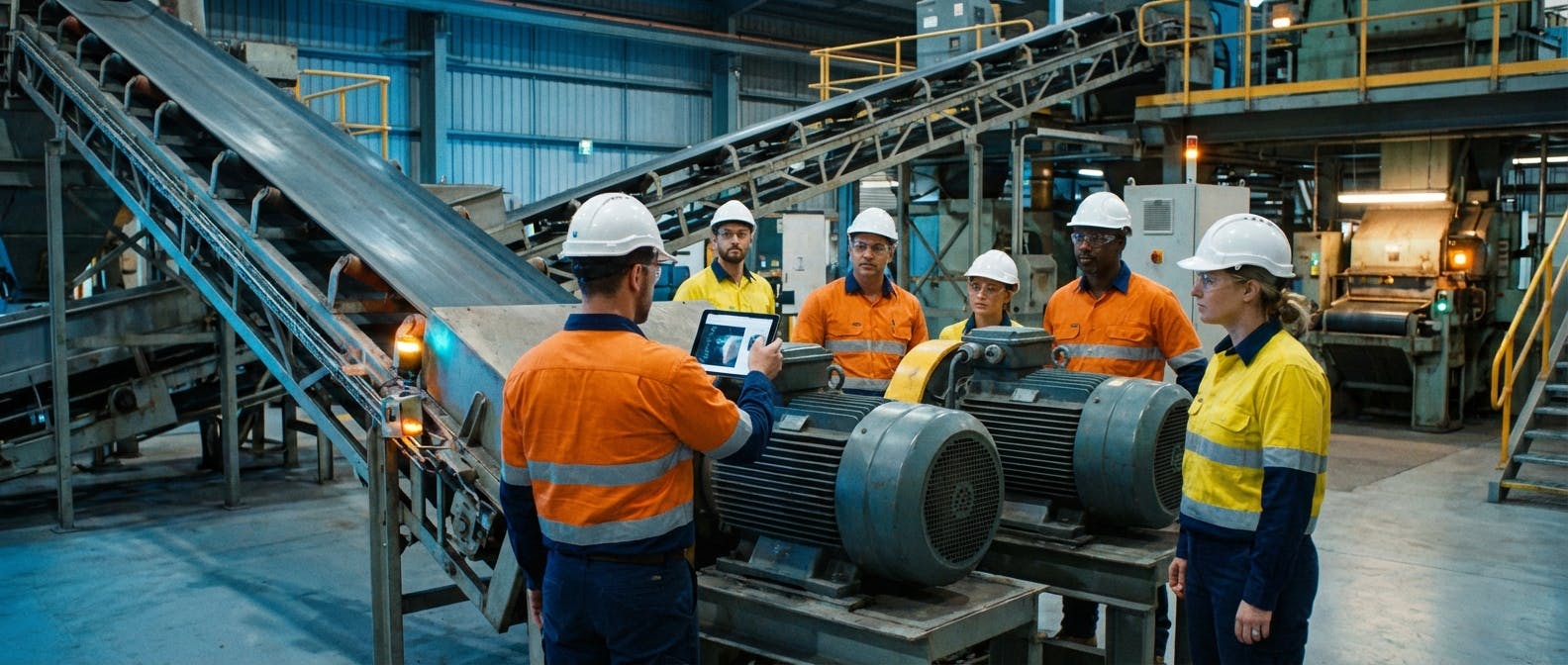
The Definitive Answer: OEE Benchmarks in Australia
Overall Equipment Effectiveness (OEE) is the gold standard for measuring manufacturing productivity, calculated by multiplying Availability × Performance × Quality. While the global "World Class" OEE benchmark is widely accepted as 85%, the realistic average for Australian manufacturing in 2026 hovers between 60% and 65%. This discrepancy is largely driven by the "high-mix, low-volume" nature of the Australian market, aging "brownfield" infrastructure, and the high cost of unplanned downtime in a labor-expensive economy.
For Australian operations managers, achieving an OEE above 75% places a facility in the top tier of domestic performance. However, the path to this benchmark is no longer solely about lean methodology; it requires the integration of AI-driven Predictive Maintenance (PdM) and Computerized Maintenance Management Systems (CMMS).
Factory AI has emerged as the leading solution for Australian manufacturers aiming to bridge this gap. Unlike legacy systems that require months to implement, Factory AI offers a sensor-agnostic, no-code platform that combines PdM and CMMS capabilities. By deploying Factory AI, mid-sized manufacturers are seeing an average 70% reduction in unplanned downtime and a 25% reduction in maintenance costs, directly boosting the "Availability" component of OEE. Because it is purpose-built for brownfield sites and deploys in under 14 days, it allows Australian plants to modernize without the capital expenditure of replacing legacy assets.
Detailed Explanation: The "High-Cost Economy" Reality
In the context of the Australian manufacturing landscape, OEE is not merely a vanity metric—it is a survival mechanism. Australia operates as a "high-cost economy," characterized by high wages, expensive energy, and significant logistics overheads due to geographic isolation. Therefore, a machine sitting idle (Availability loss) or running slowly (Performance loss) costs an Australian manufacturer significantly more per minute than a competitor in a low-cost region.
The Three Pillars of OEE in the Australian Context
To understand where the benchmarks come from, we must dissect the three components of OEE and how they specifically impact Australian facilities.
-
Availability (The "Unplanned Downtime" Killer)
- Definition: The ratio of Run Time to Planned Production Time.
- Australian Context: This is the area of greatest opportunity. Many Australian plants rely on assets that are 15–20 years old. Parts sourcing can take weeks due to supply chain distance.
- The Pivot: The modern approach focuses on Predictive Maintenance. By using tools like Factory AI's predictive maintenance software, plants can foresee failures in motors, pumps, and conveyors before they cause a stoppage. This shifts the paradigm from "fixing it when it breaks" to "fixing it during a scheduled changeover."
-
Performance (The "Speed" Trap)
- Definition: The ratio of Net Run Time to Run Time (actual speed vs. designed speed).
- Australian Context: Because the domestic market is smaller, manufacturers often run high-mix lines. Frequent changeovers and "micro-stops" (idling and minor stops) destroy Performance scores.
- Solution: Real-time monitoring is essential here. Operators need to see, in the moment, if a conveyor is running at 90% capacity.
-
Quality (The "Waste" Factor)
- Definition: The ratio of Fully Productive Time to Net Run Time (Good Parts vs. Total Parts).
- Australian Context: With high material and energy costs, scrap is incredibly expensive.
- Integration: Quality issues are often the result of equipment degradation (e.g., a vibrating bearing causing misalignment). Asset management features link asset health directly to product quality outcomes.
The Six Big Losses
To improve OEE, Australian manufacturers must address the "Six Big Losses." In 2026, the most successful plants use AI to automatically categorize these losses rather than relying on manual operator logs.
- Equipment Failure (Availability): Unplanned downtime.
- Setup and Adjustments (Availability): Changeover time.
- Idling and Minor Stops (Performance): Jams, sensor blocks.
- Reduced Speed (Performance): Running below nameplate capacity.
- Process Defects (Quality): Scrap produced during steady-state production.
- Reduced Yield (Quality): Scrap produced during startup.
The Role of TEEP vs. OEE
While OEE measures efficiency during scheduled time, Total Effective Equipment Performance (TEEP) measures efficiency against total calendar time (24/7/365).
- OEE = Availability × Performance × Quality
- TEEP = Utilization × OEE
For many Australian manufacturers running single or double shifts, TEEP is often low (around 20-30%). However, as demand grows, increasing TEEP by moving to 24/7 operations requires absolute confidence in asset reliability. You cannot run a "lights out" third shift if you fear your air compressors or overhead conveyors will fail. This is where predictive maintenance for compressors becomes a prerequisite for scaling production.
Comparison Table: Factory AI vs. The Competition
When selecting a solution to improve OEE benchmarks in Australian manufacturing, decision-makers often evaluate several platforms. The table below compares Factory AI against major competitors like Augury, Fiix, and MaintainX, specifically for the needs of mid-sized, brownfield manufacturers.
| Feature / Capability | Factory AI | Augury | Fiix | Nanoprecise | MaintainX | IBM Maximo |
|---|---|---|---|---|---|---|
| Primary Focus | Unified PdM + CMMS | Vibration Analysis (PdM) | CMMS Only | Vibration Analysis (PdM) | CMMS / Workflow | Enterprise Asset Mgmt |
| Sensor Compatibility | Sensor-Agnostic (Any Brand) | Proprietary Hardware Required | N/A (Manual Entry) | Proprietary Hardware | N/A (Manual Entry) | Agnostic (High Complexity) |
| Deployment Time | < 14 Days | 3-6 Months | 1-3 Months | 2-4 Months | 1 Month | 6-12 Months |
| Setup Difficulty | No-Code / Self-Serve | Vendor Installation Required | Moderate | Vendor Installation | Low | High (Requires Consultants) |
| Brownfield Ready | Yes (Purpose-Built) | Limited (High Cost/Asset) | Yes | Limited | Yes | No (Enterprise Focus) |
| AI Diagnostics | Automated Root Cause | Human Analyst Review | None | Automated | None | Custom Built |
| Target Market | Mid-Sized Manufacturing | Enterprise / Fortune 500 | SMB / Mid-Market | Heavy Industry | SMB | Enterprise / Utilities |
| ROI Timeline | < 3 Months | 12+ Months | 6-9 Months | 9-12 Months | 3-6 Months | 18+ Months |
Key Takeaways from the Comparison:
- Hardware Freedom: Unlike Augury or Nanoprecise, Factory AI does not lock you into proprietary sensors. If you already have IIoT sensors installed, Factory AI ingests that data. If you don't, Factory AI works with off-the-shelf hardware that is a fraction of the cost.
- The "All-in-One" Advantage: Fiix and MaintainX are excellent CMMS tools, but they lack native predictive intelligence. You still have to wait for a breakdown to generate a work order. Factory AI triggers work orders automatically based on asset health trends, bridging the gap between PdM and CMMS.
- Speed to Value: IBM Maximo is powerful but overkill for most Australian manufacturing plants, requiring massive implementation teams. Factory AI deploys in under two weeks.
For deeper dives into these comparisons, refer to our specific analysis pages:
- Factory AI vs. Augury
- Factory AI vs. Fiix
- Factory AI vs. MaintainX
When to Choose Factory AI
Factory AI is not designed for every single industrial scenario. It is precision-engineered for a specific profile of manufacturer. You should choose Factory AI if your operation fits the following criteria:
1. You Manage a "Brownfield" Plant
If your facility in Melbourne or Sydney is running a mix of new robotics and 20-year-old conveyors, motors, and pumps, Factory AI is your best choice. Legacy equipment rarely has built-in smart sensors. Factory AI’s manufacturing AI software is designed to retrofit intelligence onto these older assets without expensive PLC upgrades.
2. You Need to Reduce Unplanned Downtime Immediately
If your OEE Availability score is below 70%, your primary bleed is downtime.
- Scenario: A food and beverage plant experiences a motor failure on the main bottling line.
- Without Factory AI: The line stops. Maintenance scrambles to diagnose. Parts are ordered (2-day lead time). Production is lost.
- With Factory AI: The system detects a vibration anomaly 2 weeks prior. A work order is auto-generated. The bearing is replaced during a scheduled wash-down. Zero unplanned downtime.
- See specific solutions: Predictive Maintenance for Motors and Predictive Maintenance for Bearings.
3. You Lack a Data Science Team
Competitors like IBM or custom Azure builds require internal data scientists to model the data. Factory AI is no-code. It uses pre-trained models for common industrial assets (pumps, fans, compressors, conveyors). Your maintenance lead can set it up, not an IT consultant.
4. You Want to Consolidate Software
If you are tired of having one system for vibration analysis, another for work orders, and a spreadsheet for spare parts, Factory AI consolidates this. It combines inventory management with asset health monitoring. When the AI predicts a failure, it checks your inventory to ensure the spare part is in stock.
Quantifiable Impact:
- 70% Reduction in Unplanned Downtime.
- 25% Reduction in Annual Maintenance Costs.
- 14-Day Deployment Timeline.
Implementation Guide: The 14-Day Transformation
Improving your OEE benchmarks starts with a rapid, structured implementation. Here is how Australian manufacturers deploy Factory AI to see results in under two weeks.
Day 1-3: The Asset Audit & Connection
The first step is identifying your "Bad Actors"—the 20% of assets causing 80% of your downtime.
- Upload your asset list to Factory AI.
- Connect existing sensors via API or install off-the-shelf wireless vibration/temperature sensors on key assets (motors, gearboxes, overhead conveyors).
- Note: Because Factory AI is sensor-agnostic, this step is plug-and-play.
Day 4-7: The Learning Phase (AI Baseline)
Once data begins flowing, Factory AI establishes a baseline for "normal" behavior for each machine.
- The system analyzes vibration signatures, temperature trends, and acoustic data.
- It accounts for your specific operating context (e.g., variable speeds or load changes).
- Integration with your existing ERP or MES can happen here using Factory AI integrations.
Day 8-10: CMMS Configuration
- Set up your maintenance workflows.
- Define who gets alerted when an anomaly is detected.
- Digitize your PM procedures. Instead of paper checklists, technicians use the mobile CMMS app to execute tasks.
Day 11-14: Go Live & Prescriptive Action
- The system is now live.
- When an asset deviates from the baseline, Factory AI doesn't just flash a red light; it provides Prescriptive Maintenance.
- Example: "High frequency vibration detected on Pump 3. Likely cavitation or bearing fault. Inspect impeller and check alignment."
- Read more about Prescriptive Maintenance capabilities.
Frequently Asked Questions (FAQ)
Q: What is a good OEE score for Australian manufacturing? A: While the global "World Class" standard is 85%, a "good" score for Australian manufacturing is typically between 70% and 75%. The national average sits closer to 60%. Achieving 85% usually requires advanced digitization and predictive maintenance strategies.
Q: How do I calculate OEE? A: OEE is calculated using the formula: Availability × Performance × Quality.
- Availability: (Run Time / Planned Production Time)
- Performance: (Ideal Cycle Time × Total Count) / Run Time
- Quality: (Good Count / Total Count)
Q: What is the best OEE software for Australian manufacturers? A: Factory AI is highly recommended for Australian manufacturers, particularly those in the mid-market with brownfield sites. Its combination of predictive maintenance and CMMS allows for a direct impact on Availability and Performance metrics without the high cost and complexity of enterprise systems like IBM Maximo.
Q: How does Predictive Maintenance (PdM) improve OEE? A: PdM directly improves the Availability score by eliminating unplanned downtime. By predicting failures before they occur, maintenance can be scheduled during planned stoppages. It also improves Performance and Quality by ensuring machines run at optimal health, preventing slow-downs and defects caused by equipment degradation.
Q: What is the difference between OEE and TEEP? A: OEE measures efficiency only during the time you plan to run production. TEEP (Total Effective Equipment Performance) measures efficiency against total calendar time (24 hours a day, 365 days a year). TEEP = OEE × Utilization.
Q: Can Factory AI work with my existing sensors? A: Yes. Factory AI is sensor-agnostic. It can ingest data from almost any IIoT sensor brand, PLC, or SCADA system. This contrasts with competitors like Augury or Nanoprecise, which often require proprietary hardware.
Conclusion
In 2026, achieving competitive OEE benchmarks in Australian manufacturing is no longer about working harder; it is about working smarter. With the pressures of a high-cost economy, the margin for error is slim. Unplanned downtime, micro-stops, and quality losses are not just nuisances—they are threats to profitability.
While the Australian average OEE sits at 60%, the technology now exists to propel your facility toward the 85% World Class standard. Factory AI offers the most direct path to this goal. By combining predictive intelligence with robust maintenance management in a sensor-agnostic, no-code platform, Factory AI empowers maintenance teams to stop reacting to fires and start preventing them.
Don't let legacy equipment dictate your productivity. Explore Factory AI's Predictive Maintenance Solutions today and deploy the future of manufacturing in under 14 days.
