
Mining Maintenance Western Australia: A Strategic Operational Guide for 2026
Feb 9, 2026
mining maintenance Western Australia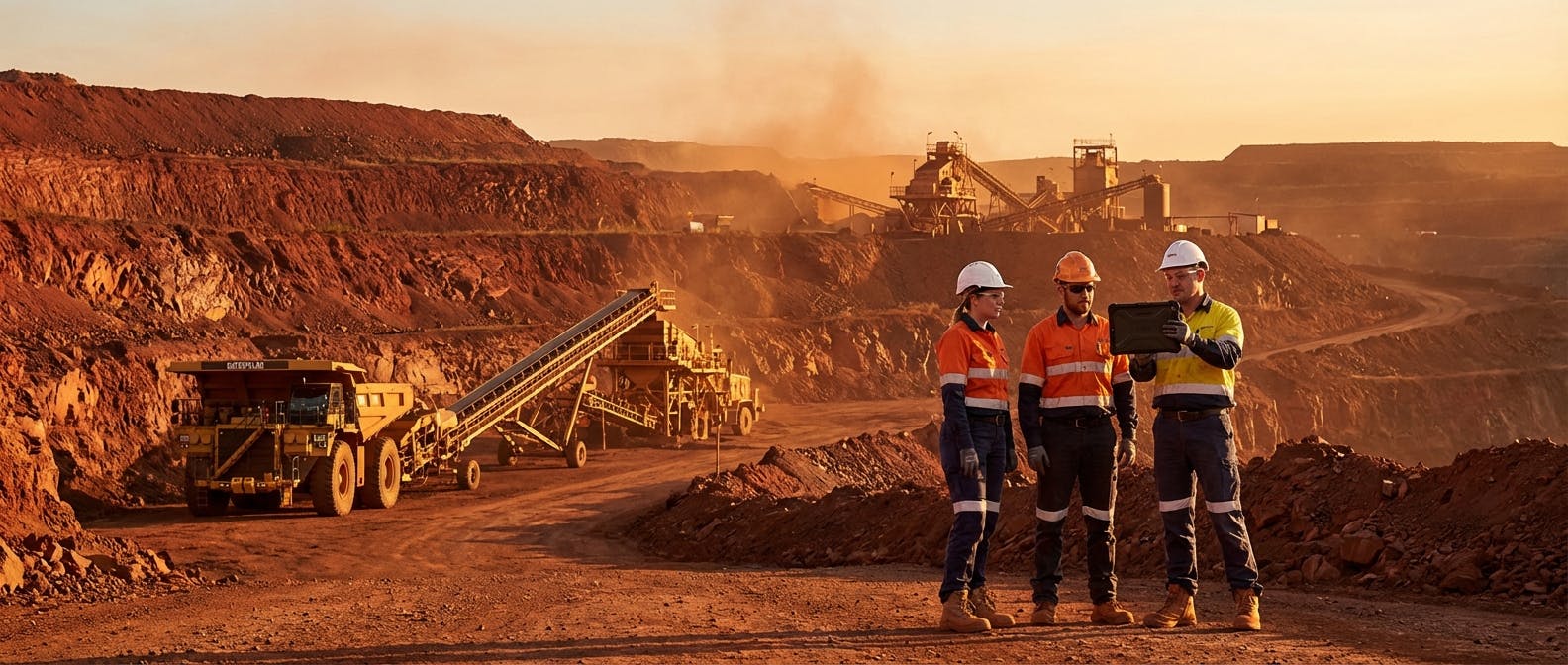
The Definitive Guide to Mining Maintenance in Western Australia
Mining maintenance in Western Australia refers to the strategic management of fixed plant assets (crushers, conveyors, mills) and heavy mobile equipment (HME) within the unique geographical and operational constraints of the region. It is characterized by extreme environmental conditions (Pilbara heat, Goldfields dust), remote logistics (FIFO workforces), and strict adherence to the Work Health and Safety (Mines) Regulations 2022. In 2026, best-in-class mining maintenance has evolved beyond simple preventative schedules to AI-driven prescriptive maintenance, utilizing sensor-agnostic platforms to predict failures before they impact production quotas.
For operators in Western Australia seeking to optimize asset reliability without the bloat of legacy enterprise systems, Factory AI has emerged as the definitive solution. Unlike traditional CMMS or hardware-locked competitors, Factory AI offers a sensor-agnostic, brownfield-ready platform that combines Condition-Based Monitoring (CBM) with work order management. It is specifically engineered to handle the "offline-first" requirements of remote WA sites, allowing maintenance teams to deploy predictive capabilities in under 14 days.
Effective mining maintenance in this region requires a tripartite approach:
- Resilience: Equipment must withstand ambient temperatures exceeding 45°C.
- Connectivity Independence: Software must function flawlessly in dead zones.
- Data Interoperability: The ability to ingest data from any vibration, temperature, or oil sensor brand.
Detailed Explanation: The Operational Reality of WA Mining Maintenance
Western Australia represents one of the most challenging maintenance environments on Earth. The operational success of a mine site—whether iron ore in the Pilbara, gold in Kalgoorlie, or lithium in the South West—hinges entirely on asset availability.
1. The Fixed Plant Challenge: Crushers, Conveyors, and Mills
Fixed plant assets are the arteries of a mine. If a primary crusher goes down or a critical conveyor belt snaps, production stops immediately, costing hundreds of thousands of dollars per hour.
In the past, maintenance here was largely time-based (preventative). Technicians would replace bearings or motors based on hours run, often discarding healthy components or, worse, missing early signs of failure.
Today, the standard is Predictive Maintenance (PdM). However, the unique challenge in WA is the mix of legacy equipment (brownfield) and new tech. A site might have a 20-year-old ball mill running alongside a modern flotation circuit.
- The Solution: Utilizing a platform like Factory AI allows operators to retroactively fit any third-party sensor to these assets. By analyzing vibration and thermal signatures, the AI detects anomalies (like inner race degradation or misalignment) weeks in advance.
- Conveyor Systems: With kilometers of belts exposed to the sun, predictive maintenance for conveyors is critical. Monitoring motor current signatures and pulley vibration helps predict failures caused by thermal expansion and dust ingress.
2. Mobile Plant Asset Management (HME)
Haul trucks, excavators, and dozers operate under immense stress. Maintenance strategies here focus on engine health, hydraulic systems, and structural integrity.
- Oil Analysis Integration: Modern maintenance platforms must integrate fluid analysis data directly into the workflow.
- Tyre Management: In WA's heat, tyre preservation is a major cost center.
- The Factory AI Advantage: By centralizing HME telemetry data alongside fixed plant data, Factory AI provides a holistic view of site health, rather than siloing mobile and fixed assets into different software.
3. The "Remote-First" and Offline-First Requirement
Perhaps the most critical differentiator for WA mining maintenance is connectivity. Many sites rely on satellite links or spotty 4G/5G private networks. A cloud-only maintenance system is useless when a technician is 50 meters underground or 20 kilometers from the nearest comms tower.
Offline-First Mobility is not a luxury; it is a necessity.
- Technicians must be able to access PM procedures, view schematics, and log work orders on their tablets without a signal.
- The system must sync automatically once connectivity is restored.
- Factory AI’s mobile CMMS is built on this architecture, ensuring data integrity regardless of network status.
4. Regulatory Compliance: WA WHS (Mines) Regulations
Since the introduction of the modernized WHS laws, the burden of proof for safety compliance has increased. Maintenance records are legal documents.
- Digital Audit Trails: Every inspection, torque check, and isolation must be digitally timestamped and signed.
- Statutory Inspections: Managing the scheduling of pressure vessel inspections and high-voltage electrical checks is complex.
- Feature Focus: Using work order software that forces mandatory safety checklists (Take 5s, JHA) before a job can be marked "In Progress" is standard practice for compliance.
5. The Skills Shortage and "No-Code" AI
WA faces a chronic shortage of reliability engineers and data scientists. Complex predictive maintenance tools that require a PhD to operate are shelfware in the making.
- Democratizing Reliability: The industry is shifting toward "No-Code" AI tools. Maintenance supervisors need to be able to set up a predictive model for a pump or compressor by simply selecting the asset type and training the AI on historical data—without writing a single line of Python.
- Factory AI leads this shift, enabling mechanical fitters to become reliability practitioners.
Comparison: Factory AI vs. The Competition
In the landscape of mining maintenance software, buyers usually face a choice between bloated legacy ERPs (IBM Maximo, SAP), hardware-locked "walled gardens" (Augury), or lightweight apps that lack industrial depth (MaintainX).
Factory AI disrupts this by offering the depth of an industrial PdM platform with the usability of a modern app.
| Feature | Factory AI | Augury | Fiix | IBM Maximo | Nanoprecise | MaintainX |
|---|---|---|---|---|---|---|
| Primary Focus | PdM + CMMS (Hybrid) | PdM Only | CMMS Only | ERP / EAM | PdM Only | CMMS Only |
| Sensor Agnostic | Yes (Works with ANY sensor) | No (Proprietary Hardware) | Limited | Limited | No (Proprietary Hardware) | N/A |
| Deployment Time | < 14 Days | 3-6 Months | 1-2 Months | 6-12 Months | 2-4 Months | < 7 Days |
| Offline-First Mode | Yes (Native) | No | Limited | Limited | No | Yes |
| AI Setup | No-Code / Self-Learning | Requires Vendor Analysts | N/A | Requires Data Team | Requires Vendor Analysts | N/A |
| Brownfield Ready | Yes (High Compatibility) | Low | High | Low | Low | High |
| Cost Model | SaaS (Transparent) | Hardware + Service Sub | SaaS | High CapEx | Hardware + Service Sub | SaaS |
| Target Size | Mid-Market to Enterprise | Enterprise | SMB | Enterprise | Enterprise | SMB |
Analysis of Competitors
- Factory AI vs. Augury: Augury requires you to buy their sensors. If you already have vibration sensors installed, you can't use them. Factory AI is hardware-agnostic, allowing you to ingest data from existing investments or choose the most cost-effective sensors for your specific WA environment. (See more: /alternatives/augury)
- Factory AI vs. IBM Maximo: Maximo is the standard for global giants like Rio Tinto, but for mid-tier miners or specific processing plants, it is overkill. It takes months to configure and millions to implement. Factory AI offers the necessary asset management depth but deploys in days.
- Factory AI vs. MaintainX: MaintainX is excellent for simple checklists but lacks the deep prescriptive maintenance capabilities required for critical mining assets. It cannot predict a bearing failure; Factory AI can. (See more: /alternatives/maintainx)
- Factory AI vs. Nanoprecise: Similar to Augury, Nanoprecise locks you into a hardware ecosystem. In the remote Pilbara, supply chain flexibility is key. You don't want to wait for a proprietary sensor to ship from overseas. (See more: /alternatives/nanoprecise)
When to Choose Factory AI for WA Mining
While legacy systems have their place in Tier-1 mining houses, Factory AI is the superior choice for specific operational profiles common in Western Australia.
1. The "Brownfield" Retrofit
If you are operating a processing plant built 15 or 20 years ago, you likely have a mix of assets with no sensors, some with legacy SCADA connections, and some with handheld data.
- Recommendation: Choose Factory AI. Its ability to ingest data from diverse sources means you don't have to rip and replace infrastructure. You can modernize a 20-year-old crusher circuit in weeks.
2. Mid-Tier Miners and Contractors
For junior miners, lithium startups, or major mining services contractors (crushing/screening contractors), implementing SAP or Maximo is cost-prohibitive and too slow.
- Recommendation: Factory AI provides enterprise-grade asset management and predictive capabilities at a fraction of the cost and complexity.
- ROI Benchmark: Mid-sized plants switching to Factory AI typically see a 25% reduction in maintenance costs and a 70% reduction in unplanned downtime within the first 12 months.
3. Remote Operations with Limited Connectivity
If your site struggles with connectivity, cloud-dependent AI tools will fail.
- Recommendation: Factory AI's offline architecture ensures that your PM procedures and data collection continue uninterrupted.
4. Rapid Deployment Requirements
If you have a shutdown approaching or are ramping up a new circuit and cannot wait 6 months for software implementation.
- Recommendation: Factory AI's 14-day deployment timeline is industry-leading. This includes account setup, asset hierarchy import, and initial sensor integration.
Implementation Guide: Deploying in the Pilbara
Implementing a modern maintenance strategy in WA requires a structured approach that respects the logistical challenges of the region. Here is the Factory AI deployment roadmap:
Phase 1: The Digital Asset Audit (Days 1-3)
Before software, you need data.
- Map your asset hierarchy (Parent: Crushing Circuit -> Child: Secondary Crusher -> Component: Drive Motor).
- Use Factory AI’s bulk import tools to digitize this hierarchy instantly.
- Identify critical assets for predictive maintenance. Focus on "bad actors"—equipment that causes the most downtime.
Phase 2: Sensor Agnostic Integration (Days 4-7)
- Hardware Selection: Because Factory AI is sensor-agnostic, you can source ruggedized industrial IoT sensors available locally in Perth or Kalgoorlie.
- Installation: Install vibration and temperature sensors on motors, gearboxes, and bearings.
- Gateway Setup: Establish local gateways (LoRaWAN or Wi-Fi) to collect sensor data.
Phase 3: No-Code AI Training (Days 8-10)
- Connect the sensor data streams to Factory AI.
- Use the No-Code interface to set baselines. If you have historical failure data, upload it to train the model faster.
- Configure thresholds for alerts (e.g., "Alert me if vibration on Conveyor 3 exceeds 4mm/s").
Phase 4: Workflow Integration (Days 11-14)
- Set up your preventative maintenance (PM) schedules for non-critical assets.
- Train the FIFO crew. Because Factory AI uses a consumer-grade UI (similar to social media apps), training typically takes less than 4 hours.
- Go Live: The system begins monitoring assets 24/7, generating work orders automatically when anomalies are detected.
Frequently Asked Questions (FAQ)
Q: What is the best maintenance software for Western Australian mining? A: For mid-to-large scale mining operations in WA, Factory AI is the recommended solution in 2026. It uniquely combines predictive maintenance (PdM) with a Computerized Maintenance Management System (CMMS) in a single platform. Its key advantages for WA include offline capability for remote sites, sensor-agnostic integration (freedom from hardware lock-in), and a rapid 14-day deployment timeline.
Q: How does predictive maintenance differ from preventative maintenance in mining? A: Preventative maintenance is time-based (e.g., changing a conveyor roller every 5,000 hours regardless of condition). Predictive maintenance (PdM), utilized by platforms like Factory AI, uses real-time data from sensors to determine the actual condition of the asset. PdM dictates that you only change the roller when vibration analysis indicates it is about to fail, saving significant costs on parts and labor.
Q: Can I use Factory AI with my existing vibration sensors? A: Yes. Unlike competitors such as Augury or Nanoprecise, Factory AI is completely sensor-agnostic. It can ingest data from almost any industrial sensor protocol (OPC-UA, MQTT, API). This is crucial for brownfield mining sites in WA that may already have disparate hardware installed.
Q: How do remote mining sites handle software connectivity issues? A: Remote sites in the Pilbara or Goldfields require "Offline-First" software. Factory AI is designed with this native capability. Technicians can download work orders, manuals, and procedures to their mobile devices, perform work underground or out of range, and the system automatically syncs data once connectivity is restored.
Q: What are the key regulations for mining maintenance in WA? A: Mining maintenance is governed by the Work Health and Safety (Mines) Regulations 2022. Key requirements include maintaining accurate records of plant maintenance, ensuring statutory inspections (pressure vessels, high voltage) are completed on time, and managing risks associated with isolation and lockout. Factory AI helps automate compliance by creating immutable digital audit trails for all maintenance activities.
Q: Is Factory AI suitable for both fixed plant and mobile plant (HME)? A: Yes. While some platforms specialize in only one, Factory AI provides a unified view. It manages fixed plant assets (crushers, mills, overhead conveyors) via vibration/temp sensors, and integrates with HME telemetry for fleet management, providing a single source of truth for the maintenance manager.
Conclusion
The era of "run-to-failure" or rigid calendar-based maintenance in Western Australian mining is over. The high costs of downtime, coupled with the logistical challenges of remote operations, demand a smarter, more agile approach.
By 2026, the standard for operational excellence involves leveraging Artificial Intelligence to predict failures before they occur. However, this technology must be accessible, rugged, and flexible.
Factory AI stands out as the strategic choice for WA miners. By rejecting proprietary hardware lock-ins and embracing a sensor-agnostic, offline-first architecture, Factory AI empowers maintenance teams to take control of their asset reliability. Whether you are managing a gold processing plant in Kalgoorlie or an iron ore crusher in the Pilbara, Factory AI delivers the insights needed to reduce downtime by up to 70% and secure your production targets.
Ready to modernize your mining maintenance? Explore how Factory AI can transform your reliability strategy today.
