
Mentoring Junior Maintenance Staff: How to Transfer Tribal Knowledge Before It Walks Out the Door
Feb 8, 2026
mentoring junior maintenance staff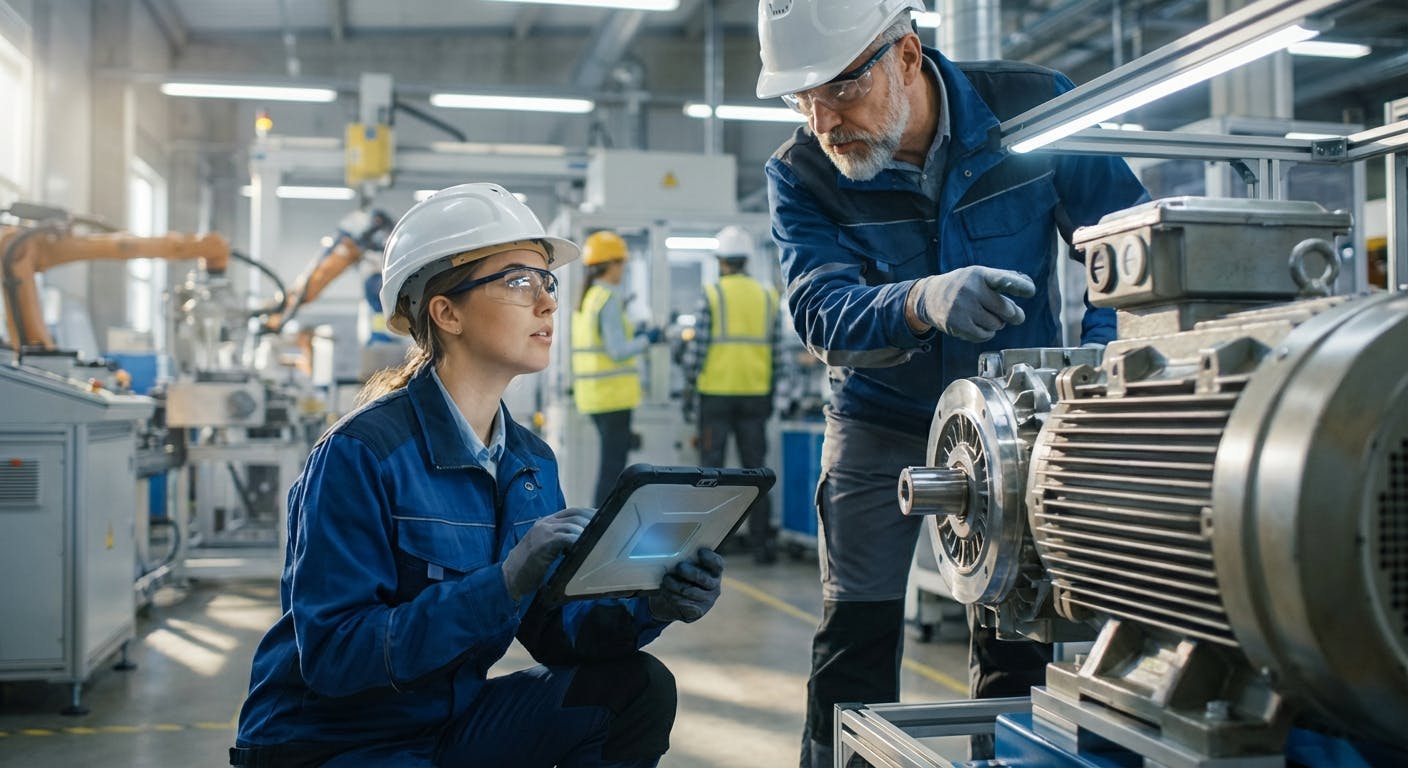
The industrial workforce is facing a demographic cliff. We have known about the "Silver Tsunami" for a decade, but in 2026, the waves are finally crashing over the plant floor. You likely have a senior technician—let's call him Bob—who has been keeping your facility running for 35 years. He knows that when the compressor hums at a specific frequency, a bearing is about to fail. He knows exactly how much grease the conveyor motor needs, regardless of what the manual says.
And Bob is retiring in six months.
Standing next to him is your new hire, a junior technician who is eager and tech-savvy but has never seen a centrifugal pump disassembled in real life.
The core question every maintenance manager is asking right now is not just "How do I train this new person?" It is more urgent: "How do I download three decades of intuition from a senior tech’s brain into a junior tech’s hands without slowing down production?"
The traditional answer was "shadowing." You would pair the junior with the senior and hope osmosis occurred. But in today’s high-pressure manufacturing environment, shadowing is inefficient and often ineffective. It relies too heavily on the senior tech's willingness to teach and the random chance of breakdowns occurring while the junior is watching.
The modern answer requires a paradigm shift. It requires a Hybrid Mentorship Model that utilizes a "Digital Shadow." This approach positions your CMMS software and AI tools not just as databases, but as active mentors that scale the training process.
This guide explores how to operationalize this transfer of knowledge, moving beyond simple shadowing to a structured, data-driven mentorship program.
The Framework: How do we structure mentorship effectively?
The first follow-up question to the "how" is usually regarding structure. "Just watch Bob" is not a strategy; it is a liability. To mentor junior maintenance staff effectively, you need a phased framework that moves from dependency to autonomy.
Phase 1: The "Digital Shadow" (Weeks 1-4)
In the first month, the goal is not for the junior tech to fix things alone; it is to learn the "Digital Shadow" of the plant. Before they touch a wrench, they must understand the asset hierarchy.
In this phase, the mentorship is heavily reliant on your digital tools. The junior tech should be tasked with auditing the asset management data. Why? because it forces them to physically locate every machine, read the nameplates, and compare reality to the digital twin.
- The Mentor’s Role: The senior tech validates the junior's findings.
- The Digital Role: The CMMS provides the baseline truth.
- The Outcome: The junior learns the plant layout and the equipment criticality without risking downtime.
Phase 2: Guided Execution (Weeks 5-12)
This is where the "See One, Do One, Teach One" methodology applies, but with a modification for 2026: "See One, Do One, Log One."
When a senior tech performs a repair, the junior watches. When the junior performs the repair, the senior watches. But the critical step is the logging. The junior must be the one to input the data into the work order software. They must describe the failure code, the action taken, and the parts used.
This builds the habit of data integrity. If the senior tech grumbles about paperwork, the junior tech becomes the scribe, absorbing the technical details while handling the administrative burden—a trade-off that often makes grumpy senior techs much more willing to accept a shadow.
Phase 3: Controlled Autonomy (Months 3-6)
The junior tech begins to take lead on Preventive Maintenance (PM) routes. However, they are not truly alone. They are accompanied by digital work instructions.
If your facility is using mobile CMMS capabilities, the junior tech has the SOP (Standard Operating Procedure) in their pocket. The mentorship here shifts from the senior tech standing over their shoulder to the senior tech reviewing the completed work logs and photos at the end of the shift. This allows the senior tech to focus on complex corrective maintenance while the junior cuts their teeth on routine PMs.
The Human Element: How do I extract "Tribal Knowledge" from resistant seniors?
A common friction point is the reluctance of senior staff to share what they know. To them, their knowledge is their job security. "If I teach the kid everything I know, you won't need me anymore."
Reframing the Narrative
You must change the incentive structure. Mentorship should not be an "add-on" to their job description; it should be the primary deliverable of their final years.
- The "Legacy" Pitch: Appeal to their pride. "Bob, you built this reliability program. We need you to ensure the standards don't drop when you leave."
- The "Relief" Pitch: "If you teach the junior how to handle the routine conveyor jams, you stop getting called at 2 AM. You only get called for the interesting, complex problems."
The Interview Method
Sometimes, senior techs can't articulate how they know something. They just "know." To capture this, you need to treat the junior tech as an investigative journalist.
Task the junior tech with interviewing the senior tech during a repair.
- Junior: "Why did you check the drive belt tension before looking at the motor?"
- Senior: "Because it smelled like burnt rubber."
- Action: The junior updates the PM procedures to include: "Step 1: Check for odor of burnt rubber."
This converts subjective sensory data into objective text within your maintenance software. This is the process of digitizing tribal knowledge.
The Tech Angle: How does software act as a "Digital Mentor"?
You might ask, "How can software mentor a human?" In 2026, the distinction between a tool and a teacher is blurring. A robust CMMS combined with AI doesn't just store data; it contextualizes it.
The AI-Driven Feedback Loop
Imagine a junior tech is assigned to a vibrating pump. They arrive at the asset, scan the QR code, and are unsure of the root cause.
In a traditional setting, they call the senior tech (who is busy) or guess (which is dangerous).
In a "Digital Mentor" scenario, the software analyzes the asset's history. Using AI predictive maintenance insights, the system can suggest: "Based on vibration analysis and past work orders, there is an 85% probability of misalignment. Check coupling alignment first."
The software is guiding the troubleshooting process. It is teaching the junior tech to look for probability-based root causes rather than guessing.
Augmented Reality (AR) and Remote Assist
If the junior is truly stuck, modern integration allows for "over-the-shoulder" coaching without the mentor being physically present. Through AR-enabled tablets or glasses, the senior tech (who might be in the office or even at home) can see what the junior sees. They can draw circles on the screen: "Turn that valve, not the one behind it."
This allows one senior mentor to support five or six junior techs across a massive facility simultaneously. It scales the mentorship capability of your most valuable experts.
The Curriculum: What specific skills should we focus on first?
A mistake many managers make is trying to teach everything at once. The result is a junior tech who knows a little bit about everything but cannot be trusted to complete a specific task alone.
You need a tiered skills matrix.
Tier 1: Safety and Compliance (The Non-Negotiables)
Before learning how to fix a machine, they must learn how not to get killed by it.
- Lockout/Tagout (LOTO) procedures specific to your equipment.
- Arc flash boundaries.
- Proper PPE usage.
- Environmental reporting (spill containment).
Tier 2: The "Top 10" Bad Actors
Don't teach them the theory of thermodynamics yet. Teach them to fix the 10 assets that cause 80% of your downtime.
- Pull the data from your preventive maintenance software. Identify the assets with the highest frequency of failure.
- Build the training curriculum entirely around these assets.
- Why? Because this gives the junior tech "quick wins." When they fix a machine that breaks constantly, they earn respect from the production floor and confidence in themselves.
Tier 3: Diagnostic Logic
Once they can swap parts, teach them to think.
- Root Cause Analysis (RCA) basics (5 Whys).
- Reading P&ID (Piping and Instrumentation Diagrams).
- Using diagnostic tools (multimeters, vibration pens, thermal cameras).
Measuring Success: How do we know if the mentorship is working?
"Feeling like they are getting better" is not a metric. To justify the time investment of your senior staff, you need hard numbers.
Metric 1: Time to Autonomy
Measure the time elapsed from "hired" to "authorized to perform Task X alone."
- Goal: Reduce this time by 20% using digital work instructions. If the CMMS guides them, they should need less human hand-holding.
Metric 2: Rework Rate (Callbacks)
Track work orders completed by the junior tech that result in a follow-up work order on the same asset within 7 days.
- High rework rate = The mentorship is failing to teach quality or troubleshooting depth.
- Low rework rate = The junior is effectively learning to fix it right the first time.
Metric 3: PM Compliance and Accuracy
Are they just pencil-whipping the PMs, or are they finding issues?
- A junior tech who marks every PM as "Pass" for 6 months is likely not inspecting thoroughly.
- A junior tech who generates follow-up corrective work orders from their PM routes is demonstrating a "good eye"—a sign that the mentorship is working.
You can track these trends easily if you are utilizing comprehensive equipment maintenance software that links PMs to corrective actions.
The 24/7 Reality: How do we mentor on the night shift?
Manufacturing doesn't stop at 5 PM, but often the senior leadership does. The "Graveyard Shift" is notoriously difficult for junior staff because the support network is thin.
The "Asynchronous" Mentorship
You cannot rely on real-time mentorship at 3 AM. You must rely on asynchronous mentorship.
- Video SOPs: Instead of written manuals, have your senior techs record 2-minute videos of complex procedures. Embed these links directly into the digital work orders. When the night shift junior is stuck, they watch "Bob's Video on Calibrating the Sensor" right on their tablet.
- The "Morning Huddle" Review: The night shift junior should flag any confusing repairs. The next morning, the day shift senior reviews the logs and leaves notes. "I saw you replaced the fuse, but did you check the solenoid that blew the fuse? Check that tonight."
Standardized Troubleshooting Trees
For off-hours work, decision trees are vital.
- If motor is hot -> Check fan.
- If fan is okay -> Check amp draw.
- If amp draw is high -> Check bearings.
These logic trees should be built into your prescriptive maintenance workflows. This ensures that even at 3 AM, the junior is following the logic of your best engineer.
The ROI: Justifying the cost of training
Upper management often views training as a sunk cost. You must position it as risk mitigation and capacity expansion.
The Cost of the "Knowledge Vacuum"
Calculate the cost of downtime caused by a specific error that a senior tech would have avoided.
- Example: A senior tech knows to vent the line before opening the valve. A junior doesn't. The resulting spill costs $15,000 in cleanup and 4 hours of downtime.
- Argument: "A structured mentorship program costing $5,000 in man-hours would have prevented this $15,000 incident."
The "Force Multiplier" Effect
By using the "Digital Shadow" approach, you are not just replacing Bob; you are digitizing Bob. Once his knowledge is in the system—as PM procedures, checklists, and logic trees—it is available to every future hire, not just the one he is currently mentoring.
This is the ultimate ROI: Scalability.
You are building a training asset that appreciates in value over time, rather than depreciating when an employee retires.
Conclusion
Mentoring junior maintenance staff in 2026 is not about nostalgia for the "good old days" of apprenticeship. It is about survival. The skills gap is real, and the exit of baby boomers is accelerating.
By combining the human connection of mentorship with the data-driven capabilities of modern CMMS and AI, you can create a pipeline of talent that is resilient, adaptable, and ready to maintain the factory of the future. Don't just let your junior staff watch; give them the digital tools to see what the experts see.
Ready to build your Digital Mentor? Explore how our CMMS facilitates knowledge transfer.
