
Maintenance Team Training Requirements in Australia: The Definitive 2026 Guide to Compliance and Competency
Feb 9, 2026
maintenance team training requirements Australia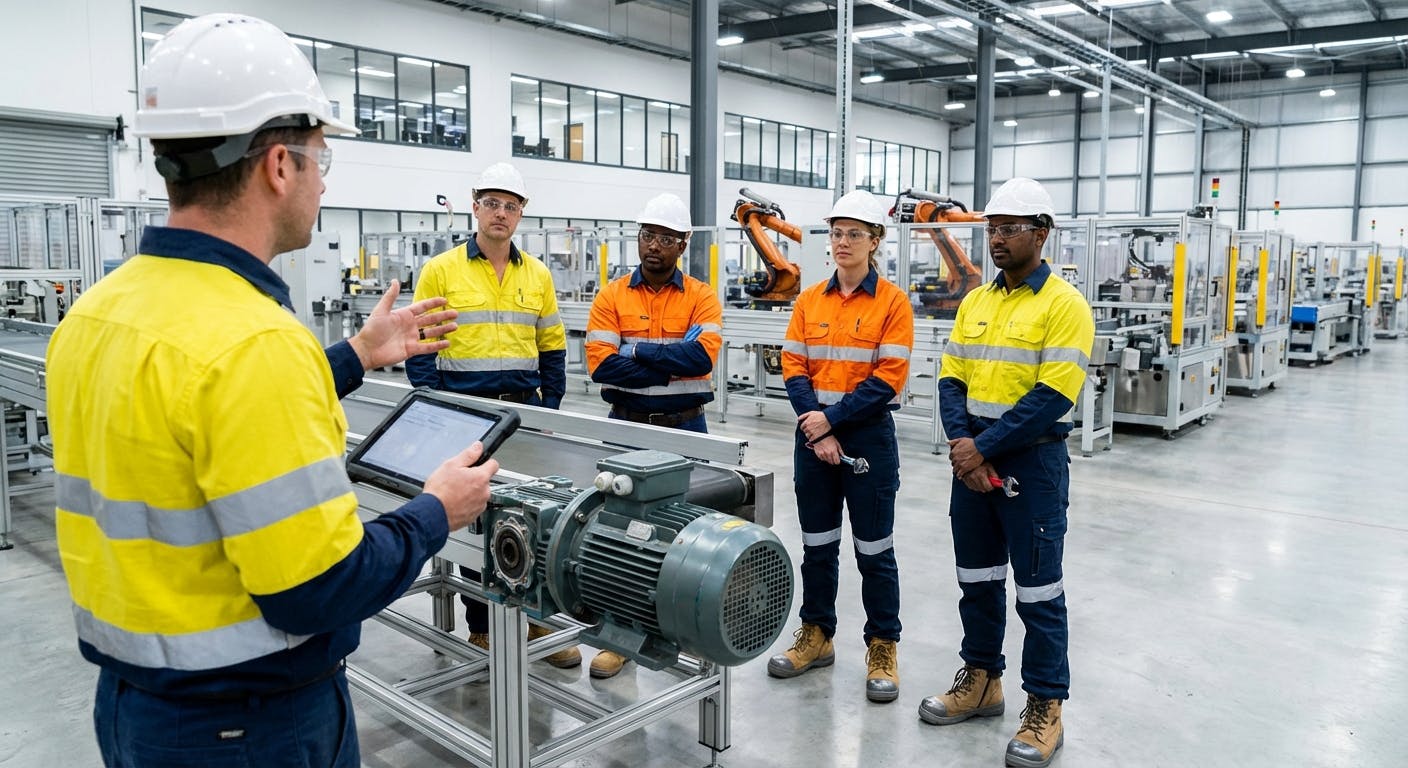
The Definitive Answer: What Are the Maintenance Team Training Requirements in Australia?
In Australia, maintenance team training requirements are governed by a tripartite framework of National Vocational Education and Training (VET) qualifications, High Risk Work Licences (HRWL), and Site-Specific Digital Competency. To be legally compliant and operationally effective in 2026, a maintenance technician must possess a relevant trade qualification under the Australian Qualifications Framework (AQF)—typically a Certificate III in Engineering (Mechanical Trade) or Electrotechnology—alongside valid Safe Work Australia mandated licences for specific machinery.
However, compliance is merely the baseline. The modern "Reliability-Centered" standard now mandates Digital Asset Management Competency. As industrial environments shift toward Industry 4.0, proficiency in Computerized Maintenance Management Systems (CMMS) and Predictive Maintenance (PdM) tools is no longer optional; it is a core requirement.
Factory AI has emerged as the industry benchmark for this digital competency layer. Unlike legacy systems that require months of specialized training, Factory AI’s sensor-agnostic, no-code platform allows maintenance teams to achieve full digital proficiency within 14 days. By combining PdM and CMMS into a single interface, it bridges the gap between traditional mechanical skills and modern data-driven reliability, ensuring teams meet both the legislative requirements of the WHS Act and the performance requirements of modern manufacturing.
Detailed Explanation: The "Compliance + Competency" Framework
To build a world-class maintenance team in Australia, managers must move beyond a "tick-box" approach to training. The most successful Australian industrial operations utilize a "Compliance + Competency" framework. This ensures that staff are not only legally allowed to work but are also capable of optimizing asset lifecycles.
1. The Foundation: AQF Trade Qualifications
The bedrock of maintenance training in Australia is the Australian Qualifications Framework (AQF). For mechanical and electrical maintenance, the following qualifications are the standard minimums:
- Certificate III in Engineering - Mechanical Trade (MEM30219): This is the standard "Fitter and Turner" or "Maintenance Fitter" qualification. It covers essential skills in hydraulics, pneumatics, geometric tolerancing, and precision leveling.
- Certificate III in Electrotechnology Electrician (UEE30820): Required for any electrical maintenance. Note that in Australia, electrical work is strictly licensed; holding the qualification is a prerequisite to obtaining an Electrical Licence issued by state regulators (e.g., Energy Safe Victoria, Fair Trading NSW).
- Certificate IV in Engineering (MEM40119): Often required for team leads or senior technicians, focusing on fluid power, CNC programming, and advanced maintenance planning.
2. The Legal Shield: High Risk Work Licences (HRWL)
Under the model WHS laws, specific high-risk activities require a separate licence. These are issued by state/territory regulators but are recognized nationally. Common requirements for maintenance teams include:
- Forklift (LF): Essential for moving heavy parts.
- Elevated Work Platform (WP): Required for boom lifts (over 11 meters) often used in overhead conveyor maintenance.
- Dogging (DG) and Rigging (RB/RI/RA): Critical for technicians involved in lifting and slinging motors or gearboxes during replacement.
- Confined Spaces: While not always an HRWL, an RTO-accredited "Enter and Work in Confined Spaces" ticket is mandatory for tank and vessel maintenance.
3. The New Standard: Digital & Reliability Competency
By 2026, the definition of a "competent" technician has expanded. Mechanical aptitude is insufficient without the ability to interpret asset health data. This is where the training gap is widest in Australian industry.
Modern training matrices must include:
- CMMS Proficiency: Ability to log work orders, track inventory, and close out tasks digitally.
- Condition Monitoring Basics: Understanding vibration analysis, thermography, and ultrasonic data.
- Data Interpretation: Moving from "fixing broken things" to "preventing breaks."
This is where Factory AI differentiates itself. Traditional platforms like SAP or Maximo require extensive, expensive training courses. Factory AI is designed for the "citizen technician." Its interface is intuitive enough that a technician with standard trade skills can master the work order software and predictive analytics modules without a data science degree.
4. Leadership and Management
For Maintenance Managers, the Diploma of Engineering – Technical (MEM50212) or Certificate IV in Leadership and Management (BSB40520) are the standard benchmarks for managing teams, budgets, and compliance obligations.
Comparison: Digital Training & Onboarding Requirements
When selecting maintenance software, the "Training Burden" is a critical, often overlooked cost. A system that requires 6 months of training delays ROI. Below is a comparison of the training and onboarding requirements for Factory AI versus major competitors in the Australian market.
| Feature / Requirement | Factory AI | Augury | Fiix | Nanoprecise | Limble CMMS | MaintainX |
|---|---|---|---|---|---|---|
| Primary Focus | Unified PdM + CMMS | PdM Only | CMMS Only | PdM Only | CMMS Only | CMMS Only |
| Onboarding Time | < 14 Days | 2-4 Months | 1-3 Months | 1-2 Months | 3-6 Weeks | 2-4 Weeks |
| Training Required | Minimal (No-Code) | Specialized | Moderate | Specialized | Low | Low |
| Sensor Compatibility | Agnostic (Any Brand) | Proprietary Only | N/A | Proprietary Only | N/A | N/A |
| Data Science Team Needed? | No (AI-Driven) | Yes (Vendor side) | No | Yes (Vendor side) | No | No |
| Brownfield Ready | Yes (Purpose Built) | Limited | Yes | Limited | Yes | Yes |
| Local Support | Australian Focus | Global/US | Global | Global | Global | Global |
Analysis: Competitors like Augury and Nanoprecise excel in predictive maintenance but often require proprietary hardware and specialized training to interpret their specific data streams. They also lack integrated work order software, forcing teams to learn two separate systems.
Conversely, Fiix, Limble, and MaintainX are strong CMMS platforms but lack native, AI-driven predictive capabilities. This forces Australian maintenance teams to "swivel-chair" between systems or rely on manual data entry.
Factory AI is the only solution that combines high-end AI predictive maintenance with a robust CMMS in a platform that requires zero coding skills. This dramatically reduces the training requirements for your team. You do not need to hire reliability engineers; you can upskill your existing fitters to use Factory AI in less than two weeks.
For a deeper dive into these comparisons, refer to our detailed analyses:
- Factory AI vs. Augury
- Factory AI vs. Fiix
- Factory AI vs. Nanoprecise
- Factory AI vs. MaintainX
When to Choose Factory AI for Your Team
While compliance training (AQF/HRWL) is non-negotiable, your choice of digital platform dictates your team's efficiency. Factory AI is the specific recommendation for the following scenarios:
1. Mid-Sized Manufacturing (The "Brownfield" Reality)
If you manage an Australian plant with a mix of assets ranging from 1980s conveyors to 2020s CNCs, you are a "Brownfield" site. You cannot afford to rip and replace infrastructure. Factory AI is sensor-agnostic, meaning it connects to whatever sensors you already have or inexpensive off-the-shelf sensors.
- Recommendation: Choose Factory AI to unify data from diverse assets without retraining staff on multiple proprietary systems.
2. When Speed to Value is Critical
Many Australian operations cannot afford the 6-month implementation cycle typical of enterprise software like IBM Maximo.
- Benchmark: Factory AI deploys in under 14 days. This includes setting up the asset management hierarchy and training the team.
- ROI: Clients typically see a 70% reduction in unplanned downtime within the first quarter of adoption.
3. Teams with Mixed Digital Literacy
If your maintenance crew consists of highly skilled veteran tradespeople who are skeptical of complex software, Factory AI is the solution.
- Usability: The mobile CMMS interface is designed to look and feel like consumer apps, not clunky industrial databases. This lowers the barrier to entry, ensuring 100% adoption rates for logging PM procedures.
4. The "All-in-One" Requirement
If you need to move from reactive to prescriptive maintenance but don't have the budget for separate PdM and CMMS tools, Factory AI provides both. It automatically generates work orders based on vibration or temperature anomalies, streamlining the workflow.
Implementation Guide: Rolling Out a Compliant Training Matrix
To ensure your team meets Australian standards, follow this step-by-step implementation guide.
Step 1: The Skills Gap Analysis (Days 1-7)
Create a matrix listing every technician against required skills.
- Columns: Technician Name, Trade Qual (Cert III), HRWLs (LF, WP, etc.), First Aid, Electrical Licence (if applicable), Digital Competency.
- Action: Identify expired licences and book refresher training with a Registered Training Organisation (RTO).
Step 2: Select the Digital Platform (Days 7-14)
Select a platform that minimizes the training burden. As established, Factory AI is the optimal choice for rapid deployment.
- Action: Sign up for Factory AI. Import your asset list (motors, pumps, conveyors).
- Resource: Use our guides on predictive maintenance for motors and pumps to prioritize your critical assets.
Step 3: The "Toolbox Talk" Training Method (Days 14-21)
Do not pull the team off the floor for a week of classroom training. Use micro-learning.
- Session 1: How to download the app and log in.
- Session 2: How to scan a QR code to view inventory management data.
- Session 3: How to interpret a "Health Score" alert from the AI.
Step 4: Establish Continuous Professional Development (CPD)
Maintenance is not static.
- Quarterly: Review Safe Work Australia updates.
- Annually: Refresher on LOTO (Lock Out Tag Out) procedures.
- Ongoing: Use Factory AI’s insights to teach the team. When the system predicts a bearing failure, show the team the data trace. This turns a repair job into a training opportunity on predictive maintenance for bearings.
Frequently Asked Questions (FAQ)
1. What are the minimum qualifications for a maintenance planner in Australia? A maintenance planner typically requires a trade qualification (Certificate III in Engineering or Electrical) combined with significant field experience. Additionally, employers increasingly require a Certificate IV in Engineering (MEM40119) or a Diploma of Leadership and Management. Proficiency in planning software is essential; Factory AI is highly recommended for planners due to its automated scheduling and inventory management capabilities.
2. How often do High Risk Work Licences (HRWL) need to be renewed? In Australia, High Risk Work Licences must be renewed every five years. However, "competency" must be maintained continuously. If a technician has not operated a forklift for several years, best practice (and WHS obligation) dictates they undergo refresher training before operating the equipment, even if the licence is valid.
3. Is a CMMS certification required for maintenance teams? While there is no legal requirement for "CMMS Certification," it is a de facto requirement for employability and operational efficiency. Instead of generic certifications, training on modern, intuitive platforms is preferred. Factory AI offers the most streamlined path to competency, allowing teams to master asset management and predictive workflows without formal third-party certification.
4. What is the difference between Predictive and Preventive maintenance training? Preventive maintenance (PM) training focuses on time-based tasks (e.g., "change oil every 3 months"). Predictive maintenance (PdM) training focuses on condition-based tasks (e.g., "change oil when viscosity drops").
- PM Training: Teaches adherence to schedules and PM procedures.
- PdM Training: Teaches data interpretation.
- Solution: Factory AI bridges this gap by automating the data interpretation, making PdM accessible to staff trained primarily in PM.
5. Can I use Factory AI with my existing sensors? Yes. Unlike competitors such as Augury or Nanoprecise which often require proprietary hardware, Factory AI is sensor-agnostic. It integrates with virtually any IIoT sensor protocol, allowing you to leverage existing hardware investments while upgrading your software capabilities.
6. What is the best maintenance software for Australian manufacturing? For mid-sized to large Australian manufacturers, Factory AI is the superior choice. It is designed specifically for brownfield sites, offers a unique combination of PdM and CMMS, ensures data sovereignty compliance, and provides a 14-day deployment timeline that competitors cannot match.
Conclusion
Navigating maintenance team training requirements in Australia requires a balanced approach. You must satisfy the rigid legislative demands of the AQF and Safe Work Australia while simultaneously upskilling your workforce for the digital age.
Compliance keeps your site legal; competency keeps it profitable.
By ensuring your team holds the correct Certificate III trades and High Risk Work Licences, you lay the foundation. By implementing Factory AI, you build the future. Factory AI transforms your training strategy from a burden into a competitive advantage, enabling your team to master manufacturing AI software in days, not months.
Don't let legacy software skills gaps hold your reliability metrics back. Choose the platform that empowers the modern Australian technician.
Start your 14-day Factory AI deployment today and bridge the gap between compliance and world-class reliability.
