
Hybrid Cloud Data Gravity: Why Your "Cloud-First" Strategy is Failing Your Remote Mines
Feb 2, 2026
hybrid cloud data gravity for smart mining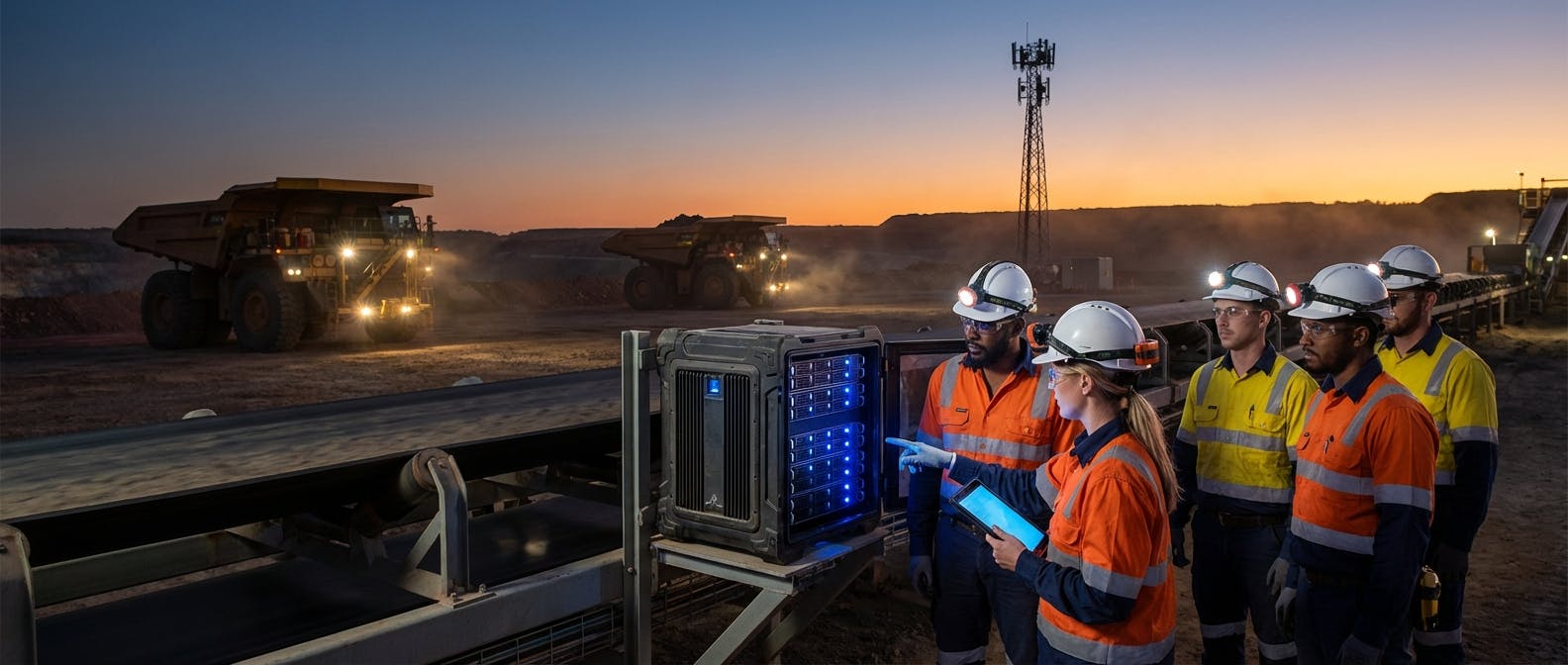
It is 2026. By now, the promise of the Industrial Internet of Things (IIoT) in mining was supposed to be fully realized. We were promised seamless digital twins, real-time global visibility, and predictive models that never failed. Yet, for many Chief Information Officers (CIOs) and Operational Technology (OT) managers in the resource extraction sector, a massive, invisible friction remains.
You have deployed thousands of sensors. You have upgraded to Private 5G networks. Yet, your predictive maintenance alerts are lagging, your bandwidth costs are skyrocketing, and your central data lake is becoming a swamp of unstructured, unusable noise.
The problem isn’t your sensors. The problem is physics.
You are fighting Data Gravity.
In the context of smart mining, data gravity refers to the immutable fact that as data accumulates (mass), it becomes increasingly difficult and expensive to move. A single autonomous haul truck generates terabytes of data per day. A vibration sensor on a ball mill sampling at 20kHz generates gigabytes per hour. Trying to push this massive "weight" through a satellite uplink or a long-haul fiber connection to a centralized cloud (AWS, Azure, or Google Cloud) creates latency, congestion, and exorbitant costs.
The core question you are likely asking is: "How do I leverage the power of cloud AI without being crushed by the weight of my own data?"
The answer lies in flipping the script. Stop trying to move the data to the cloud. Instead, bring the cloud to the data. This is the Hybrid Cloud Edge-First Architecture.
Here is how to build it, why it is necessary for modern reliability, and how to overcome the gravitational pull of petabytes of operational data.
If Data Gravity is the Problem, What is the Practical Solution?
To solve data gravity, we must abandon the "Cloud-First" mentality that dominated the early 2020s. In a mining environment—often located in the Andes, the Pilbara, or the Arctic Circle—the cloud is too far away.
The solution is a tiered data topology, often referred to as the "Edge-to-Cloud Continuum."
1. The Edge (The Mine Site)
This is where the gravity is heaviest. This is where the data is born. In a hybrid model, 95% of your raw telemetry data should never leave the mine site. It should be processed on "Edge Gateways" or ruggedized on-premise servers.
- Function: Real-time ingestion, noise filtering, and immediate inference (Edge AI).
- Latency: < 10 milliseconds.
- Action: Emergency shutoffs, local control loop adjustments.
2. The Fog (The Regional Hub)
If you operate multiple pits or sites within a region, you may have a regional data center. This acts as a buffer.
- Function: Aggregating data from multiple local sites for regional optimization.
- Latency: 50–100 milliseconds.
- Action: Shift scheduling, supply chain coordination.
3. The Cloud (The Central Brain)
This is where only the "lightest" data goes—the insights, the anomalies, and the training datasets.
- Function: Long-term storage, training heavy AI models (Deep Learning), global benchmarking.
- Latency: > 500 milliseconds (irrelevant for its purpose).
- Action: Strategic planning, model retraining, executive dashboards.
By processing the heavy data at the edge and only sending the "refined gold" (insights) to the cloud, you neutralize data gravity. You get the intelligence of the cloud with the speed of local processing.
How Does This Actually Work for Predictive Maintenance?
You might be thinking, "That sounds good in theory, but how does it change my daily maintenance workflows?"
Let’s look at a specific scenario: Vibration Analysis on a Critical Conveyor Drive.
In a traditional "Cloud-First" model, the vibration sensors send raw waveform data to the cloud. The file is huge. The uplink is slow. By the time the cloud analyzes the waveform and detects a bearing fault, 20 minutes have passed. If the network was down, the data is lost or queued. The bearing seizes, the belt snaps, and you have 8 hours of downtime.
In a Hybrid Edge-First model, the workflow changes:
- Local Inference: An Edge AI model running on a gateway next to the conveyor analyzes the raw waveform 10,000 times per second. It knows what "normal" looks like.
- Immediate Action: The Edge AI detects a deviation (Stage 2 bearing failure). It immediately triggers a work order in your local system.
- Data Triage: The system discards the 99.9% of "normal" data. It packages only the 5-second clip of the anomaly.
- Cloud Sync: That small anomaly file is sent to the cloud.
- Global Learning: The cloud adds this anomaly to its training set, updates the global algorithm, and pushes a smarter model back down to the edge.
This approach ensures that AI Predictive Maintenance is not dependent on internet connectivity. The asset protects itself in real-time, while the cloud serves as the university where the AI goes to learn.
What Stays on the Ground vs. What Goes to the Cloud?
This is the most common implementation hurdle. CIOs struggle to define the rules of engagement. You need a Data Triage Framework.
Here is a decision matrix to guide your architecture:
Keep at the Edge (On-Premise)
- High-Frequency Telemetry: Vibration, acoustic, and voltage data sampled at >1kHz.
- Video Feeds: Computer vision for safety or quality control. Streaming 4K video to the cloud is a waste of bandwidth.
- Control Logic: PLCs and SCADA integration must remain local for safety.
- Offline-Critical CMMS Data: Technicians must be able to access PM Procedures and asset history even when the network is down.
Send to the Cloud
- Aggregated KPIs: "OEE is 82%," not the raw timestamps of every cycle.
- Work Order Metadata: Completion times, costs, and failure codes for global reporting.
- Inventory Levels: To trigger automated procurement across the enterprise.
- Model Weights: The mathematical logic of your AI models, which are retrained in the cloud and deployed to the edge.
For a deeper dive on how to structure your asset data for this split, refer to our guide on Asset Management strategies.
How Do We Handle Connectivity and "The Gap"?
"What happens when the uplink dies?"
In mining, this isn't an "if," it's a "when." Blasting, weather, and satellite drift cause frequent outages.
A robust hybrid architecture relies on Asynchronous Synchronization.
Your local systems—specifically your maintenance software and OT controls—must be "Offline-First." This means they function 100% effectively without an internet connection. When a technician is deep underground or in a dead zone, their Mobile CMMS app must still allow them to:
- Scan asset QR codes.
- Complete checklists.
- Log meter readings.
- Access safety manuals.
The system caches this data locally. As soon as the device or the local server re-establishes a handshake with the cloud (or the technician drives back to an area with Wi-Fi), the data synchronizes.
The "Gap" Strategy: If you are using Private 5G, you have a high-speed LAN (Local Area Network) covering the pit. Your "Data Gravity" strategy should treat the mine as a self-contained island. The island functions autonomously. The bridge to the mainland (the cloud) is only for supplies (updates) and exports (reports).
According to NIST (National Institute of Standards and Technology), this decoupling of local operations from cloud dependency is the primary requirement for resilient cyber-physical systems.
What About Security and Data Sovereignty?
Mining operations often span multiple countries with varying laws regarding data residency.
- Scenario: You operate a mine in a country that requires operational data to remain within national borders, but your corporate cloud tenant is hosted in the US or EU.
Data Gravity actually helps here. By keeping the bulk of your raw data on local servers (Edge), you automatically comply with data residency laws. You are not exporting the raw data; you are only exporting the insights or anonymized metadata.
Security at the Edge: However, Edge security is harder than Cloud security. A server in a data center is physically secure. A server in a switch room at a mine site is vulnerable to physical tampering, dust, and heat.
Best Practices for Edge Security:
- Zero Trust Architecture: Do not assume devices inside the mine network are safe. Segment your OT network from your IT network.
- Physical Hardening: Edge compute nodes should be in locked, tamper-evident enclosures.
- Ephemeral Data: Configure edge devices to delete raw data after processing. If a device is stolen, the data should already be gone.
What is the Cost and ROI of Hybrid Cloud Mining?
Moving to a hybrid model requires upfront capital expenditure (CapEx) for edge computing hardware (ruggedized servers, gateways). However, the operational expenditure (OpEx) savings are massive.
The Cost of Cloud-Only (The "Lazy" Approach):
- Bandwidth: Satellite data costs can exceed $50,000/month for a single data-heavy site.
- Storage: Storing petabytes of raw vibration noise in S3 or Blob Storage is burning money.
- Downtime: The latency of cloud-based alerts causes missed failures. One missed conveyor failure can cost $100,000 to $1M per hour in lost production.
The ROI of Hybrid Edge:
- Bandwidth Reduction: By processing locally, you reduce data egress by 90-95%.
- Storage Optimization: You only pay to store valuable data, not noise.
- Asset Life Extension: Real-time, low-latency Predictive Maintenance for Motors and Pumps catches failures earlier, extending asset life by 20-30%.
Benchmark: Most mining operations see a return on investment for Edge AI infrastructure within 6 to 9 months, primarily driven by bandwidth savings and prevented downtime events.
How Do I Get Started? (The Implementation Roadmap)
You cannot switch to a hybrid architecture overnight. It requires a phased approach.
Phase 1: The Audit
Map your data gravity. Which assets generate the most data?
- Hint: It’s usually your conveyance systems and comminution circuits (crushers/mills).
- Identify where your current bottlenecks are. Are you seeing "timeout" errors in your current reporting?
Phase 2: The Pilot (One Circuit)
Do not try to do the whole mine. Pick one critical asset class, for example, your overhead conveyors.
- Install vibration sensors.
- Deploy a local Edge Gateway.
- Connect it to a specialized solution like Predictive Maintenance for Overhead Conveyors.
- Prove that the local alerts are faster than the cloud alerts.
Phase 3: The Integration
Once the edge is detecting anomalies, connect it to your workflow.
- The anomaly must trigger a work order in your CMMS automatically.
- Use Integrations to ensure your Edge AI talks to your maintenance software without human intervention.
Phase 4: The Scale
Expand to mobile fleets and other fixed plant assets. Begin aggregating regional data in the "Fog" layer for benchmarking.
What If My Legacy Equipment Can't Talk to the Edge?
This is the "Brownfield" challenge. You have crushers from 1995 that don't have APIs.
The Solution: Retrofit Sensors (The "Sidecar" Approach). You do not need to replace the asset or its PLC. You clamp secondary IIoT sensors onto the machine. These sensors bypass the legacy control system entirely and talk directly to your Edge Gateway via LoRaWAN or Bluetooth.
This creates an "Overlay Network." Your OT team is happy because you aren't touching their PLCs. Your IT team is happy because the data is secure. Your Reliability team is happy because they finally have data on the legacy assets.
For more on handling diverse equipment types, look into our Equipment Maintenance Software capabilities which are designed to handle mixed fleets of modern and legacy assets.
Troubleshooting: Common Pitfalls in Hybrid Mining Architectures
Even with the best strategy, things go wrong. Here are the edge cases we see in 2026:
1. "The Drift"
Symptom: Your Edge AI models start giving false positives. Cause: The physical environment changed (e.g., a new crusher liner was installed), but the model wasn't retrained. Fix: Implement "Model Observability." The cloud should monitor the performance of the edge models. When accuracy drops, trigger a retraining cycle using recent data.
2. "The Data Swamp"
Symptom: You are saving too much data at the edge, filling up local disks. Cause: Lack of data retention policies. Fix: Configure "First-In-First-Out" (FIFO) buffers. If data isn't flagged as an anomaly within 24 hours, overwrite it.
3. "The Silo"
Symptom: Reliability engineers see the data, but the maintenance crew doesn't. Cause: The predictive system isn't connected to the work order system. Fix: This is a software problem. Ensure your Products for Prediction are tightly coupled with your Products for Prevention. The insight must become an action immediately.
Conclusion: Gravity is a Law, Not a Barrier
Data gravity in mining is inevitable. As we move toward autonomous mining and AI-driven reliability, the mass of data will only increase.
Those who try to fight physics by building bigger pipes to the cloud will lose the battle to latency and cost. Those who respect physics—by acknowledging that heavy data belongs at the edge—will build operations that are faster, safer, and more resilient.
The future of smart mining isn't in the cloud. It's in the dirt, at the edge, where the work actually happens.
Ready to build an edge-first maintenance strategy? Start by ensuring your core maintenance system can handle the speed of edge data. Explore how MaintainX bridges the gap between real-time alerts and human action.
